Why Did Israel’s High Priest Wear the Names of the Twelve Tribes?
Exodus 28 Explained: The Ephod, the Twelve Stones, Urim and Thummim, and the Names Aaron Bore Before YHWH
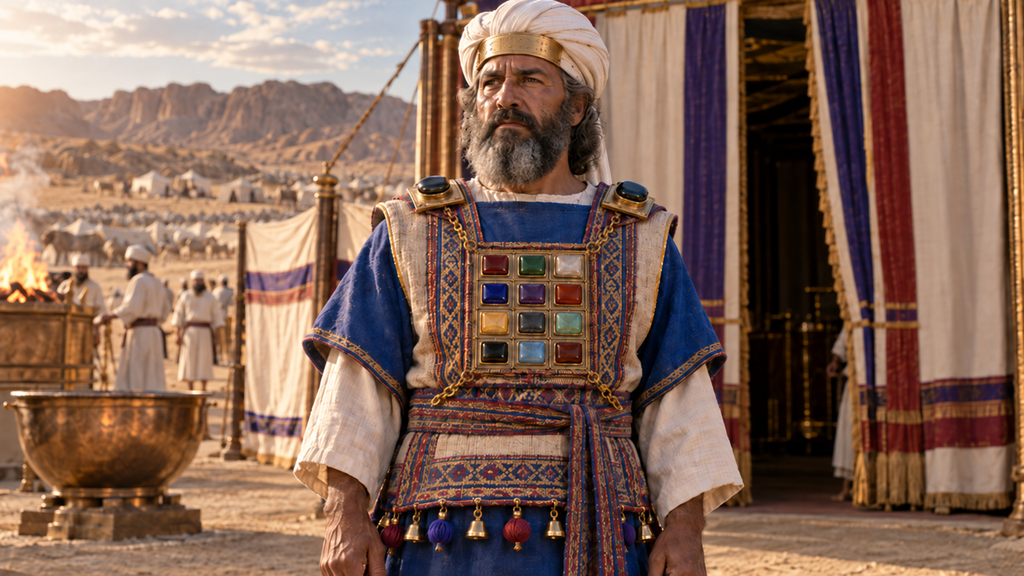
Source: AI-generated image created for Beyond The Known.
Exodus 27 ended with Aaron and his sons appearing almost without introduction.
The sanctuary had been designed. The bronze altar stood before its entrance. Oil had been provided for the lamps. But a sacred structure could not function by architecture alone. Someone had to serve within it.
The previous study, Why Was the Bronze Altar Placed Outside the Tabernacle?, followed the movement from Israel’s camp toward increasingly restricted sacred space. Exodus 28 now turns from that sacred geography to the people authorized to move within it.
Aaron is given clothing unlike anything worn by an ordinary Israelite. Gold, blue, purple, scarlet, fine linen, engraved stones, bells, and a golden inscription transform his appearance.
Yet the chapter’s most important feature is not luxury.
Aaron will carry Israel with him.
The names of Israel’s sons are engraved on stones at his shoulders. Twelve tribal names appear again over his heart. When he enters the sanctuary, he does not appear before YHWH simply as Aaron.
He bears the people he represents.
Aaron Is Brought Near for Priestly Service
Exodus 28 begins before any garment is described.
YHWH tells Moses to bring Aaron and his sons Nadab, Abihu, Eleazar, and Ithamar near from among the Israelites so that they may serve as priests.
The chapter itself does not yet call Aaron the “high priest” using the later title kōhēn gādôl. Nevertheless, Aaron is clearly distinguished from his sons through a unique set of garments and responsibilities.
His priestly role originates in divine appointment, not in the clothing.
Yet the garments are more than decorative signs added after the fact. Verse 41 will place dressing, anointing, ordination, and consecration within the larger process that prepares Aaron and his sons for priestly service.
The clothing therefore neither invents the office nor merely advertises it.
It belongs to the ritual formation of the priest.
Garments “for Glory and for Beauty”
YHWH commands Moses to make:
בִּגְדֵי־קֹדֶשׁ — bigdê-qōdeš — holy garments
for Aaron.
Their purpose is described with another striking expression:
לְכָבוֹד וּלְתִפְאָרֶת — ləkābôd ûlətipʾāret — for glory/honor and for beauty/splendor
כָּבוֹד — kābôd can convey weight, honor, importance, or glory, while תִּפְאֶרֶת — tipʾeret concerns beauty, splendor, or adornment.
The garments are meant to be visually impressive, but Exodus does not present them as personal luxury.
They belong to sacred service.
Their craftsmanship, precious materials, and distinctive appearance make the priestly office visible.
Even the artisans who produce them are described in theological language. Moses is to summon skilled workers whom YHWH has filled with wisdom.
Sacred service therefore depends not only on priests and sacrifices but also on weaving, engraving, metalwork, design, and skilled hands.
What Exactly Was the Ephod?
The first major garment described is the:
אֵפוֹד — ʾēp̄ōd — ephod
Its exact shape is uncertain.
Exodus specifies its materials, shoulder pieces, decorated band, rings, and its relationship to the breastpiece. It does not provide enough information to reconstruct the garment with the confidence of a modern sewing pattern.
That has produced a long history of attempted reconstructions.
An apron-like or vest-like form is plausible, but it remains a reconstruction rather than something explicitly described by the text. Other biblical references to an ephod complicate the picture further because the word is not always used in precisely the same way.
What Exodus emphasizes more clearly is what the ephod carries.
Two stones are placed on its shoulders.
And those stones bear names.
Six Names on Each Shoulder
Moses is instructed to take two:
אַבְנֵי־שֹׁהַם — ʾavnê-šōham — shoham stones
and engrave upon them the names of the sons of Israel according to their birth order.
Many English translations identify shoham as onyx. Others propose different stones, and the precise mineral identification remains uncertain.
The textual function of the stones, however, is unmistakable.
Six names are engraved on one stone and six on the other, using workmanship compared to the engraving of a seal.
They are then mounted on Aaron’s shoulders as:
אַבְנֵי זִכָּרוֹן — ʾavnê zikkārôn — stones of remembrance
Aaron is to carry the names before YHWH “for remembrance.”
This language should not be reduced to the idea that God might otherwise forget Israel. Biblical memorial language often concerns something being ritually presented or kept before YHWH.
The emphasis is relational and representational.
Aaron enters bearing names.
Do the Shoulders Symbolize Strength?
Perhaps.
But Exodus does not say so.
Later interpreters can naturally associate shoulders with carrying burdens, strength, or responsibility. Those associations may be meaningful, but they should not be confused with the explicit explanation in Exodus 28.
The text gives us something firmer.
Aaron bears the names of Israel on his shoulders before YHWH.
That statement is already theologically significant without requiring an additional symbolic code.
And the shoulders are only the beginning.
The names soon appear again.
Twelve Stones Over Aaron’s Heart
Moses next receives instructions for the:
חֹשֶׁן מִשְׁפָּט — ḥōšen mišpāṭ — breastpiece of judgment / decision
It is made from the same combination of gold, blue, purple, scarlet, and fine linen used for the ephod.
The breastpiece is square and doubled. Exactly how that doubled construction functioned is debated; it may have created a space associated with the Urim and Thummim, but Exodus does not explain the mechanics in detail.
Twelve gemstones are mounted on its surface in four rows of three.
Each carries an engraved name.
This time the tribes are not grouped six and six. Each receives its own stone.
The exact modern identification of several gemstone terms is difficult. Ancient mineral vocabulary does not map neatly onto modern gemological categories, and ancient translations themselves differ. The chapter is therefore much more certain about the number and function of the stones than about what a modern jeweler would call each mineral.
Twelve stones.
Twelve engraved names.
Twelve tribes.
Israel is represented as one people without erasing the identities within that people.
Why Are the Names Over Aaron’s Heart?
Verse 29 explains that Aaron is to carry the names of the sons of Israel over his heart when he enters the sanctuary, as a continual remembrance before YHWH.
Modern readers often hear “heart” and immediately think of emotion.
Biblical Hebrew is broader.
The לֵב — lēb — heart can be associated with thinking, intention, discernment, decision, memory, and inner disposition as well as emotion.
That matters especially here because the breastpiece is called the ḥōšen mišpāṭ—the breastpiece of judgment or decision.
The text does not tell us that Aaron wears the tribes over his heart because he feels affection for them.
It makes a more official claim.
Their names accompany him in his representative and judicial priestly role before YHWH.
What Were the Urim and Thummim?
At this point Exodus introduces two of the most mysterious objects in Israel’s priestly tradition:
הָאוּרִים וְאֶת־הַתֻּמִּים — hāʾûrîm wəʾet-hattummîm — the Urim and the Thummim
They are placed in or associated with the breastpiece of judgment so that they will be over Aaron’s heart when he comes before YHWH.
Exodus never tells us what they looked like.
It does not identify their material.
It does not explain their size.
It does not provide a technical description of how they produced decisions.
Later Jewish interpreters developed several sophisticated explanations, including traditions involving divine names and letters on the breastpiece, but those reconstructions belong to later interpretive history rather than to Exodus 28 itself.
Other biblical passages associate the Urim with seeking decisions from YHWH. Scholars therefore commonly discuss the practice within the technical category of ancient divination, although the biblical texts present it as an authorized form of priestly inquiry rather than an illicit attempt to manipulate the divine.
Beyond that, caution is necessary.
Mystery is part of what the surviving text leaves us.
The Robe Could Be Heard
The ephod was worn with a distinctive robe:
מְעִיל — məʿîl — robe
The robe is made entirely of blue material, with a reinforced opening for the head.
Along its hem are textile pomegranates in blue, purple, and scarlet, alternating with small golden bells.
Aaron therefore entered priestly service wearing garments that were not merely visible.
They produced sound.
Verse 35 explicitly connects the bells with his entry and exit from the Holy Place. Their sound is to be heard when he enters before YHWH and when he comes out, “so that he may not die.”
The severity of that statement has generated many explanations.
Some interpreters understand the sound as announcing Aaron’s approach. Others connect it more generally with the danger of entering sacred space according to anything other than YHWH’s prescribed order.
Exodus itself does not explain the mechanism.
That limitation matters.
The popular story that a rope was attached to the high priest so that his body could be pulled from the sanctuary if he died is not found in Exodus 28.
It should not be inserted into the chapter as biblical information.
“Holy to YHWH”
Aaron also wears a golden object on his forehead described as a:
צִּיץ — ṣîṣ — frontlet / plate / ornament
Its exact physical form is less certain than many artistic reconstructions suggest.
What is completely clear is the inscription engraved upon it:
קֹדֶשׁ לַיהוָה — qōdeš laYHWH — Holy to YHWH
The phrase is short, but visually powerful.
Aaron’s shoulders carry Israel’s names.
His chest carries Israel’s names again.
His forehead carries a declaration of holiness belonging to YHWH.
The priest stands between no two equal parties. His representative role is possible only within a sanctuary defined by YHWH’s holiness.
What Does It Mean That Aaron “Bears the Guilt of the Holy Things”?
Verse 38 contains one of the chapter’s most difficult statements.
Aaron is said to bear:
עֲוֹן הַקֳּדָשִׁים — ʿăwōn haqqodāšîm — the guilt/iniquity of the holy things
The verse connects this responsibility with the sacred gifts that the Israelites consecrate and with their acceptance before YHWH.
Exactly what defect or liability is in view is not specified.
The statement should therefore not be expanded into a comprehensive doctrine in which Aaron bears every moral sin committed by Israel.
Its immediate context concerns sacred gifts.
Scholars commonly understand the verse in relation to ritual fault or liability that might otherwise compromise the acceptability of offerings. Even the Hebrew expression “bear guilt” can function differently depending on context, which makes excessive precision unwise.
The gold frontlet thus does more than identify Aaron as holy to YHWH.
It is connected with his responsibility for Israel’s approach through sacred gifts.
Aaron’s Sons Do Not Wear the Same Garments
Aaron’s sons also receive priestly clothing, but their garments are much simpler.
They are given tunics, sashes, and head coverings made for honor and beauty.
They do not receive Aaron’s complete ensemble of ephod, engraved shoulder stones, jeweled breastpiece, blue robe, and golden forehead inscription.
The distinction is significant.
Just as the tabernacle contains differentiated zones of holiness and access, the priesthood itself contains differentiated responsibilities.
Not every priest occupies Aaron’s role.
The Chapter Ends with the Garment No One Was Supposed to See
After gold, gemstones, colored textiles, intricate weaving, engraved names, and sacred inscriptions, Exodus 28 concludes with linen undergarments.
The priests must wear them from the waist to the thighs:
to cover their naked flesh.
The command applies when they enter the Tent of Meeting or approach the altar for service.
The warning is severe: failure brings guilt and death.
The contrast with the earlier garments is striking.
Some priestly clothing is deliberately magnificent and public.
Other priestly clothing is hidden.
Both matter.
Sacred service regulates the priest’s entire embodied presence, not only the parts visible to the congregation.
Priestly Clothing in Its Ancient Near Eastern World
Specialized religious clothing was not unique to Israel.
Across the ancient Near East, ritual personnel could wear distinctive garments that marked office, status, or changes in ritual role. Egyptian evidence, for example, shows that clothing could be integral to the performance of priestly rituals rather than merely decorative.
Such comparisons provide useful context.
They do not prove that Exodus copied a particular Egyptian garment, nor do they explain every feature of Aaron’s vestments.
What is distinctive in Exodus is the particular theological arrangement of the clothing: Israel’s names, sacred inscriptions, the breastpiece of judgment, the Urim and Thummim, and materials coordinated with the sanctuary itself.
The Priest Is Visually Connected to the Tabernacle
One feature of Aaron’s garments becomes difficult to miss after Exodus 25–27.
Gold.
Blue.
Purple.
Scarlet.
Fine linen.
These are already familiar materials.
They belong to the visual world of the tabernacle.
Now they appear on the priest who serves inside it.
Scholars have long noticed this coordination between sanctuary and vestments. The priest does not literally become the tabernacle, and Exodus never states such an equation. Yet his clothing clearly belongs to the same sacred material environment.
Aaron is dressed for the space he is authorized to enter.
But Exodus 28 goes further than visual correspondence.
The chapter is structured around what he carries into that space.
The Deeper Discovery
One Hebrew verb quietly ties the chapter together:
נָשָׂא — nāśāʾ — to bear / carry
In verse 12, Aaron bears the names of Israel on his shoulders before YHWH.
In verse 29, Aaron bears the names of Israel over his heart.
In verse 30, Aaron bears the judgment of the Israelites over his heart before YHWH.
Then, in verse 38, Aaron bears the guilt associated with Israel’s holy things.
The repetition changes how the entire chapter can be read.
Exodus 28 is not fundamentally a catalogue of spectacular religious clothing.
It is a chapter about what the priest is appointed to bear.
On his shoulders: Israel’s names.
Over his heart: Israel’s names and Israel’s judgment.
At his forehead: responsibility connected with Israel’s sacred gifts.
His clothing transforms representation into something visible.
Aaron does not enter the sanctuary as a private worshiper.
He enters as a priest whose body has been marked with the people, decisions, responsibilities, and holiness attached to his office.
This also explains why the tribal names appear twice.
Their repetition is not redundant decoration.
Israel remains present on the priest as he moves into sacred space where the nation as a whole does not enter.
The answer to the chapter’s central question is therefore deeper than “because the stones represented the tribes.”
The high priest wears their names because his approach before YHWH is representative.
Aaron goes in.
Israel’s names go with him.
FAQ
Why did Israel’s high priest wear the names of the twelve tribes?
Exodus 28 presents the engraved names as a memorial before YHWH. Aaron carried Israel’s names on his shoulders and again over his heart when entering the sanctuary, making his representative role visible.
What was the ephod?
The ephod was a specialized priestly garment made with gold, blue, purple, scarlet, and fine linen. Exodus describes its components but does not provide enough information to reconstruct its exact shape with certainty.
Were the twelve stones the same as modern birthstones?
No such connection appears in Exodus. Each stone represented one of Israel’s tribes and carried its engraved name. Several ancient gemstone terms also remain difficult to identify precisely with modern minerals.
What were the Urim and Thummim?
They were objects associated with the breastpiece of judgment and with seeking decisions before YHWH. Their physical appearance and exact operating procedure are never explained in Exodus.
Why did Aaron wear bells on his robe?
Exodus states that their sound was to be heard as Aaron entered and left the Holy Place so that he would not die. The chapter does not explain precisely how the sound functioned.
What did “Holy to YHWH” mean?
The phrase was engraved on the golden frontlet worn on Aaron’s forehead. It marked his priestly service as consecrated to YHWH and was connected with the acceptability of Israel’s sacred offerings.
Why were linen undergarments required?
Exodus explicitly says they covered the priests’ naked flesh when they entered the Tent of Meeting or approached the altar. Their inclusion shows that priestly holiness governed even the hidden aspects of bodily preparation for sacred service.
Exodus 28 has clothed the priest.
Israel’s names rest on his shoulders and over his heart. The judgment of Israel accompanies him. Holiness is engraved on his forehead.
But Aaron is not yet ready to serve.
Exodus 29 moves from clothing to consecration.
Sacrifices will be offered. Blood will touch the altar. Then blood will be placed on three surprisingly specific parts of the priests’ bodies: the right ear, the right thumb, and the right big toe.
Why those places?
Why Was Blood Put on the Priests’ Ear, Thumb, and Toe?
Selected Sources
- Brevard S. Childs, The Book of Exodus: A Critical, Theological Commentary. Old Testament Library. Westminster Press, 1974.
- John I. Durham, Exodus. Word Biblical Commentary 3. Word Books, 1987.
- Carol L. Meyers, Exodus. New Cambridge Bible Commentary. Cambridge University Press, 2005.
- William H. C. Propp, Exodus 19–40: A New Translation with Introduction and Commentary. Anchor Bible 2A. Doubleday, 2006.
- Nahum M. Sarna, Exodus: The Traditional Hebrew Text with the New JPS Translation. JPS Torah Commentary. Jewish Publication Society, 1991.
- Søren Lorenzen, “Colors of Holiness: Clothing the High Priest to Match the Tabernacle.” TheTorah.com.
- Marty Lockshin, “The Obscure Ephod of the High Priest.” TheTorah.com.
- Ilona N. Rashkow, “Gemstones of the Gods: The Symbolism of the High Priest’s Breastpiece.” TheTorah.com.