Why Was Blood Put on the Priests’ Ear, Thumb, and Toe?
Exodus 29 Explained: Priestly Installation, the Ram of Ordination, Blood on the Body, Daily Sacrifice, and God’s Dwelling Presence
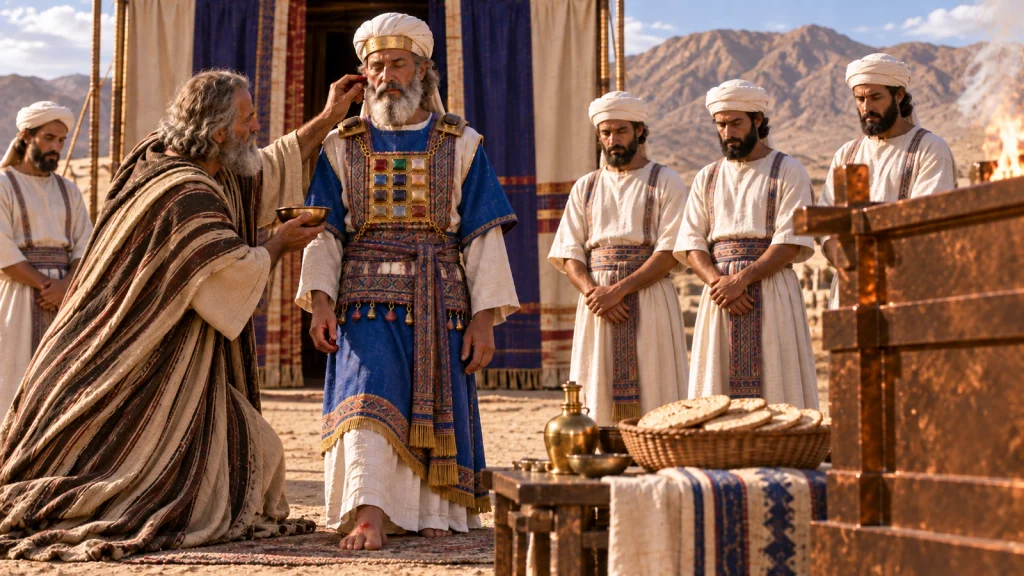
Source: AI-generated image created for Beyond The Known.
Exodus 29 installs him into it.
The previous study, Why Did Israel’s High Priest Wear the Names of the Twelve Tribes?, examined the ephod, breastpiece, engraved stones, and sacred garments Aaron would wear before YHWH.
But clothing alone did not make him ready to serve.
Aaron and his sons must be washed, dressed, anointed, brought to the altar, marked with sacrificial blood, and taken through a seven-day rite of installation.
At the center of that ceremony appears one of the chapter’s most unusual instructions.
Blood from a ram is placed on the priests’ right ears, right thumbs, and right big toes.
Why these three places?
Exodus never gives a direct explanation.
That makes the ritual worth examining carefully.
Priestly Service Begins with Consecration
Aaron and his sons are brought to the entrance of the Tent of Meeting and washed with water.
Aaron is dressed in the garments described in Exodus 28. The sacred headpiece is placed on him, and anointing oil is poured on his head. His sons are clothed for priestly service as well.
The sequence makes an important point.
Priesthood is not simply a title, and the garments are not ceremonial decoration.
The men who will serve at the sanctuary must themselves be prepared for that service.
Their bodies, clothing, sacrifices, and relationship to the altar all belong to the consecration process.
What Does “Ordination” Mean in Exodus 29?
Several English translations use words such as ordain, consecrate, or install.
The Hebrew uses an unusual expression:
מִלֵּא יָד — millēʾ yād — fill the hand
In priestly contexts, “filling the hand” functions as an idiom for installing someone into office. Its precise historical origin is uncertain, so it should not be turned into a confident etymological explanation.
Exodus 29 does, however, create an interesting literary connection.
Later in the ceremony, portions of the ordination sacrifice and unleavened bread are physically placed into the hands of Aaron and his sons before being presented to YHWH.
The idiom already means ordination. The ritual then gives the reader an actual scene of priestly hands being filled.
That connection is suggestive without proving that the ceremony explains the origin of the expression.
The Bull and the Two Rams
Three animals structure the installation rite: a bull and two rams.
The bull is offered first.
Aaron and his sons place their hands on its head before it is slaughtered. Some of its blood is applied to the horns of the altar, while the rest is poured at its base.
The offering is called a:
חַטָּאת — ḥaṭṭāʾt — sin offering / purification offering
Selected portions are burned on the altar, while the remaining flesh, hide, and refuse are burned outside the camp.
The first ram follows.
Again, Aaron and his sons place their hands on the animal before slaughter.
This ram becomes an:
עֹלָה — ʿōlāh — burnt offering
Its blood is thrown against the altar, and the animal is burned in its entirety.
The second ram receives a different role.
Its blood reaches the priests themselves.
The Ram of Ordination
Exodus calls the second animal:
אֵיל מִלֻּאִים — ʾêl milluʾîm — ram of ordination / installation
Aaron and his sons place their hands on its head, and the ram is slaughtered.
Then Moses applies some of its blood to three places on each priest:
the lobe of the right ear,
the thumb of the right hand,
and the big toe of the right foot.
The rest of the blood is thrown against the altar.
Leviticus 8 later narrates the performance of this same ordination ritual and repeats the same ear-thumb-toe pattern.
The question is what those three points mean.
Does the Ear Mean Hearing, the Thumb Service, and the Toe Walking?
That interpretation is common.
The ear is associated with hearing.
The hand with action.
The foot with movement.
From there, it is easy to construct a symbolic reading: the priest must hear God, serve God, and walk faithfully before God.
It is an attractive interpretation.
But Exodus 29 never explains the ritual in those terms.
No verse says that the ear symbolizes obedience, the thumb ministry, or the toe moral conduct.
Those associations are interpretive deductions from the functions of the body parts.
They may be useful theological reflections, but they should not be presented as the explicit meaning of the ceremony.
There is another biblical passage that makes the issue more complicated.
Leviticus 14 Uses the Same Three Body Parts
In Leviticus 14, a person undergoing ritual purification after ṣāraʿat is marked with sacrificial blood on the same three locations: the right ear, right thumb, and right big toe.
Oil is then applied to those same places over the blood.
That parallel matters.
It shows that the pattern was not restricted to priestly symbolism.
The same bodily locations could appear in a ritual that restored another person to a changed status within Israel’s sacred order.
This makes it difficult to reduce the pattern to a simple code such as “hear, work, walk.”
A more restrained conclusion fits the evidence better.
The blood marks the person bodily as part of a ritual transition.
In Exodus 29, Aaron and his sons are being installed into priestly service.
In Leviticus 14, a person is being restored through purification.
The precise symbolism of each body part remains unexplained.
The ritual function of marking the person is much clearer.
Blood Moves from Sacrifice to Priest
Verse 21 develops the connection further.
Moses is told to take some of the blood from the altar together with anointing oil and sprinkle it on Aaron, his sons, and their garments.
The ritual now places altar, sacrifice, priest, clothing, blood, and oil within the same consecratory sequence.
Exodus does not give a theological formula explaining every part of this combination.
But the structure is unmistakable.
The priests who will serve at the altar are themselves brought into the ritual sphere of that altar.
Their consecration is not merely verbal or administrative.
It reaches their bodies and their garments.
Their Hands Are Filled
After the blood rite, portions of the ram are combined with unleavened bread and placed in the hands of Aaron and his sons.
They present the portions before YHWH, after which Moses takes them back and burns them on the altar.
This is one of the most visually concrete moments in the ceremony.
The men being installed into office stand with sacred portions in their hands.
The Hebrew idiom “fill the hand” already means ordination, but Exodus places that terminology alongside an actual act of filling priestly hands.
Again, the literary connection is stronger than any claim that the ritual explains the historical origin of the phrase.
The Ordination Ram Also Becomes a Priestly Meal
The ram is not exhausted at the altar.
Aaron and his sons must eat its meat together with the bread at the entrance of the Tent of Meeting.
Others are excluded because the food is sacred.
Any portion remaining until morning must be burned.
The ceremony therefore moves through several forms of bodily participation.
The priests are washed.
They are clothed.
They are anointed.
Their bodies are marked with blood.
Sacred portions are placed in their hands.
Then they eat from the sacrifice connected with their installation.
Jonathan Grossman and Eliezer Hadad have argued that the different elements of priestly installation perform distinguishable functions: the garments qualify the priests for sanctuary service, anointing marks them as holy, and the ram ceremony qualifies them to eat sacrificial food. That is a modern academic interpretation, not an explanation supplied directly by Exodus, but it draws attention to the importance of the meal within the rite.
Consecration Takes Seven Days
The installation is not completed in a single ceremony.
The process continues for seven days.
A bull is offered each day, and the altar itself undergoes purification and consecration.
By the end of the period, Exodus describes the altar as:
קֹדֶשׁ קָדָשִׁים — qōdeš qodāšîm — most holy
The chapter does not explain why seven days were required.
There is no need to manufacture a symbolic meaning that the passage itself leaves unstated.
What is clear is that priestly installation and altar consecration are presented as a sustained process rather than a momentary appointment.
From Installation to Daily Worship
Verse 38 changes the rhythm of the chapter.
The instructions move away from the one-time installation ceremony and toward the worship that will continue after the priests have been consecrated.
Two year-old lambs are to be offered each day.
One in the morning.
One toward evening.
Exodus describes this as an:
עֹלַת תָּמִיד — ʿōlat tāmîd — regular / continual burnt offering
Here תָּמִיד — tāmîd refers to recurring regularity. The passage itself defines that pattern through the morning and evening offerings.
Each lamb is accompanied by grain, oil, and wine.
The shift is significant.
The first part of Exodus 29 prepares priests and altar.
The final part shows what that preparation is for.
Sacred service must continue.
The Climax Is Not the Priesthood
Exodus 29 could have ended after Aaron and his sons were installed.
It does not.
The chapter moves from priestly ordination to daily sacrifice and then to something larger than either.
YHWH promises to meet Israel at the Tent of Meeting.
He will consecrate the sanctuary.
He will consecrate the altar.
He will consecrate Aaron and his sons.
Then comes the statement toward which the tabernacle instructions have been moving:
וְשָׁכַנְתִּי בְּתוֹךְ בְּנֵי יִשְׂרָאֵל — wəšākantî bətôḵ bənê yiśrāʾēl — I will dwell among the Israelites
The verb:
שָׁכַן — šāḵan — dwell / reside
belongs to the same Hebrew word-family as:
מִשְׁכָּן — miškan — tabernacle / dwelling place
The structure is called a dwelling because divine dwelling is the theological reality toward which it points.
The Exodus Leads Toward Divine Presence
The final verse states the connection with unusual clarity.
Israel will know YHWH as the God who brought them out of Egypt:
“that I might dwell among them.”
The wording directly connects deliverance from Egypt with divine presence among Israel.
That does not mean the Exodus had only one purpose.
The book has already spoken about liberation, covenant, worship, and Israel becoming YHWH’s people.
But Exodus 29 makes dwelling central to the sanctuary project.
Israel was not simply brought out of one geographical location and moved toward another.
The narrative moves from slavery under Pharaoh toward life with YHWH in their midst.
The Deeper Discovery
The final movement of Exodus 29 changes the voice of the chapter.
For most of the instructions, Moses is addressed through commands.
Bring them.
Wash them.
Clothe them.
Anoint them.
Slaughter the sacrifice.
Apply the blood.
Consecrate the altar.
Then the language changes.
YHWH begins speaking about what he will do.
I will meet.
I will consecrate.
I will dwell.
I will be their God.
That shift keeps the ritual in its proper place.
Moses can perform the prescribed ceremonies.
The priests can wear the garments.
The altar can receive sacrifice.
Morning and evening offerings can establish the rhythm of worship.
But ritual action does not manufacture divine presence.
The chapter ends with presence as a divine promise.
That also changes how the blood on the ear, thumb, and toe should be understood.
The ritual is not an isolated symbolic puzzle.
It belongs to the larger preparation of priests who will serve at a sanctuary where YHWH promises to meet and dwell among Israel.
The blood marks them for that sacred office.
Exactly why those three body parts were selected remains unstated.
What they are being prepared for is not.
FAQ
Why was blood put on the priests’ ear, thumb, and toe?
Exodus 29 requires blood from the ram of ordination to be placed on the right ear, right thumb, and right big toe of Aaron and his sons. The passage does not explicitly explain the symbolism of those three locations. The ritual clearly forms part of their bodily installation into priestly service.
Does the ear represent hearing, the thumb service, and the toe walking?
That is a common symbolic interpretation, but Exodus 29 does not state it. The same three body parts also appear in the purification ritual of Leviticus 14, which suggests that the pattern had a broader ritual function than priestly symbolism alone.
Why were the right side of the ear, hand, and foot marked?
The text consistently specifies the right side but does not explain why. Any symbolic explanation of the right side should therefore remain tentative.
What was the ram of ordination?
It was the second ram used in the installation of Aaron and his sons. Its blood marked the priests, portions of the animal were placed in their hands and presented before YHWH, and part of the meat was later eaten as sacred food.
What does “fill the hand” mean?
מִלֵּא יָד — millēʾ yād — fill the hand is a Hebrew idiom used for installing or ordaining someone into priestly office. Exodus 29 also contains a ritual in which sacred portions are literally placed into the priests’ hands.
Why did the ordination last seven days?
Exodus commands a seven-day installation process but does not explain the significance of the number in this passage. The period includes repeated sacrifice and consecration of the altar.
Why does Exodus 29 end with daily sacrifices?
The chapter moves from the one-time installation of priests to the recurring service they will perform. The morning and evening offerings establish the regular rhythm of worship at the sanctuary where YHWH promises to meet Israel.
Exodus 29 has prepared the priests and the altar for service.
But the sanctuary still contains another altar.
It stands inside the tent, before the veil.
No bull or ram will be burned on it.
Instead, fragrant incense will rise from it every morning and evening.
Why?
Why Did the Tabernacle Need an Altar of Incense?
Selected Sources
- Brevard S. Childs, The Book of Exodus: A Critical, Theological Commentary. Old Testament Library. Westminster Press, 1974.
- John I. Durham, Exodus. Word Biblical Commentary 3. Word Books, 1987.
- Jonathan Grossman and Eliezer Hadad, “The Ram of Ordination and Qualifying the Priests to Eat Sacrifices.” Journal for the Study of the Old Testament 45.4 (2021): 476–492. DOI: 10.1177/0309089220963436.
- Jacob Milgrom, Leviticus 1–16: A New Translation with Introduction and Commentary. Anchor Bible 3. Doubleday, 1991.
- Carol L. Meyers, Exodus. New Cambridge Bible Commentary. Cambridge University Press, 2005.
- William H. C. Propp, Exodus 19–40: A New Translation with Introduction and Commentary. Anchor Bible 2A. Doubleday, 2006.
- Nahum M. Sarna, Exodus: The Traditional Hebrew Text with the New JPS Translation. JPS Torah Commentary. Jewish Publication Society, 1991.