Why Did Moses Have to Stop Israel from Giving to the Tabernacle?
Exodus 36 Explained: More Than Enough Offerings, Skilled Artisans, and the Tabernacle Built According to God’s Command
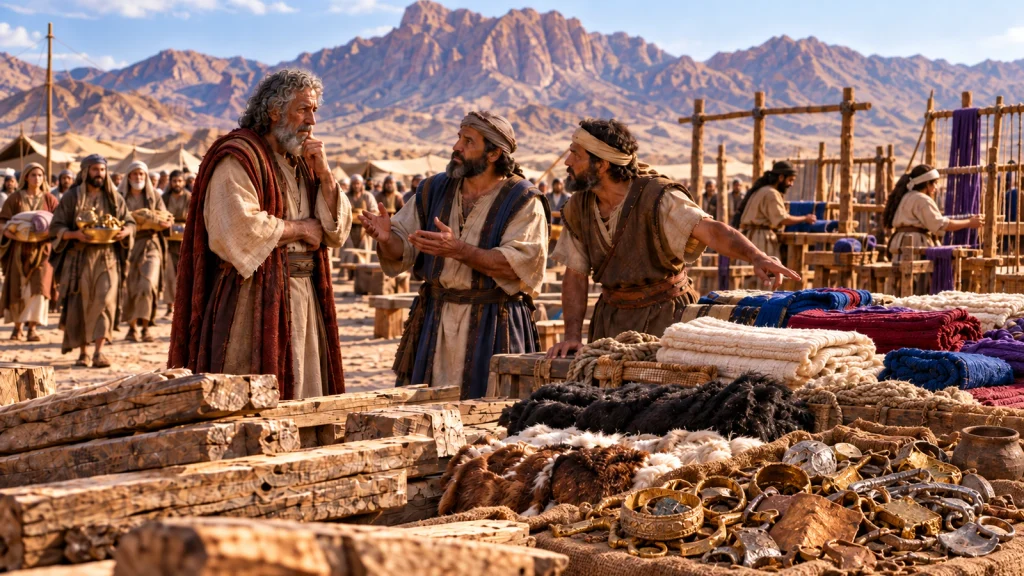
Source: AI-generated image created for Beyond The Known.
Israel has an unusual problem at the beginning of Exodus 36.
The people are giving too much.
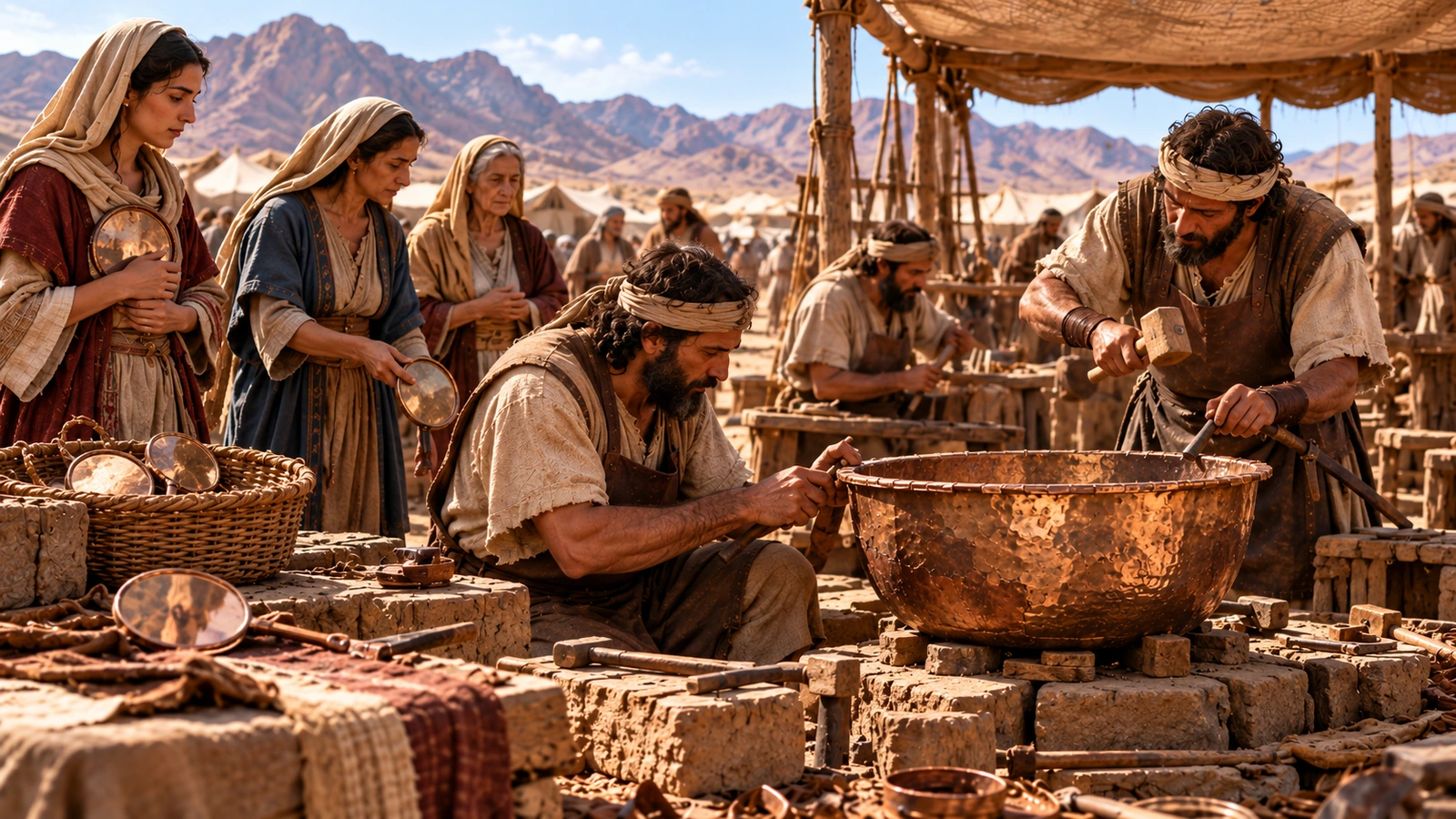
Bezalel, Oholiab, and the other skilled artisans have begun the sanctuary work. Moses has transferred to them the materials already contributed by Israel, but the gifts keep arriving. Morning after morning, the people continue bringing voluntary offerings until the craftsmen themselves leave what they are doing and report that the project already has more than it requires.
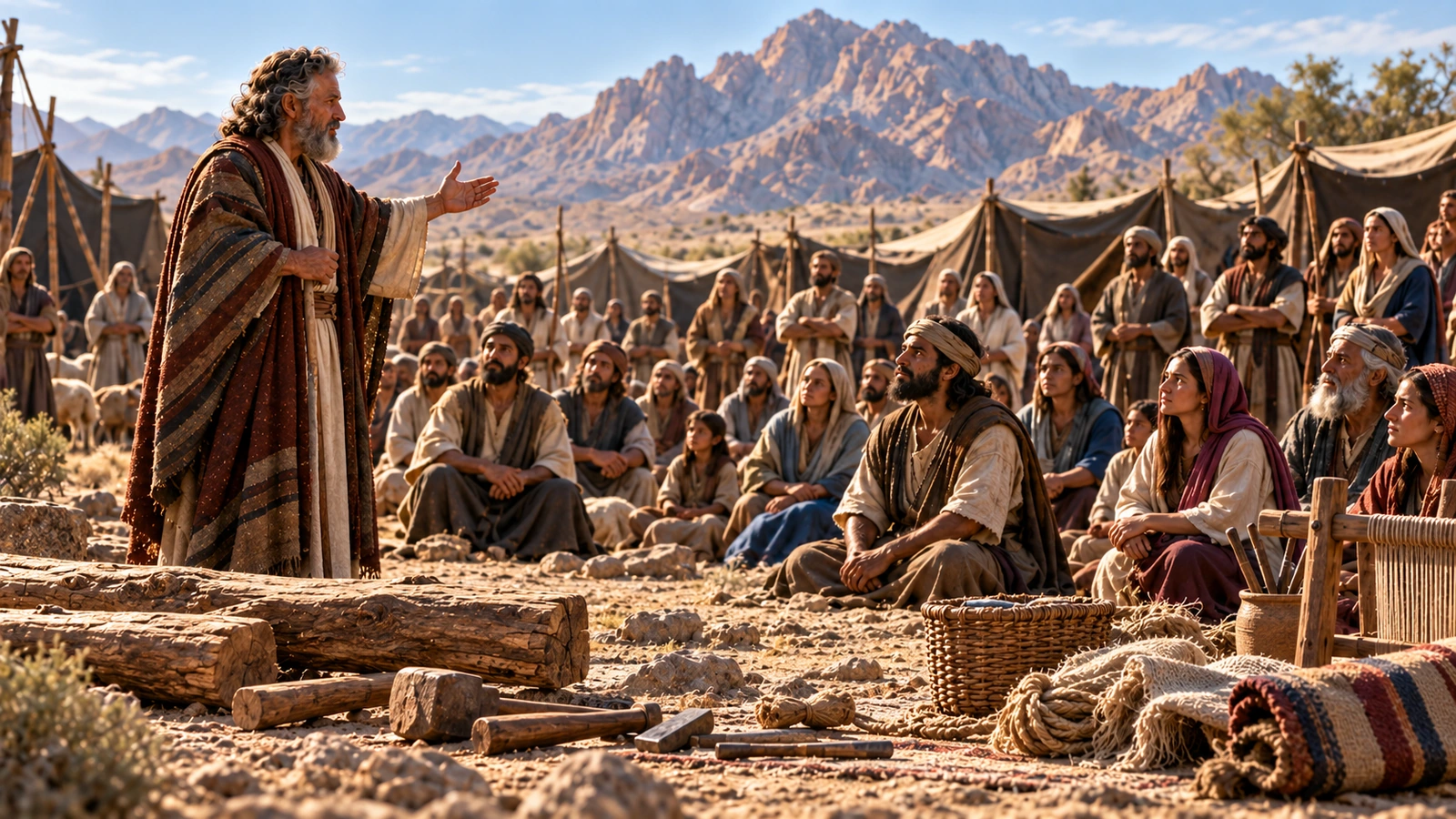
Moses responds by sending a proclamation through the camp: no man or woman is to prepare anything further for the sanctuary contribution.
The collection stops because there is already enough.
That scene is memorable, but the chapter is doing more than celebrating generosity. It asks a sharper question: what happens when a good religious impulse has fulfilled its purpose?
The answer is not “keep going because more must be better.”
The offerings exist for a defined work. Once that work has been fully supplied, Moses stops the inflow and the narrative turns from what Israel brings to what the artisans make.
The previous study, Why Does Moses Repeat the Sabbath Command Before Israel Builds the Tabernacle?, showed that even sacred labor remains subject to limits.
Exodus 36 shows that sacred giving does too.
The Chapter Begins with Skilled People Who Are Also Willing
Exodus 36 opens by returning to Bezalel, Oholiab, and the other artisans whom YHWH has equipped for the sanctuary.
Their competence has already been established. Exodus 35 describes wisdom, understanding, knowledge, design, metalwork, stonecutting, woodwork, weaving, embroidery, and teaching.
But 36:2 adds something important.
Moses calls those whose hearts move them to come to the work:
אֲשֶׁר־נְשָׂאוֹ לִבּוֹ — ʾăšer-nəśāʾô libbô — whose heart lifted him
The wording recalls Exodus 35:21, where those whose hearts lifted them brought materials for the tent of meeting.
The same language therefore appears around two different forms of participation.
Some are moved to bring.
Others are moved to build.
Skill and willingness belong together, but neither is enough on its own. The craftsmen know how to perform the task, yet the opening verse still places their ability inside a clear framework: they are to carry out the sanctuary work according to what YHWH commanded.
They contribute judgment and expertise.
They do not invent the goal.
Israel Keeps Bringing Offerings “Morning After Morning”
The craftsmen receive what Israel has already contributed, but the supply continues to grow.
Exodus 36:3 says the people keep bringing offerings:
בַּבֹּקֶר בַּבֹּקֶר — babbōqer babbōqer — morning after morning
The expression describes repetition, not a single burst of enthusiasm.
Construction has begun, yet the contributions keep arriving.
Nothing in the passage suggests that Moses launches another appeal or pressures the community to give more. The momentum comes from the people themselves.
That makes the next development more striking.
The problem is not reluctance.
It is excess.
The Artisans Are the First to Recognize the Problem
Moses does not discover the surplus by inspecting the collection.
The workers tell him.
Exodus 36:4–5 says that the skilled artisans leave their tasks, come to Moses, and report that the people are bringing more than is required for the work YHWH commanded.
That detail gives the scene much of its force.
The people who understand the construction are the people who know when the materials have crossed from sufficiency into excess.
They know the design.
They know what remains to be made.
They know what has already been received.
Their report is not a complaint about generosity. It is an assessment of need.
The standard is the work itself.
“Enough—and More”
Verse 7 makes the situation explicit.
The materials are described as:
דַּיָּם — dayyām — sufficient for them
and then:
וְהוֹתֵר — wəhôtēr — and there was excess / something remained over
Israel has not merely reached the minimum.
There is enough for everything required, with surplus beyond it.
That distinction explains Moses’ response without inventing a hidden motive.
The purpose of the collection has been fulfilled.
The sanctuary is not an undefined treasury into which more material is automatically better. It is a specific project whose needs can actually be met.
Moses Stops a Successful Collection
Moses orders a proclamation throughout the camp:
No man or woman is to prepare anything further for the sanctuary contribution.
Then the text says:
וַיִּכָּלֵא הָעָם מֵהָבִיא — wayyikkālēʾ hāʿām mēhāḇîʾ — and the people were restrained from bringing
This is not a gradual decline in interest.
The giving is deliberately stopped.
Verse 6 also says that no one should make any further melāʾkhâ for the contribution. That wording fits the previous chapter, where some offerings were themselves produced through labor—spun materials, prepared textiles, and other crafted goods.
Moses is therefore not merely closing a collection.
He is ending further production for it.
Why Stop Something Good?
Because generosity is not the final measure of faithfulness in Exodus 36.
The people are not contributing to an open-ended sacred fund. Their gifts serve a task whose design and requirements have already been established.
Once the materials are sufficient, continuing to enlarge the supply would not make the sanctuary more faithful to its instructions.
That is where the chapter becomes more demanding than a simple lesson about giving.
A willing act can still have a proper limit.
Moses does not confuse religious intensity with obedience. He listens to the craftsmen who understand the project, accepts their judgment, and ends the collection.
More is not automatically holier.
The Golden Calf Complicates the Meaning of Generosity
The abundance of Exodus 36 sits only a few chapters after the golden calf.
In Exodus 32, Israel also contributes valuable material.
Aaron asks for gold.
The people bring it.
A religious object is made.
Now Israel is again surrendering precious resources for a sacred purpose.
The contrast matters, but it must be stated carefully.
Exodus does not say that the same pieces of gold are being “redeemed” by their later use, nor does it present every contribution in chapter 36 as a reversal of the calf episode.
The point is broader.
Material generosity by itself cannot distinguish faithful worship from unfaithful worship.
Israel gave in Exodus 32.
Israel gives again in Exodus 35–36.
The difference lies in what that generosity serves.
The calf emerges from a project Israel initiates while Moses is absent.
The tabernacle is constructed according to instructions already received.
Giving becomes faithful when it is directed toward the work YHWH actually commanded.
Then the Donations Disappear from the Story
After verse 7, the collection recedes almost completely from view.
There is no ceremony honoring the largest donors.
No ranking of contributions.
No extended celebration of the surplus.
Verse 8 simply moves into construction.
The skilled workers begin making the tabernacle.
That shift reveals what the gifts were for.
They were never the destination of the chapter.
They were the means by which the sanctuary could be built.
Once the resources are sufficient, the narrative has no reason to keep admiring the pile.
Attention moves from possession to craftsmanship.
Why Does Exodus 36 Repeat So Much of Exodus 26?
Beginning in verse 8, the chapter describes curtains, loops, clasps, coverings, frames, bases, crossbars, the inner veil, and the entrance screen.
Readers who remember Exodus 26 will recognize most of the material.
There, YHWH gives the construction instructions.
Here, the craftsmen carry them out.
In the Masoretic Text, the most obvious literary shift is from command to execution.
Earlier, Israel is told what it shall make.
Now the narrative reports what the artisans made.
The repetition can feel tedious to modern readers because many of the details have already appeared. Yet in the final Hebrew form of Exodus, the correspondence has a clear effect: the sanctuary that once existed only as instruction is becoming physical reality.
The design is no longer merely spoken.
It is being executed.
The Textual History Is More Complicated Than the Repetition Suggests
That literary observation should not be confused with a claim about how Exodus 35–40 developed historically.
The ancient Greek Septuagint preserves this section in a shorter and differently arranged form than the Masoretic Text. Material corresponding to much of MT Exodus 36:8b–34 is absent from the Greek version.
Domenico Lo Sardo’s study of the Masoretic Text, Septuagint, and Vetus Latina argues for a complex history of rewriting and expansion in these chapters.
That belongs to historical-critical reconstruction.
The literary point belongs to the final Masoretic form.
Both questions are legitimate, but they are not the same question.
As the Hebrew text now stands, instruction and execution are placed in close correspondence.
The Tabernacle Begins with Ten Curtains
The construction account begins with the inner fabric structure.
Ten curtains are made from finely twisted linen with blue, purple, and scarlet material, with cherubim worked into them.
Five curtains are joined together, and another five form a second set. Fifty loops correspond across the edges, and golden clasps connect the two sections.
Then verse 13 gives the result:
וַיְהִי הַמִּשְׁכָּן אֶחָד — wayhî hammiškān ʾeḥād — and the tabernacle became one
After so many measurements, that short statement is easy to overlook.
Separate pieces become a single dwelling through careful workmanship.
The emphasis here is architectural, not allegorical. Exodus does not tell the reader to turn the joined curtains into a symbol of later communal unity.
The craftsmen are solving a concrete problem.
Many components must function as one structure.
The Coverings Reveal a Layered Sanctuary
The same careful organization continues with the goat-hair tent.
Eleven curtains are arranged into two groups, joined by loops and bronze clasps. Additional coverings are placed above them.
The sanctuary is therefore built in layers.
The inner fabric is richly worked with colored yarn and cherubim, but the exterior coverings serve different functions and are not described in the same decorative terms.
That matters for how the tabernacle is imagined.
Not every beautiful element was necessarily visible from outside.
Some of the most elaborate workmanship belonged within the structure itself.
The text describes a dwelling whose visual richness is ordered rather than displayed all at once.
Frames, Bases, and Crossbars Turn Fabric into Architecture
Verse 20 moves from textiles to acacia wood.
Frames are made for the sides and rear.
Silver bases support them.
Crossbars stabilize the structure.
Gold covers the frames and bars.
The prose becomes intensely practical because the sanctuary must actually stand.
A theological concept does not hold up fabric.
Someone has to measure.
Someone has to shape joints.
Someone has to understand weight, alignment, and stability.
That is why the craftsmanship described in Exodus 35 matters so much here.
Spirit-given wisdom produces technically competent work.
The sacredness of the project does not eliminate the demands of construction.
The Veil Creates an Internal Boundary
Near the end of the chapter, the artisans make the inner veil from fine linen and colored yarn, with cherubim incorporated into the work.
Four gold-covered acacia columns support it.
Readers already know from the earlier instructions that this veil will divide the interior of the sanctuary.
The tabernacle therefore brings YHWH’s dwelling into Israel’s midst without erasing distinctions of holiness.
Divine nearness and restricted access remain together.
That tension has been present throughout the Sinai narrative.
YHWH will dwell among the people.
But proximity to divine holiness is never treated as casual.
The Entrance Screen Is Not the Inner Veil
The chapter ends with another textile barrier at the entrance of the tent.
It also uses fine linen and colored yarn, but it is not identical to the inner veil.
The inner veil includes cherubim and hangs from four columns.
The entrance screen is embroidered work supported by five.
Those differences may seem minor, but they reveal the precision of the construction account.
Not every curtain serves the same purpose.
Not every threshold is designed in the same way.
The craftsmen must preserve distinctions already present in the instructions.
Skill Does Not Give the Artisans Authority Over Worship
Exodus treats Bezalel and the other workers as genuinely capable people.
They design.
They carve.
They weave.
They work metal.
They teach.
The book does not reduce them to mechanical laborers.
Yet Exodus 36:1 sets the boundary before their skill is exercised: the work is to be performed according to what YHWH commanded.
That framework avoids two opposite mistakes.
The chapter does not distrust artistic intelligence.
It also does not make artistic intelligence sovereign.
Craftsmanship contributes judgment to execution without redefining the purpose of the sanctuary.
The artisans know how to make what they have been given to make.
The Deeper Discovery
The most revealing connection between Exodus 35 and 36 may lie in the language of the heart.
In Exodus 35:21, the people who bring materials are described as those:
אֲשֶׁר־נְשָׂאוֹ לִבּוֹ — whose heart lifted him
Exodus 36:2 uses essentially the same expression for the skilled people who come to perform the work.
The same inward willingness therefore drives two movements.
Some hearts move people to bring.
Other hearts move artisans to build.
But Exodus 36 introduces a further step.
The craftsmen whose hearts move them to work are also the first people to recognize that the supply has become excessive.
That is a significant development.
Willingness begins the process.
Skill evaluates what the task requires.
Wisdom recognizes when the purpose has been fulfilled.
The artisans do not prove devotion by continuing to collect materials they no longer need. Their competence includes the ability to say that the project is fully supplied.
Moses then turns that judgment into a command for the whole camp.
Exodus 35 celebrates hearts willing to give.
Exodus 36 shows that mature participation also knows when enough is enough.
Why Did Moses Stop Israel from Giving?
Because the sanctuary had a defined requirement, and the craftsmen reported that the available resources had exceeded it.
Nothing in the chapter suggests that Moses is disappointed with the people’s generosity.
The collection ends because it has succeeded.
That distinction changes the meaning of the scene.
The gifts are not valuable because accumulation itself is sacred.
They are valuable because they serve the work YHWH commanded.
Once the materials are sufficient, faithfulness no longer means adding to the pile.
It means building.
That is why the chapter moves so quickly from surplus to construction.
Israel has given enough.
Now the gifts must become the dwelling.
FAQ
Why did Moses tell the Israelites to stop giving?
The skilled artisans reported that the materials already available exceeded what was required for the sanctuary project. Moses therefore ordered the camp to stop preparing further contributions.
Were the tabernacle offerings voluntary?
Yes. Exodus 35–36 repeatedly emphasizes willing participation. The people continue bringing voluntary contributions without the narrative portraying Moses as coercing them.
What does “morning after morning” mean in Exodus 36:3?
The Hebrew expression babbōqer babbōqer repeats “morning” and describes an ongoing pattern. The people continued bringing offerings on successive mornings while construction was underway.
What does “more than enough” mean in Exodus 36:7?
The verse says the materials were sufficient for all the required work and adds wəhôtēr, indicating that there was surplus beyond what the project needed.
What happened to the extra materials?
Exodus 36 does not say. It tells us only that the supply exceeded the need and that Moses stopped further contributions. Any specific explanation of how the surplus was later used would go beyond the text.
Why does Exodus 36 repeat material from Exodus 26?
In the Masoretic Text, Exodus 26 gives construction instructions and Exodus 36 narrates their execution. The close correspondence creates an instruction-to-execution pattern. The textual history is more complicated because the Septuagint preserves a shorter and differently arranged form of Exodus 35–40.
Who built the tabernacle?
Bezalel, Oholiab, and the other skilled artisans whom YHWH had equipped with wisdom and ability carried out the construction.
Did the artisans have creative freedom?
They exercised genuine artistic and technical judgment, but Exodus 36:1 places that activity within the instructions YHWH had given. Their skill serves the received design rather than replacing it.
Why does Exodus 36 give so many construction details?
Because the chapter is describing execution rather than merely repeating an idea. Measurements, joins, clasps, frames, coverings, and supports matter because the sanctuary must become a functioning physical structure.
What Comes Next?
By the end of Exodus 36, the tabernacle itself has taken shape.
The structure is there, but its sacred interior is still waiting for the objects that will occupy it.
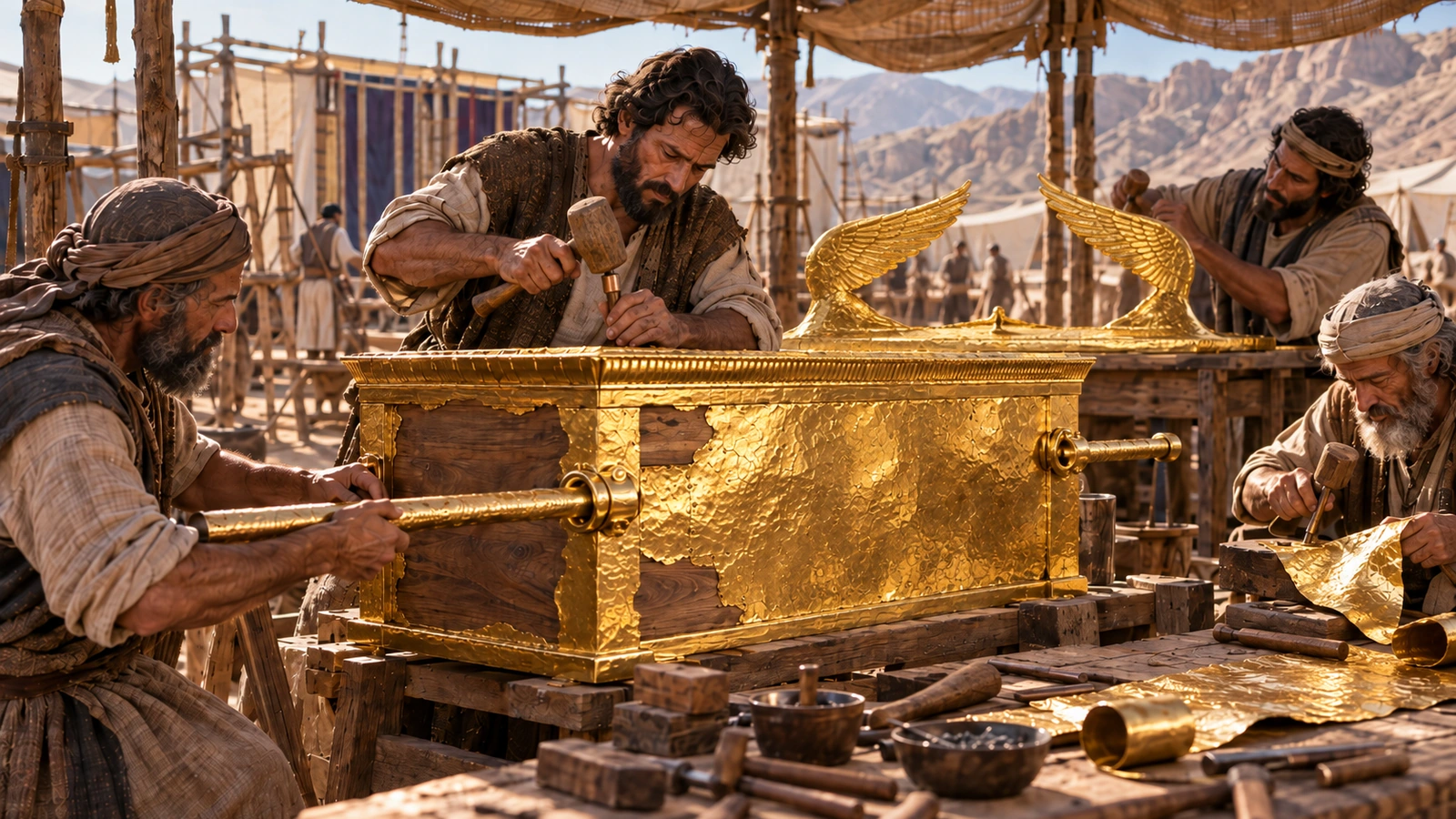
Exodus 37 begins with Bezalel making the ark.
Not the table.
Not the lampstand.
Not the incense altar.
The ark comes first.
Why?
Why Was the Ark the First Sacred Object Bezalel Made?
Selected Sources
- Brevard S. Childs, The Book of Exodus: A Critical, Theological Commentary. Old Testament Library. Westminster Press, 1974.
- Thomas B. Dozeman, Exodus. Eerdmans Critical Commentary. Eerdmans, 2009.
- Carol Meyers, Exodus. New Cambridge Bible Commentary. Cambridge University Press, 2005.
- Nahum M. Sarna, The JPS Torah Commentary: Exodus. Jewish Publication Society, 1991.
- William H. C. Propp, Exodus 19–40: A New Translation with Introduction and Commentary. Anchor Bible 2A. Doubleday, 2006.
- Domenico Lo Sardo, Post-Priestly Additions and Rewritings in Exodus 35–40: An Analysis of MT, LXX, and Vetus Latina. Forschungen zum Alten Testament 2. Reihe 119. Mohr Siebeck, 2020.