Why Was the Ark the First Sacred Object Bezalel Made?
Exodus 37 Explained: The Ark, the Kapporet, Cherubim, the Table, the Lampstand, and the Altar of Incense
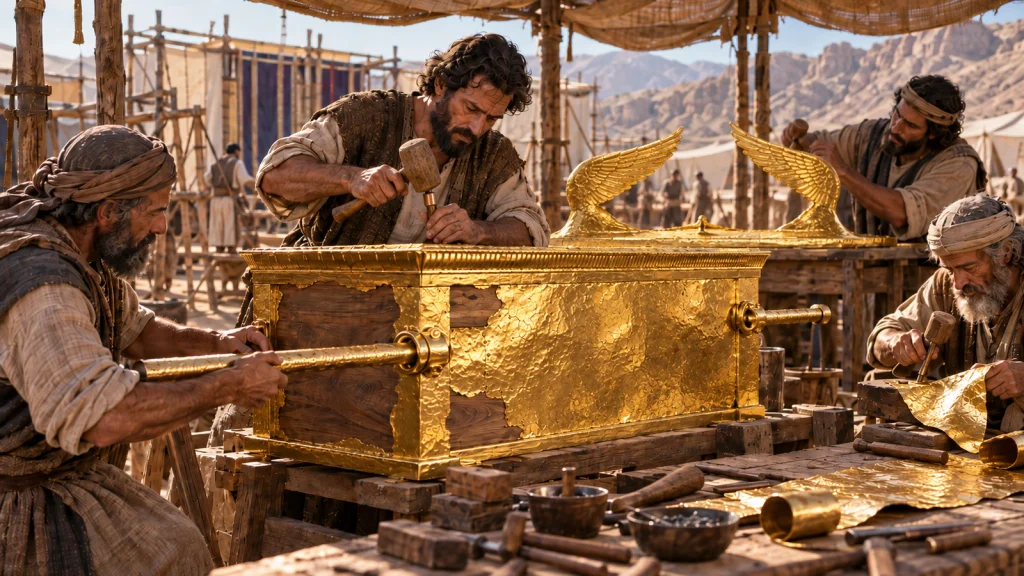
Source: AI-generated image created for Beyond The Known.
Exodus 37 opens with the ark.
The tabernacle structure has already taken shape. Now the objects that will occupy its sacred interior are made, and the first one the narrative names is the ark.
That order invites a question.
Why does the construction account begin there?
We need to state the problem carefully. Exodus 37 does not say that Bezalel independently chose the ark as his first project, nor does it explicitly tell us that the ark was chronologically the first object manufactured. What the chapter gives us is narrative order: the ark is the first sacred furnishing described as being made.
That sequence is not invented in Exodus 37. It follows the earlier instructions.
Exodus 25 also begins the sanctuary furniture with the ark, followed by the table and lampstand.
So the deeper question is not why Bezalel personally preferred the ark.
It is why the sanctuary instructions themselves begin at that point.
The answer emerges from the ark’s place within the tabernacle. It holds the covenant testimony, belongs in the innermost sanctuary, and stands beneath the place from which YHWH promises to meet with Moses and speak.
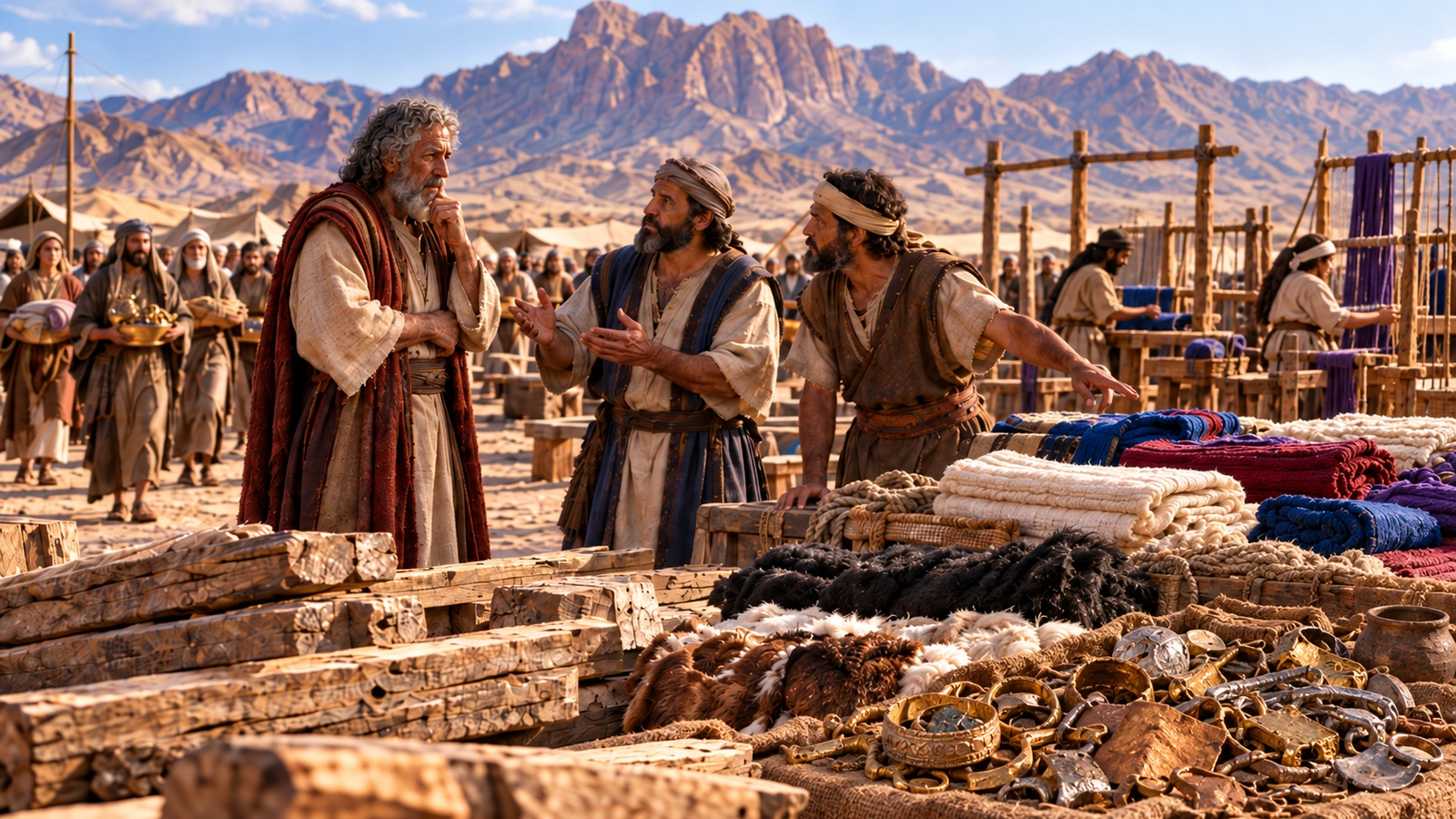
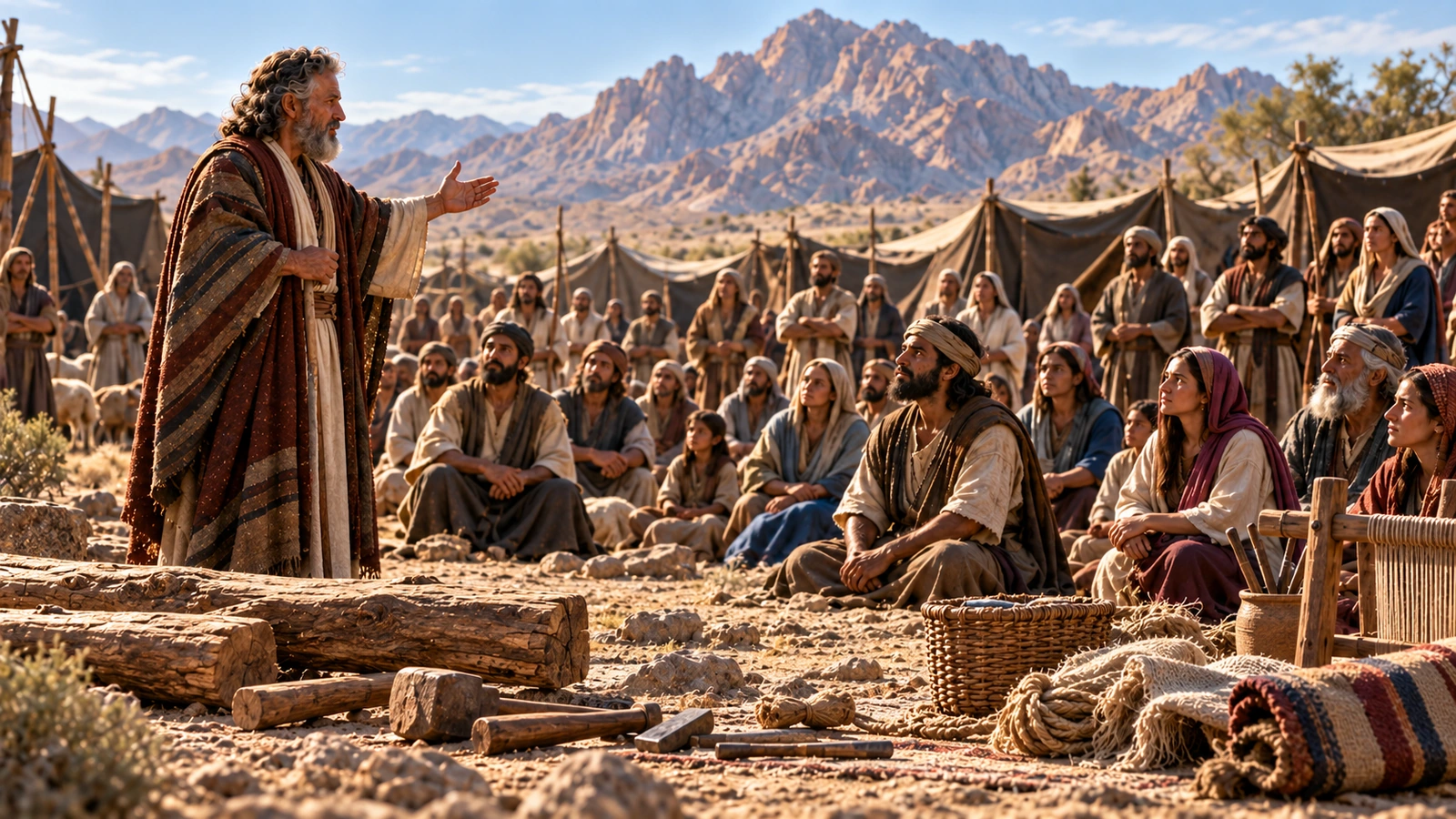
The previous study, Why Did Moses Have to Stop Israel from Giving to the Tabernacle?, followed Israel’s offerings into the construction process.
Exodus 37 now moves further inward.
The dwelling is being furnished.
What belongs at its sacred center?
Bezalel Follows a Received Pattern
Exodus 37:1 begins directly:
“Bezalel made the ark…”
The chief artisan is named, and the first object attached to his work is the ark.
That wording can create the impression that Bezalel is choosing the order himself. But Exodus has already established the sequence.
In Exodus 25, YHWH begins the furniture instructions with the ark. The table follows. Then the lampstand.
Exodus 37 largely reproduces that order in execution.
The movement is therefore from instruction to construction.
Bezalel’s skill is real. He can design, shape metal, carve wood, and supervise complex craftsmanship. Yet the project remains governed by a pattern already given.
His creativity serves the commission.
It does not define the sanctuary on its own.
The Ark Belongs in the Innermost Space
The ark is not placed in the courtyard.
It is not stationed in the outer room beside the table and lampstand.
It belongs behind the inner veil.
Earlier instructions make that spatial hierarchy clear. The veil separates the Holy Place from the innermost chamber, and the ark is placed beyond it.
That location matters.
The tabernacle becomes more restricted as one moves inward, and the ark stands at the endpoint of that movement.
This does not prove that narrative order always equals rank. Exodus never gives such a formula.
But it does make the ark’s opening position significant.
The first furnishing described in Exodus 37 is also the object destined for the most restricted space in the sanctuary.
The Ark Holds the Covenant Testimony
Bezalel makes the ark from acacia wood and overlays it with pure gold inside and outside.
Its materials are impressive, but its significance is not exhausted by craftsmanship.
The earlier instructions identify it as the ark of the testimony.
The covenant tablets are to be placed within it.
The sanctuary’s innermost object is therefore tied directly to the covenant words that define Israel’s relationship with YHWH.
That connection carries particular weight after the golden calf.
The first tablets were shattered.
A second set was given after covenant renewal.
Now the construction of the sanctuary proceeds with an ark prepared to receive the testimony.
Exodus 37 does not pause to explain that relationship, but the preceding narrative makes it difficult to ignore.
The tabernacle is being built by a restored people, and at its center stands an object associated with the covenant they had broken.
The Ark Is Designed for Movement
Four gold rings are attached to the ark, and poles of acacia wood covered with gold are placed through them so it can be carried.
The detail is practical, but it reveals something essential about the wilderness sanctuary.
Israel is not building a permanent stone temple.
The tabernacle must travel.
So must its sacred furniture.
The ark belongs to the innermost space when the sanctuary is erected, yet it is built from the beginning to be transported.
Holiness and mobility are not opposites here.
The sacred center of Israel’s worship is constructed for a people still on the move.
What Is the Kapporet?
After making the ark, Bezalel makes the gold object placed above it.
The Hebrew term is:
כַּפֹּרֶת — kappōret
Many English translations traditionally render this as “mercy seat.”
That expression has a long theological history, but readers should not assume that the Hebrew word simply means “seat.”
The kapporet is the gold covering associated with the top of the ark. Its name belongs to the Hebrew k-p-r word group, which is strongly associated elsewhere with atonement and purification.
English translations therefore vary.
Some retain mercy seat.
Others prefer atonement cover.
The important point is lexical restraint: Exodus does not call the object a chair.
The traditional wording may carry theological associations, but those associations should not be confused with the basic physical description.
The Text Directs Attention Above the Ark
The ark itself is striking.
So is the gold kapporet.
So are the cherubim.
Yet the earlier instructions draw attention to the space above them.
In Exodus 25:22, YHWH tells Moses that he will meet with him there and speak from above the kapporet, from between the two cherubim.
That statement is crucial for understanding the ark complex.
No image of YHWH is placed inside the ark.
No statue of YHWH stands between the cherubim.
The sanctuary contains elaborate sacred imagery while refusing to manufacture a visible representation of the God who speaks.
The focal point is associated with presence and communication, but it is not occupied by an idol.
That distinction becomes especially significant only a few chapters after the golden calf.
What Were the Cherubim?
Two cherubim of hammered gold are made at the ends of the kapporet.
Their wings stretch upward and overshadow it. They face one another, with their faces directed toward the cover.
Beyond those details, Exodus is remarkably restrained.
It does not provide enough anatomical information to reconstruct their exact appearance.
That matters because later religious art often portrays cherubim as winged human figures or even as childlike angels.
The biblical evidence is more complex.
Elsewhere in Scripture, cherubim are heavenly beings associated with divine presence, sacred boundaries, and throne imagery. Scholars frequently compare them with composite winged creatures known from the wider ancient Near East.
Those comparisons can be useful.
They are still comparisons.
Exodus 37 gives us position, wings, orientation, and relationship to the kapporet. It does not give us a complete visual description.
Any reconstruction should admit that uncertainty.
Was the Ark YHWH’s Throne?
The ark and cherubim are often interpreted in relation to throne imagery.
There are good reasons for that.
Later biblical texts describe YHWH as enthroned or dwelling among the cherubim, and ancient Near Eastern iconography provides parallels between winged composite beings and royal throne symbolism.
But Exodus 37 itself never says:
“The ark is YHWH’s throne.”
The earlier instruction is more precise.
YHWH promises to meet Moses and speak from above the kapporet, between the cherubim.
Later biblical tradition strengthens the throne association, but we should preserve the distinction between what Exodus explicitly states and what later texts and comparative evidence suggest.
The safest conclusion is that the ark-cherubim complex marks the sanctuary’s focal point of divine presence and communication without containing an image of YHWH.
Why Does the Ark Come First in the Narrative?
Several observations now converge.
The ark:
- holds the covenant testimony;
- belongs in the innermost sanctuary;
- stands beneath the place associated with divine meeting and speech;
- is flanked by cherubim associated with the divine presence;
- and appears first in the earlier furniture instructions.
None of those facts authorizes us to invent a sentence Exodus never gives, such as:
“Bezalel made the ark first because it was the most important object.”
But they do explain why its narrative position carries weight.
Exodus begins the furnishing of the sanctuary at its most restricted and theologically charged point.
The Table Comes Next
After the ark complex, Bezalel makes the table.
Like the ark, it is constructed from acacia wood and overlaid with pure gold.
It also receives rings and poles so that it can be carried.
The table belongs in the Holy Place and will hold the bread of the Presence.
Once again, sacred furniture is designed for mobility.
The tabernacle is not yet the sanctuary of a settled monarchy.
Its furnishings must travel with Israel.
Exodus 37 does not pause to re-explain the table’s entire theological function. That work has already been done in the instructions.
Here the emphasis falls on execution.
What was commanded is now being made.
The Lampstand Is Different
The lampstand is not built around an acacia-wood core.
It is made from pure hammered gold.
Its base, shaft, branches, cups, buds, and blossoms form an integrated work.
Six branches extend from the central shaft, producing seven lamp positions in total.
The design is explicitly botanical.
Its cups resemble almond blossoms, and floral forms appear throughout the structure.
Many interpreters have connected this imagery with stylized tree symbolism.
That is possible.
But Exodus 37 never calls the lampstand a tree of life.
The text itself already gives us a rich image without requiring that identification: a functional source of light shaped through botanical forms in pure gold.
“One Piece” Matters
The craftsmanship of Exodus 37 repeatedly emphasizes integration.
The cherubim belong to the same worked composition as the kapporet.
The lampstand’s branches and floral elements are not independent decorations loosely attached afterward.
They form a coordinated whole.
That detail helps us understand what Exodus 35 meant when it described Bezalel as possessing extraordinary wisdom and craftsmanship.
His ability is not an abstract spiritual credential.
It becomes technically demanding work in wood and metal.
The chapter turns giftedness into material form.
How Much Gold Was Used for the Lampstand?
Exodus 37 says the lampstand and its utensils were made from:
כִּכָּר זָהָב טָהוֹר — kikkār zāhāb ṭāhôr — a talent of pure gold
Modern translations sometimes convert the biblical talent into kilograms.
Those figures are approximate.
Ancient weight standards were not perfectly uniform, and modern equivalents vary.
The Hebrew text does not give a metric number.
Its point is that a substantial quantity of pure gold was devoted to the lampstand and its utensils.
Modern conversions can help readers visualize the scale.
They should not be mistaken for the original unit.
The Incense Altar Appears with the Interior Furnishings
After the table and lampstand, Bezalel makes the altar of incense.
That creates an interesting difference between the instruction sequence and the construction sequence.
The ark, table, and lampstand are introduced in Exodus 25.
The incense altar does not appear until Exodus 30.
Yet when the furnishings are actually made in Exodus 37, the incense altar is grouped with the interior objects.
Scholars have long noticed the unusual position of the incense altar in the instruction material and have proposed different explanations for the compositional history behind it.
Those historical-critical questions should remain distinct from the literary observation.
In Exodus 37 as it stands, the altar is placed naturally among the furnishings associated with the interior sanctuary.
The Incense Altar Faces the Inner Boundary
The altar is made from acacia wood and overlaid with pure gold.
Its horns belong to the structure itself. It also receives a gold molding, rings, and carrying poles.
Its earlier placement instructions explain its relation to the ark.
The incense altar stands before the veil, near the boundary behind which the ark and kapporet are located.
It is therefore outside the innermost chamber while oriented toward it.
The spatial arrangement matters.
The ark is behind the veil.
The incense altar stands before it.
Once again, Exodus organizes sacred space through proximity and restriction.
The Chapter Ends with Fragrance
The final verse turns from furniture to substances.
The sacred anointing oil and fragrant incense are prepared as the work of a perfumer.
That ending broadens the chapter’s picture of craftsmanship.
The sanctuary requires more than carpentry, metalwork, and textile production.
It also requires expertise in fragrance.
The tabernacle is a material environment that engages several senses.
Gold reflects light.
Lamps illuminate.
Textiles create color and texture.
Incense produces scent.
Exodus does not present the sanctuary as an abstract diagram.
It is built through specialized human skill.
The Deeper Discovery
There is a subtle difference between the order of instruction and the order of execution.
Exodus 25 introduces:
the ark,
the table,
and the lampstand.
The instructions then move through the tabernacle structure, priesthood, altar, consecration, and other matters before the incense altar appears in Exodus 30.
Exodus 37 gathers the interior furnishings into a tighter sequence:
the ark,
the table,
the lampstand,
the incense altar,
the anointing oil,
and the incense.
The construction account therefore brings together objects that were introduced at different points in the instructions.
Yet one thing does not change.
The ark remains first.
Even when the execution account groups the interior furnishings more closely, it begins with the object associated with the innermost sanctuary, the covenant testimony, and the place of divine speech.
That does not prove an unstated ranking system.
But it strengthens the literary impression that the furnishing of the sanctuary begins at its sacred center and moves outward.
The First Object Named Is Not an Image of YHWH
There is another important contrast.
The first sacred furnishing described in the construction account is not a statue of YHWH.
That would have been familiar in many ancient temple settings.
Instead, Bezalel makes a chest associated with the covenant testimony, a gold kapporet, and two cherubim surrounding a focal space from which YHWH promises to speak.
This comes only a few chapters after the golden calf.
Exodus never says:
“Notice the contrast.”
We should not pretend that it does.
But the juxtaposition is difficult to miss.
The sanctuary contains sacred art.
It contains gold.
It contains extraordinary craftsmanship.
It even contains cherubim.
What it does not contain is a manufactured image of YHWH.
The God who dwells among Israel is represented by neither statue nor idol.
His presence is associated with the place from which he speaks.
Why Was the Ark First?
The most careful answer is also the strongest.
Exodus 37 narrates the ark first because the construction account follows the order already established in the sanctuary instructions.
But that order is not empty.
The instructions begin with the ark, and the ark is connected with the covenant testimony, the innermost sanctuary, and the place from which YHWH promises to meet with Moses.
So we should not claim that Bezalel independently chose it because he personally considered it the most important object.
The text never says that.
What it does show is that the furnishing of the sanctuary begins where the theological center of the sanctuary is located.
Before the table bears bread,
before the lampstand gives light,
before incense rises,
the narrative places the ark beneath the place of divine encounter.
FAQ
Why did Bezalel make the ark first?
Exodus does not explicitly explain the reason or state that Bezalel personally chose the order. The construction account follows the sequence established in Exodus 25, where the furniture instructions also begin with the ark. Its position in the innermost sanctuary and its association with the covenant testimony and divine speech make that narrative placement significant.
What was the ark made from?
The ark was made from acacia wood and overlaid with pure gold inside and outside. Gold rings and gold-covered wooden poles allowed it to be carried.
What is the kapporet?
The Hebrew kappōret refers to the gold covering placed over the ark. Traditional English translations often call it the “mercy seat,” while others use “atonement cover.” The Hebrew word itself does not simply mean “seat.”
What did the cherubim look like?
Exodus describes their wings, position, and orientation but does not provide enough anatomical detail for a precise reconstruction. Later artistic depictions should not be treated as though they reproduce an explicit biblical description.
Was the ark God’s throne?
Exodus 37 does not call the ark a throne. Later biblical language and ancient Near Eastern parallels have led many scholars to interpret the ark-cherubim complex in relation to throne imagery. Exodus 25 explicitly says that YHWH will meet Moses and speak from above the kapporet, between the cherubim.
Why did the ark have carrying poles?
The tabernacle was a mobile wilderness sanctuary. The poles allowed the ark to be transported with the people.
Why was the lampstand decorated with almond blossoms?
Exodus describes botanical forms—almond-shaped cups, buds, and flowers—but does not explicitly explain their symbolism. Connections with tree imagery remain interpretive.
Why is the incense altar constructed in Exodus 37 when its instructions appear in Exodus 30?
The construction account groups the incense altar with the other interior furnishings. This differs from the earlier instruction sequence and has generated substantial discussion in historical-critical scholarship.
Who made the sacred oil and incense?
Exodus 37:29 describes their preparation within the Bezalel construction account and calls them the work of a perfumer, showing that specialized fragrance-making belonged to the sanctuary crafts.
What Comes Next?
By the end of Exodus 37, the sanctuary’s interior furnishings have been made.
The ark.
The table.
The lampstand.
The incense altar.
Exodus 38 moves outside the tent to the bronze altar and basin.
Then the text gives an unusual detail.
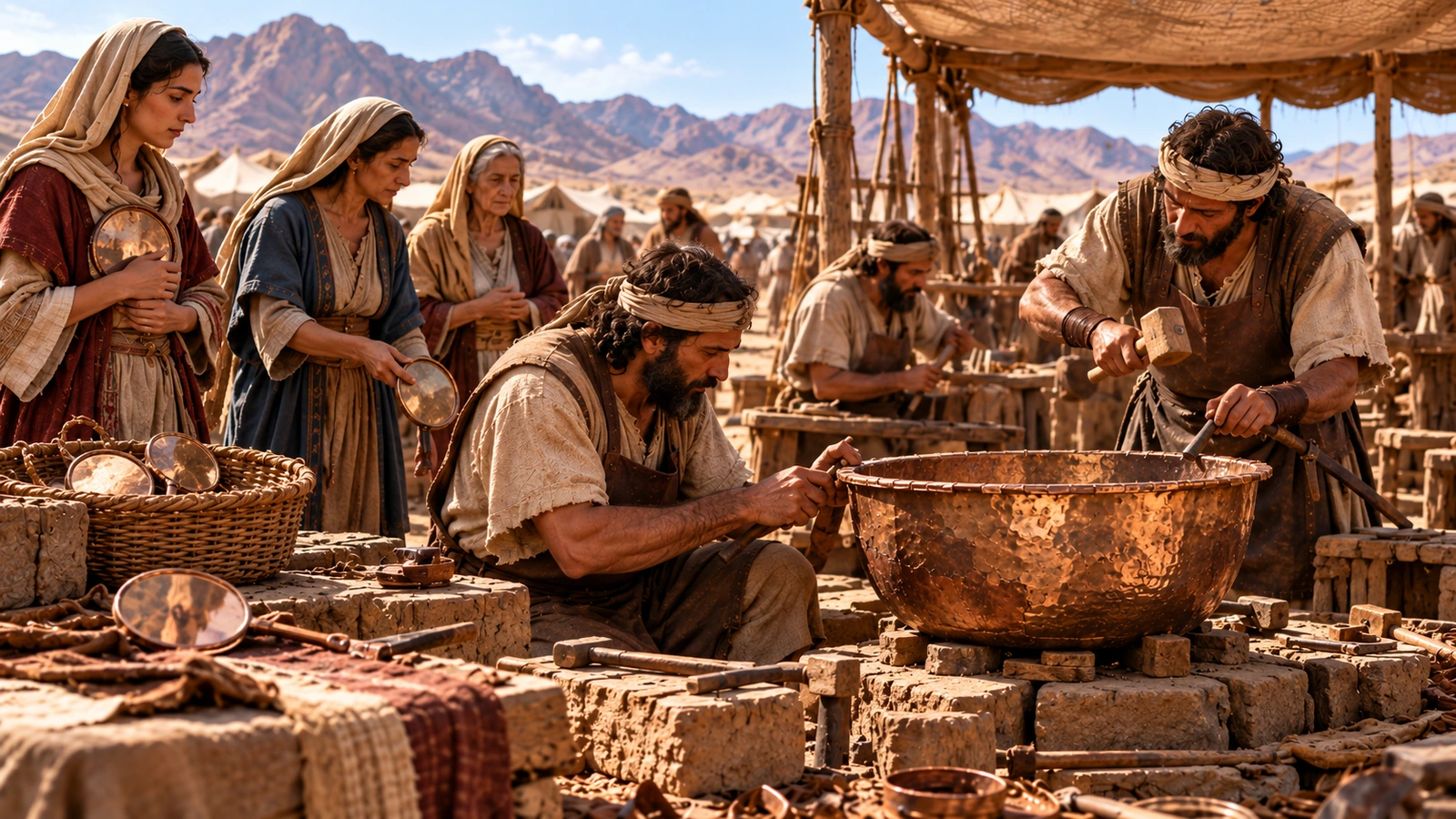
The bronze basin is made from the mirrors of women who served at the entrance of the tent of meeting.
Why mention where that bronze came from?
Why Was the Bronze Basin Made from the Women’s Mirrors?
Selected Sources
- Brevard S. Childs, The Book of Exodus: A Critical, Theological Commentary. Old Testament Library. Westminster Press, 1974.
- Thomas B. Dozeman, Exodus. Eerdmans Critical Commentary. Eerdmans, 2009.
- Raanan Eichler, “Ark of the Covenant,” Oxford Bibliographies in Biblical Studies.
- Raanan Eichler, “What Kind of Creatures Are the Cherubim?”
- Nathan MacDonald, The Making of the Tabernacle and the Construction of Priestly Hegemony. Oxford University Press, 2023.
- Carol Meyers, Exodus. New Cambridge Bible Commentary. Cambridge University Press, 2005.
- William H. C. Propp, Exodus 19–40: A New Translation with Introduction and Commentary. Anchor Bible 2A. Doubleday, 2006.
- Nahum M. Sarna, The JPS Torah Commentary: Exodus. Jewish Publication Society, 1991.