Why Was the Bronze Basin Made from the Women’s Mirrors?
Exodus 38 Explained: The Bronze Altar, the Women at the Tent of Meeting, the Courtyard, and the Tabernacle’s Final Inventory
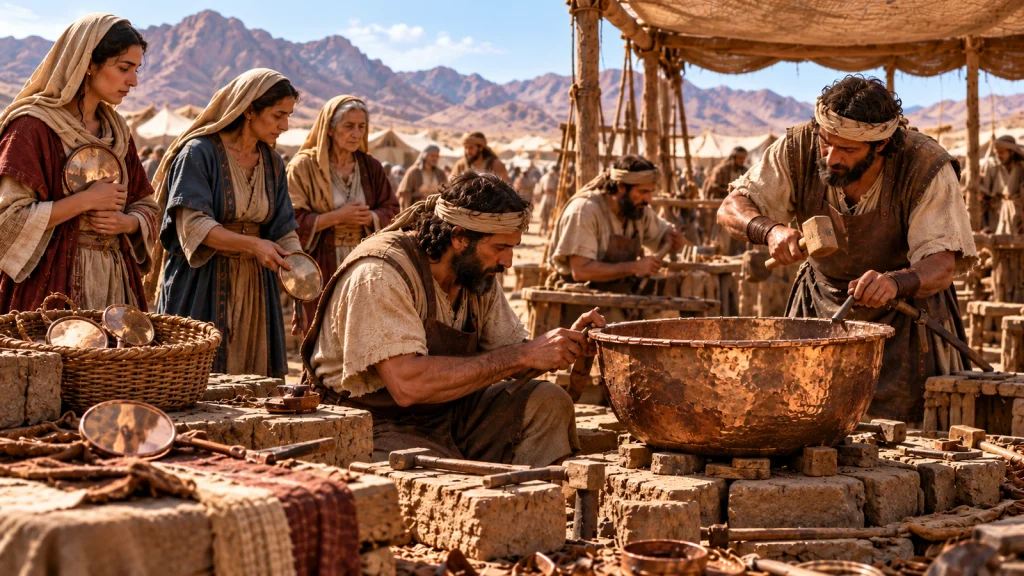
Source: AI-generated image created for Beyond The Known.
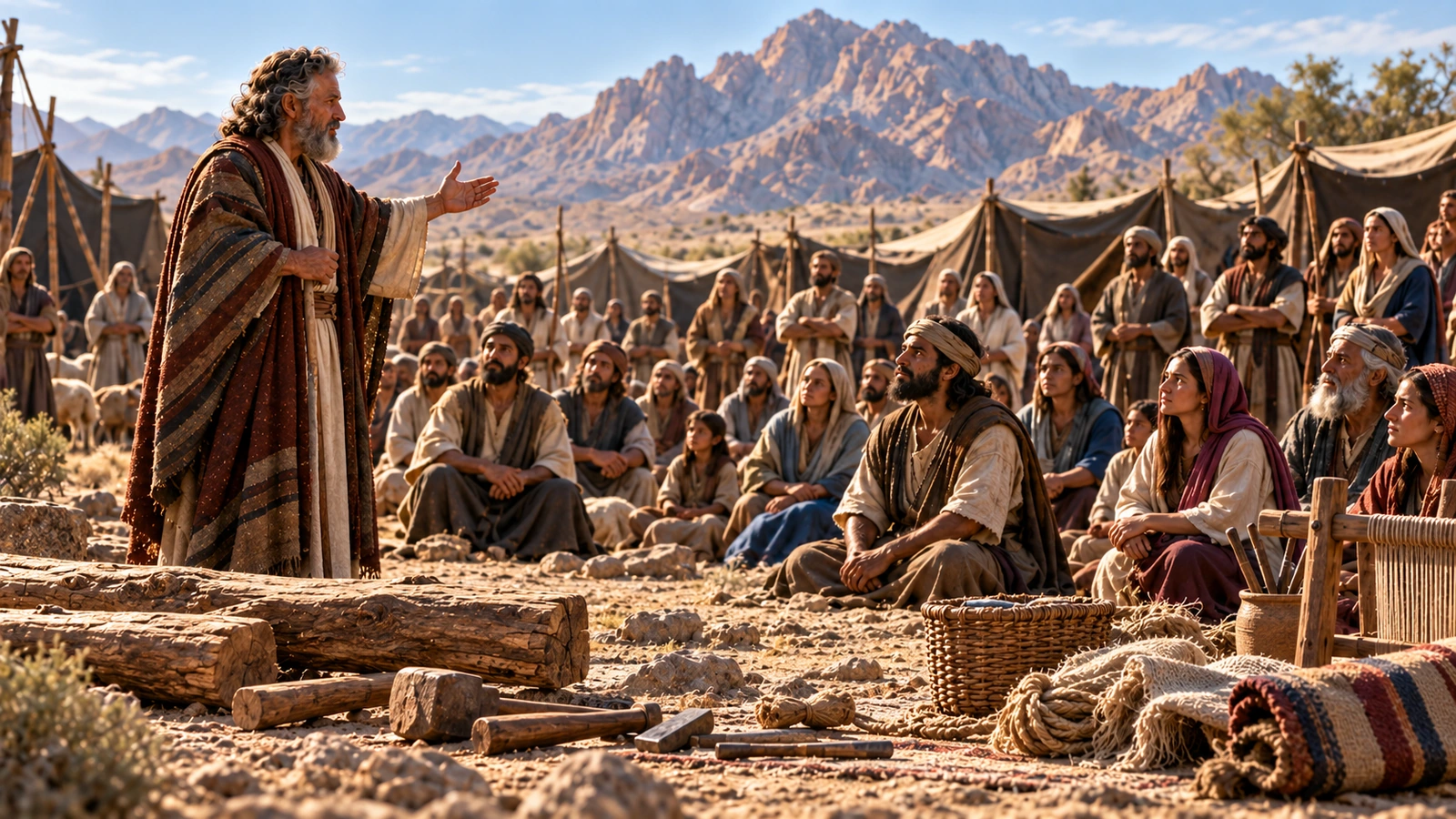
Exodus 38 is dominated by construction details.
The bronze altar is measured and built. The courtyard is enclosed. Columns, bases, hooks, screens, and tent pegs are specified. Then the chapter closes by accounting for the gold, silver, and bronze used in the sanctuary.
In the middle of that technical material, one verse suddenly becomes personal.
Bezalel makes the bronze basin and its stand:
“from the mirrors of the women who served at the entrance to the tent of meeting.”
No other object in the chapter receives a note quite like that.
The altar is identified by dimensions and materials. The courtyard is described by measurements. The final inventory turns metals into weights and quantities.
The basin is different.
Exodus tells us where its metal came from.
Why preserve that detail? Who were these women? What kind of “service” did they perform? And does the fact that their mirrors became a basin carry a meaning the text expects us to see?
Those questions have generated centuries of interpretation. Some later Jewish readings attached a powerful story to the mirrors. Modern scholarship has asked what ancient metal mirrors were, what the unusual Hebrew for the women means, and how the verse fits the chronology of the tabernacle narrative.
The first task, however, is simpler.
We need to separate what Exodus actually says from what later readers have inferred.
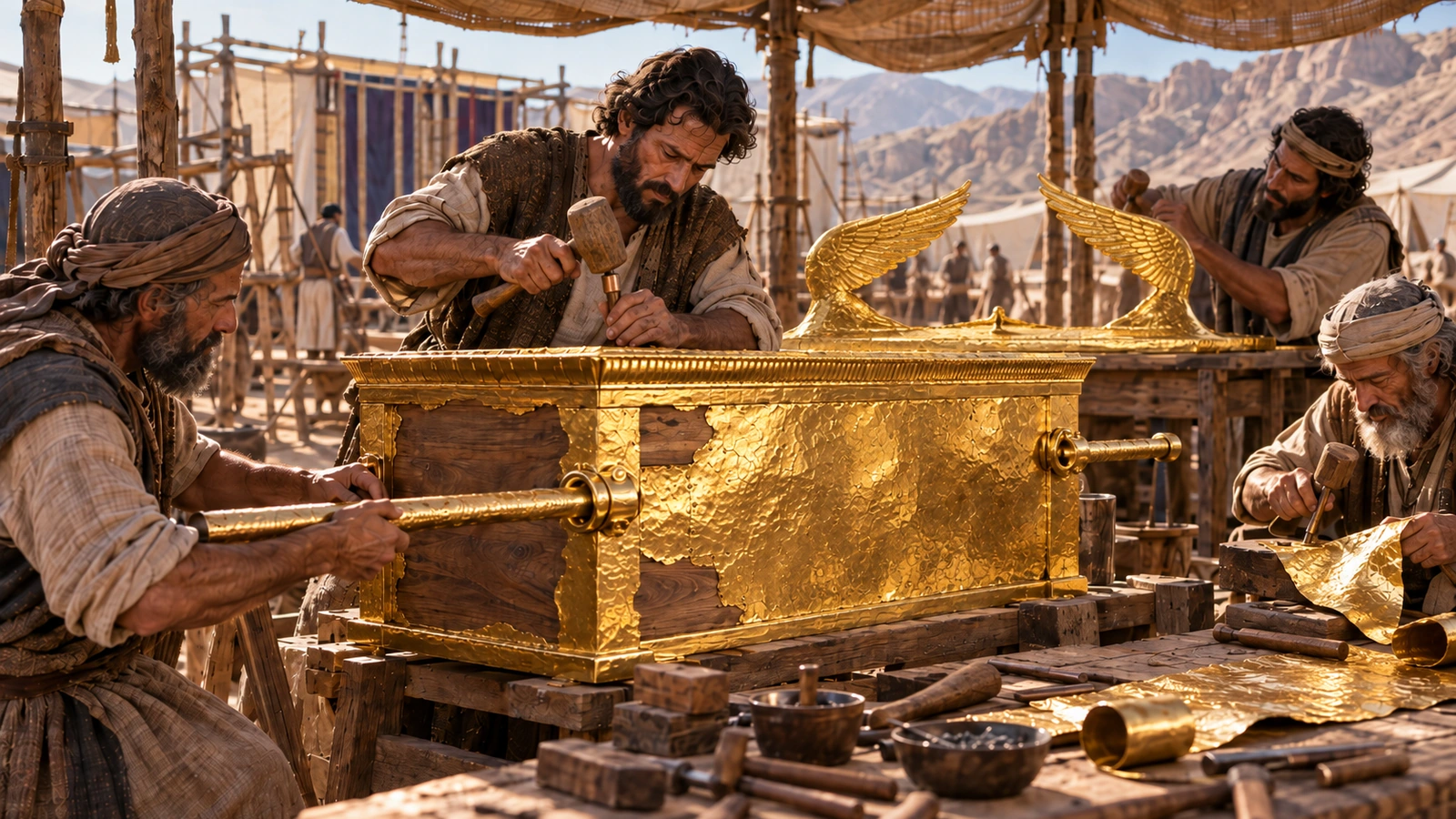
The previous study, Why Was the Ark the First Sacred Object Bezalel Made?, followed the construction of the tabernacle’s interior furnishings.
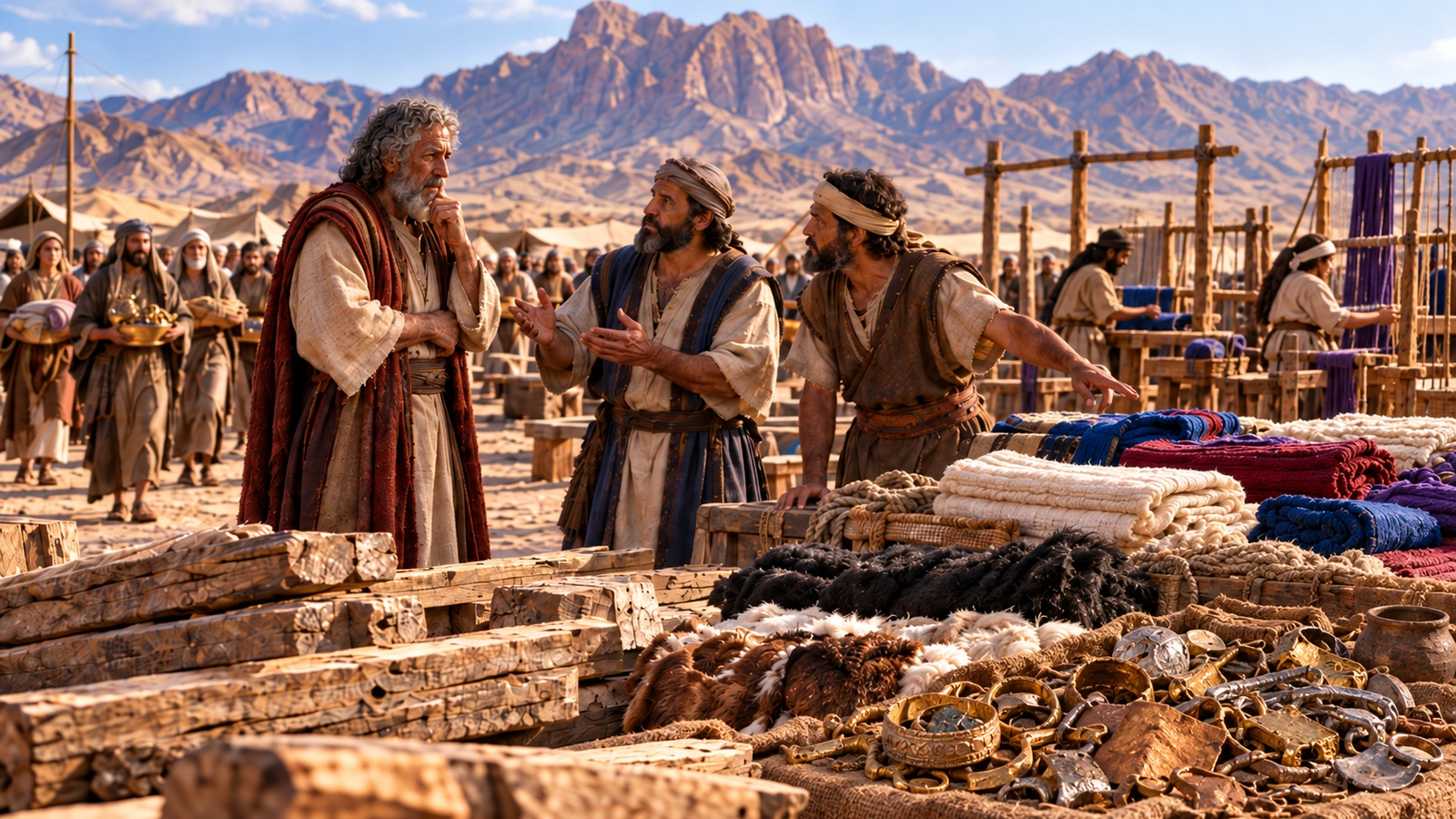
Exodus 38 moves outward—to the altar, the basin, the courtyard, and finally the accounting of the sanctuary’s metals.
And in that outward movement, the text pauses long enough to remember the women behind one piece of bronze.
The Chapter Begins with the Bronze Altar
Exodus 38 opens with the altar of burnt offering.
Like several other tabernacle objects, it has an acacia-wood core. Unlike the gold-covered furniture associated with the tent’s interior, this altar is overlaid with bronze.
It is square, fitted with horns at its four corners, equipped with a bronze grate, and supplied with utensils for sacrificial use.
It also receives rings and poles.
That last feature is easy to overlook because an altar can feel like the most stationary object imaginable. Yet the wilderness sanctuary is still mobile. Even the place of sacrifice must be constructed so that it can travel with Israel.
Verse 7 adds that the altar is hollow and made from boards.
The description keeps the reader from imagining a massive block of metal. The altar is a portable piece of sacred architecture, built by artisans who have to think not only about symbolism but also about weight, stability, heat, and transport.
The construction account repeatedly refuses to separate holiness from technical competence.
Then the Basin Receives an Unexpected Provenance
The bronze basin had already been commanded in Exodus 30:17–21.
There YHWH instructed Moses to make a bronze basin with a bronze stand and to place it between the Tent of Meeting and the altar.
But Exodus 30 did not say where its metal would come from.
Exodus 38 does.
The Hebrew reads:
בְּמַרְאֹת הַצֹּבְאֹת — bəmarʾōṯ haṣṣōḇəʾōṯ
The basin and its stand are made from the mirrors associated with a group of women at the entrance to the Tent of Meeting.
That information is new.
The instruction tells us what object must exist and what it is for.
The execution account adds a history to its material.
The bronze was not anonymous.
It had belonged to someone.
What Kind of Mirrors Were These?
Modern readers naturally imagine glass.
That is almost certainly the wrong picture.
Ancient mirrors in the eastern Mediterranean were commonly made from highly polished metal. Archaeological evidence includes copper and copper-alloy mirrors whose surfaces were polished enough to reflect a face.
Laura Quick’s study of Exodus 38:8 places the verse within that broader material culture and argues that there is nothing inherently implausible about women contributing metal mirrors for the basin.
The exact alloy should not be stated with more precision than the evidence allows.
The Hebrew describes the basin and stand as נְחֹשֶׁת — nəḥōšeṯ, a term that can refer to copper or bronze depending on context. Because the basin is said to be made from the mirrors, the verse strongly implies that the mirrors themselves supplied workable metal.
What Exodus does not describe is the manufacturing process.
It is reasonable to imagine the metal being melted or otherwise reworked.
The text never tells us exactly how Bezalel did it.
That distinction matters. Physical plausibility is not the same thing as explicit narration.
Who Were the Women?
The difficult phrase is not “mirrors.”
It is the description of the women.
Exodus calls them:
הַצֹּבְאֹת אֲשֶׁר צָבְאוּ — haṣṣōḇəʾōṯ ʾăšer ṣāḇəʾû
The root צ־ב־א — ṣ-b-ʾ is used elsewhere for a host, army, ordered service, or organized duty.
That is why English translations vary.
Some say the women “served.”
Others describe them as women who “ministered,” “assembled,” or “performed tasks” at the entrance to the Tent of Meeting.
The Hebrew does not give us a job description.
It tells us that the women were associated with some kind of organized activity there.
Susan Ackerman devotes a substantial discussion to these ṣōḇəʾōṯ because the evidence is too sparse to define their religious role with confidence.
That uncertainty should remain visible in the article.
We know that the text remembers them as a group.
We know the place with which they were associated.
We do not know exactly what they did.
We Should Not Turn Them into Something the Text Never Says
This is one of those verses where a lack of information has encouraged large reconstructions.
Some interpreters have imagined practical service.
Others have suggested prayer or some kind of cultic ministry.
More sensational proposals have tried to connect these women with sexual activity.
Exodus 38 does not support that conclusion.
The verse does not call them prostitutes.
It does not describe sexual service.
And the existence of a disputed parallel in 1 Samuel 2:22 does not give us permission to import a sexual role into Exodus.
In fact, that Samuel text is itself textually complicated. The clause referring to women at the entrance to the Tent of Meeting is absent from important ancient witnesses, including the shorter reading preserved in the Septuagint and 4QSamᵃ. Domenico Lo Sardo has examined the relationship between the Exodus and Samuel passages in detail and argues that their literary and textual history is complex.
The safest conclusion remains the simplest:
Exodus remembers women associated with organized service at the sanctuary entrance, but it does not define their duties.
There Is a Chronological Tension in the Verse
Another question appears once we pay attention to the narrative sequence.
Exodus 38 says these women were associated with the entrance to the Tent of Meeting.
But the tabernacle being constructed in Exodus 35–39 has not yet been erected.
That happens in Exodus 40.
How, then, are women already serving at its entrance?
The text does not explain the relationship.
One possibility is that the phrase refers to the earlier Tent of Meeting associated with Moses in Exodus 33:7–11.
Another is that the wording reflects a later institutional description placed within the construction account.
Historical-critical scholars have used the verse as part of broader discussions about the compositional development of the tabernacle material.
Those are legitimate questions, but they should not be confused with what the final narrative explicitly states.
In the received form of Exodus, the women and their mirrors belong to the construction story.
How that description relates historically to the sequence of the tent’s erection remains debated.
The Basin Stands on the Way Toward Holy Space
The basin is easy to neglect because Exodus 38 gives it only one verse.
Its earlier instructions show why it matters.
Exodus 30 places it between the altar and the Tent of Meeting.
Aaron and his sons are to wash their hands and feet from it when they approach priestly service.
The warning is severe: they must wash so that they do not die.
The basin therefore belongs to the ordered movement toward holy space.
A priest comes from the courtyard.
The altar is nearby.
The tent lies ahead.
Before entering or approaching sacrificial service, he washes.
The basin is not merely useful equipment. It stands at a ritual threshold.
The Basin Has No Recorded Dimensions
That makes another omission noticeable.
The altar has dimensions.
The courtyard has dimensions.
The ark, table, lampstand, and other furnishings are described with significant structural detail.
The basin is not.
Exodus 30 commands it.
Exodus 38 says it was made.
But the text never gives its height, diameter, capacity, or a detailed shape.
That should place limits on modern reconstruction.
Artwork can represent a plausible bronze basin.
It cannot honestly claim to reproduce the biblical design with precision.
We know its material, stand, location, and function.
We do not know its full form.
Do the Mirrors Symbolize Self-Examination?
This interpretation is common because it seems almost irresistible.
A mirror becomes a basin.
The mirror reflects the face.
The basin provides water for washing.
So perhaps the object symbolizes seeing one’s impurity and being cleansed.
The problem is that Exodus never says this.
The verse does not connect reflection with moral self-examination.
It does not say the completed basin remained mirror-like.
It does not tell us that priests looked into it.
A later theological analogy may still be meaningful to a reader, but it must be labeled as an analogy.
It is not the explanation supplied by Exodus 38.
The same caution applies to claims that the women surrendered vanity.
The text never calls the mirrors vain.
Later Jewish Interpretation Gave the Mirrors a Story
Jewish interpreters noticed immediately that the mirrors were unusual.
One of the most famous traditions appears in Midrash Tanchuma and is later preserved by Rashi.
In that reading, Israelite women used their mirrors in Egypt to encourage intimacy with husbands exhausted by forced labor. Their actions helped sustain Israel’s families under Pharaoh’s oppression.
When the mirrors are later brought for the tabernacle, Moses initially regards them as inappropriate. God tells him to accept them because of the role they played in Israel’s survival.
It is a striking interpretation, and Rashi develops it further.
But it is not information supplied by Exodus 38.
The biblical verse does not say that Moses rejected the mirrors.
It does not connect them with the women’s marriages in Egypt.
It does not explain their contribution through Israelite fertility.
Those details belong to later midrashic interpretation.
That distinction does not diminish the tradition.
It simply keeps later interpretation from being mistaken for the narrative of Exodus itself.
Ibn Ezra Read the Same Mirrors Differently
The interpretive history becomes even more instructive when we compare another medieval Jewish reading.
Ibn Ezra understands the women as devoted worshipers who no longer needed the mirrors they once used for adornment. In his reading, surrendering the mirrors reflects their withdrawal from ordinary concern with beautification.
That is almost the opposite emphasis from the tradition preserved by Rashi.
For Rashi, the mirrors are honored because of their positive use in marital life.
For Ibn Ezra, they fit women who have moved away from concern with adornment.
Both readings try to explain the same short biblical verse.
Their disagreement exposes how little Exodus itself tells us about motive.
The strongest interpretation begins by admitting that silence.
The Final Bronze Inventory Creates a New Question
The chapter eventually moves from construction to accounting.
Gold is counted.
Silver is counted.
Bronze is counted.
Exodus 38:29–31 then lists what was made from the bronze associated with the general offering:
the bases at the entrance to the Tent of Meeting,
the bronze altar,
its grate,
its utensils,
the bases around the courtyard,
the bases at the courtyard entrance,
and the tent pegs.
One object is not named.
The basin.
The omission is real.
The Cambridge commentary on Exodus 38 explicitly notes that the bronze basin is passed over in the enumeration.
That becomes especially interesting because verse 8 has already given the basin another source of metal: the women’s mirrors.
The Basin Has a Different Material History
Rashi noticed the omission centuries ago.
He argued that because the basin and its stand are not included among the objects made from the bronze offering in verses 29–31, their metal should be understood as coming separately from the women’s mirrors.
That is an interpretive inference rather than a sentence Exodus states outright.
Ancient inventories do not always satisfy modern expectations of exhaustive accounting.
Still, the combination is striking.
Verse 8 singles out the mirrors.
Verses 29–31 account for the general bronze but do not list the basin.
At minimum, Exodus gives the basin a provenance that no other bronze object in the chapter receives.
That is stronger than any theory about vanity or self-examination because it arises from the structure of the chapter itself.
The Deeper Discovery
The deeper pattern in Exodus 38 is not that mirrors secretly symbolize something.
It is that the chapter remembers material in two different ways.
Most of the sanctuary metal eventually becomes quantity.
Gold is weighed.
Silver is weighed.
Bronze is weighed.
The final inventory turns precious material into talents and shekels and then connects those totals with parts of the sanctuary.
But the basin is remembered differently.
Exodus does not tell us how much metal went into it.
It tells us whose metal it had been.
The bronze came from the mirrors of women associated with service at the Tent of Meeting.
Then the basin disappears from the later list of uses for the general bronze offering.
The effect is subtle but important.
The sanctuary is not made only from anonymous resources.
At least one object carries a remembered human provenance.
The text preserves the women even while leaving their service unexplained.
That may be the most responsible answer to the question raised by verse 8.
Why mention the mirrors?
Because for this object, Exodus chooses to remember not merely the material but the people from whom it came.
The Courtyard Extends the Pattern of Boundaries
After the basin, the chapter describes the courtyard.
Fine linen hangings define its perimeter.
Bronze bases support its columns.
Silver appears in hooks, bands, and overlays.
An embroidered screen marks the entrance.
The architecture creates an ordered path rather than an undifferentiated sacred zone.
There is an outside.
There is a courtyard.
There is an altar.
There is a basin.
There is the tent.
And within the tent, there are further boundaries.
The basin belongs within that progression.
Its placement between altar and tent makes it part of the movement toward greater restriction.
“These Are the Records of the Tabernacle”
Verse 21 introduces the final section with language often rendered:
“These are the records” or “These are the accountings of the tabernacle.”
The tone changes.
The narrative is no longer concentrating on how an object was made. It is documenting the materials used in the sanctuary.
The Levites are involved under the direction of Ithamar son of Aaron.
Bezalel and Oholiab are named again.
Then the metals are quantified.
That does not make Exodus 38 a modern audit report.
But it does show a clear interest in reckoning, allocation, and material accountability.
The resources collected from Israel have become identifiable parts of a finished project.
Metric Conversions Are Approximate
Many modern translations convert the biblical weights into kilograms or tons.
Those numbers are useful for communicating scale.
They are not the units Exodus gives.
The Hebrew text speaks in talents, shekels, and the בֶּקַע — beqaʿ, the half-shekel unit named in verse 26.
Ancient weight standards were not perfectly uniform, so modern conversions should be treated as approximations.
The main point does not depend on whether one modern estimate differs slightly from another.
Exodus is emphasizing the enormous amount of precious material invested in the sanctuary and accounting for that material through ancient standards of weight.
The Silver Comes from a Different Source
The chapter also distinguishes the sources of the metals.
Gold is associated with the sanctuary offering.
Bronze is associated with the offering.
The silver in verses 25–28 is tied to those who were counted.
Each man twenty years old and above contributes a beqaʿ, identified as half a shekel.
The total number of men is given as 603,550.
That number immediately creates another question because it is identical to the total in Numbers 1:46.
The Census Total Creates a Real Chronological Question
Numbers 1 dates its census to the first day of the second month of the second year.
Exodus 40:17 says the tabernacle was erected on the first day of the first month.
If Exodus 38:25–26 is referring to the same census described in Numbers 1, the sequence becomes difficult: silver from that census is said to have been used for a sanctuary already completed before Numbers dates the census.
Scholars and commentators have handled the problem differently.
Some have proposed an earlier collection or numbering connected with the half-shekel requirement of Exodus 30, with Numbers 1 representing a later registration or military organization based on the same population.
Historical-critical interpreters have more often taken the identical total and chronology as evidence that the Priestly materials have a complex compositional history.
The text itself does not resolve the relationship.
A serious article should therefore do neither of two things:
pretend there is no chronological question,
or present one proposed reconstruction as though it were the only possible reading.
The tension is real.
Its explanation remains debated.
The Inventory Is More Than a List of Wealth
It is tempting to modernize this section and call it a lesson in “financial transparency.”
That language can be useful as an analogy, but it is not the vocabulary of Exodus.
The chapter is not describing a nonprofit accounting system.
What it does show is a concern with reckoning.
The artisans are named.
Metals are quantified.
Silver is linked to the counted Israelites.
Bronze is connected with particular structural components.
The generosity of Exodus 35–36 has not disappeared into an undefined sacred accumulation.
Resources have become a sanctuary.
The accounting section looks back and tells the reader, in ancient terms, what that construction required.
So Why Were the Women’s Mirrors Used?
Exodus does not give a direct theological explanation.
That is the answer we must protect from embellishment.
The verse tells us four things with reasonable confidence:
the basin and stand were made from the mirrors;
the mirrors were metal objects suitable for reworking;
they belonged to a group of women associated with service at the Tent of Meeting;
and the chapter remembers this provenance even though most other bronze is later treated through aggregate accounting.
It does not say the mirrors represented vanity.
It does not say they symbolized self-examination.
It does not say Moses rejected them.
It does not explain the women’s exact duties.
Those claims belong either to later interpretation or to modern reconstruction.
What Exodus preserves is already significant enough.
Personal objects belonging to these women entered the sanctuary project.
Their metal became the basin used in priestly washing.
And the text chose not to let their contribution disappear into the anonymous total of bronze.
The Mirrors Became Part of the Approach to YHWH’s Dwelling
One final observation can be made without inventing symbolism.
The basin made from these mirrors would stand between the altar and the tent.
Priests would wash there before entering sacred service.
The women’s metal therefore became permanently embedded in the ordered approach toward YHWH’s dwelling.
That is not because Exodus tells us what the mirrors “meant.”
It is because the text tells us what they became.
A personal possession became sanctuary material.
Sanctuary material became a vessel of priestly washing.
And the women who supplied that metal remained part of the object’s remembered history.
FAQ
Why was the bronze basin made from women’s mirrors?
Exodus 38:8 says the basin and its stand were made from mirrors belonging to women associated with service at the entrance to the Tent of Meeting. The verse does not explicitly explain why their mirrors were chosen.
Were the mirrors made of glass?
They were almost certainly metal mirrors rather than modern glass mirrors. Ancient eastern Mediterranean mirrors were commonly made from polished copper or copper alloys. Exodus describes the basin made from them as nəḥōšeṯ, a term commonly rendered bronze or copper.
Who were the women who served at the Tent of Meeting?
The Hebrew uses ṣ-b-ʾ language associated with organized service, but the verse does not define their duties. Their exact religious role remains uncertain.
Does Exodus say the mirrors were melted down?
No. Reworking the metal is a reasonable reconstruction, and melting is plausible, but Exodus does not describe the manufacturing process.
Did Moses refuse the women’s mirrors?
Not in the biblical narrative. That detail comes from later Jewish midrash and is famously preserved by Rashi.
Were the mirrors symbols of vanity or self-examination?
Exodus does not assign either symbolism to them. Those are later theological interpretations, not explanations stated in the chapter.
What was the basin used for?
Aaron and his sons were to wash their hands and feet from it before entering the Tent of Meeting or approaching the altar for priestly service. Exodus 30:20–21 connects this washing with the danger of death in approaching sacred service improperly.
Why are no dimensions given for the basin?
Exodus does not explain. The basin’s material, stand, location, and function are given, but its precise dimensions and shape are not preserved.
Why is the basin absent from the bronze inventory in Exodus 38:29–31?
The chapter lists several objects made from the general bronze offering but does not name the basin. Because verse 8 already gives the basin another source of metal—the women’s mirrors—later interpreters such as Rashi took the omission as significant. The omission is clear; what exactly it proves should be stated cautiously.
Why does Exodus 38 use the same number, 603,550, as Numbers 1?
The identical total creates a chronological question because Numbers dates its census after the tabernacle was erected. Some interpreters propose an earlier numbering or collection behind Exodus 38, while historical-critical scholars often see evidence of compositional complexity. Exodus itself does not explain the relationship.
What Comes Next?
By the end of Exodus 38, the altar, basin, courtyard, and structural hardware are complete, and the sanctuary’s metals have been accounted for.
Exodus 39 turns back to the priests.
Aaron’s garments are made from blue, purple, scarlet, fine linen, gold, and precious stones.
And as the chapter proceeds, one formula keeps returning:
“as YHWH commanded Moses.”
Why repeat it so many times?
Why Does Exodus 39 Keep Repeating “As the LORD Commanded Moses”?
Selected Sources
- Brevard S. Childs, The Book of Exodus: A Critical, Theological Commentary. Old Testament Library. Westminster Press, 1974.
- Thomas B. Dozeman, Exodus. Eerdmans Critical Commentary. Eerdmans, 2009.
- Carol Meyers, Exodus. New Cambridge Bible Commentary. Cambridge University Press, 2005.
- William H. C. Propp, Exodus 19–40: A New Translation with Introduction and Commentary. Anchor Bible 2A. Doubleday, 2006.
- Nahum M. Sarna, The JPS Torah Commentary: Exodus. Jewish Publication Society, 1991.
- Laura Quick, “Through a Glass, Darkly: Reflections on the Translation and Interpretation of Exodus 38:8.” Catholic Biblical Quarterly 81, no. 4 (2019): 595–612.
- Susan Ackerman, Women and the Religion of Ancient Israel. Yale University Press, 2022, especially the discussion of the ṣōḇəʾōṯ associated with the entrance to the Tent of Meeting.
- Domenico Lo Sardo, “The Tent of Meeting and the Women’s Mirrors in 1 Sam 2:22 and Exod 38:8: A Text-Critical Inquiry of the MT, LXX, Qumran Texts and the Vetus Latina.” Textus 29, no. 2 (2020): 168–192.
- J. Liver, “The Half-Shekel Offering in Biblical and Post-Biblical Literature.” Harvard Theological Review 56, no. 3 (1963): 173–198.
- Midrash Tanchuma, Pekudei 9 and Rashi on Exodus 38:8, used as later interpretive witnesses rather than as evidence for events explicitly narrated in Exodus.