Why Did God Kill the Firstborn in Egypt?
Exodus 11 Explained: Israel as YHWH’s Firstborn, Egypt’s Final Warning, and the Ethics of the Tenth Plague
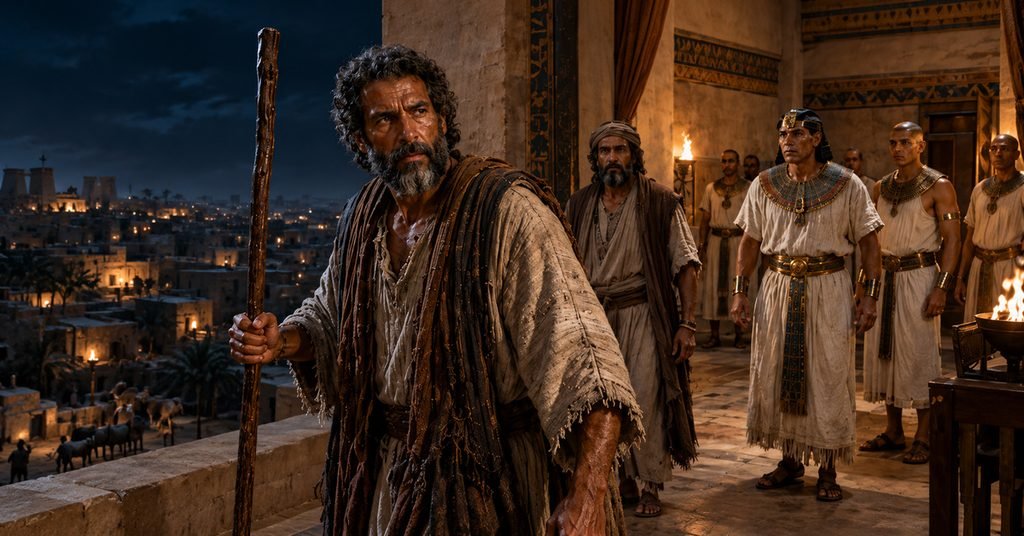
Source: AI-generated image created for Beyond The Known.
Exodus 11 does not begin with midnight. It begins with an announcement of death.
The negotiations collapsed in Why Did Pharaoh Refuse to Let Israel Go Even After Egypt Was Destroyed? Pharaoh has threatened Moses, and another compromise is no longer offered.
One final judgment remains.
Every Egyptian firstborn will die, from Pharaoh’s house to the lowest social ranks. Firstborn livestock are included.
That raises the hardest question in the plague narrative:
Why did God kill the firstborn in Egypt?
Exodus supplies a narrative logic for the judgment. It does not erase its ethical difficulty.
That distinction must remain intact.
Why Was the Final Plague Announced So Early?
The firstborn theme appears long before Exodus 11.
While Moses is still returning to Egypt, YHWH instructs him:
“Israel is my firstborn son.”
Exodus 4:22
Then comes the demand:
“Let my son go, that he may serve me.”
Refusal carries a corresponding threat against Pharaoh’s firstborn.
The Hebrew noun is:
בְּכוֹר — bĕḵôr
“firstborn.”
Applied to Israel, the term cannot describe literal birth order among nations.
It defines a claimed relationship.
Israel is identified as YHWH’s son.
Pharaoh is preventing that son from leaving to serve his God.
The conflict now reaches beyond forced labor.
Two authorities are making incompatible claims over Israel’s allegiance.
What Does “Firstborn” Actually Mean?
Modern images often portray the tenth plague as the death of infants.
Exodus never gives the victims’ ages.
A bĕḵôr is defined by firstborn status, not childhood.
Elsewhere, the same category applies to adults with inheritance rights.
Deuteronomy 21:17 assigns the paternal firstborn a double portion.
So Exodus 11 cannot be reduced to a massacre of babies.
Neither can it be softened into the deaths of adults.
Children could certainly belong to the threatened category.
The text simply does not provide an age profile.
That uncertainty matters because precision should increase the moral question, not evade it.
Pharaoh’s Firstborn Represents More Than One Family
Exodus places Pharaoh’s household at one end of the coming disaster.
His firstborn belongs to the royal line.
Ancient Egyptian kingship tied succession to legitimacy, divine ideology, queenship, and court politics. Royal descent cannot be reduced to automatic modern-style primogeniture. UCL’s overview of Egyptian kingship highlights the special importance of royal mothers and wives within succession ideology. (University College London)
Exodus does not explain which succession rules applied to this unnamed ruler.
It does something simpler.
The plague reaches the house at the summit of Egyptian power.
Then it moves downward through society.
Dynastic continuity stands within the judgment’s scope.
Why Does Exodus 4 Threaten One Son but Exodus 11 Threaten Every Firstborn?
A real textual tension appears here.
Exodus 4 threatens Pharaoh’s firstborn son.
Exodus 11 announces the death of every firstborn in Egypt, including animals.
A final-form reading can connect these passages narratively.
Israel is YHWH’s firstborn.
Pharaoh refuses to release that son.
The later judgment expands the firstborn theme across Egypt.
Yet the scope is not identical.
Some source-critical scholars interpret that difference as evidence of distinct stages or traditions.
David Frankel, for example, argues that Exodus 4:22–23 preserves an earlier version centered on Pharaoh’s heir. In his reconstruction, the broader plague tradition developed later. That remains a scholarly proposal, not a fact stated by Exodus.
Both observations deserve preservation.
The received narrative creates a literary connection.
Historical-critical analysis asks how that connection may have developed.
Those are different questions.
Was the Tenth Plague Revenge for Pharaoh Killing Hebrew Boys?
Exodus begins with another assault on children.
Pharaoh orders Hebrew sons thrown into the Nile.
Later, Egypt loses its firstborn.
The correspondence is difficult to miss.
It creates a strong literary symmetry between an attack on Israel’s future and devastation within Egyptian households.
Still, Exodus 11 never says:
“Because Pharaoh killed Hebrew boys, every Egyptian firstborn must die.”
That causal formula would go beyond the passage.
The clearest explicit rationale appears earlier.
Israel is YHWH’s firstborn son.
Pharaoh refuses to release him.
Retributive symmetry can be observed.
It should not be converted into an unstated divine motive.
Does Exodus Treat Every Egyptian as Equally Guilty?
No.
Earlier plagues already complicated that picture.
Some Egyptian officials took YHWH’s warning seriously before the hail.
They moved servants and animals into shelter.
Others ignored it.
Exodus 11 also says many Egyptians regarded Moses favorably.
Those details prevent a simple equation:
Egyptian = personally guilty to the same degree.
Yet the final plague falls across households.
The narrator does not pause to assign individual culpability to each victim.
That gap creates part of the passage’s ethical burden.
Corporate judgment describes how the story operates.
It does not, by itself, solve the problem of individual justice.
What Can Hammurabi’s Law 230 Actually Tell Us?
An ancient Mesopotamian parallel helps clarify the cultural distance.
Hammurabi’s law collection includes a case involving defective construction.
If a poorly built house collapses and kills its owner, the builder dies.
If the owner’s son dies, Law 230 orders the death of the builder’s son. (Avalon Project)
The child did not construct the house.
Liability follows correspondence between households.
The famous inscribed stele dates to Hammurabi’s reign and was discovered at Susa during French excavations. It is now held by the Louvre.
This parallel proves no dependence on Exodus.
It also offers no moral defense of the tenth plague.
Its value is narrower.
It illustrates one ancient legal world where consequences could extend through household structures.
Modern individual liability cannot simply be projected backward without explanation.
At the same time, biblical law later contains a striking counterprinciple.
Deuteronomy 24:16 forbids human courts from executing children for their parents’ sins.
Exodus 11 is not presented as Israelite judicial procedure.
It is narrated as divine judgment.
Why Does the Plague Reach an Enslaved Woman’s Household?
Moses describes the coming deaths through a social spectrum.
At one end stands Pharaoh’s firstborn.
At the other stands:
בְּכוֹר הַשִּׁפְחָה — bĕḵôr haššip̄ḥâ
“the firstborn of the slave woman.”
She is described as working behind the millstones.
The movement is deliberate.
Royal privilege offers no protection.
Low social status provides no exemption.
Yet that breadth creates another problem.
The enslaved woman is not Pharaoh.
Her firstborn is given no personal accusation.
Exodus offers no individualized explanation for that death.
The narrative’s national judgment reaches far beyond the person who repeatedly refused Moses.
Readers should not pretend otherwise.
Why Does Exodus 12 Describe the Social Bottom Differently?
The announcement and fulfillment are not worded identically.
Exodus 11 moves from Pharaoh’s house to the slave woman behind the millstones.
Exodus 12:29 instead reaches to the firstborn of the captive in prison.
The two descriptions perform a similar literary function.
Both extend the catastrophe from the throne toward society’s lowest levels.
Yet they are not the same phrase.
Final-form readers can see rhetorical variation.
Source-critical approaches may ask whether different formulations reflect compositional history.
Nothing requires us to erase the difference.
Textual authority grows when such details remain visible.
Why Were Firstborn Animals Included?
Exodus includes:
“all the firstborn of the livestock.”
Animals cannot share Pharaoh’s political responsibility.
Their inclusion makes the judgment wider than human punishment.
The passage never explains their personal “guilt.”
Later, Exodus 13 connects Israel’s own firstborn animals with remembrance of Egypt’s firstborn deaths.
Some source-critical scholars argue that the animal element and firstborn laws developed together within the tradition. (The Torah)
That reconstruction remains debated.
What the final text clearly does is connect human and animal firstborn status within a continuing memorial system.
The plague reaches households, economy, inheritance, and future reproduction.
Its scope is intentionally comprehensive.
Does the Ipuwer Papyrus Prove the Exodus?
No.
The Admonitions of Ipuwer survive in Papyrus Leiden I 344.
The sole manuscript is Ramesside, probably from the Nineteenth Dynasty. Linguistic evidence points scholars toward an older Middle Egyptian composition. (University College London)
The poem describes social disorder, disrupted hierarchy, suffering, and a world turned upside down.
That sounds superficially attractive to plague comparisons.
Yet Ipuwer never names Moses.
Israel never appears.
No sequence of ten plagues is recorded.
Modern Egyptology treats the work as literature exploring chaos and threatened order, not an eyewitness chronicle of Exodus. Roland Enmarch’s major study analyzes its genre, literary setting, and Middle Kingdom cultural world.
The papyrus can illuminate Egyptian ideas about societal disorder.
It cannot verify the tenth plague.
Does Exodus Resolve the Moral Objection?
Not fully.
The narrative explains why the firstborn theme belongs inside the conflict.
Israel has been identified as YHWH’s firstborn.
Pharaoh has attacked Israel’s future and refused repeated release.
Egypt has endured escalating warnings and judgments.
Still, Exodus does not establish equal personal guilt among every firstborn who dies.
The slave woman’s child receives no indictment.
Neither do the animals.
That cannot be repaired by inventing accusations the text never makes.
A responsible reading must hold two realities together.
Egypt’s regime enslaves Israel and resists repeated warnings.
The final judgment also reaches individuals whose personal culpability is not narrated.
Exodus explains the conflict.
It does not answer every ethical question a modern reader can raise.
Did God Kill the Firstborn—or Did “the Destroyer”?
Exodus 12 introduces the destroyer.
That has sometimes been used to distance YHWH from the deaths.
The text does not permit that separation.
In Exodus 11:4, YHWH announces:
“About midnight I will go out in the midst of Egypt.”
Exodus 12:12 states that YHWH will pass through Egypt and strike the firstborn.
Verse 23 describes the destroyer as the operative agent connected with that judgment.
Later, Exodus 13:15 again attributes the deaths to YHWH.
The destroyer does not function as an independent rival actor.
Agency may be mediated.
Responsibility remains divine within the narrative.
That fact makes the ethical question harder, not easier.
What Finally Breaks Pharaoh’s Control?
Exodus 10 ended with Pharaoh still setting conditions.
Who may leave?
Which animals may go?
How far may Israel travel?
Exodus 11 predicts that this entire bargaining structure will collapse.
After the final plague, Pharaoh will not merely permit departure.
He will drive Israel out.
His officials will bow before Moses and demand that the people leave.
The ruler who controlled movement will lose control of departure.
No one negotiates livestock anymore.
No family members remain as conditions.
The argument over service is finished.
Then comes one of Exodus 11’s most striking contrasts.
Egypt will erupt in:
צְעָקָה — ṣĕʿāqâ
“a great cry.”
Israel receives an image of extreme quiet.
Not even a dog will sharpen its tongue against human or animal.
The point is distinction.
Yet Exodus 11 does not explain how that distinction will protect Israel’s firstborn.
That information is withheld until the next chapter.
The Deeper Discovery
The firstborn theme does not end when Israel leaves Egypt.
Exodus 13 turns survival into an enduring claim.
YHWH commands:
“Consecrate to me every firstborn.”
Israel’s firstborn were spared during the night narrated in Exodus 12.
Afterward, their survival creates a ritual obligation.
Human sons are not sacrificed.
They are redeemed.
The relevant verb is:
פָּדָה — pādâ
“to redeem,” “ransom,” or release through an exchange.
That sequence matters.
The blood sign in Exodus 12 belongs to the night of protection.
The redemption rule in Exodus 13 belongs to the memory created afterward.
Those mechanisms must not be confused.
Pharaoh loses his claim over Israel.
Yet liberation does not leave Israel ownerless.
The narrative redirects service toward YHWH.
Even the spared firstborn now embody that claim.
Source-critical scholarship has proposed that firstborn laws and plague traditions developed in relation to each other. The final form, whatever its compositional history, intentionally makes the ritual remember the deliverance.
That is the unexpected aftermath of the tenth plague.
Survival itself becomes something Israel must remember.
FAQ
Were all the Egyptian firstborn babies?
No. Bĕḵôr identifies firstborn status, not a specific age. Adults could also be firstborn.
Was the tenth plague revenge for Pharaoh killing Hebrew boys?
The stories create strong literary symmetry. Exodus 11 does not explicitly state that revenge was YHWH’s motive.
Why were firstborn animals killed?
Exodus includes them but gives no direct moral explanation. Later firstborn laws connect animal firstlings with remembrance of Egypt.
Did the destroyer act independently from God?
No. Exodus repeatedly attributes the judgment to YHWH. The destroyer functions within that divine action.
Does the Ipuwer Papyrus describe the ten plagues?
No. It is an Egyptian literary work about social chaos and does not name Moses, Israel, or a ten-plague sequence.
Why were Israel’s firstborn spared?
Exodus 11 announces a distinction but does not explain its mechanism. Exodus 12 introduces the blood sign placed on Israelite houses.
What Exodus 11 Still Refuses to Explain
Exodus 11 tells us who is endangered.
It identifies the judgment’s scale.
The chapter also predicts that Egypt will finally drive Israel away.
One question remains deliberately unanswered.
How will death pass through the same land while Israel’s firstborn survive?
Before midnight arrives, Exodus 12 introduces a lamb, hyssop, blood, and a sign placed on Israelite houses.
The next mystery is not whether judgment is coming.
It is why blood appears on the entrances of homes.
Why Did the Israelites Put Blood on Their Doorposts?
Selected Sources
- Brevard S. Childs, The Book of Exodus: A Critical, Theological Commentary.
- Thomas B. Dozeman, Exodus.
- William H. C. Propp, Exodus 1–18: A New Translation with Introduction and Commentary.
- Nahum M. Sarna, Exodus. JPS Torah Commentary.
- Roland Enmarch, A World Upturned: Commentary and Analysis of The Dialogue of Ipuwer and the Lord of All.
- Martha T. Roth, Law Collections from Mesopotamia and Asia Minor.
- Musée du Louvre, “The Code of Hammurabi.”
- David Frankel, “The Death of Pharaoh’s Firstborn: A One-Plague Exodus.”