Why Does Joseph Give Benjamin Five Times More Food?
Genesis 43 Explained: Benjamin’s Fivefold Portion, Joseph’s Hidden Identity, and the Banquet Before the Final Test
 |
Why Did Joseph Accuse His Brothers of Being Spies? ended with a family still divided by fear.
Joseph had demanded Benjamin.
Jacob resisted.
Simeon remained in Egypt.
Now famine forces the brothers south again.
This time, Rachel’s youngest son comes with them.
Joseph finally sees Benjamin standing before him.
Hours later, everyone sits at an Egyptian banquet.
Then one plate becomes impossible to ignore.
Benjamin receives five times more than any other brother.
Genesis explains neither hunger nor nutritional need.
No guest asks why.
Still, the narrator preserves the exact disparity.
That detail recalls an older family wound.
Another son of Rachel once received visible preference before these same men.
So why does Joseph publicly distinguish Benjamin?
The safest answer begins with what Genesis actually says.
Benjamin Reaches Egypt Only After Judah Accepts Responsibility
Genesis 42 ended with Jacob refusing to send Benjamin.
Reuben had offered his own sons as security.
Jacob rejected that proposal.
Genesis 43 introduces a different solution.
Judah tells his father:
“I myself will be surety for him.”
The Hebrew uses:
אָנֹכִי אֶעֶרְבֶנּוּ — ʾānōḵî ʾeʿerḇennû
“I myself will guarantee him.”
That commitment matters beyond travel logistics.
Judah assumes personal responsibility for Rachel’s remaining son.
The brother who once proposed selling Joseph now guarantees Benjamin’s return.
Genesis has not yet completed that contrast.
Chapter 44 will.
Joseph Sees Benjamin and Almost Loses His Composure
When the brothers arrive, Joseph immediately notices Benjamin.
He orders his steward:
“Bring the men into the house.”
An animal is prepared.
They will eat with him at noon.
That invitation terrifies the visitors.
They assume the mysterious silver returned in their sacks has brought them into danger.
The steward reassures them.
Simeon is released.
Then Joseph enters.
Presents are brought forward.
Again the brothers bow.
Yet his first questions concern family.
Is their father alive?
Then Joseph looks toward Benjamin.
“Is This Your Youngest Brother?”
Joseph asks whether this is the youngest brother they mentioned earlier.
Then he says:
“God be gracious to you, my son.”
Genesis immediately describes Joseph’s emotional reaction.
כִּי־נִכְמְרוּ רַחֲמָיו אֶל־אָחִיו — kî-niḵmərû raḥămāyw ʾel-ʾāḥîw
His compassion or deep affection is stirred toward his brother.
Joseph hurries away.
He enters a private room.
There he weeps.
This gives us one explicit reason Benjamin matters differently.
He is Joseph’s full brother.
Both are sons of Rachel.
The fivefold serving later occurs after the narrator has already shown that emotional bond.
Any interpretation of the meal should begin there.
The Banquet Is Divided Into Three Groups
Genesis 43:32 contains an unusual seating arrangement.
Joseph eats separately.
His brothers form another group.
The Egyptians dining with him sit apart as well.
The narrator explains that Egyptians would not eat bread with Hebrews because such dining was regarded as an abomination to Egyptians.
The verse uses:
תּוֹעֵבָה — tôʿēḇāh
a term associated with something regarded as objectionable or taboo.
Genesis does not explain the precise custom behind this separation.
Attempts to reconstruct a single Egyptian rule from the verse remain uncertain.
Egyptian food practices, ritual distinctions, and social hierarchies varied across long periods.
The text’s narrative point is clearer.
Joseph occupies an extraordinary position between two worlds.
He belongs neither at his brothers’ table nor simply among them.
Egyptian Evidence Confirms That Formal Banquets Mattered
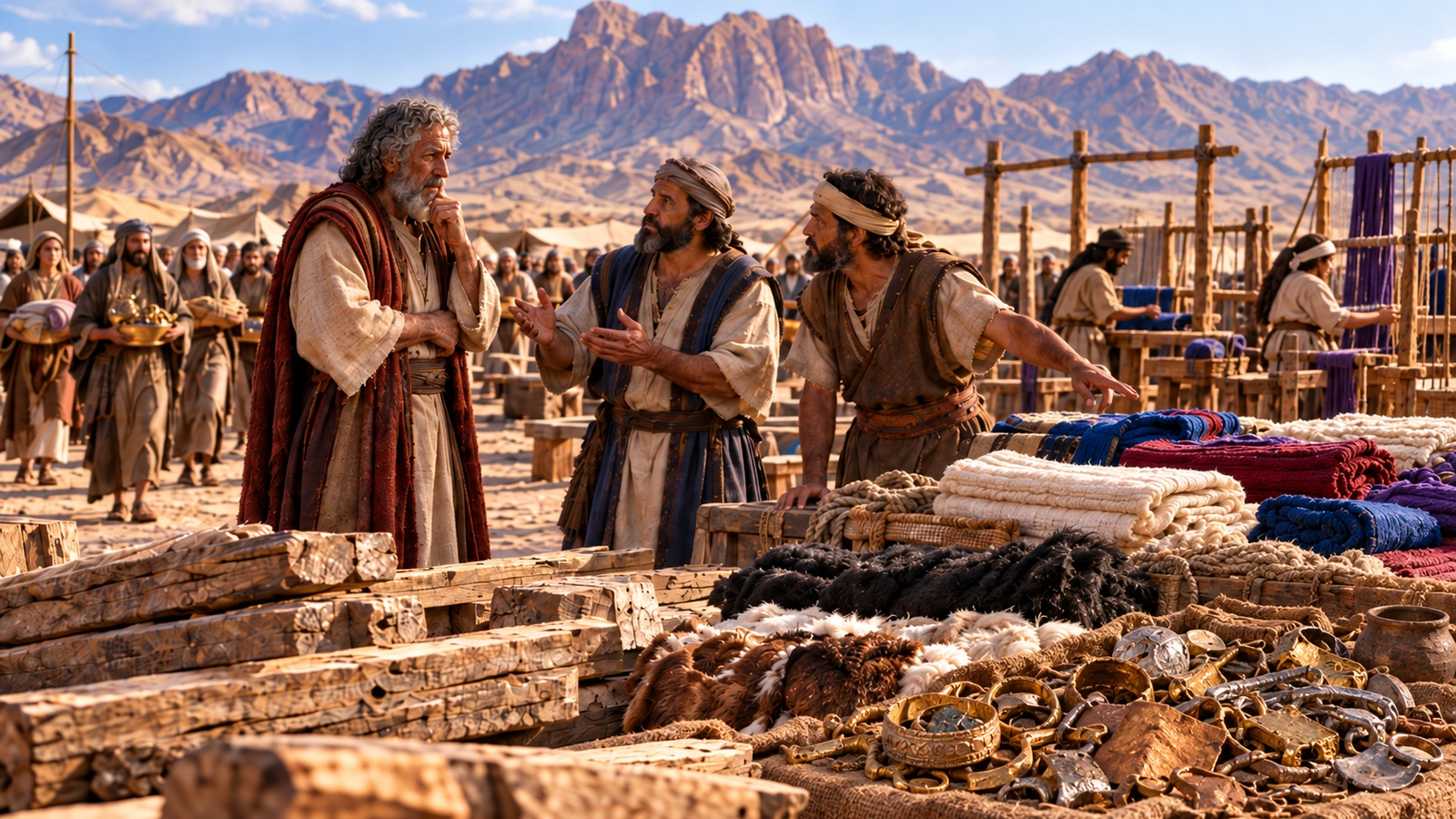
Archaeological and artistic material makes the broader setting plausible.
Middle Kingdom Egyptian evidence preserves banquet scenes and abundant food displays.
A Dynasty 13 relief from Abydos depicts a feast, while earlier offering tables show bread, meat, vegetables, and other provisions arranged for elite consumption.
Later New Kingdom tomb paintings provide richer visual evidence.
Scenes from Theban tombs portray seated guests receiving food and wine from attendants during formal banquets.
These images do not verify Joseph’s meal.
Neither do they establish that fivefold portions were an Egyptian custom.
Their value is contextual.
Formal dining, abundant servings, attendants, hierarchy, and public honor belonged to Egyptian elite culture.
Genesis places the brothers inside such a socially charged meal.
Joseph Seats Them in Exact Birth Order
Before the portions arrive, something else unsettles the brothers.
They are seated:
הַבְּכֹר כִּבְכֹרָתוֹ וְהַצָּעִיר כִּצְעִרָתוֹ
habbəḵōr kiḇḵōrāṯô wəhaṣṣāʿîr kiṣʿirāṯô
“the firstborn according to his birthright, and the youngest according to his youth.”
They stare at one another in astonishment.
Genesis does not state how Joseph presents the arrangement.
The men simply know something extraordinary has happened.
From their perspective, this Egyptian official somehow knows their family order.
For Joseph, no mystery exists.
He grew up among them.
The seating quietly exposes the knowledge gap governing the entire encounter.
What Exactly Is Benjamin Given?
Genesis 43:34 uses the noun:
מַשְׂאַת — maśʾēṯ
a portion, gift, or serving carried to someone.
Food comes to the brothers from Joseph’s own table.
Then the narrator specifies Benjamin’s share:
חָמֵשׁ יָדוֹת — ḥāmēš yāḏôṯ
literally, “five hands.”
In context, the expression means a fivefold share.
English translations naturally render it “five times as much.”
That is conspicuous honor.
The youngest brother does not merely receive slightly better treatment.
His serving visibly exceeds everyone else’s.
Genesis wants the audience to notice.
Does the Number Five Have a Hidden Egyptian Meaning?
Older commentators sometimes argued that five carried special significance in Egypt.
Genesis itself never explains the number that way.
Other appearances of five within the Joseph cycle exist.
Pharaoh takes a fifth of agricultural produce.
Joseph later gives Benjamin five changes of clothing.
Five brothers are presented before Pharaoh.
Those occurrences make the numeral interesting.
They do not establish a secret Egyptian code.
No archaeological evidence allows us to say that a fivefold meal portion was a standard Egyptian honor.
The safest observation is textual.
Benjamin receives an unmistakably excessive share.
Its effect matters more than speculative numerology.
A Larger Portion Could Mark Honor
Serving selected guests larger or better portions is understandable across ancient banquet cultures.
Biblical literature itself contains another example.
In 1 Samuel 9:23–24, Saul receives a specially reserved portion at Samuel’s meal.
Genesis 43 fits that broader social logic.
Food can communicate rank.
A serving can become public honor.
Joseph’s choice therefore does not require an exotic custom to make sense.
Benjamin is visibly distinguished at the table.
The harder question is why Genesis places that distinction before these particular brothers.
The Scene Echoes Joseph’s Own Favoritism
Genesis 37 began with visible inequality.
Jacob loved Joseph more than his other sons.
A distinctive garment made that preference public.
The brothers saw it.
Hatred followed.
Now another son of Rachel receives exceptional treatment before the same family.
The object has changed.
A garment has become a serving.
The favored brother has changed too.
Joseph now creates the disparity rather than suffering from it.
That literary resemblance is difficult to dismiss.
Yet one qualification is necessary.
Genesis never says:
“Joseph gave Benjamin five portions to test whether his brothers were still jealous.”
That motive is an interpretation.
A compelling one.
Not an explicit statement.
What Does the Brothers’ Reaction Actually Tell Us?
This is where the older article went too far.
Genesis does not say:
“They felt no jealousy.”
Neither does it report resentment.
Instead, the verse closes:
וַיִּשְׁתּוּ וַיִּשְׁכְּרוּ עִמּוֹ — wayyištû wayyiškerû ʿimmô
“They drank and drank freely with him.”
Translations vary because š-k-r can carry the sense of becoming intoxicated.
The immediate scene is convivial.
Fear has temporarily given way to feasting.
What remains absent is equally notable.
No quarrel appears.
No attack follows.
Nobody protests Benjamin’s honor.
Still, silence about envy cannot prove inner transformation.
Genesis will provide stronger evidence soon.
The Banquet Is Not the Final Test
If Joseph intends to examine brotherly loyalty, food alone cannot settle the question.
Eating beside a favored sibling costs little.
Genesis 44 changes everything.
Benjamin will appear guilty of stealing Joseph’s silver cup.
The penalty threatens to separate him permanently from Jacob.
At that moment, the brothers face a scenario far closer to Genesis 37.
One favored son can be abandoned.
Everyone else can return home.
That is where behavior becomes decisive.
The feast prepares the pattern.
The cup creates the cost.
Why Benjamin Matters More Than Another Brother
Benjamin is not interchangeable with Simeon or Reuben.
He is Rachel’s surviving son in Jacob’s household.
After Joseph disappeared, Jacob’s attachment became concentrated on Benjamin.
Judah knows this.
Chapter 44 will repeatedly stress the father’s emotional bond with the youngest son.
That makes Benjamin uniquely capable of reopening the old family structure.
Once again, the brothers stand beside someone their father cannot bear to lose.
The question is no longer theoretical.
What will they do with another favored son of Rachel?
Joseph’s Table Temporarily Reverses Genesis 37
Years earlier, the brothers sat down to eat while Joseph remained in the pit.
Genesis 37:25 records the chilling transition:
“Then they sat down to eat.”
Joseph was excluded.
His brothers ate.
Genesis 43 reverses that arrangement.
Joseph now controls the table.
They eat from portions sent by him.
Benjamin receives exceptional honor.
The former victim has become host.
That reversal adds another layer to the banquet.
Food once accompanied Joseph’s abandonment.
Now a shared meal precedes the possibility of restoration.
Genesis does not announce that symmetry.
Its narrative architecture makes the comparison available.
The Brothers Are Not Yet Reconciled
A cheerful meal can make the chapter feel resolved.
It is not.
Joseph still conceals his identity.
Jacob remains unaware that his son lives.
The brothers have admitted guilt in chapter 42, but confession has not yet been tested by sacrifice.
Benjamin’s presence creates the conditions for that next stage.
Joseph cannot know merely from words what they will do under pressure.
Genesis 44 will place action where verbal claims once stood.
That difference matters.
Reconciliation arrives only after behavior answers the unresolved question.
The Fivefold Portion May Be a Controlled Repetition of the Past
A strong literary inference now becomes possible.
Joseph knows what favoritism did to his family.
He remembers his dreams.
He has heard his brothers confess their guilt.
Benjamin is finally present.
Then Joseph publicly favors him.
Seen across chapters 37–44, the banquet can function as a controlled reappearance of an old pattern.
Once again:
Rachel’s son is singled out.
Once again:
the other brothers must live beside visible preference.
But Genesis 43 keeps the stakes low.
No inheritance disappears.
No one loses freedom.
Food is abundant.
The scene creates exposure without catastrophe.
Chapter 44 will intensify the same problem.
That progression makes the jealousy-test interpretation plausible.
The text still stops short of naming Joseph’s private intention.
The Deeper Discovery
The deepest feature of Genesis 43 is not the size of Benjamin’s meal.
It is the sequence connecting favor with danger.
At the banquet, Benjamin becomes the privileged brother.
One chapter later, he becomes the endangered brother.
That movement matters.
Genesis first places Rachel’s youngest son in the position once occupied by Joseph:
publicly favored.
Then the narrative places him in a situation that echoes Joseph’s fate:
he can be left behind while the others go home.
The meal alone cannot demonstrate that the brothers have changed.
It prepares the conditions under which change can later become visible.
That distinction improves the whole reading.
Joseph does not need to infer transformation from facial expressions around a table.
Genesis 44 will give him behavior.
When Benjamin receives fivefold honor, nobody attacks him.
That is suggestive.
When his freedom is threatened, however, Judah will offer his own.
That is evidence.
The banquet is the rehearsal.
The silver cup creates the real decision.
So why does Benjamin receive five times more?
At minimum, Joseph openly honors the full brother he loves.
At the literary level, the excess also restores a familiar imbalance inside Jacob’s family.
Genesis lets us watch the brothers experience favoritism again.
Then it refuses to declare the experiment complete.
The hardest question is still ahead.
Frequently Asked Questions
Why did Benjamin receive five times more food?
Genesis does not explicitly state Joseph’s motive. The larger serving certainly marks Benjamin for special honor. His relationship as Joseph’s full brother explains the affection, while the surrounding narrative makes a test of jealousy a plausible literary inference.
What does “five times” mean in Hebrew?
Genesis says Benjamin’s portion exceeded the others by ḥāmēš yāḏôṯ, literally “five hands.” In context, the idiom means a fivefold share.
Was five a special sacred number in Egypt?
The chapter gives no such explanation. Claims about a specific Egyptian meaning for Benjamin’s portion go beyond the available evidence.
Did Joseph seat the brothers according to age?
Yes. Genesis 43:33 says they were arranged from firstborn to youngest, causing them to look at one another in astonishment.
Does Genesis say the brothers were no longer jealous?
No. Their envy is neither stated nor denied. The chapter records a convivial meal without visible conflict. Stronger evidence of changed behavior comes in Genesis 44.
Were banquets common in ancient Egypt?
Egyptian art preserves numerous banquet scenes with seated guests, attendants, food, and drink. Middle Kingdom and later examples provide historical context for elite feasting, though none verifies Joseph’s banquet.
Joseph has now placed Benjamin in a familiar position.
Rachel’s youngest son receives conspicuous favor before the brothers who once hated Joseph’s special treatment.
Nothing happens.
But a generous meal can reveal only so much.
Genesis 44 removes the safety of the table.
Joseph secretly places his own silver cup inside Benjamin’s sack.
The brothers leave Egypt believing the crisis has ended.
Then soldiers overtake them.
The cup is found with Benjamin.
Why would Joseph create evidence against the brother he most wanted to protect?
Why Did Joseph Put the Silver Cup in Benjamin’s Sack?
Selected Sources
Gordon J. Wenham, Genesis 16–50. Word Books.
Victor P. Hamilton, The Book of Genesis: Chapters 18–50. Eerdmans.
Nahum M. Sarna, The JPS Torah Commentary: Genesis. Jewish Publication Society.
Robert Alter, The Hebrew Bible: A Translation with Commentary. W. W. Norton & Company.
Kenneth A. Mathews, Genesis 11:27–50:26. Broadman & Holman.
Meir Sternberg, The Poetics of Biblical Narrative: Ideological Literature and the Drama of Reading. Indiana University Press.
J. P. Fokkelman, Narrative Art in Genesis: Specimens of Stylistic and Structural Analysis.
The Metropolitan Museum of Art, “Food and Feasts in Middle Kingdom Egypt,” with Middle Kingdom banquet material from Abydos.