Why Did Pharaoh Refuse to Let Israel Go Even After Egypt Was Destroyed?
Exodus 10 Explained: Locusts, Darkness, Pharaoh’s Compromises, and “Not a Hoof” Left Behind
 |
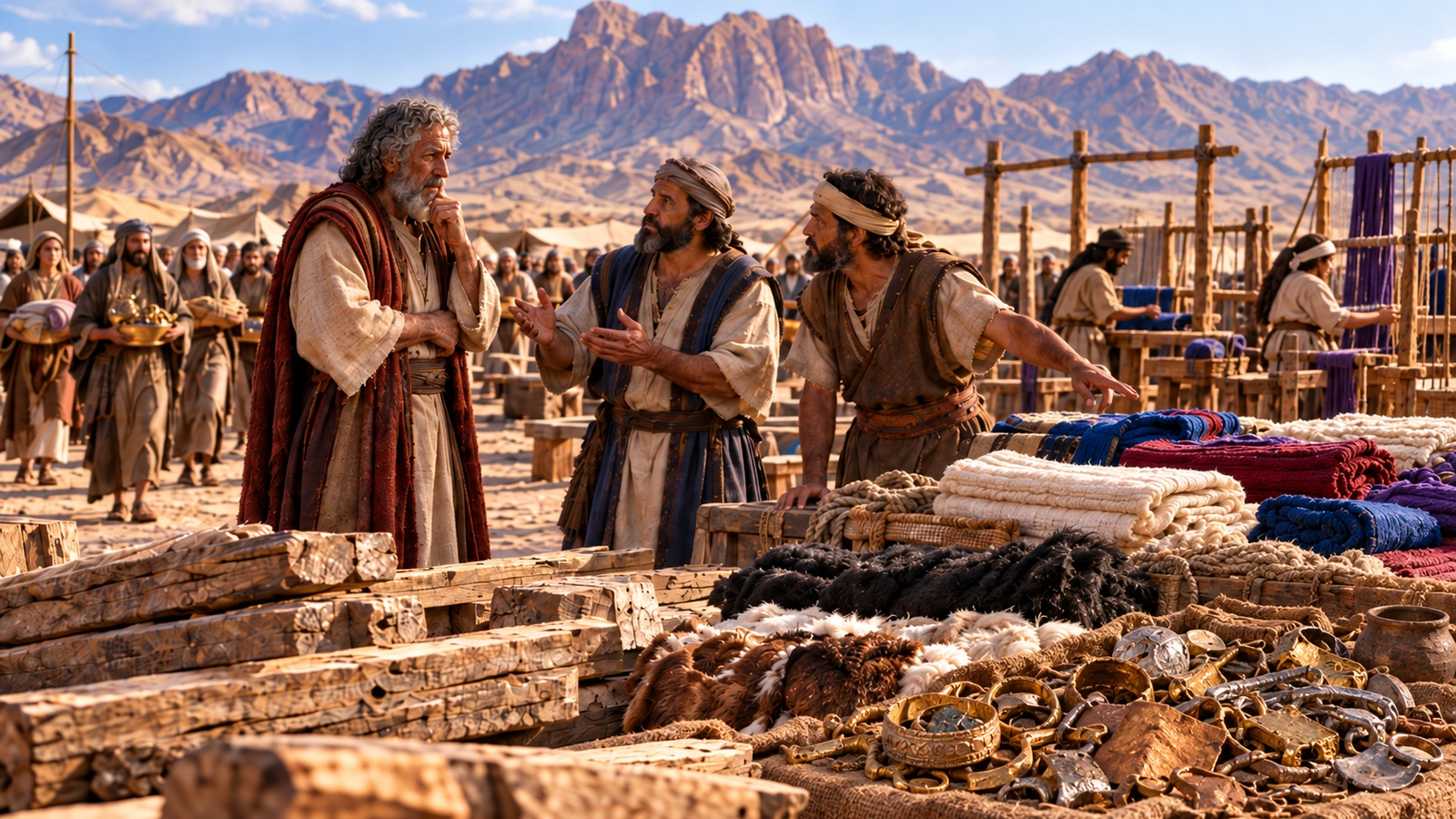
| Figure 1 — Moses refuses Pharaoh’s final condition as Egypt remains under the ninth plague, while Israel’s flocks and herds stand visible behind him, illustrating the demand that “not a hoof” be left behind. Source: AI-generated image created for Beyond The Known. |
Exodus 9 ended with Pharaoh saying something once almost unimaginable: “I have sinned.”
That confession was examined in Why Did Pharaoh Harden His Heart Again After Admitting He Had Sinned? Exodus 10 opens after his resistance returns.
Egypt is approaching economic catastrophe.
The hail has already damaged crops, livestock, trees, and exposed workers.
Now locusts threaten whatever survived.
Before they arrive, Pharaoh’s own officials issue their verdict:
“Do you not yet realize that Egypt is ruined?”
Exodus 10:7
The Hebrew is even sharper:
אָבְדָה מִצְרָיִם — ʾāḇĕḏāh miṣrayim
“Egypt has perished,” or “Egypt is ruined.”
This is the language of Pharaoh’s own administration.
Yet the king still refuses complete release.
Why?
Exodus 10 does not portray a ruler who simply says “no.”
He begins offering compromises.
Every proposal gives Israel something.
Each one also keeps something under Egyptian control.
That pattern reveals what Pharaoh still refuses to surrender.
Exodus 10 Changes the Question From Power to Humility
Moses and Aaron return with another demand.
This time, YHWH identifies Pharaoh’s resistance differently:
“How long will you refuse to humble yourself before me?”
Exodus 10:3
The Hebrew expression is:
לֵעָנֹת מִפָּנָי — lēʿānōṯ mippānay
“to humble yourself before me.”
The verb derives from ענה — ʿnh.
Here it appears in the Niphal and concerns submission or humbling.
That wording marks a development.
Pharaoh has already witnessed signs.
He has requested prayer.
Earlier chapters even preserve his confession of wrongdoing.
The question is no longer whether information has reached him.
It has.
Exodus now asks whether Egypt’s ruler will yield before another authority.
He will not.
The Locusts Will Eat What the Hail Spared
The eighth plague is announced with agricultural precision.
Locusts will cover the ground.
They will consume what escaped the hail.
Every remaining tree in the field is threatened.
That connection with Exodus 9 matters.
The judgments are not disconnected spectacles.
One disaster leaves something behind.
The next targets the remainder.
Egyptian agriculture depended heavily upon Nile-fed cultivation and seasonal crop cycles. Cereals formed a central part of food production.
Ancient Egyptian material culture also preserves insect imagery.
The Metropolitan Museum holds a New Kingdom scarab bearing a grasshopper or locust emblem. It dates roughly to 1550–1295 BCE.
Another possible locust-shaped amulet comes from an earlier Egyptian period.
Neither object verifies Exodus 10.
Archaeology provides context, not verification.
They simply confirm that such insects belonged within Egypt’s environmental and visual world.
The biblical scene requires no exotic setting.
Its terror comes from something agriculturally recognizable becoming uncontrollable.
Pharaoh’s Own Officials Finally Challenge Him
Before the insects arrive, something politically remarkable happens.
Royal servants speak against continued resistance.
They call Moses a מוֹקֵשׁ — môqēš, a snare.
Then comes their devastating assessment:
“Do you not yet know that Egypt is ruined?”
The officials are not debating whether the warnings matter.
Their concern is survival.
Pharaoh’s policy has become costly enough to provoke pressure inside his own court.
Yet we should not invent a political rebellion.
Exodus records an objection, not a coup.
Their intervention does produce one result.
Moses and Aaron are brought back.
For the first time in this chapter, Pharaoh appears ready to concede.
Then he asks one question:
“Who are the ones who will go?”
The negotiation begins.
Pharaoh’s First Compromise: Let the Men Go
Moses gives an expansive answer.
Young and old will leave.
Sons and daughters will go.
Flocks and herds will accompany them.
The reason is simple.
Israel will hold a feast for YHWH.
Pharaoh rejects those terms.
Only the men may depart.
That proposal deserves careful wording.
Exodus does not explicitly explain Pharaoh’s motive.
The text never says he retained families as “hostages.”
That interpretation is plausible, but still inferential.
What can be stated directly is stronger.
Pharaoh permits only part of Israel to leave.
Moses has demanded the departure of the whole community.
The difference is textual, not psychological.
One proposal divides the people.
The other includes generations, households, and livestock.
Pharaoh is still defining who may obey YHWH’s command.
The Plagues Are Becoming Israel’s Memory
Before the locust warning, Exodus briefly shifts away from Pharaoh.
YHWH explains why these events will be retold:
“That you may tell in the hearing of your son and grandson…”
Exodus 10:2
Future generations now enter the narrative.
The signs will outlive the ruler who resisted them.
A difficult Hebrew verb appears in the same verse:
הִתְעַלַּלְתִּי — hiṯʿallaltî
Translations vary sharply.
Some render it “dealt harshly.”
Others prefer “made a mockery of” or “made fools of.”
The Hitpael form comes from a root whose semantic range can include severe or humiliating treatment.
The variation should remain visible.
No single English gloss captures every nuance comfortably.
What the verse clearly states is the purpose of remembrance.
Israel will recount these acts so later generations know YHWH.
Pharaoh is no longer the only audience.
The Locusts Remove What Egypt Still Has
Moses stretches out his staff.
An east wind blows across Egypt.
By morning, locusts cover the country.
The narrative stresses their scale.
They consume the remaining vegetation.
Nothing green survives in the affected landscape.
Now Pharaoh summons Moses and Aaron quickly.
His words sound even stronger than before:
“I have sinned against the LORD your God and against you.”
Exodus 10:16
He also asks forgiveness.
Then comes a striking phrase:
“Forgive my sin only this once.”
Again, Exodus does not tell us he is consciously lying.
A responsible reading should not supply that motive.
What follows can be observed directly.
Moses intercedes.
A powerful west wind removes every locust.
Then Pharaoh still does not release Israel.
Exodus Explicitly Adds Divine Hardening
At this point, the article cannot describe Pharaoh’s behavior as human stubbornness alone.
Verse 20 says:
וַיְחַזֵּק יְהוָה אֶת־לֵב פַּרְעֹה — wayḥazzēq YHWH ʾeṯ-lēḇ parʿōh
YHWH “strengthened” or “hardened” Pharaoh’s heart.
The verb derives from חזק — ḥzq.
Agency is explicit.
YHWH is the grammatical subject.
That prevents an oversimplified explanation.
Pharaoh negotiates, threatens, confesses, and refuses.
Those actions belong to the narrative.
Yet Exodus also attributes his continued hardening to divine action.
The text places both realities together.
It does not offer a philosophical formula reconciling them.
Any interpretation should preserve that tension.
Darkness Changes the Negotiation Again
The ninth plague begins without another recorded audience with Pharaoh.
Moses stretches his hand toward the heavens.
Darkness falls across Egypt for three days.
Exodus uses unusually intense vocabulary:
חֹשֶׁךְ אֲפֵלָה — ḥōšeḵ ʾăp̄ēlāh
“darkness of gloom” or “thick darkness.”
Verse 21 also contains the difficult phrase:
וְיָמֵשׁ חֹשֶׁךְ — wĕyāmēš ḥōšeḵ
Many translations render this as darkness “that may be felt.”
Ancient interpreters already disagreed about the wording. Some connected it with tangible darkness. Others proposed different verbal explanations.
The uncertainty deserves preservation.
Exodus itself gives clearer effects.
Egyptians cannot see one another.
People do not rise from their places.
Israel, by contrast, has light in its dwellings.
That is enough for the narrative’s contrast.
Was the Darkness an Attack on Ra?
A popular interpretation identifies the ninth plague as a direct attack upon Ra.
Egyptian religion certainly attached immense significance to solar deities.
That historical background makes the darkness culturally provocative.
Yet Exodus 10 never names Ra.
It never says, “YHWH defeated the Egyptian sun god.”
Such a claim goes beyond the chapter.
The text instead emphasizes control over light, movement, geography, and Israel’s distinction.
Egypt is immobilized.
Israel has illumination.
That contrast carries the narrative without forcing a deity-by-deity plague chart.
Pharaoh’s Second Compromise Is Much Larger
After three days, the ruler calls Moses again.
His new offer goes further:
“Go, serve the LORD.”
This time the dependents may leave too.
The earlier restriction has disappeared.
One condition remains.
Flocks and herds must stay.
The negotiation has moved significantly.
Pharaoh is willing to release the human community.
He still attempts to retain Israel’s livestock.
Moses refuses immediately.
His response becomes the defining line of Exodus 10:
“Not a hoof shall be left behind.”
Exodus 10:26
The Hebrew noun is:
פַּרְסָה — parsāh
“hoof.”
The singular works metonymically for the animals themselves.
Nothing belonging to Israel’s livestock will remain.
Then Moses explains why.
“We Do Not Know With What We Must Serve YHWH”
Moses does not claim complete knowledge of the coming ritual.
He says the opposite:
“We do not know with what we must serve the LORD until we arrive there.”
That admission matters.
The verb for service is built from עבד — ʿbd.
This root can describe labor, service, or worship depending upon context.
Exodus has built its conflict around that semantic field.
Israel has served Pharaoh under bondage.
Now YHWH commands that His people leave to serve Him.
The same broad vocabulary makes the confrontation sharper.
Who determines Israel’s service?
Pharaoh still attempts to define its limits.
Moses refuses that authority.
The livestock must travel because Pharaoh cannot determine Israel’s future worship requirements.
That is what “not a hoof” means within the immediate context.
It is not merely dramatic rhetoric.
The animals are required because their use has not yet been specified.
The Compromises Reveal What Has Not Changed
Pharaoh’s offers have expanded across the plague narrative.
Worship inside Egypt.
Travel, but not very far.
Men may go.
Families may go, but livestock must remain.
Each concession moves closer to the command.
None fully accepts it.
That pattern explains why Exodus 10 feels different from earlier confrontations.
The king is no longer refusing every request.
He is negotiating the boundaries of compliance.
This is why the old article’s central insight remains sound: his concessions grow while his claim to set conditions survives.
Yet one qualification is necessary.
The narrative does not reduce everything to Pharaoh’s desire for control.
Verses 20 and 27 explicitly attribute heart-strengthening to YHWH.
Human negotiation and divine hardening remain side by side.
After Darkness, YHWH Hardens Pharaoh Again
Moses rejects the livestock condition.
Immediately afterward, Exodus repeats its theological statement:
“The LORD hardened Pharaoh’s heart.”
Again the Hebrew uses חזק — ḥzq.
The king becomes unwilling to release them.
Then negotiation gives way to threat.
Pharaoh orders Moses away.
Seeing his face again will mean death.
Moses answers:
“As you say. I will not see your face again.”
The chapter closes with negotiations exhausted.
No agreement has been reached.
Israel remains in Egypt.
Yet Pharaoh has run out of compromises.
So Why Did Pharaoh Refuse After Egypt Was Ruined?
Exodus gives no single psychological diagnosis.
“Pride” may describe part of the picture.
“Stubbornness” is also too small by itself.
The chapter provides several concrete answers.
First, Pharaoh never accepts the complete command.
He repeatedly substitutes narrower terms.
Second, his administration sees national disaster before he yields.
The phrase “Egypt is ruined” comes from his own servants.
Third, temporary confession still does not become release.
The locust crisis produces another admission of sin.
Removal is followed by continued resistance.
Finally, Exodus says YHWH strengthens Pharaoh’s heart.
That statement cannot be deleted to simplify the story.
The result is a deliberate tension.
Pharaoh acts as a responsible royal agent.
Divine purpose simultaneously governs the confrontation.
Exodus preserves both.
The Deeper Discovery
Exodus 10:2 contains a lexical detail whose importance appears much later.
YHWH says Israel will recount how He hiṯʿallaltî with Egypt.
That unusual verb does not disappear from biblical memory.
In 1 Samuel 6, Philistine priests discuss another crisis involving Israel’s God.
They warn:
“Why should you harden your hearts as the Egyptians and Pharaoh hardened their hearts?”
Then the passage recalls what happened when God dealt severely with Egypt.
The Hebrew uses the same root:
הִתְעַלֵּל — hiṯʿallēl.
The connection is remarkable.
Exodus 10 says these events will become a story told afterward.
1 Samuel later shows outsiders invoking that very story.
Even the vocabulary of severe treatment returns.
More strikingly, so does the warning about hardened hearts.
The memory promised in Exodus 10 has become a cautionary example.
Pharaoh’s resistance did not remain inside Egypt.
Later characters can look backward and ask:
Why repeat his mistake?
That is precisely what Exodus 10:2 anticipates.
The plague story becomes remembered theology.
FAQ
Was Egypt literally completely destroyed in Exodus 10?
No. Pharaoh’s officials say Egypt is “ruined” in verse 7.
The phrase expresses devastating national conditions, not the disappearance of the country.
Why did Pharaoh allow only the men to leave?
Exodus does not state his private motive.
What it clearly records is a partial permission that excludes the whole community.
Why did Moses insist that every animal go?
Israel did not yet know what worship would require.
Moses therefore refused to leave even one parsāh, or hoof, behind.
Did Pharaoh confess again during the locust plague?
Yes. He says he sinned against YHWH and against Moses and Aaron.
He asks them to forgive him and seek removal of the plague.
Was the darkness definitely supernatural “tangible darkness”?
Exodus describes extraordinary darkness, but wĕyāmēš ḥōšeḵ is linguistically debated.
Claims about its physical substance go beyond what can be established securely.
Was the darkness specifically an attack against Ra?
The chapter never says so.
Egyptian solar religion provides context, but Exodus names no solar deity here.
Did Pharaoh harden his own heart in Exodus 10?
Exodus 10:20 and 10:27 explicitly say YHWH strengthened Pharaoh’s heart.
That divine agency must remain part of any responsible reading.
When Negotiation Finally Ends
By the end of Exodus 10, almost every bargaining position has collapsed.
Pharaoh has offered partial departure, full family departure, and restricted livestock.
Moses accepts none.
Freedom will not occur through a compromise between competing rulers.
Then Pharaoh ends the audience itself.
He threatens Moses with death.
That leaves no further room for negotiation.
Exodus 11 will introduce something far more severe.
Moses will announce one final judgment.
This time, the question will no longer concern frogs, crops, darkness, or livestock.
It will concern every Egyptian household.
And that raises the hardest question yet:
Why Did God Kill the Firstborn in Egypt?
Selected Sources
Brevard S. Childs, The Book of Exodus: A Critical, Theological Commentary.
William H. C. Propp, Exodus 1–18: A New Translation with Introduction and Commentary.
Nahum M. Sarna, Exodus. JPS Torah Commentary.
John I. Durham, Exodus. Word Biblical Commentary.
HALOT, Hebrew lexical resource.
The Metropolitan Museum of Art, Egyptian grasshopper and locust objects.
UCL Digital Egypt, ancient Egyptian food production and agricultural cycles.