Why Did God Wait Before Destroying Sodom?
The Judgment That Followed Investigation, Intercession, and Rescue
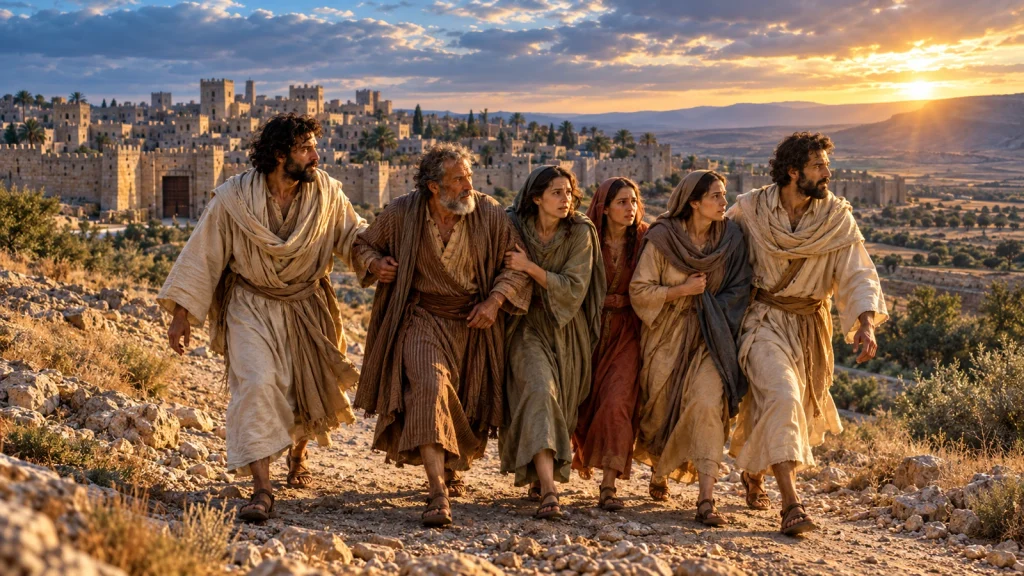
Source: AI-generated image created for Beyond The Known.
After God gave Abram the covenant name Abraham in Why Did God Change Abram’s Name to Abraham?, Genesis immediately shows what that calling involves. Abraham is not only promised nations and kings; he is brought into a conversation about the justice of the “Judge of all the earth.”
The destruction of Sodom does not begin when its sin is first mentioned, when its outcry reaches God, or even when judgment is announced. Genesis 18–19 places several events before the fire: God describes an investigation, allows Abraham to intercede, sends messengers into the city, warns Lot’s household, physically removes Lot when he hesitates, and postpones the overthrow until he reaches Zoar.
Why does God wait?
The shortest answer is that Genesis portrays divine judgment as deliberate rather than impulsive. The narrative distinguishes the righteous from the wicked, permits an appeal based on justice, and completes Lot’s removal from the city before destruction begins.
The text does not say that God required additional time to discover information in the way a limited human investigator would. Nor does it say that Lot was rescued because Genesis considered him morally exemplary. What it explicitly emphasizes is investigation, Abraham’s intercession, the LORD’s compassion toward Lot, and the timing of Lot’s arrival in Zoar.
The Delay Begins Before Genesis 19
The Outcry Comes Before the Descent
Genesis has already characterized the people of Sodom as exceedingly wicked in chapter 13. Nevertheless, when Sodom reenters the story in Genesis 18, judgment is not portrayed as immediate.
The LORD says:
“The outcry against Sodom and Gomorrah is so great and their sin so grievous.”
Genesis 18:20, NIV
The word translated “outcry” is זְעָקָה — zəʿāqâ. Elsewhere in the Hebrew Bible, related forms frequently describe a cry produced by suffering, oppression, or a demand for justice. Genesis does not identify the people whose outcry has risen, but the term gives the scene the atmosphere of a judicial complaint rather than divine irritation over a minor offense.
God then says that he will “go down” and see whether the cities’ conduct corresponds to the outcry. The wording echoes the Tower of Babel, where the LORD descends to see the city and tower before intervening.
From a later systematic theological perspective, readers may ask why an omniscient God would need to investigate. Genesis does not pause to resolve that philosophical question. At the level of the narrative, the descent communicates examination: the sentence follows scrutiny rather than rumor alone.
The story therefore begins answering the question before Lot ever meets the messengers. God waits because Genesis wants readers to see judgment preceded by inquiry.
Why Is Abraham Told?
As the visitors turn toward Sodom, the LORD asks whether he should conceal from Abraham what he is about to do.
The reason given reaches back to Abraham’s covenant calling. He is to direct his household to keep the way of the LORD by doing righteousness and justice. Immediately afterward, Abraham must reason about those very qualities in relation to Sodom.
He asks:
“Will you sweep away the righteous with the wicked? … Will not the Judge of all the earth do right?”
Genesis 18:23, 25, NIV
Abraham begins with fifty righteous people and gradually reduces the number to ten. The conversation is often described as bargaining, but scholars disagree about its precise rhetorical form. Edward Bridge, for example, argues that Abraham’s repeated, carefully softened requests function less like ordinary marketplace haggling than an audacious appeal expressed with elaborate politeness.
Whatever label is used, the central issue is explicit. Abraham asks whether the presence of righteous people should prevent the destruction of the entire city. At every stage, God agrees to spare it if the proposed number can be found.
The narrative does not portray Abraham persuading God to ignore wickedness. He appeals to God’s own justice by questioning whether the innocent and guilty should receive the same fate.
Did Abraham Change God’s Mind?
Genesis never says that God had made an irreversible decision and then reversed it under pressure. The conversation begins before the destruction and establishes the condition under which the city would be spared.
Abraham stops at ten. The text does not explain why he stops there, and it does not present a final declaration that fewer than ten could never be rescued. Genesis 19 will show a different outcome: the city is not spared, but particular people are removed from it.
Some scholars, including Bridge, propose that Lot’s rescue was Abraham’s unstated concern throughout the dialogue. That is a plausible literary interpretation because Lot connects Abraham to Sodom, but Abraham never mentions his nephew by name. It should therefore remain an interpretation rather than an explicit motive assigned to him.
Why Does Judgment Wait for Lot?
The Visit Confirms the Crisis
Two messengers arrive in Sodom at evening. Lot welcomes them into his house, but the men of the city surround it and demand access to the visitors.
The episode depicts threatened collective violence and a catastrophic violation of the protection owed to guests. Debates about “the sin of Sodom” have often isolated one dimension of the scene, but Genesis 18–19 presents a broader collapse involving grave wickedness, violent domination, and hostility toward vulnerable outsiders.
Later biblical texts add their own perspectives. Ezekiel 16:49–50 identifies pride, excess, neglect of the poor, and abominable conduct; 2 Peter 2 describes Lot as righteous. Those are later canonical interpretations. Genesis itself does not provide a single exhaustive catalogue of Sodom’s sins, nor does it explicitly call Lot righteous.
The messengers tell Lot that the outcry has become great before the LORD and that they have been sent to destroy the city. Lot warns his prospective sons-in-law, but they think he is joking.
By dawn, the time for persuasion has ended. Yet even then, destruction does not begin immediately.
Lot Lingers, and the Messengers Take His Hand
The messengers urge Lot to take his wife and two daughters out of the city. Genesis then records an uncomfortable detail:
“When he hesitated, the men grasped his hand and the hands of his wife and of his two daughters and led them safely out of the city, for the LORD was merciful to them.”
Genesis 19:16, NIV
Lot is not pictured leading a heroic escape. He hesitates until the messengers take hold of all four family members and bring them outside.
The narrative supplies the reason for this intervention: the LORD’s compassion was upon him. The Hebrew uses חֶמְלָה — ḥemlâ, a term associated with sparing or showing compassion.
Calling the action mercy is therefore not merely a later theological judgment; it reflects the narrator’s own explanation. Yet the mercy is forceful. Lot is rescued despite his delay, not because he responds quickly.
The messengers command the family not to look back or stop anywhere in the plain. They are to flee to the mountains. Lot objects that he may not survive there and asks permission to escape to a small nearby town instead.
Who Says, “I Cannot Do Anything”?
The reply is given in the singular:
“Very well, I will grant this request too; I will not overthrow the town you speak of. But flee there quickly, because I cannot do anything until you reach it.”
Genesis 19:21–22, NIV
The identity of the singular speaker is not perfectly transparent. Genesis 19 introduced two angels, but after “they” bring the family outside, the narration shifts to “he said.” Many readers understand one of the two messengers to be speaking with delegated divine authority. Others see the speech as the divine voice mediated through the messenger.
What should not be done is silently replace the speaker with God and then build a doctrine from the words “I cannot.” At the narrative level, the statement means that the commissioned overthrow will not proceed until Lot reaches the approved destination.
The Hebrew is emphatic: “I am not able to do a thing until you arrive there.” It establishes a genuine narrative limit, but one created by the commitment to remove Lot—not evidence that God lacks the power to judge the city.
The next verse marks Lot’s arrival in Zoar. Only then does the LORD rain sulfur and fire upon Sodom and Gomorrah.
- The sequence is exact:
Lot enters Zoar.
The judgment begins.
This is the strongest textual answer to the article’s question. Destruction waits because the rescue mission has not yet reached the destination authorized by the messenger.
Was the Rescue Completely Finished?
The phrase “rescue was completed before judgment” needs qualification. Lot, his wife, and his daughters have been removed from Sodom, and Lot reaches Zoar before the overthrow begins. But Genesis soon records that Lot’s wife looks back and becomes a pillar of salt.
The story therefore does not end with every person who left the city safely beginning a new life. Lot’s prospective sons-in-law remain behind, his wife does not survive the episode, and the final scene involving Lot and his daughters is deeply troubling.
What the narrative specifically protects before the fire falls is Lot’s removal to the designated refuge. “Complete rescue” would be too broad a description of everything that follows.
Why Was Lot Spared?
Compassion Is Explicit
Genesis offers more than one answer without reducing them to a formula.
First, the messengers physically remove the family because of the LORD’s compassion. That is the explicit explanation in Genesis 19:16.
Second, the structure answers Abraham’s concern about destroying the righteous with the wicked. The city is judged, but Lot is separated from its fate. This connection is a strong narrative inference even though Genesis does not directly label Lot “the righteous man.”
Third, the chapter ends its account of the destruction with an important summary:
“God remembered Abraham, and he brought Lot out of the catastrophe that overthrew the cities where Lot had lived.”
Genesis 19:29, NIV
In biblical narrative, divine “remembering” does not usually mean that God had forgotten and suddenly recalled a fact. It describes God acting with regard to a person, promise, or relationship. The same pattern will appear when God “remembers” Noah in Genesis 8:1.
Genesis 19:29 deliberately brings Abraham back into the story. He stood before God and appealed for justice in chapter 18; after the destruction, the narrator connects Lot’s removal with God remembering Abraham.
Michael Ndele’s narrative analysis highlights this framing: Abraham accompanies the visitors toward Sodom, returns to view the aftermath, and is named in the final explanation of Lot’s deliverance. The Sodom episode cannot be fully understood as an isolated adventure about Lot.
Justice and Mercy Are Not Presented as Opposites
Genesis does not resolve the tension by declaring Sodom innocent. The city’s outcry is investigated, its violence is exposed, and it is destroyed.
Nor does the narrative portray mercy as indiscriminate cancellation of every consequence. Lot is removed, Zoar is spared at his request, and the judgment still proceeds.
Thomas Bolin argues that Genesis 18–19 explores both divine justice and the possibility of mercy. That combination helps explain the narrative’s deliberate pacing. The delay creates space for moral examination, intercession, warning, and compassionate removal without denying the final judgment.
The Seven Days In Collection
WITHHELD
A Seven-Day Guided Study of Genesis 18–19
Why Judgment Waited — Justice, Mercy, and the Rescue of Lot
Move beyond the familiar account of Sodom and follow the complete narrative: investigation, Abraham’s intercession, warning, compassionate removal, arrival at Zoar, judgment, loss, and remembrance.
- 50 professionally designed pages
- Seven days of focused study
- Fillable and printable PDF editions
- Daily Scripture observation
- Hebrew terms and textual insights
- Reflection and note fields
Instant digital download · Fillable and print-friendly PDFs · Personal-use license
The Deeper Discovery
The question first appears to be about time: Why did God not destroy Sodom immediately?
Genesis answers by showing what happens within the interval.
The outcry is examined. Abraham is allowed to challenge the possibility of sweeping away the righteous with the wicked. Messengers enter the city, expose its violence, warn Lot’s household, and grasp the hands of those who hesitate. The overthrow does not begin until Lot reaches Zoar.
The deeper discovery is that the delay is part of the judgment’s meaning. Genesis wants readers to see not only that Sodom is destroyed, but that the destruction follows investigation and that Lot’s removal occurs through compassion and in connection with Abraham.
This does not make every feature of the chapter comfortable. Lot is morally compromised, his wife is lost, and the family story that follows is disturbing. Mercy in Genesis 19 does not turn the episode into a simple rescue tale.
It does, however, prevent the fire from becoming the chapter’s only theological image. Before the cities fall, the Judge of all the earth listens, distinguishes, warns, and removes.
Genesis then leaves the ruins behind and moves to Gerar. There, Abimelech takes Sarah into his household without knowing that she is Abraham’s wife. Before he touches her, God intervenes in a dream and stops him.
That creates the next question in the story:
Why Did God Stop Abimelech Before He Touched Sarah?
Selected Sources
- Bolin, Thomas M. “The Role of Exchange in Ancient Mediterranean Religion and Its Implications for Reading Genesis 18–19.” Journal for the Study of the Old Testament 29.1 (2004), pp. 37–56. DOI: 10.1177/030908920402900102.
- Bridge, Edward. “An Audacious Request: Abraham’s Dialogue with God in Genesis 18.” Journal for the Study of the Old Testament 40.3 (2016), pp. 281–296. DOI: 10.1177/0309089216637143.
- Hamilton, Victor P. The Book of Genesis: Chapters 18–50. New International Commentary on the Old Testament. Eerdmans, 1995.
- Irvine, Stuart A. “‘Is Anything Too Hard for Yahweh?’: Fulfillment of Promise and Threat in Genesis 18–19.” Journal for the Study of the Old Testament 42.3 (2018), pp. 285–302. DOI: 10.1177/0309089216690381.
- Mathews, Kenneth A. Genesis 11:27–50:26. New American Commentary 1B. Broadman & Holman, 2005.
- Ndele, Michael. “The Narrative Significance of the Role of Abraham in the Identity of the Visitors in Genesis 18–19.” Old Testament Essays 36.3 (2023), pp. 709–735. DOI: 10.17159/2312-3621/2023/v36n3a9.
- Sarna, Nahum M. Genesis. JPS Torah Commentary. Jewish Publication Society, 1989.
- Wenham, Gordon J. Genesis 16–50. Word Biblical Commentary 2. Word Books, 1994.