Why Did the Tabernacle Need Curtains, Veils, and Sacred Boundaries?
Exodus 26 Explained: Layered Coverings, Cherubim, Wooden Frames, the Veil, and the Architecture of Holiness
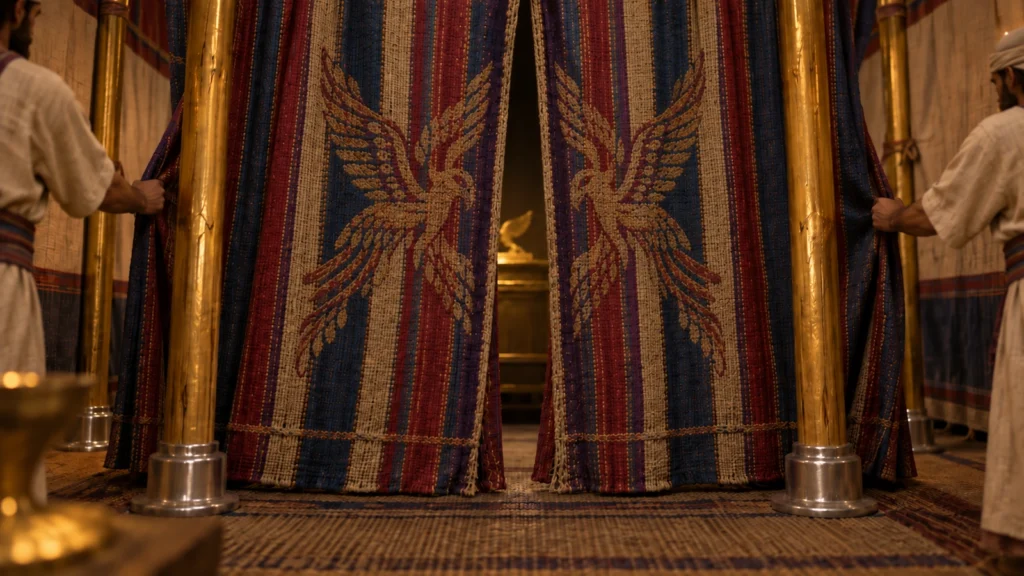
Source: AI-generated image created for Beyond The Known.
Exodus 25 ended with a remarkable promise.
YHWH intended to dwell among Israel.
The previous study, Why Did God Ask Israel to Build Him a Sanctuary?, explored the ark, the table, the menorah, and the sacred center that would accompany the people beyond Sinai.
Then Exodus 26 begins building walls around that presence.
Curtains are joined together. Layers are placed over them. Wooden supports rise beneath the fabric. Finally, a veil divides the interior and hides the ark inside the innermost chamber.
That creates an immediate tension.
If God wants to dwell among Israel, why surround the place of encounter with barriers?
Why bring divine presence closer to the people and then conceal its center?
Exodus 26 answers through architecture.
The sanctuary makes nearness possible without making holiness ordinary.
The Tabernacle Begins with Its Interior
The chapter does not begin with an exterior wall.
It begins with ten curtains of finely twisted linen, made with blue, purple, and scarlet yarn and decorated with cherubim.
Their dimensions are carefully specified.
Five curtains form one set.
Five form another.
Loops line their edges, and fifty golden clasps connect the two sections.
Only after describing this elaborate inner textile does the instruction move outward toward goat hair, protective skins, wooden supports, and crossbars.
The sequence is revealing.
Exodus begins with the space closest to the sacred furnishings and works toward the exterior.
The dwelling is conceived from its interior outward.
Mishkan and Ohel: Dwelling and Tent
English translations often use “tabernacle” and “tent” in ways that blur a distinction visible in Exodus 26.
The richly woven inner curtains form the:
מִשְׁכָּן — miškan — dwelling / tabernacle
The goat-hair layer placed above them is described as an:
אֹהֶל — ʾōhel — tent
Verse 7 speaks of the goat-hair material as a tent over the dwelling.
The terminology helps clarify the structure.
The miškan is the sacred dwelling formed by the decorated inner textile and its supporting framework.
The ʾōhel provides an additional covering above it.
The distinction should not be forced everywhere those words appear, but in this section the arrangement is deliberate.
Israel is not simply erecting an ordinary tent and furnishing it with sacred objects.
Layers define the building from the beginning.
Why Were So Many Coverings Necessary?
The innermost textile is the most elaborate.
Fine linen.
Blue, purple, and scarlet yarn.
Cherubim.
Above it comes goat hair.
Then verse 14 adds ram skins colored red and another outer covering made from skins identified by the difficult Hebrew term:
תְּחָשִׁים — təḥāšîm
The precise material remains uncertain.
Translations and interpreters have proposed different kinds of leather or animal skin, but the Hebrew does not permit a confident modern identification.
That uncertainty does not prevent us from seeing the architectural logic.
The richly decorated textile belongs to the interior.
More durable materials protect it from the outside.
This is sacred craftsmanship designed for a mobile people.
The dwelling must survive exposure, dismantling, transport, and reassembly without losing the distinction of its inner space.
The Richest Fabric Was Not Made for Public Display
One of the most striking features of the design is easy to overlook.
The cherubim woven into the fine linen were not primarily exterior decoration.
They belonged within the sacred structure.
Someone approaching the tabernacle from the camp would encounter its protective layers rather than an architectural façade designed to impress from a distance.
The visual richness intensifies inward.
That pattern becomes even clearer when the metals are considered.
Gold appears prominently in the inner construction and furnishings. Bronze becomes more prominent as the instructions move toward more external areas. Scholars have long noticed a broader gradation of materials according to proximity to the sanctuary’s sacred center.
The chapter never supplies a symbolic code explaining every metal.
Still, the spatial pattern is difficult to miss.
Sacred value is expressed not only through what is built, but also through where particular materials belong.
What Did the Cherubim on the Curtains Look Like?
Exodus tells us that cherubim were worked into the inner curtains.
It does not provide a complete anatomical description.
That restraint matters.
The small winged children of later European art should not be projected backward into the biblical scene.
Ancient Near Eastern visual culture included various winged composite beings associated with sacred and royal settings, giving us a broader cultural context for such imagery.
But parallels cannot reconstruct the exact form of Israel’s cherubim.
The passage is more specific about craftsmanship than anatomy.
The curtains are described as:
מַעֲשֵׂה חֹשֵׁב — maʿăśēh ḥōšēb
The expression refers to specialized artistic textile work.
Judith Lapkin Craig has argued that the terminology reflects a technically sophisticated weaving tradition rather than a vague reference to decoration.
What we can say with confidence is simpler.
The cherubim were not added casually.
They belonged to the carefully designed visual environment of the sacred interior.
Many Curtains Become One Dwelling
The repeated measurements and loops can sound purely technical until the narrator tells us what all that joining accomplishes.
Once the two groups of linen curtains are connected with golden clasps:
“the dwelling shall be one.”
The Hebrew is:
וְהָיָה הַמִּשְׁכָּן אֶחָד — wəhāyâ hammiškan ʾeḥād
The same idea appears when the goat-hair curtains are joined.
Multiple components form a single structure.
That detail fits the tabernacle’s mobility.
The dwelling can be dismantled because it consists of separate pieces.
Yet when assembled, those pieces are not treated as a collection of unrelated parts.
They become one.
The instructions combine portability with structural unity.
Gold Inside, Bronze Farther Out
The fine linen curtains are joined with gold clasps.
The goat-hair covering uses bronze.
Again, Exodus does not interpret the contrast for us.
It would be too much to claim that each metal possesses a fixed theological meaning.
But location and material repeatedly correspond.
The closer the design moves toward the sacred center, the more prominent gold becomes.
As the structure extends outward, less costly metals appear more frequently.
The architecture teaches through gradation.
Not every part of sacred space is treated identically.
The Dwelling Needs a Skeleton
Verse 15 changes materials.
Fabric gives way to acacia wood.
The Hebrew calls the upright elements:
קְרָשִׁים — qərāšîm
Traditional translations often call them “boards.”
Others prefer “frames.”
The precise engineering remains debated because the ancient terminology does not give modern builders every detail required for a single unquestionable reconstruction.
What the passage does specify is substantial.
The upright units have defined dimensions.
They contain paired projections or tenons.
They stand in silver sockets.
Crossbars stabilize the sides.
A central bar extends from one end to the other.
Gold covers the wooden elements and their rings.
The sacred dwelling is not imagined as fabric loosely draped over poles.
It is a carefully constructed portable system.
Holiness Does Not Eliminate Engineering
The technical precision serves an important purpose.
Exodus describes sacred architecture, but it never treats practical construction as spiritually irrelevant.
Weight must be supported.
Sections must align.
Curtains need tension.
Connections must survive movement.
The tabernacle belongs to a people who will travel.
Its theology does not float above material reality.
Wood, metal, fabric, measurements, sockets, clasps, and bars all participate in the project.
The dwelling is holy precisely as something built in the physical world.
Moses Must Follow What He Saw on Sinai
After the framework has been described, verse 30 returns to the mountain.
Moses must erect the tabernacle according to what was shown to him there.
The word used in this verse is:
מִשְׁפָּט — mišpāṭ
The noun often means “judgment,” “ordinance,” or “prescribed order.”
Here it refers to the divinely disclosed arrangement or specification for the dwelling.
Exodus 25 used tabnît, “pattern” or “model.”
The vocabulary is not identical, but the emphasis is consistent.
Moses is not given a general religious concept and told to improvise the architecture.
The design is presented as revealed.
The mountain from which YHWH currently speaks supplies the pattern for the sacred structure that will accompany Israel after they leave it.
Then the Architecture Creates a Boundary
Verse 31 introduces a new textile.
It resembles the inner curtains in color and craftsmanship.
Blue.
Purple.
Scarlet.
Fine twisted linen.
Cherubim.
But its function is different.
This is the:
פָּרֹכֶת — pārōḵeṯ — veil / sacred curtain
It hangs from four acacia pillars overlaid with gold.
And for the first time, the narrative explicitly tells us that a curtain exists to divide sacred space.
The Veil Separates Holy from Most Holy
Verse 33 explains its function:
וְהִבְדִּילָה הַפָּרֹכֶת לָכֶם בֵּין הַקֹּדֶשׁ וּבֵין קֹדֶשׁ הַקֳּדָשִׁים
The veil separates:
הַקֹּדֶשׁ — haqqōdeš — the Holy Place
from:
קֹדֶשׁ הַקֳּדָשִׁים — qōdeš haqqŏdāšîm — the Most Holy Place / Holy of Holies
The Hebrew construction intensifies holiness.
The inner chamber is not contrasted with something secular.
Both sides of the curtain belong to sacred space.
One zone, however, is set apart more strictly than the other.
The veil therefore does more than hide something from sight.
It creates a distinction within holiness itself.
The verb used for that separation belongs to the semantic world of distinguishing one category or realm from another.
Why Is the Ark Hidden Behind the Veil?
The ark is placed within the Most Holy Place.
The kappōret rests above it.
Outside the veil stand the table and the menorah.
That arrangement gives architectural form to the theology already introduced in Exodus 25.
YHWH had promised to meet Moses and speak from above the kappōret, between the cherubim.
Now the location associated with that encounter receives the strictest spatial boundary in the dwelling.
The ark is not displayed near the entrance.
It does not function as a public religious centerpiece visible to everyone who approaches.
It is concealed.
The closer one comes to the focal point of divine presence, the less ordinary access becomes.
Why Dwell Among Israel and Still Remain Hidden?
This is where the chapter’s architecture begins to answer its central question.
Divine presence and unrestricted access are not the same thing.
YHWH can dwell among Israel without becoming common property.
The tabernacle brings the sacred center closer to the camp, but it does not dissolve the distinction between God and the community.
Distance is transformed rather than abolished.
At Sinai, boundaries surrounded an entire mountain.
In the tabernacle, those boundaries become portable.
The mountain’s geography is translated into sacred architecture.
There is approach.
Then greater restriction.
Then an innermost space.
Presence has moved nearer.
Holiness continues to govern how near someone may come.
The Parokhet Was Architecture, Not Decoration
Sacred curtains were not unique to the biblical imagination.
Textual and archaeological evidence from the wider ancient Near East shows that curtains could mark or conceal sacred interiors, including in contexts involving portable shrines.
Madeleine Mumcuoglu and Yosef Garfinkel have surveyed evidence for such curtains across several ancient cultural settings.
Those parallels provide context.
They do not prove that Exodus copied a particular shrine or ritual arrangement.
Nor do they verify the wilderness tabernacle archaeologically.
They show that using textiles as meaningful architectural boundaries belonged to a recognizable ancient sacred world.
The veil is not a decorative accessory added to an otherwise complete room.
It makes the inner room what it is.
Why Are Cherubim on the Veil?
Cherubim now appear in three closely related settings.
They stand over the ark in Exodus 25.
They appear in the inner curtains.
They are also worked into the veil marking the entrance to the Most Holy Place.
Exodus does not explicitly interpret that repetition.
A later reader may naturally remember Genesis 3:24, where cherubim appear in connection with guarded access to the way to the Tree of Life.
That canonical echo is intriguing.
It should remain an echo.
Exodus 26 never tells us that the veil reenacts Eden or that its cherubim serve exactly the same function as those in Genesis.
What the chapter itself makes unmistakable is that cherubic imagery clusters around the sanctuary’s most restricted visual and spatial zones.
The Entrance Screen Is Different from the Veil
The chapter ends with another curtain.
But Exodus gives it a different name:
מָסָךְ — māsāḵ — screen / hanging
This screen marks the entrance to the tent.
Its materials resemble those used for the inner veil: blue, purple, scarlet, and fine linen.
The workmanship, however, is described differently.
The pārōḵeṯ uses:
מַעֲשֵׂה חֹשֵׁב — maʿăśēh ḥōšēb
while the entrance screen uses:
מַעֲשֵׂה רֹקֵם — maʿăśēh rōqēm
a term associated with embroidery or variegated needlework.
The inner veil also contains cherubim.
The entrance screen does not mention them.
The two curtains therefore resemble one another without being interchangeable. The biblical description intentionally distinguishes the entrance screen from the pārōḵeṯ.
There is an entrance boundary.
Then there is a deeper one.
Sacred Space Is Organized by Degrees
By the end of Exodus 26, the interior has acquired a clear hierarchy.
The entrance screen marks access to the tent.
Inside lies the Holy Place.
The table stands on one side.
The menorah stands opposite it.
Farther in, another curtain interrupts movement.
Beyond that veil lies the Most Holy Place.
There stands the ark.
Above it is the kappōret.
And there YHWH has promised to meet and speak.
The layout pulls attention inward while making physical approach increasingly restricted.
The architecture directs the reader toward the center without pretending that everyone may enter it.
Can Archaeology Reconstruct the Tabernacle Exactly?
No.
Portable textile structures leave a different archaeological signature from monumental stone buildings, and the historical development of Exodus 25–40 remains debated.
Historical-critical scholars commonly associate the tabernacle instructions with priestly traditions and ask how the description relates to Israel’s later sanctuary institutions.
Other studies have emphasized ancient evidence for mobile shrines and sacred tents, arguing that portability itself is not historically implausible.
Frank Moore Cross’s early archaeological study became influential in that discussion by comparing the biblical description with sacred structures and architectural traditions from the wider ancient Near East.
Those comparisons illuminate possibilities.
They do not produce certainty.
Archaeology can help us understand materials, construction practices, textiles, sacred boundaries, and cultural environment.
It cannot recover Exodus 26 as a photograph.
Later Christian Interpretation of the Veil
The veil becomes important again in later Christian texts.
The Synoptic Gospels describe the temple curtain tearing at Jesus’ death.
Hebrews develops sanctuary and veil imagery in its discussion of access to God.
Those passages profoundly shaped Christian interpretation of the tabernacle.
But they come later.
Exodus 26 itself does not say that the veil represents Christ, predicts its own removal, or serves as an explicit symbol of human sin.
Its immediate function is architectural and cultic.
It separates the Holy Place from the Most Holy Place.
Understanding that original role first makes later canonical reuse more precise rather than less theological.
The Deeper Discovery
One of the most revealing patterns in Exodus 26 is hidden in two opposite actions.
First, the chapter keeps joining things.
Five curtains are joined to five.
Golden clasps turn them into:
“one dwelling.”
Goat-hair curtains are connected in the same way until the tent also becomes:
“one.”
Piece after piece is assembled into unity.
Then the veil appears.
Its stated function is to:
בָּדַל — bādal — separate / distinguish
The same structure that must become one also requires an internal division.
That is not a contradiction in the design.
It is the design.
The tabernacle cannot function as a pile of disconnected sacred objects.
It must be one dwelling.
Yet unity does not mean that every location inside it has the same status.
Exodus 26 therefore places two architectural principles side by side:
joining and separating.
Many pieces become one sacred house.
Within that house, holiness still creates distinctions.
That observation reaches beyond construction technique.
YHWH intends to dwell among Israel, bringing divine presence into the center of the community.
But relationship does not erase difference.
The sanctuary comes closer to the people.
Its veil prevents “closer” from becoming “common.”
FAQ
Why did the tabernacle need several layers of curtains?
The coverings served different roles. Fine linen formed the richly decorated sacred interior, while goat hair and additional skins provided outer protection for a structure designed to travel through the wilderness.
What was the veil in Exodus 26?
The Hebrew pārōḵeṯ was the special curtain separating the Holy Place from the Most Holy Place. The ark was positioned behind it.
Why was the Ark of the Covenant hidden?
The ark belonged to the innermost zone associated with YHWH’s promised meeting and speech. Placing it behind the veil emphasized the restricted character of access to the focal point of divine presence.
Were the cherubim embroidered on the curtains?
Exodus describes them as incorporated through specialized skilled textile work. The precise ancient technique is debated, so “woven,” “worked,” or “skillfully made” is safer than claiming a modern embroidery method with certainty.
What was the difference between the veil and the entrance screen?
The pārōḵeṯ separated the Holy Place from the Most Holy Place and included cherubim. The māsāḵ stood at the tent entrance and was described with different textile workmanship.
Does Exodus 26 teach that the veil represented sin?
Not explicitly. The chapter presents it as the boundary separating two levels of sacred space. Later Christian interpretation develops additional meanings around sanctuary and veil imagery.
Why are the construction instructions so detailed?
The detail reflects the chapter’s concern with a precise sacred arrangement. Measurements, materials, fasteners, supports, and textile techniques all define how the dwelling is to be assembled according to the pattern revealed to Moses.
Exodus 26 has enclosed the sacred furnishings.
The dwelling now has coverings.
It has structure.
It has an entrance.
And at its center stands a veil guarding the innermost space.
But Israel still cannot move directly from the camp into that sanctuary.
Before anyone reaches the tent, another object will dominate the approach.
It will stand outside.
It will be made of wood and bronze rather than gold.
And its surface will receive sacrifices.
The next question is unavoidable:
Why Was the Bronze Altar Placed Outside the Tabernacle?
Selected Sources
- Brevard S. Childs, The Book of Exodus: A Critical, Theological Commentary. Old Testament Library. Westminster Press, 1974.
- John I. Durham, Exodus. Word Biblical Commentary 3. Word Books, 1987.
- Carol L. Meyers, Exodus. New Cambridge Bible Commentary. Cambridge University Press, 2005.
- William H. C. Propp, Exodus 19–40: A New Translation with Introduction and Commentary. Anchor Bible 2A. Doubleday, 2006.
- Nahum M. Sarna, Exodus: The Traditional Hebrew Text with the New JPS Translation. JPS Torah Commentary. Jewish Publication Society, 1991.
- Frank M. Cross Jr., “The Tabernacle: A Study from an Archaeological and Historical Approach.” The Biblical Archaeologist 10.3 (1947): 45–68.
- Judith Lapkin Craig, “Text and Textile in Exodus: Toward a Clearer Understanding of maʿăśēh ḥōšēb.” Journal of the Ancient Near Eastern Society 29 (2002).
- Madeleine Mumcuoglu and Yosef Garfinkel, “Was a Sacred Curtain (Parokhet) Depicted on Portable Shrines in the Ancient Near East?” Religions 11.9 (2020): 469.