Why Does Genesis Interrupt Joseph’s Story with Judah and Tamar?
Genesis 38 Explained: Judah, Tamar, Onan, and the Hidden Literary Link to Joseph’s Story
 |
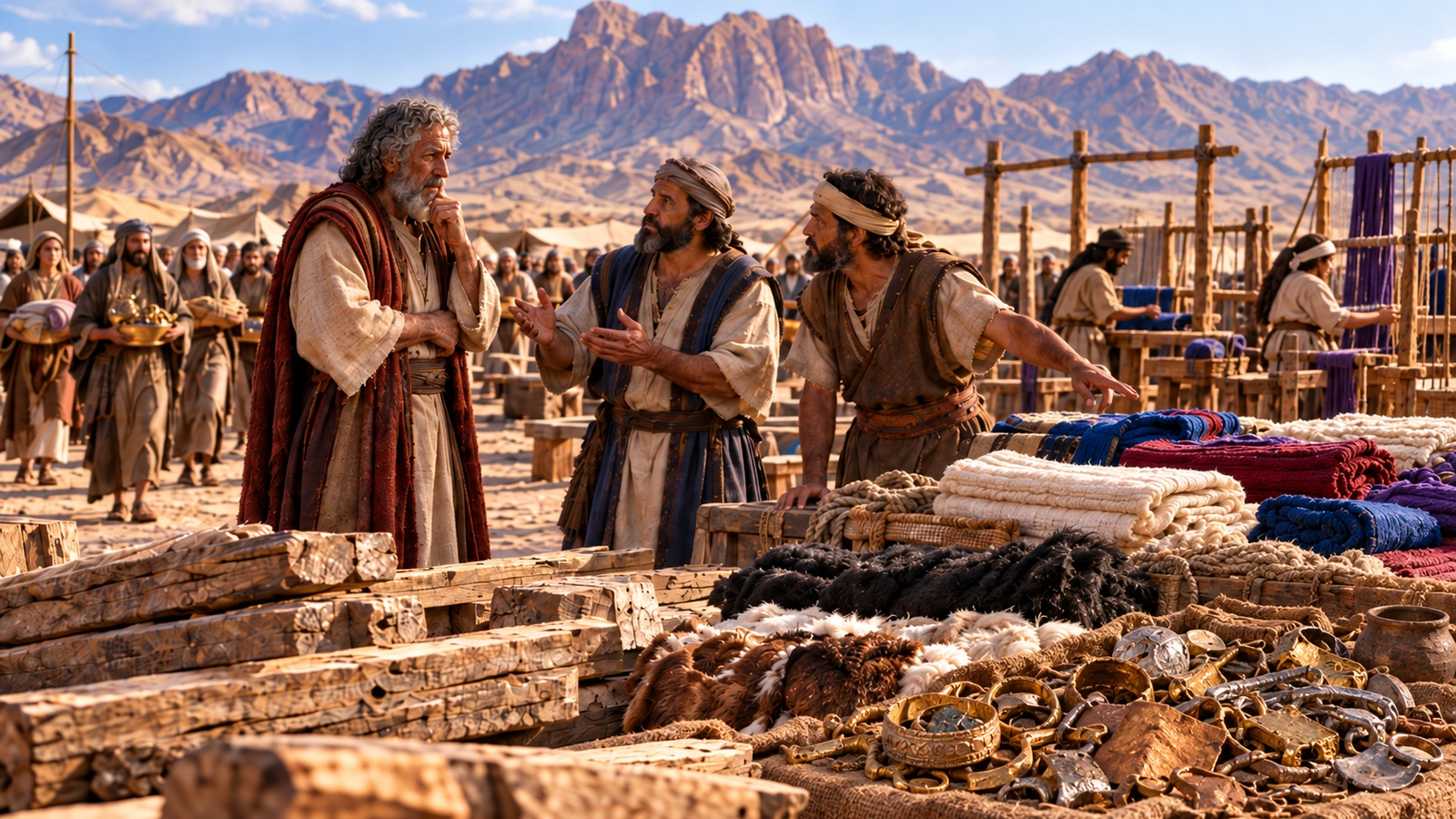
Figure 1. Artistic reconstruction of Judah recognizing his own seal, cord, and staff after Tamar sends them as identifying evidence, representing the decisive reversal in Genesis 38:24–26. |
Where Was God When Joseph Was Sold? ended with Joseph disappearing toward Egypt while Genesis refused to explain God’s role in his betrayal.
A reader turning the page naturally expects to discover what happens when the young slave arrives.
Genesis does not take us there.
Instead, Joseph vanishes from the foreground and Judah takes his place.
A marriage follows. Sons are born. Two die. A widow is denied the future promised to her. Disguise, sex, pregnancy, threatened execution, recognition, and twins fill an entire chapter before Genesis returns to Egypt.
Remove Genesis 38, and 37:36 connects almost seamlessly with 39:1.
That apparent interruption is precisely the problem.
Why stop Joseph’s descent at the moment of greatest suspense?
The answer becomes visible only when Genesis 38 is read not as an isolated scandal, but as part of the literary architecture surrounding Joseph and Judah.
Joseph Goes Down — Then Judah Goes Down
Genesis 38 begins:
וַיֵּרֶד יְהוּדָה מֵאֵת אֶחָיו — wayyēreḏ Yəhûḏāh mēʾēṯ ʾeḥāyw
“Judah went down from his brothers.”
The verb comes from ירד — y-r-d, “to go down.”
One chapter later, when the account resumes Joseph’s Egyptian experience, Genesis 39:1 says:
וְיוֹסֵף הוּרַד מִצְרָיְמָה — wə-Yôsēp̄ hûraḏ Miṣrāymāh
“Joseph had been brought down to Egypt.”
Judah goes down. Joseph is brought down.
That verbal correspondence does not prove that Judah’s movement is automatically a metaphor for moral decline. Geographical descent is the direct meaning of Genesis 38:1.
Its placement still invites comparison.
One brother leaves his family voluntarily.
The other has been removed by force.
Literary studies have long noticed that Genesis 38 is tied to the surrounding Joseph material through repeated words, motifs, and resumptive language. Even scholars who regard the Judah–Tamar account as having an earlier independent history recognize that its final position creates deliberate connections with chapters 37 and 39.
That distinction matters.
We do not need to prove how the passage originated before asking what it does where Genesis now places it.
God Returns to the Story — But Not to Explain Joseph
Genesis 37 was striking because God never spoke during Joseph’s betrayal.
Chapter 38 suddenly names YHWH again.
Judah’s first son, Er, is described as evil in YHWH’s sight, and YHWH puts him to death. Onan later meets the same judgment after his conduct displeases God.
The divine absence surrounding Joseph has not become a universal absence from the book.
Genesis can still attribute an event directly to God.
That makes the contrast sharper.
The narrator explains Er’s death.
He explains Onan’s death.
Joseph’s sale remains uninterpreted.
Genesis 38 does not answer where God was when Joseph disappeared. Instead, it suspends that question while turning toward the brother whose proposal in Genesis 37 resulted in Joseph being sold rather than killed.
Judah now becomes the character under examination.
What Was Onan Actually Required to Do?
After Er dies without offspring, Judah tells Onan:
וְיַבֵּם אֹתָהּ — wəyabbēm ʾōṯāh
“Perform the duty of a brother-in-law to her.”
The verb belongs to the same Hebrew family later associated with levirate marriage, a kinship arrangement in which a close male relative could help preserve the deceased man’s line.
Deuteronomy 25:5–10 later regulates a specific form of this practice.
We should not simply impose every detail of that later legislation onto Genesis 38.
The household custom portrayed here is similar, but not identical in every recorded feature.
Comparative material from the ancient Near East shows that societies could use family-based arrangements to preserve lineage after a husband’s death. Hittite legal material, for example, contains circumstances in which responsibility for a widow could move through male relatives, including a father-in-law. Such parallels provide historical context; they do not prove which precise legal system Genesis assumes.
Onan understands the consequence of the obligation.
Genesis says he knew that the offspring would not be considered his.
His response is deliberate.
Whenever he has intercourse with Tamar, he prevents conception so that he will not “give offspring to his brother.”
Popular discussions sometimes reduce this episode to a prohibition against masturbation.
That is not what the passage describes.
The sexual act is withdrawal during intercourse. More importantly, Genesis explicitly connects Onan’s behavior to his refusal to provide offspring for his deceased brother.
His offense cannot be separated from that stated motive.
Shelah Grows Up — Tamar Is Still Waiting
After Onan dies, Judah sends Tamar back to her father’s household.
He tells her:
“Remain a widow … until Shelah my son grows up.”
Then the narrator gives Judah’s private reason.
He fears that Shelah may die like his brothers.
Genesis does not say Tamar caused either death.
Er was condemned because he was evil before YHWH. Onan’s behavior receives its own explanation.
Judah’s fear nevertheless determines Tamar’s future.
Time passes.
Shelah grows.
The promised marriage does not happen.
Genesis 38:14 explicitly explains Tamar’s next move by saying that she saw Shelah had grown up and she had not been given to him.
That sentence is decisive.
Tamar does not act because the narrator describes her as sexually reckless.
Her action follows Judah’s failure to do what he had told her would occur.
The social consequences are difficult to reconstruct in every detail, but her position is precarious: she remains tied to Judah’s family without receiving the kinship arrangement that could produce descendants within it.
Tamar’s Veil Does Not Make the Scene Simple
Tamar removes her widow’s garments, covers herself, and sits beside the route to Timnah.
Judah sees her and thinks she is a prostitute because her face is covered.
That line has often generated reconstructions of ancient prostitution based on veiling.
The evidence is less secure.
Scholarly study of Genesis 38 has challenged the idea that a veil functioned as a universal costume identifying prostitutes in the ancient Near East. In this episode, concealment certainly prevents Judah from recognizing Tamar; historical evidence does not justify turning that detail into a broad social rule.
Another linguistic complication appears soon afterward.
Judah initially thinks Tamar is a זֹנָה — zônāh, ordinarily “prostitute.”
When Hirah later searches for her, he asks about a קְדֵשָׁה — qədēšāh.
Older translations frequently rendered the second term “cult prostitute” or “temple prostitute.”
That interpretation is disputed.
Genesis 38 mentions no shrine, fertility ceremony, deity, or ritual context surrounding Tamar’s encounter. Wider scholarship has also challenged sweeping reconstructions of institutional “sacred prostitution” from this vocabulary alone.
The safer conclusion is narrower.
Judah believes he is negotiating a sexual transaction with a woman whose real identity he does not know.
Tamar knows exactly who he is.
Why Does Tamar Ask for the Seal, Cord, and Staff?
Judah promises a young goat as payment.
Tamar requires a pledge until it arrives.
She asks for three objects:
his seal
his cord
his staff
These are not random household items.
A personal seal could function as an identifying instrument within ancient administrative and social life. The combination of objects in Genesis gives Tamar evidence tied specifically to the man who possesses them.
Their importance becomes clear only later.
Judah’s friend cannot find the woman.
The promised payment returns undelivered.
Months pass.
Then Tamar’s pregnancy becomes visible.
Judah is told that his daughter-in-law has become pregnant through sexual misconduct.
His reaction is immediate:
“Bring her out, and let her be burned.”
Genesis does not identify the legal code behind that sentence.
We should resist importing later Israelite penalties backward as though the passage explicitly cites them.
What matters inside the scene is that Judah issues judgment before knowing the identity of the man involved.
Tamar already possesses the evidence that will change the case.
“Recognize, Please”
Genesis 38 now connects itself to Joseph’s betrayal through one of the strongest verbal echoes in the entire sequence.
When the brothers deceive Jacob in Genesis 37, they send Joseph’s bloodstained garment to their father and say:
הַכֶּר־נָא — hakkēr-nāʾ
“Recognize, please.”
Is this your son’s garment?
One chapter later, Tamar sends Judah the seal, cord, and staff.
Her message begins:
הַכֶּר־נָא — hakkēr-nāʾ
“Recognize, please.”
Whose seal, cord, and staff are these?
The wording is not merely similar.
It is the same imperative with the same particle.
Judah participated in presenting an object to Jacob and asking a father to recognize evidence that concealed the truth.
Now objects are presented to Judah, and he must recognize evidence that exposes it.
This link between Genesis 37 and 38 has been widely observed in literary interpretation.
The interruption has begun to look far less accidental.
Genesis has carried the vocabulary of Joseph’s deception directly into the Tamar episode.
“She Is More in the Right Than I”
Judah recognizes the objects.
Then he says:
צָדְקָה מִמֶּנִּי — ṣāḏəqāh mimmennî
Many English Bibles translate:
“She is more righteous than I.”
Another natural rendering is:
“She is more in the right than I.”
The sentence does not mean Genesis has declared everything Tamar did a universal model for imitation.
Judah immediately explains his statement:
“because I did not give her to Shelah my son.”
His admission concerns a concrete failure.
He had told Tamar to wait for Shelah.
Shelah matured.
Judah did not give him to her.
When the evidence forces recognition, he acknowledges that Tamar’s position is more justified than his own.
Classical Jewish interpreters developed additional readings of mimmennî, including a wordplay on “from me.” The contextual comparative sense, however, fits Judah’s explanation naturally: she is more in the right than he is.
Genesis then adds:
“He did not know her again.”
The encounter is not turned into an ongoing sexual relationship.
Its consequence lies elsewhere.
Does Genesis 38 Show Judah Repenting?
The older version of this article answered too quickly.
Genesis 38 never uses a technical word meaning, “Judah now completed a process of repentance.”
Nor does the narrator describe his internal psychology.
What we can say is stronger because it is narrower.
Genesis 38:26 records an explicit acknowledgment of responsibility.
Judah recognizes the evidence and admits that his failure toward Tamar makes her claim more justified than his own.
Whether this confession represents a complete transformation cannot be established from that sentence alone.
Later behavior provides the better test.
In Genesis 37, Judah proposed selling Joseph.
In Genesis 43, he becomes personally responsible for Benjamin’s return.
By Genesis 44, Judah offers himself as a slave rather than allow Benjamin to remain in Egypt and force Jacob to suffer the loss of another favored son.
That later contrast is substantial.
Genesis never inserts a narrator’s comment saying, “Tamar changed Judah.”
Still, reading 38:26 beside 44:18–34 supports a strong literary inference: the man who once helped remove a brother from his father eventually becomes willing to lose his own freedom to return another brother to that same father.
Genesis 38 gives us the first explicit moment in that trajectory where Judah says, in effect:
I was the one in the wrong.
That is more precise than claiming we can see every stage of his inner development.
Genesis 38 and 39 Place Two Sexual Encounters Side by Side
The positioning creates another contrast.
Genesis 38 depicts Judah initiating intercourse with a woman he believes to be available for payment.
Genesis 39 immediately places Joseph in the opposite position.
Potiphar’s wife repeatedly propositions him.
Joseph refuses.
The episodes are not identical, and simplistic moral comparisons can distort both.
Their juxtaposition still matters.
Judah misidentifies Tamar because he does not recognize her.
Potiphar’s wife knows exactly who Joseph is and uses her power against him after his refusal.
Clothing plays a role in both accounts.
Tamar changes garments to conceal identity.
Joseph’s garment becomes false evidence in the hands of Potiphar’s wife.
Genesis 37 had already used clothing as the instrument through which Jacob was deceived.
Across all three chapters, garments and objects carry knowledge that characters either misunderstand or manipulate. Scholars have identified these parallels as one reason Genesis 38 functions effectively in its present location even when questions about earlier composition remain open.
The interruption is doing comparative work.
What About Perez and the Royal Line?
Genesis 38 does not end with Judah’s confession.
Tamar gives birth to twins.
During delivery, one child’s hand emerges first, and a scarlet thread is tied around it. The hand withdraws, however, and the other child breaks through ahead of him.
He receives the name Perez — פֶּרֶץ, connected within the scene to the idea of “breaking through.”
Zerah follows.
Inside Genesis 38, the immediate result is the preservation and continuation of Judah’s family.
The larger biblical canon gives Perez greater importance later.
Ruth 4:18–22 traces a genealogy from Perez to David.
Genesis itself will first move toward Judah’s royal significance in chapter 49, where Jacob speaks of the scepter and ruler’s staff in connection with him.
That chronology matters.
Genesis 38 does not announce:
“Tamar has now produced the ancestor of King David.”
Later biblical literature makes that connection.
What this episode already accomplishes is simpler and foundational: Judah’s line survives through the very woman whom his failure had left without the promised route to offspring.
Was Genesis 38 Originally an Independent Story?
Serious scholarship does not give only one answer.
Many historical-critical interpreters have argued that the Judah–Tamar material once circulated independently and was incorporated into the Joseph cycle during the formation of Genesis.
Others emphasize how thoroughly its present placement has been integrated through vocabulary, motifs, character development, and connections with Judah’s later role.
These positions are not mutually exclusive.
A passage can have an earlier literary history and still perform a deliberate function within its final context.
Mark Leuchter’s work on Genesis 38, for example, examines its social, historical, and literary dimensions while recognizing its relationship to the larger ancestral traditions. Other treatments focus strongly on the verbal architecture linking it to Joseph.
For Beyond The Known, the distinction is essential.
The compositional question asks:
How did Genesis 38 arrive here?
The literary question asks:
What does Genesis 38 do now that it is here?
Our title concerns the second question.
The Deeper Discovery
Genesis 38 does not simply interrupt Joseph’s story to tell us that Judah also had problems.
Its most revealing function is subtler.
Judah is made to experience the vocabulary of recognition that he helped impose on Jacob.
In Genesis 37, evidence is manipulated.
“Recognize, please.”
Jacob recognizes Joseph’s garment and reaches a false conclusion because his sons have controlled what he sees.
In Genesis 38, evidence exposes the concealed truth.
“Recognize, please.”
Judah recognizes his own objects and can no longer maintain the judgment he pronounced against Tamar.
The same verbal formula moves from deception to disclosure.
That reversal gives the chapter a reason to stand exactly where it does.
Before Genesis can show Judah assuming responsibility for Benjamin, it first shows him confronted with responsibility for Tamar.
Before Jacob’s sons can be reconciled, one of the brothers most important to that reconciliation must learn what it means to be recognized by his own evidence.
Joseph’s Egyptian ascent has not been forgotten.
Genesis has temporarily changed cameras.
While Joseph disappears into slavery, the book turns back toward the family and begins preparing another character whose future choices will become indispensable when the brothers finally stand together again.
That is why Genesis 38 belongs between the pit and Potiphar.
The apparent detour is part of the road.
Frequently Asked Questions
Why is Genesis 38 placed between Joseph’s sale and his life in Egypt?
The chapter creates literary links between Joseph and Judah through repeated language, clothing, deception, sexual encounters, and recognition. Genesis 39 resumes Joseph’s descent after Genesis 38 has developed the brother who later becomes central to the family’s reconciliation.
What was Onan’s sin in Genesis 38?
Genesis explicitly says Onan prevented conception because he knew the offspring would not be considered his. His wrongdoing is tied to refusing the obligation to provide offspring for his deceased brother, not to masturbation as popularly defined.
Was Tamar a prostitute?
No. Tamar disguises herself, and Judah mistakenly identifies her as a zônāh. Hirah later uses the term qədēšāh, but the passage provides no secure basis for claiming Tamar participated in cultic prostitution.
Why does Tamar say “recognize, please”?
She uses the exact formula previously used when Joseph’s garment was presented to Jacob. The repetition connects Judah’s role in the deception of Genesis 37 with his forced recognition of evidence in Genesis 38.
What does “she is more righteous than I” mean?
Judah explains his own statement: he had failed to give Tamar to Shelah as promised. The phrase can naturally mean “she is more in the right than I,” acknowledging that her claim is more justified than his.
Is Perez connected with King David?
Yes, but that connection is made later. Ruth 4:18–22 traces David’s genealogy through Perez. Genesis 38 itself records Perez’s birth without mentioning David.
Joseph is still in Egypt.
Genesis 38 has made us wait an entire chapter to see him again.
When the camera finally returns, something changes immediately.
Genesis no longer leaves God’s presence unstated.
It tells us repeatedly that YHWH was with Joseph.
Why repeat it when Joseph will still be enslaved, falsely accused, and imprisoned?
Why Does Genesis Repeat That the Lord Was With Joseph?
Selected Sources
Gordon J. Wenham, Genesis 16–50. Word Books, 1994.
Victor P. Hamilton, The Book of Genesis, Chapters 18–50. Eerdmans, 1995.
Nahum M. Sarna, The JPS Torah Commentary: Genesis. Jewish Publication Society, 1989.
Claus Westermann, Genesis 37–50: A Commentary. Fortress Press.
Tikva Frymer-Kensky, Reading the Women of the Bible: A New Interpretation of Their Stories.
Robert Alter, The Hebrew Bible: A Translation with Commentary.
Mark Leuchter, “Genesis 38 in Social and Historical Perspective,” Journal of Biblical Literature 132.2 (2013): 209–227.