Why Does Genesis Let Everyone Speak Except Dinah?
The Missing Voice at the Center of Genesis 34
 |
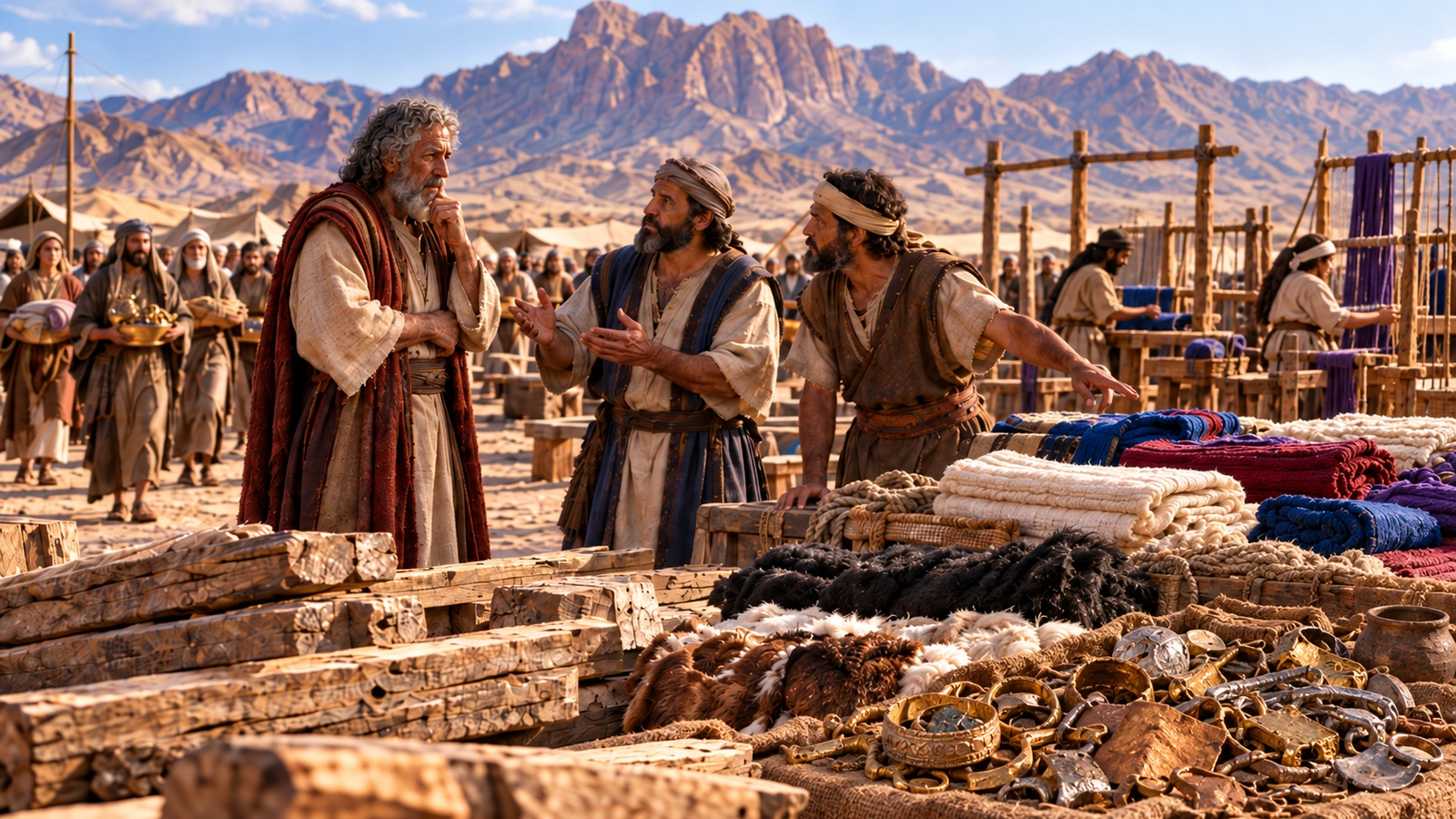
Figure 1. Artistic reconstruction of Dinah standing apart while Hamor, Shechem, Jacob, and Jacob’s sons negotiate near the city gate, representing the absence of Dinah’s recorded voice in Genesis 34. |
Why Doesn’t Jacob Go to Seir After Promising Esau He Would? ended at Shechem.
The following chapter turns that settled landscape into the family’s most violent crisis.
Dinah goes out to see the women living nearby.
A local ruler’s son sees, takes, sleeps with, and humiliates her.
From that moment, nearly every consequential decision belongs to somebody else.
The daughter at the center receives no recorded dialogue.
Why preserve extensive negotiations while withholding her perspective?
The answer requires more precision than the title initially suggests.
“Everyone” Is Deliberately Rhetorical
Strictly speaking, not every person in Genesis 34 receives direct speech.
The city’s male population accepts Hamor’s proposal without quoted responses.
Several minor figures also remain voiceless.
Yet the distribution remains remarkably uneven.
Fathers, brothers, and Shechem receive lengthy opportunities to define events.
Leah’s daughter receives none.
That distinction gives us a stronger question.
Why does nearly every male decision-maker speak while her viewpoint remains inaccessible?
Dinah Begins as an Acting Subject
Verse 1 gives Jacob’s daughter an independent action:
וַתֵּצֵא דִינָה — wattēṣēʾ Dînâ
She “went out” to see the daughters of the land.
Nothing inside יָצָא — yāṣāʾ makes that departure sexually suggestive.
The verb ordinarily means leaving, departing, or going outward.
Caroline Blyth challenges interpretive traditions blaming her movement for subsequent events.
The opening consequently provides no textual basis for assigning responsibility to her.
Something striking happens after that first verse.
Dinah almost disappears as an independent grammatical agent.
Other people now see, seize, negotiate, demand, deceive, attack, rescue, and condemn.
She becomes someone whom actions affect.
That grammatical shift parallels the disappearance of her spoken perspective.
Four Hebrew Verbs Describe What Shechem Does
Verse 2 compresses the encounter into a rapid sequence.
The prince’s son first sees her.
Next, he takes her.
Then he lies with her.
Finally comes:
וַיְעַנֶּהָ — wayʿannêhā
The form derives from ענה — ʿ-n-h.
Its semantic force in sexual contexts remains contested.
Many English versions understand violation or rape.
Other scholars prefer humiliation, degradation, debasement, or affliction.
Biblical Hebrew lacks one technical verb matching every modern definition of rape.
S. David Sperling separates lexical meaning from the larger scene.
Shawna Dolansky likewise cautions against letting one verb settle everything.
That uncertainty should not erase what the account explicitly provides.
Shechem performs every narrated action in verse 2.
Consent, resistance, and Dinah’s verbal reaction remain unreported.
He Speaks to Her Heart—Yet We Hear Nothing Back
Verse 3 intensifies the imbalance.
Hamor’s son becomes attached to the young woman and professes affection.
Then the Hebrew says:
וַיְדַבֵּר עַל־לֵב הַנַּעֲרָ — waydabbēr ʿal-lēḇ hannǎʿărâ
He “spoke to the heart of the young woman.”
The idiom can describe comforting, reassuring, or persuasive communication.
Here is the literary problem.
Genesis tells us that he addressed her.
The composition never preserves her answer.
Readers learn what he feels.
Her response remains unavailable.
The informational gap appears before any public bargaining begins.
Jacob’s Silence Is Different
Verse 5 introduces another silent character.
Jacob hears that his daughter has been defiled.
Then:
וְהֶחֱרִשׁ יַעֲקֹב — wəheḥĕrîš Yaʿăqōḇ
Jacob “kept silent” until his sons returned.
His quiet receives an explicit verb.
It also receives a temporal boundary.
Later, the patriarch speaks directly to Simeon and Levi.
Dinah’s absence works differently.
No clause says she “kept silent.”
Nothing establishes when her voicelessness began or ended.
The storyteller simply never grants her a turn.
That difference deserves far more attention than the older article gave it.
The Marriage Proposal Moves Around Her
Verse 4 moves immediately toward household authority.
Shechem tells Hamor:
“Get me this girl for a wife.”
The prospective bride receives no recorded question.
Soon, her father learns what occurred.
The brothers return from the field.
Hamor then approaches the family to negotiate.
Marriage becomes a discussion among male representatives.
Her wishes never enter the preserved conversation.
Bride-Payment Reveals the Social Framework
Genesis 34:11–12 introduces explicit economic terminology.
The suitor offers whatever her relatives demand.
Two nouns appear together:
מֹהַר וּמַתָּן — mōhar ûmattān
The phrase refers to bride-payment and an additional gift.
Comparable transfers existed across several ancient Near Eastern legal traditions.
Old Babylonian documentation uses terhatum for groom-side marriage payments.
Legal corpora from Mesopotamia regulate such transfers under differing circumstances.
Those parallels illuminate social structure, not direct literary dependence.
Genesis cannot simply be mapped onto one Babylonian statute.
The comparison still explains why marriage involved households, property, and negotiated status.
None of that recovers the woman’s own preference.
A Private Crisis Becomes Civic Policy
Hamor’s proposal soon expands beyond one household.
Father and son go to the city’s gate.
Their argument concerns residence, intermarriage, trade, property, and livestock.
The affair has become economic and political.
A proposed union now threatens to merge two communities.
Genesis 34:20 explicitly locates this public persuasion at the urban entrance.
That setting has important archaeological context.
Archaeology Makes the City Gate More Concrete
Tell Balata is widely identified with ancient Shechem.
Excavations revealed substantial Middle Bronze Age urban construction.
Remains include major fortifications and monumental gate complexes.
The settlement occupied a strategic valley between Mount Gerizim and Mount Ebal.
UNESCO describes it as an important Canaanite political and commercial center.
Such discoveries illuminate the urban world evoked by Genesis 34.
They do not prove that this negotiation happened at an excavated gateway.
Nor can archaeology securely date the patriarchal episode itself.
The evidence provides context rather than verification.
That distinction protects history from becoming apologetic decoration.
The Negotiation Uses Sacred Identity as a Weapon
Jacob’s sons answer Hamor and his heir:
בְּמִרְמָה — bəmirmâ
The noun means deception, guile, or treachery.
Genesis itself supplies that evaluation.
Circumcision becomes their stated condition for intermarriage.
Privately, the requirement prepares an attack.
The city’s males accept.
Three days later, Simeon and Levi strike while those men suffer.
Hamor and his son die with the wider male population.
Other brothers then plunder animals, wealth, children, and women.
The conflict has expanded far beyond the original offense.
Dinah Reappears Inside Shechem’s House
Verse 26 names her again during the assault.
The brothers kill Hamor and Shechem.
Then comes:
וַיִּקְחוּ אֶת־דִּינָה מִבֵּית שְׁכֶם — wayyiqḥû ʾeṯ-Dînâ mibbêṯ Šəḵem
They “took Dinah from Shechem’s house.”
That sentence establishes her location.
It does not explain why she remained there.
No reaction accompanies her removal.
Relief is not narrated.
Neither are grief, resistance, attachment, terror, or anger.
Assigning any of those emotions would reconstruct material Genesis withholds.
The Account Does Judge the Initial Act
Voicelessness does not mean complete moral neutrality.
Verse 7 calls what happened:
נְבָלָה — nəḇālāh
The noun can describe disgrace, outrage, or reprehensible conduct.
The same verse declares such behavior should not occur.
That is one of the chapter’s strongest evaluative statements.
Yet condemnation still arrives outside Dinah’s mouth.
The affected person’s first-person account remains unavailable.
Moral judgment and personal testimony are not identical.
Genesis supplies the former while withholding the latter.
“Defilement” Shapes the Family’s Vocabulary
Another root repeatedly frames the crisis:
טמא — ṭ-m-ʾ
Jacob hears that his daughter has been “defiled.”
His sons use related wording during their reply.
The plundering later receives justification through the same category.
Such terminology belongs to ancient concepts involving sexuality, kinship, and communal status.
It should not automatically become modern psychological language.
Nothing tells readers how the young woman understood herself afterward.
Her relatives’ vocabulary cannot simply become her own.
The Final Question Still Belongs to Men
After the massacre, Jacob confronts Simeon and Levi.
His objection concerns survival among surrounding populations.
The brothers answer with Genesis 34’s closing question:
הַכְזוֹנָה יַעֲשֶׂה אֶת־אֲחוֹתֵנוּ — haḵəzônâ yaʿăśeh ʾeṯ-ʾăḥōṯēnû
“Should he treat our sister like a prostitute?”
Family honor becomes their final defense.
The narrator gives no immediate verdict.
Jacob receives no answering sentence within this chapter.
More tellingly, the sister still receives no voice.
Her brothers frame the last moral question for her.
Modern Scholarship Does Not Explain the Silence One Way
Caroline Blyth places Dinah’s voicelessness near the center of her interpretation.
Her Oxford monograph reads that absence through sexual violence and survivor testimony.
Such methodology consciously brings modern ethical concerns into dialogue with Genesis.
Carrie Cifers approaches the gap through narrative ethics.
Her work emphasizes reticence, ambiguity, and competing perspectives.
The missing viewpoint becomes central because readers cannot access Dinah’s evaluation.
Other researchers place stronger weight upon ancient social categories.
Alison Joseph highlights household honor, kinship interests, and marriageability.
Dolansky questions whether ʿinnah alone demonstrates coercive intercourse.
These approaches cannot simply be merged.
They agree upon the literary absence.
They disagree about what that absence authorizes interpreters to conclude.
What Does the Text Actually Allow Us to Say?
Several observations remain secure.
Dinah voluntarily goes out in verse 1.
The subsequent sexual actions are narrated with Shechem as initiator.
His later affection cannot retroactively establish consent.
Silence alone cannot prove consent either.
No direct quotation from Leah’s daughter appears anywhere.
Marriage negotiations unfold among male household representatives.
Her brothers remove her from Shechem’s residence after killing its occupants.
Nothing records her emotional response afterward.
Those boundaries matter.
They prevent interpreters from manufacturing testimony the passage never preserves.
Social Context Explains Something—but Not Everything
Patriarchal households commonly placed marriage negotiations under male kinship authority.
Genesis 34 reflects that world through several mechanisms.
Bride-payment appears.
Family honor governs argument.
Circumcision becomes an identity boundary.
Economic integration motivates Hamor’s civic proposal.
Still, historical explanation cannot answer every literary question.
A social system may explain why men bargain.
It cannot tell us what Dinah thought about that bargaining.
Nor Does Ancient Context Equal Moral Approval
Description should not automatically become endorsement.
The account labels Shechem’s deed a nəḇālāh.
Its narrator calls the brothers’ negotiations mirmâ.
Later, Jacob condemns Simeon and Levi’s violence with severe language.
Genesis 49 associates their anger with destructive weapons.
No male participant emerges as an uncomplicated moral representative.
Each attempted solution creates another problem.
That complexity makes Dinah’s missing perspective more consequential.
The Deeper Discovery
Why does Genesis let so many people speak except Dinah?
The book never supplies an explicit reason.
Responsible interpretation must preserve that limit.
Yet the literary effect remains observable.
Male voices repeatedly define offense, marriage, identity, economics, and vengeance.
The person whose future is being negotiated never defines any of them.
That absence prevents every surviving spokesman from becoming her unquestioned representative.
Shechem claims affection.
Hamor offers integration.
The brothers appeal to family disgrace.
Jacob fears retaliatory destruction.
None of those positions automatically equals Dinah’s perspective.
Her missing voice becomes a boundary around our certainty.
Genesis 34 leaves competing male interpretations surrounding one inaccessible viewpoint.
That may be the hardest feature of the entire episode.
Not because silence explains Dinah.
It does precisely the opposite.
Her silence prevents everyone else from explaining her completely.
The aftermath immediately creates another crisis.
Jacob now fears retaliation after the bloodshed at Shechem.
Then Genesis 35 opens with a command to leave for Bethel.
Why does that sacred location reappear precisely after this catastrophe?
Why Does Jacob Bury the Foreign Gods Before Returning to Bethel?
Selected Sources
Alter, Robert. The Art of Biblical Narrative. Basic Books.
Blyth, Caroline. The Narrative of Rape in Genesis 34: Interpreting Dinah’s Silence. Oxford University Press, 2010.
Cifers, Carrie A. Dangerous Tales: Genesis 34 and Its Literary Descendants. Society of Biblical Literature, 2025.
Cifers, Carrie A. “She Decides: Reading Genesis 34 in Conversation with Narrative Ethics.” Interpretation 77.1 (2023): 52–60.
Hamilton, Victor P. The Book of Genesis: Chapters 18–50. Eerdmans.
Sarna, Nahum M. Genesis. Jewish Publication Society.
Sperling, S. David. “Dinah, ʿInnah, and Related Matters.” In Mishneh Todah. Eisenbrauns.
Wenham, Gordon J. Genesis 16–50. Word Biblical Commentary.
UNESCO World Heritage Centre. “Canaanite City-States: Tell Balata.”