Why Does Genesis List the Kings of Edom Before Israel Had a King?
The Royal List That Appears Before Jacob’s Family Has a Throne
 |
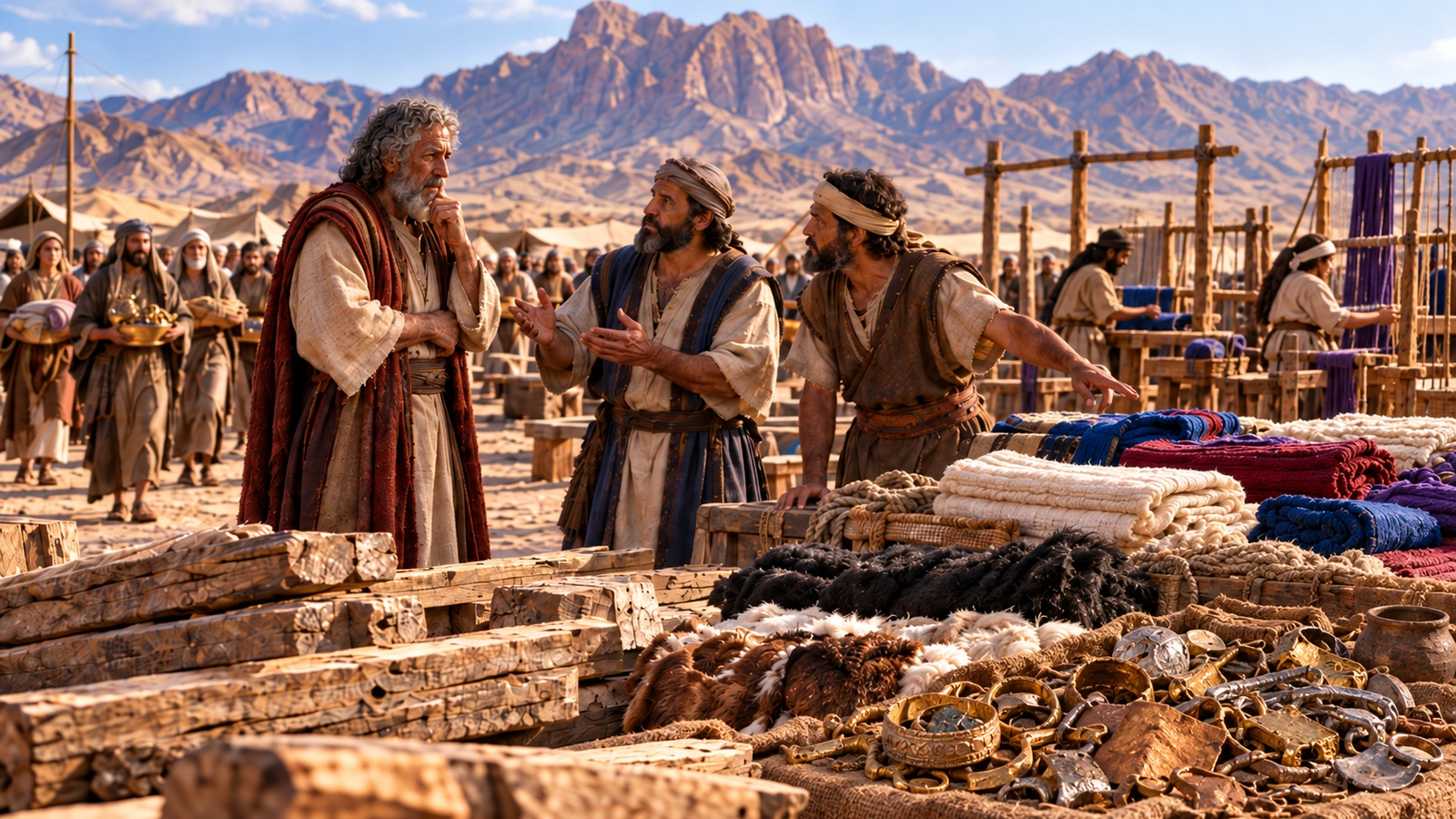
Figure 1. Artistic reconstruction of an unidentified Edomite ruler surrounded by regional chiefs in the rugged territory of Seir, representing the kingship described in Genesis 36:31–43 before Israel possessed a monarchy. |
Why Does Genesis Spend More Time Preparing for Bethel Than Traveling There? ended with Jacob’s return completed.
One chapter later, the narrative unexpectedly turns away from his household.
Esau receives an entire genealogy.
Names become clans.
Settlements appear.
Then royal succession suddenly enters the record.
Genesis 36:31 announces:
“These are the kings who reigned in Edom before any king reigned over Israel.”
The Hebrew is striking:
וְאֵלֶּה הַמְּלָכִים אֲשֶׁר מָלְכוּ בְּאֶרֶץ אֱדוֹם
wəʾēlleh hamməlāḵîm ʾăšer māləḵû bəʾereṣ ʾĔḏôm
“These are the kings who reigned in the land of Edom.”
Then comes the comparison:
לִפְנֵי מְלָךְ־מֶלֶךְ לִבְנֵי יִשְׂרָאֵל
lip̄nê məlāḵ-meleḵ liḇnê Yiśrāʾēl
“Before a king reigned for the Israelites.”
Why does the narrator tell us this here?
The answer begins one chapter earlier.
Jacob Had Just Been Promised Kings
At Bethel, Jacob receives another divine appearance.
Genesis 35:11 promises nations and future royalty from his descendants.
The Hebrew clause reads:
וּמְלָכִים מֵחֲלָצֶיךָ יֵצֵאוּ
ûməlāḵîm mēḥălāṣeḵā yēṣēʾû
“Kings shall come from your body.”
That promise appears immediately before Esau’s genealogy.
The placement creates an extraordinary narrative tension.
Royal descendants are promised to Jacob.
Actual monarchs are listed first under Esau.
The juxtaposition does not cancel the earlier promise.
Instead, it delays its visible realization.
Jacob’s family possesses no throne when Genesis 36 begins.
His brother’s branch already receives a royal catalogue.
Genesis 36 Is More Than One Genealogy
The chapter opens with:
וְאֵלֶּה תֹּלְדוֹת עֵשָׂו — wəʾēlleh tôlədôt ʿĒśāw
“These are the generations of Esau.”
A second tôlədôt heading appears again in verse 9.
The material then combines several kinds of records.
We encounter descendants, chieftains, Horite inhabitants, rulers, places, and territorial units.
That structure corrects a common oversimplification.
The account does not move neatly from family toward monarchy.
Royal names appear between different lists of אַלּוּפִים — ʾallûp̄îm.
The noun ʾallûp̄ can designate a chief or clan leader.
Such figures occur before the monarchs and reappear afterward.
Political organization is present.
Its exact institutional structure remains harder to reconstruct.
Eight Kings Appear Without a Dynasty
Verses 32–39 preserve eight successive rulers.
Bela is followed by Jobab.
Husham comes next.
Hadad follows him.
Samlah, Shaul, Baal-hanan, and Hadar complete the sequence.
One detail immediately stands out.
No succession formula identifies the next monarch as the previous ruler’s son.
Several men also come from different locations.
Bela is associated with Dinhabah.
Jobab comes from Bozrah.
Husham belongs to the Temanite territory.
Samlah comes from Masrekah.
Shaul is connected with Rehoboth by the River.
Hadar’s city is Pau.
That pattern differs from a straightforward hereditary dynasty.
Yet “elective monarchy” goes beyond available evidence.
The text never describes an election.
Neither does it explain how each successor gained authority.
Changing centers could reflect regional leadership, political turnover, or another arrangement.
Genesis preserves succession.
It does not preserve the constitution.
One King Even Receives a Military Notice
Hadad son of Bedad receives unusual additional information.
He defeated Midian:
בִּשְׂדֵה מוֹאָב — biśdê Môʾāḇ
“in the territory of Moab.”
This short comment differs from ordinary genealogical information.
It remembers a military achievement outside Edomite territory.
The royal section consequently resembles more than a family tree.
It preserves names, seats, succession, and one remembered conflict.
That does not make it a complete court chronicle.
Still, its informational profile is distinctly political.
Why Mention Israel at All?
Verse 31 could simply have introduced Edomite rulers.
Instead, it compares them with another people.
That comparison changes everything.
The genealogy suddenly asks readers to view Esau’s development beside Jacob’s future.
Nothing required such a chronological remark for identifying Bela or Jobab.
The editor deliberately inserts Israel into an Edomite list.
That comparison makes political precedence visible.
Esau’s branch possesses kings first.
Jacob’s line must wait.
The Statement Also Creates a Dating Question
Genesis 36:31 has long attracted attention beyond literary interpretation.
Its wording naturally sounds retrospective.
The writer knows a period when Israelite kingship can serve as a chronological reference.
For many critical scholars, this indicates that the verse reached its present form after monarchy began.
Saul provides the earliest obvious narrative reference point within Israelite history.
Traditional interpreters have proposed alternative readings.
Some understand the phrase as referring to an Israelite ruler over Edom.
Others suggest later editorial updating within a Mosaic textual tradition.
Those approaches concern composition.
They should not be confused with the verse’s literary function.
A passage can reveal something about editorial history while serving narrative design.
Both questions deserve separate treatment.
Esau’s Story Is Being Closed Before Jacob’s Continues
Genesis often finishes a collateral branch before returning to the selected line.
Ishmael’s descendants appear before Isaac’s family narrative advances.
Esau receives the same broad treatment before Genesis 37 turns toward Jacob.
Thomas Brodie describes the contrast as an expansive genealogy beside Jacob’s compressed family notice.
Chapter 37 then announces:
אֵלֶּה תֹּלְדוֹת יַעֲקֹב — ʾēlleh tôlədôt Yaʿăqōḇ
“These are the generations of Jacob.”
The next word is not “king.”
It is Joseph.
That transition is one of Genesis’ sharpest reversals.
Esau’s branch concludes with rulers.
Jacob’s continuation begins with a seventeen-year-old shepherd.
Joseph Makes the Contrast Even Stronger
Royal language appears almost immediately in Genesis 37.
Joseph dreams that his brothers’ sheaves bow toward his own.
Their response is hostile:
הֲמָלֹךְ תִּמְלֹךְ עָלֵינוּ
hămālōḵ timlōḵ ʿālênû
“Will you really reign over us?”
The verb comes from מלך — m-l-k, the same kingship root.
That lexical connection deserves attention.
Chapter 36 records men already exercising məlûḵâ, royal authority.
The next section introduces a young dreamer mocked for imagined rule.
One side possesses actual monarchs.
The other receives only an ambiguous dream about future supremacy.
The narrative contrast could hardly be sharper.
Then the Possible Ruler Goes Into a Pit
Joseph’s brothers do not crown him.
They conspire against him.
His special garment is stripped away.
Then he is thrown into an empty cistern.
A caravan eventually carries him toward Egypt.
Read after Genesis 36, the reversal becomes striking.
Esau’s genealogy ends with political authority.
Jacob’s family immediately descends into hatred, trafficking, and apparent collapse.
Visible power has appeared in the sibling nation first.
The promised line looks increasingly unstable.
This Does Not Mean Edom “Won”
The chapter never describes Esau’s development as a divine mistake.
His prosperity is already compatible with earlier blessings.
Nor does Genesis portray every benefit outside Jacob’s branch as counterfeit.
Esau possesses livestock, territory, descendants, leaders, and political structures.
Those achievements remain real.
Election functions differently.
The covenant narrative follows Jacob without requiring every neighboring people to fail.
Political precedence and narrative selection are separate categories.
Archaeology Makes the Question More Complicated
Modern archaeology cannot simply confirm Genesis 36’s royal chronology.
The historical emergence of Edom remains heavily debated.
Southern Jordan contained major copper-production centers during the early Iron Age.
Faynan experienced industrial expansion during the tenth and ninth centuries BCE.
Erez Ben-Yosef has argued for considerable social complexity among mobile groups.
His model allows an early nomadic polity associated with emerging Edom.
Other researchers reject that identification.
Piotr Bienkowski argues that highland Edomite state formation belongs much later.
His reconstruction places the recognizable kingdom mainly in the late eighth century BCE.
Assyrian influence plays a major role within that model.
Bienkowski and Juan Manuel Tebes have pressed the criticism further.
They connect early Faynan’s copper boom more closely with western Negev networks.
Their reconstruction challenges continuity between that industry and later highland Edom.
The debate remains active.
Archaeology confirms substantial political and economic complexity south of the Dead Sea.
It cannot securely identify Genesis 36’s eight kings.
Neither can excavated evidence presently establish their sequence.
External Records Eventually Confirm Edomite Kingship
Later documentation gives firmer historical ground.
Neo-Assyrian sources mention Edom within imperial tribute systems.
Tiglath-pileser III records Qauš-malaka during the eighth century BCE.
Later inscriptions preserve additional Edomite royal names.
Those texts demonstrate that a historical Edomite monarchy certainly existed.
They do not authenticate Bela, Jobab, or the complete Genesis list.
That distinction is essential.
Archaeological context can establish plausibility around institutions.
It cannot identify every biblical ruler without independent evidence.
Genesis 36 Should Not Become an Archaeological Shortcut
An older apologetic argument sometimes works backward from verse 31.
Eight biblical kings become evidence for an early centralized state.
Excavated complexity then becomes proof for those specific names.
Neither step is methodologically secure.
Written tradition and material evidence must first be studied independently.
Only afterward should possible intersections be evaluated.
Current evidence permits several reconstructions of early Edomite development.
Claiming more would weaken the article.
The Royal List Is Also Not Proof of Political Stability
Eight successive monarchs sound impressive.
Yet the account says little about their governments.
We know almost nothing about administration.
Territorial boundaries remain uncertain.
No taxation system appears.
Military organization receives only one brief notice.
Changing royal cities may even indicate institutional fluidity.
The safest statement is narrower.
Genesis portrays Edom as possessing kings before Israelite monarchy.
Anything beyond that requires additional argument.
The Chapter Ends With Chiefs Again
After Hadar, royal succession stops.
Verses 40–43 return to ʾallûp̄îm.
Families, places, and territorial holdings dominate the closing lines.
The final identification reads:
“This is Esau, father of Edom.”
That ending matters.
The monarchy does not replace every earlier social category.
Chiefs remain part of the chapter’s final portrait.
Genesis 36 consequently preserves a layered political memory.
Family descent, local leadership, territory, and kingship coexist within the compilation.
The Real Contrast Is Timing
Why list Edomite monarchs before Israel had one?
The strongest answer comes from narrative placement.
Genesis 35 promises kings through Jacob.
Chapter 36 immediately displays kings among Esau’s descendants.
Then chapter 37 begins Jacob’s tôlədôt through Joseph.
That young man has no throne.
He has dreams.
Soon, even his freedom disappears.
The sequence teaches readers not to confuse chronological precedence with narrative displacement.
Esau’s descendants can reach royal organization first.
Jacob’s promise can remain unfulfilled.
Nothing in the covenant requires simultaneous development.
The Deeper Discovery
The old article treated Genesis 36 mainly as political success versus covenant promise.
The text allows a sharper conclusion.
The narrator places fulfillment and waiting beside each other.
Esau’s branch already possesses what Jacob has only been promised.
That literary asymmetry generates tension before Joseph ever reaches Egypt.
Royalty has appeared.
Just not where the reader expected it first.
Genesis does not explain the delay.
Instead, it sends Jacob’s family toward apparent disaster.
Joseph’s dreams suggest future authority.
His brothers answer with hatred.
A pit replaces a palace.
Slavery replaces visible advancement.
The royal catalogue therefore prepares an uncomfortable question.
If kingship has already appeared elsewhere, where is divine purpose during Joseph’s collapse?
That mystery drives the next article:
Where Was God When Joseph Was Sold?
Selected Sources
Brodie, Thomas L. Genesis as Dialogue: A Literary, Historical, and Theological Commentary. Oxford University Press, 2001, pp. 344–348.
Bienkowski, Piotr. “The Formation of Edom: An Archaeological Critique of the ‘Early Edom’ Hypothesis.” Bulletin of the American Society of Overseas Research 388 (2022): 113–132.
Bienkowski, Piotr, and Juan Manuel Tebes. “Faynan, Nomads and the Western Negev in the Early Iron Age.” Palestine Exploration Quarterly (2024): 262–289.
Ben-Yosef, Erez. “A False Contrast? On an Early Iron Age Nomadic Monarchy in the Arabah.” In From Nomadism to Monarchy? Penn State University Press.
Hamilton, Victor P. The Book of Genesis: Chapters 18–50. Eerdmans.
Sarna, Nahum M. Genesis. Jewish Publication Society.
Wenham, Gordon J. Genesis 16–50. Word Biblical Commentary.