Why Does Jacob Refuse to Be Buried in Egypt?
Genesis 47 Explained: Jacob’s Final Oath, Canaan, Ancestral Burial, and Why Prosperity Could Not Make Egypt Home
 |
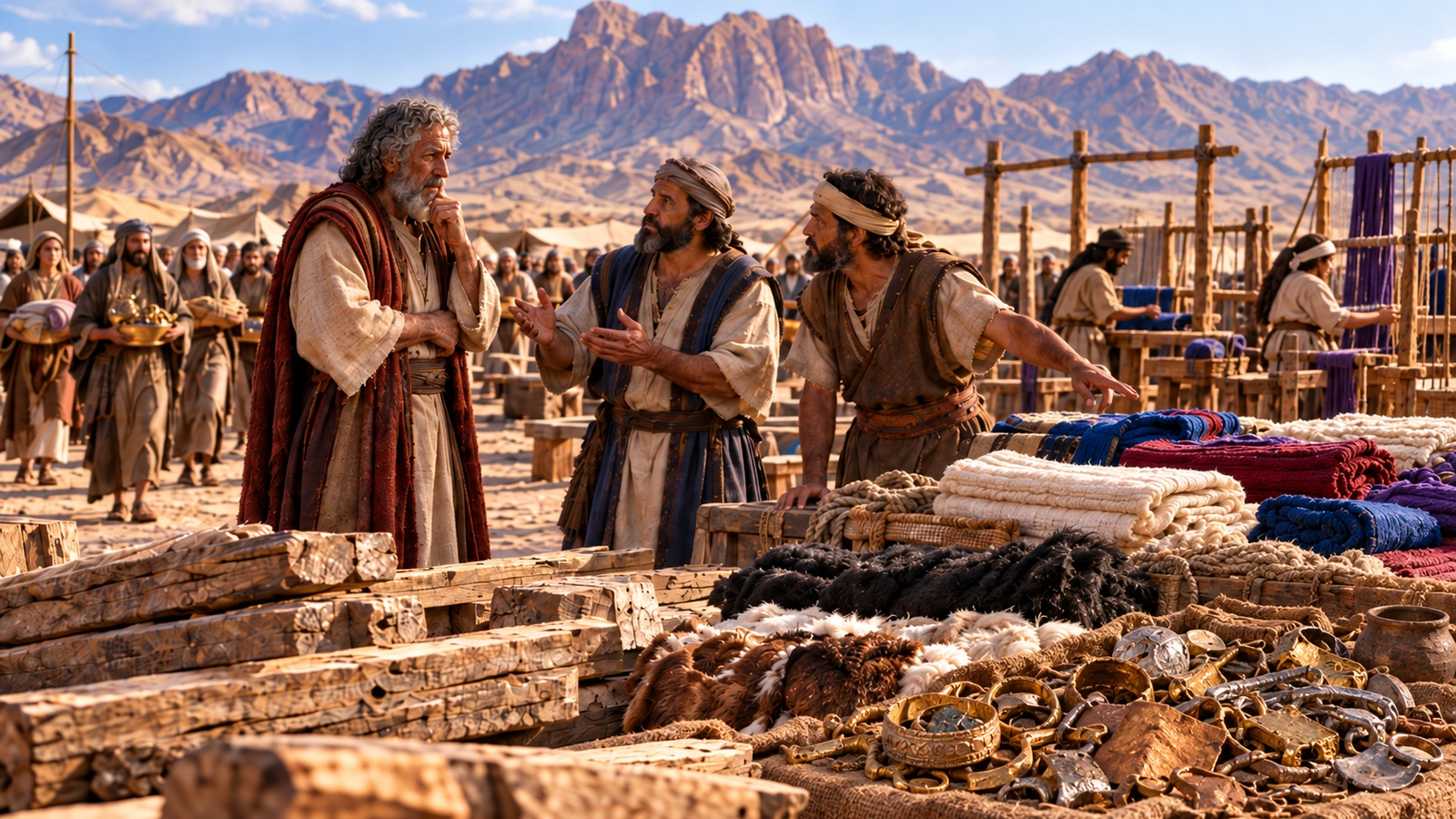
Figure 1. Artistic reconstruction of the elderly Jacob making Joseph swear not to bury him in Egypt, while the prosperity of Goshen remains visible around them, representing Genesis 47:27–31. |
Why Does God Tell Jacob, “Do Not Be Afraid to Go Down to Egypt ? ended with a promise containing two directions.
Jacob would go down.
God would later bring him up.
Seventeen years pass.
The family prospers in Goshen.
Then Jacob makes a request that turns the entire narrative back toward Canaan.
“Please do not bury me in Egypt.”
His demand seems strange.
Egypt saved his household from famine.
Joseph remains powerful there.
Israel possesses land and multiplies.
Why refuse an Egyptian grave?
Genesis answers through geography, oath language, ancestral burial, and an unfinished promise.
Jacob can live in Egypt.
He refuses to let Egypt define where his story ends.
Genesis First Makes Egypt Look Like Home
The chapter creates the problem deliberately.
Genesis 47:27 says:
וַיֵּאָחֲזוּ בָהּ — wayyēʾāḥăzû ḇāh
“They acquired holdings in it.”
Then Israel:
וַיִּפְרוּ וַיִּרְבּוּ מְאֹד — wayyip̄rû wayyirbû məʾōḏ
“was fruitful and multiplied greatly.”
Those verbs sound remarkably positive.
Famine brought Jacob’s household into Egypt.
Goshen now provides stability.
Joseph’s relatives are no longer temporary visitors seeking grain.
They have become settled residents.
That success makes Jacob’s next words more surprising.
Jacob Lives Seventeen Years in Egypt
Genesis gives an exact period.
Jacob lives there for seventeen years.
His total lifespan reaches 147.
Nothing in Genesis 47 suggests constant deprivation during those final decades.
Quite the opposite.
His descendants hold property.
They multiply.
Joseph remains near enough to be summoned.
Yet approaching death redirects Jacob’s attention elsewhere.
Egypt can sustain his final years.
It cannot receive his body permanently.
“Do Not Bury Me in Egypt”
Jacob calls Joseph.
His request begins politely:
אִם־נָא מָצָאתִי חֵן בְּעֵינֶיךָ — ʾim-nāʾ māṣāʾṯî ḥēn bəʿênêḵā
“If I have found favor in your eyes.”
Then comes the command:
אַל־נָא תִקְבְּרֵנִי בְּמִצְרָיִם — ʾal-nāʾ ṯiqbərēnî bəMiṣrayim
“Please do not bury me in Egypt.”
The negative statement comes first.
Jacob does not initially name a particular Canaanite tomb.
His immediate demand is geographical.
Egypt must not become his burial place.
The Request Is Stronger Than a Personal Preference
Joseph quickly agrees.
That should settle the matter.
It does not.
Jacob requires an oath.
The sequence is striking:
Joseph says:
“I will do as you have said.”
Jacob responds:
“Swear to me.”
Only after Joseph swears does the scene close.
A casual funeral preference would not require this level of solemnity.
The patriarch wants an obligation that survives his own death.
Joseph must guarantee the return.
“Kindness and Faithfulness” Carry Relational Weight
Before requesting burial elsewhere, Jacob asks Joseph to deal with him in:
חֶסֶד וֶאֱמֶת — ḥeseḏ weʾĕmeṯ
The pair can communicate loyal kindness, reliability, and faithfulness.
Translations vary because both terms possess broad semantic ranges.
Here the expression belongs to an oath-bound request.
Jacob asks for more than affection.
He wants dependable loyalty after he can no longer enforce his wishes.
Death will place the responsibility entirely in Joseph’s hands.
Why Does Jacob Ask Joseph Alone?
Jacob has eleven other sons.
Yet Joseph receives this responsibility.
Genesis does not explain the choice explicitly.
His position offers an obvious practical advantage.
Joseph possesses extraordinary authority in Egypt.
Transporting Jacob’s body outside the country will later involve Pharaoh’s permission.
Genesis 50 confirms that Joseph communicates with Pharaoh’s household before departure.
Choosing him therefore makes logistical sense.
A more intimate reason is possible.
The narrator never specifies one.
What Does “Put Your Hand Under My Thigh” Mean?
Jacob tells Joseph:
שִׂים־נָא יָדְךָ תַּחַת יְרֵכִי — śîm-nāʾ yāḏəḵā taḥaṯ yərēḵî
“Please put your hand under my thigh.”
Genesis contains a close parallel in chapter 24.
Abraham uses the same gesture while placing his servant under oath.
That correspondence shows that Genesis treats the action as oath-related.
Its exact symbolism remains disputed.
Some Jewish interpreters connected the gesture with circumcision.
Others understand the thigh as representing lineage or generative power.
The biblical text itself never explains the symbolism.
We should preserve that uncertainty.
What cannot be missed is its seriousness.
Jacob is formalizing Joseph’s obligation.
“When I Lie With My Fathers”
Jacob next says:
וְשָׁכַבְתִּי עִם־אֲבֹתַי — wəšāḵaḇtî ʿim-ʾăḇōṯay
“When I lie with my ancestors.”
Then:
וּנְשָׂאתַנִי מִמִּצְרַיִם — ûnəśāʾṯanî mimMiṣrayim
“carry me from Egypt.”
Finally:
וּקְבַרְתַּנִי בִּקְבֻרָתָם — ûqəḇarttanî biqbūrāṯām
“bury me in their burial place.”
The destination is relational before it becomes geographical.
Jacob wants burial with his ancestors.
Genesis 49 will identify the location explicitly.
Genesis 47 Does Not Yet Say “Machpelah”
This is a small but important correction.
Many summaries say Jacob immediately requests burial in Machpelah.
Genesis 47:29–31 does not name it.
The patriarch says:
“their burial place.”
Later, Genesis 49:29–32 removes the ambiguity.
Jacob identifies the cave in the field of Machpelah near Mamre.
He also names those buried there.
Abraham and Sarah.
Isaac and Rebekah.
Leah.
Reading Genesis 47 in light of chapter 49 is legitimate.
Claiming verse 30 itself names Machpelah is not.
Machpelah Was Abraham’s Purchased Property
Genesis 23 gives the tomb unusual importance.
Abraham acquires the field and cave from Ephron the Hittite.
The account carefully narrates negotiation and payment.
Sarah is buried there.
Later Abraham joins her.
Isaac and Rebekah follow.
Jacob says Leah is there as well.
This creates a striking contrast.
The patriarchs possess very little of Canaan.
Their family tomb is one securely acquired piece of ground.
Death becomes tied to a tangible foothold within the promised territory.
Jacob’s Grave Points Backward and Forward
Burial with his ancestors looks backward.
It joins Jacob to Abraham and Isaac.
Yet the same act points beyond his lifetime.
He will die before the territorial promise reaches fulfillment.
His grave remains inside the country associated with that future.
The burial request therefore works on two temporal levels.
It remembers previous generations.
It also refuses to treat the current Egyptian settlement as final.
Bronze Age Canaan Offers a Relevant Archaeological Parallel
Archaeology cannot identify Jacob’s tomb.
It can illuminate the burial world surrounding Genesis.
Bronze Age communities across the southern Levant practiced several forms of interment.
Caves and shaft tombs were especially important in many regions.
Some burial chambers contained multiple individuals.
At Jebel Qaaqir, radiocarbon research found human remains spanning centuries.
Researchers suggest that such evidence can reflect long-lived family or tribal burial traditions.
Other Canaanite tombs were reused across generations.
Later Bronze Age evidence likewise shows continued cave burial traditions.
That context makes ancestral burial culturally intelligible.
It does not prove the identification of Machpelah.
Archaeology Cannot Verify the Patriarchal Tomb
Hebron contains the traditional site associated with Machpelah.
Its later religious history is extraordinarily rich.
That history cannot independently demonstrate that the Genesis patriarchs were buried there.
The biblical claim and archaeological verification must remain separate.
We possess no excavated inscription reading:
“Jacob son of Isaac.”
Neither can existing remains establish the patriarchal chronology.
Historical context helps us understand burial customs.
It cannot substitute for missing direct evidence.
Egypt Had Its Own Powerful Culture of Death
Jacob’s refusal becomes sharper within an Egyptian setting.
Few ancient societies invested more heavily in burial.
Egyptian tombs, mortuary equipment, embalming traditions, and funerary texts are archaeologically abundant.
Genesis itself will acknowledge that world.
After Jacob dies, Joseph orders Egyptian physicians to embalm his father.
The process takes forty days.
Egypt mourns him for seventy.
Jacob therefore receives substantial Egyptian funerary treatment.
Yet the body does not remain there.
That combination is significant.
Egyptian preparation serves a Canaanite destination.
Jacob Does Not Reject Everything Egyptian
This prevents another overreading.
His burial instructions are not a blanket condemnation of Egypt.
Egypt preserved his household.
Pharaoh treated the family favorably.
Joseph’s position provided security.
Jacob himself lives there for seventeen years.
Later, Egyptian embalming prepares his body for transport.
The tension concerns permanence.
Provision is accepted.
Final belonging remains elsewhere.
Genesis Places Israel’s Prosperity Beside Egypt’s Economic Crisis
The wider chapter makes the contrast difficult to ignore.
During famine, Egyptians exhaust their money.
Livestock passes to Pharaoh.
Land eventually follows.
Joseph institutes a continuing fifth for the crown.
Meanwhile Genesis 47:27 describes Israel differently.
The household settles in Goshen.
It acquires holdings.
Its population increases.
The literary juxtaposition is remarkable.
Yet we should avoid oversimplifying it into moral judgment.
Genesis does not say every Egyptian was cursed while Israel was rewarded.
The economic policy and Israelite settlement serve different narrative functions.
Prosperity Creates a New Danger for the Reader
Goshen now works remarkably well.
That success can alter expectations.
Readers might begin imagining Egypt as the permanent answer to famine.
Jacob’s oath disrupts that possibility.
Material security does not redefine the land promise.
His descendants may prosper outside Canaan.
The ancestral burial ground still pulls the narrative back.
This creates one of Genesis 47’s strongest reversals.
The chapter expands Israel’s roots in Egypt.
Its ending refuses to let those roots become ultimate.
Is Jacob’s Request Explicitly Called an Act of Faith?
Genesis does not use that phrase.
The older article described the burial decision as a “declaration of faith.”
That is a reasonable theological interpretation.
It should not be confused with the narrator’s wording.
The text gives us stronger evidence than an abstract label.
Jacob remembers ancestral burial.
He insists on removal from Egypt.
He requires an oath.
Later he identifies the purchased Canaanite tomb.
Those actions demonstrate how seriously he treats the family’s attachment to the promised territory.
Does Jacob Know the Exodus Is Coming?
Genesis never says he foresees Moses.
He does know more than immediate circumstances, however.
God has just promised:
“I will surely bring you up again.”
The Abraham narrative also contains the earlier prediction of foreign residence and eventual return.
How precisely Jacob understands the future is not explained.
Readers of Genesis can see the larger trajectory.
We should not place that complete perspective inside Jacob’s mind without textual warrant.
His burial request aligns with the future exodus.
It is not presented as a detailed prophecy of it.
The Language of “Going Up” Returns
Genesis 46 promised:
“I will surely bring you up again.”
Jacob now tells Joseph:
“carry me from Egypt.”
Genesis 50 will repeatedly describe the funeral procession as going up.
Joseph “goes up” to bury his father.
Egyptian officials travel with him.
Chariots and horsemen join the procession.
Jacob’s corpse makes the geographical ascent before the nation does.
That connection does not exhaust Genesis 46:4.
It gives the promise an immediate fulfillment inside Jacob’s own story.
His Burial Becomes a Small Exodus Before Exodus
The analogy must remain literary, not identical.
Jacob dies in Egypt.
His body leaves.
A large company travels toward Canaan.
He is buried there.
Then Joseph’s household returns to Egypt.
Nothing resembling national liberation has occurred.
Yet the movement anticipates a larger geographical pattern.
Egypt → Canaan.
Death → burial in the ancestral land.
Temporary residence → return.
Genesis begins rehearsing a route the next biblical book will enlarge dramatically.
Joseph Will Make a Similar Demand
Jacob is not the last person to refuse permanent burial in Egypt.
Genesis 50 ends with Joseph himself dying there.
His instructions resemble his father’s in purpose but differ in timing.
Joseph does not demand immediate burial in Canaan.
Instead, he makes Israel swear to carry his bones when God brings them out.
That difference matters.
Jacob’s body leaves almost immediately.
Joseph’s remains must wait.
Both deaths point away from Egypt.
The book ends with a corpse still awaiting the promised ascent.
Jacob’s Oath Creates a Pattern Joseph Will Inherit
Genesis 47 contains:
“Swear to me.”
Genesis 50 contains another oath involving burial.
The dying father binds Joseph.
Later Joseph binds Israel’s descendants.
Funeral instructions become intergenerational commitments.
Memory must survive the people who received the original promises.
The dead cannot move themselves.
The living must carry the promise forward.
That gives burial an unusual narrative function.
A grave becomes an act of continuity.
Why Not Simply Be Buried Near Joseph?
From an emotional perspective, Egypt offers obvious reasons.
Joseph lives there.
Jacob’s descendants now reside there.
His final seventeen years unfold there.
Nothing in the chapter says he hates the country.
Yet burial with Joseph is not his request.
He chooses the tomb containing earlier generations.
Family identity runs backward through Abraham and Isaac.
The chosen grave locates Jacob inside that lineage.
Joseph belongs to the future of Israel.
Machpelah ties Jacob to its past.
Leah’s Presence Makes the Family Tomb More Complex
Genesis 49 adds an often-overlooked detail.
Jacob says Leah is buried at Machpelah.
Rachel is not.
Rachel died near Bethlehem and received a separate grave.
Jacob’s chosen burial location therefore cannot simply be explained as romantic attachment.
He does not ask to lie beside Rachel.
He chooses the ancestral tomb.
That strengthens the territorial and dynastic dimensions of his request.
The grave connects him to the patriarchal family structure.
The Text Never Says “My Body Belongs to Canaan”
Another common formulation goes too far.
Jacob never speaks those exact words.
His actions make attachment to Canaan unmistakable.
Still, precision matters.
He asks not to be buried in Egypt.
He requests burial with his ancestors.
Chapter 49 specifies their Canaanite tomb.
The theological meaning emerges from those details.
We do not need to invent a speech for him.
The Oath Also Protects the Request Politically
Joseph’s promise soon faces a practical problem.
After Jacob dies, Joseph does not simply leave Egypt.
He seeks permission from Pharaoh’s household.
The burial journey becomes a major state-supported procession.
An oath gives Joseph a reason he can present publicly.
Genesis 50:5 quotes Jacob’s command when requesting permission.
The dying patriarch’s sworn requirement therefore matters beyond symbolism.
It has political consequences.
Joseph can say:
“My father made me swear.”
Pharaoh Allows the Burial
The king grants permission.
Joseph travels to Canaan.
He is accompanied by Pharaoh’s servants, household elders, and Egyptian dignitaries.
Chariots and horsemen also go.
Genesis describes the company as very great.
The funeral becomes almost paradoxical.
Jacob refuses burial in Egypt.
Egypt itself helps carry him home.
His adopted country honors the decision not to remain there.
That nuance prevents crude anti-Egyptian interpretation.
Egypt Is Refuge Before It Becomes Bondage
Readers know what comes later.
Another Pharaoh will arise.
Israel’s multiplication will become threatening.
Forced labor will follow.
Genesis 47 has not reached that world.
Its Pharaoh supports Joseph.
His administration sustains Jacob.
Egypt is currently refuge.
The burial oath still looks toward Canaan before oppression gives Israel another reason to leave.
That chronology matters enormously.
Jacob’s choice is not merely an escape from Egyptian persecution.
No such persecution exists yet.
His request precedes it.
The Deeper Discovery
Jacob’s refusal becomes most revealing when placed beside Genesis 46.
Before entering Egypt, he hears:
“I will go down with you.”
Near death, he says:
“Do not bury me in Egypt.”
Those statements are not contradictions.
Together they define the theological geography of Jacob’s final years.
Divine presence allows him to descend.
The ancestral promise prevents the descent from becoming permanent.
Egypt can be a place where God accompanies.
Canaan can remain the land toward which the family’s future points.
One does not cancel the other.
The deeper literary reversal appears in Jacob’s prosperity.
If Egypt were miserable from the beginning, refusing burial there would require little explanation.
Genesis does the opposite.
Jacob experiences safety.
His descendants multiply.
Joseph holds power.
Pharaoh remains favorable.
The temptation created for the reader is stronger precisely because Egypt works.
Then Jacob orders his body removed.
His request exposes the distinction between provision and inheritance.
The place preserving the family during famine is not automatically its final destination.
That is why the grave matters.
Jacob cannot possess Canaan in the fullness promised to his descendants.
He can choose where his bones will wait.
The family tomb becomes a physical refusal to interpret present prosperity as completed promise.
Yet Jacob has one more astonishing act before death.
Joseph arrives with two Egyptian-born sons.
Manasseh is the firstborn.
Ephraim is younger.
Joseph carefully positions them so Jacob’s right hand will fall on Manasseh.
The old patriarch crosses his hands.
For the fourth time in Genesis, the expected heir loses first place.
Why Does Jacob Bless the Younger Son Instead of the Firstborn?
Selected Sources
- Gordon J. Wenham, Genesis 16–50, Word Biblical Commentary.
- Victor P. Hamilton, The Book of Genesis: Chapters 18–50, Eerdmans.
- Nahum M. Sarna, The JPS Torah Commentary: Genesis, Jewish Publication Society.
- Robert Alter, The Hebrew Bible: A Translation with Commentary, W. W. Norton.
- Kenneth A. Mathews, Genesis 11:27–50:26, New American Commentary.
- Claus Westermann, Genesis 37–50: A Commentary.
- Raphael Greenberg, The Archaeology of the Bronze Age Levant: From Urban Origins to the Demise of City-States, 3700–1000 BCE, Cambridge University Press.
- Ronny Levy and Elisabetta Boaretto et al., “Chronology of IBA Shaft Tombs in the Southern Levant,” Radiocarbon 64.5 (2022): 969–987.