Why Was the Bronze Altar Placed Outside the Tabernacle?
Exodus 27 Explained: The Bronze Altar, Its Horns, the Courtyard, the Eastern Entrance, and the Oil for the Lamps
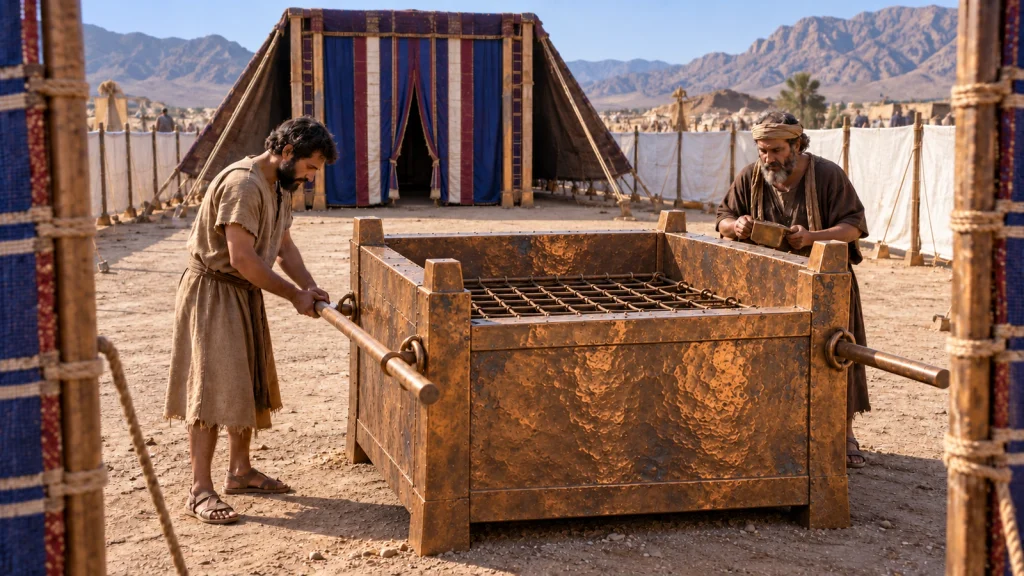
Source: AI-generated image created for Beyond The Known.
Exodus 26 ended at the veil.
Behind it stood the ark, hidden inside the Most Holy Place. In the previous study, Why Did the Tabernacle Need Curtains, Veils, and Sacred Boundaries?, we saw how the sanctuary brought YHWH into Israel’s midst while preserving carefully ordered limits around his presence.
Exodus 27 takes the reader back outside.
Before anyone reaches the tent, there is an altar.
It is large, square, covered with bronze, and equipped for fire, ash, blood, and sacrifice. Horns rise from its four corners. Poles allow it to travel with the camp.
Its position is striking.
The ark marks the innermost center of the sanctuary. The altar does not stand beside it.
It stands outside.
Why?
The First Major Object Outside the Tent
The instructions have been moving inward.
Exodus 25 described the ark, table, and menorah.
Exodus 26 enclosed them with curtains, frames, and the veil.
Then the direction changes.
The bronze altar belongs in the courtyard, not inside the tabernacle.
Exodus 27:1–8 describes its construction without yet giving its final position, but later instructions remove any doubt. When the sanctuary is assembled, the altar is placed before the entrance to the tent.
That means sacrifice occurs along the route of approach.
The altar is outside the sacred interior, but it is not incidental to it.
Anyone moving toward the dwelling encounters it first.
What Kind of Altar Was It?
The Hebrew noun is:
מִזְבֵּחַ — mizbēaḥ — altar
It belongs to the same lexical family as the verb associated with sacrifice, although by biblical Hebrew the noun simply functions as the normal term for an altar.
Its dimensions are substantial:
five cubits long,
five cubits wide,
three cubits high.
It is made from acacia wood and overlaid with:
נְחֹשֶׁת — nəḥōšet — copper / bronze
“Bronze altar” is the traditional English name, though the Hebrew word itself does not identify a modern alloy with chemical precision.
The difference from the furnishings inside the tabernacle is immediately visible.
There, gold dominates.
Here, bronze does.
Why Bronze Instead of Gold?
Exodus never gives a symbolic key in which gold means one theological idea and bronze another.
So we should not invent one.
The practical contrast is already meaningful.
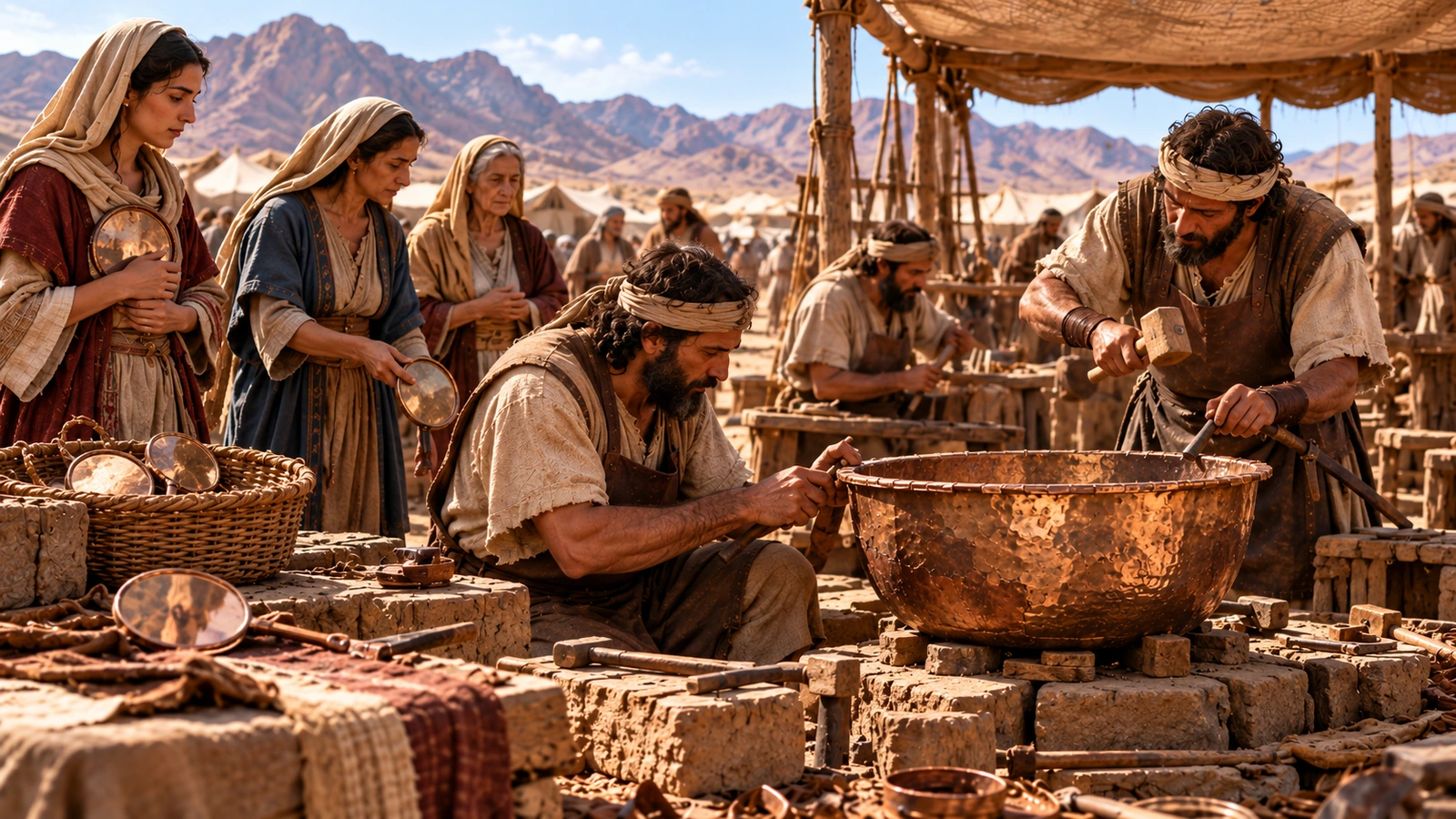
The altar will be exposed to heat, ash, sacrificial material, tools, and repeated outdoor use. Its utensils are made from the same metal.
Its location also fits a broader material pattern.
Gold becomes increasingly prominent as the sanctuary moves toward its inner center.
Bronze appears more strongly in the outer areas.
The distinction is spatial as much as decorative.
The altar belongs to the working environment of the courtyard.
A Portable Altar Built for Fire
The altar is large, yet it must travel.
Rings are attached to it, and bronze-covered acacia poles allow it to be carried.
Verse 8 adds a detail that has puzzled interpreters:
the structure is to be hollow with boards.
That raises an obvious question.
How was fire used safely in a wooden altar covered with metal?
Some reconstructions suggest that the hollow interior may have been filled with earth or stones when the sanctuary was set up, sometimes connecting this possibility with the altar instructions of Exodus 20:24–25.
It is a reasonable proposal.
It is not stated in Exodus 27.
The chapter gives us enough to know that the altar was designed for both sacrificial use and transport, but not enough to produce a single unquestionable engineering reconstruction.
The Bronze Network
Another difficult feature is the:
מִכְבָּר — miḵbār — grating / network
made of bronze.
It is associated with a ledge and positioned so that it reaches about halfway up the altar.
Modern illustrations disagree over how this system worked.
Some place the network inside as part of the fire-support structure.
Others understand it differently in relation to the altar’s outer ledge.
The Hebrew instructions are detailed, but they are not a modern technical drawing.
What is certain is more useful than forcing precision where the passage does not provide it.
This altar was built for repeated ritual use.
Its design had to accommodate fire, handling, transport, and sacrificial activity.
Why Did the Altar Have Horns?
At each corner stood a horn:
קְרָנוֹת — qərānôt — horns
The four projections were made as part of the altar itself.
They were not decorative pieces attached afterward.
Exodus 27 does not yet explain their ritual function.
Later passages do more with them.
Blood is applied to altar horns in certain sacrifices, and in later narratives individuals grasp the horns of an altar while seeking protection.
Archaeology provides a useful comparison.
Four-horned stone altars have been found at Iron Age sites in the southern Levant, including the well-known altar from Beer-sheba.
That does not prove the existence of the wilderness altar described here.
The material, historical setting, and construction are different.
What those finds show is that horned altars belonged to the religious landscape of the region in later periods.
They give context without turning archaeology into verification.
Why Was the Altar Outside?
The answer begins with location.
The ark is associated with YHWH’s presence and speech.
The bronze altar is associated with sacrifice.
Those functions belong to the same sanctuary system, but not to the same room.
The altar stands before the tent.
The ark stands behind the veil.
That spatial arrangement tells the reader something before Leviticus ever explains the sacrificial system in detail.
Sacrifice belongs to approach.
A worshiper does not move deep into the sacred interior and then encounter the altar.
The altar is encountered first.
Later law will explain what happens with animals, blood, fire, fat, and priestly actions.
Exodus 27 first establishes where that activity belongs.
The Courtyard Creates a Middle Zone
After describing the altar, the chapter turns to the enclosure surrounding the tabernacle.
The Hebrew term is:
חָצֵר — ḥāṣēr — courtyard / enclosure
Fine linen hangings mark its perimeter.
The court measures one hundred cubits long and fifty cubits wide, with curtains five cubits high.
Bronze bases support the posts. Silver is used for hooks and connecting pieces.
This creates a space that is neither the ordinary camp nor the interior of the tent.
It is an intermediate zone.
That matters.
The sanctuary does not move directly from everyday Israelite life to the ark behind the veil.
There are stages.
The courtyard is one of them.
And the altar occupies that transitional space.
An Entrance on the Eastern Side
The court is enclosed, but it is not sealed.
Its entrance faces east.
A twenty-cubit screen marks the opening, woven from blue, purple, and scarlet yarn with fine linen.
The entrance is therefore visually distinct from much of the plain perimeter.
Exodus gives no explanation for the eastern orientation.
Later readers have proposed symbolic meanings, but the chapter itself does not supply one.
The architectural point is clearer.
There is a designated way in.
Sacred space is accessible, but approach is directed.
A Geography of Increasing Restriction
By this point in Exodus, the sanctuary can be mapped in layers.
The camp surrounds the sacred precinct.
Inside the courtyard stands the bronze altar.
Beyond it lies the entrance to the tent.
Then comes the Holy Place.
Farther in, the veil.
Behind that, the Most Holy Place.
And there stands the ark.
This is not simply a division between “sacred” and “ordinary.”
It is a progression.
The closer the movement comes to the center, the tighter the restrictions become.
That is why the altar’s outdoor position should not be read as a sign of lesser importance.
Its significance comes from standing exactly where it does.
It marks the sacrificial threshold of approach.
Two Altars, Two Locations
Later in Exodus another altar appears.
It is smaller.
It is covered with gold.
It stands inside the sanctuary and is used for incense.
That object, introduced in Exodus 30, must not be confused with the altar of Exodus 27.
The bronze altar belongs to the courtyard and receives sacrifices.
The incense altar belongs inside the Holy Place.
Their different materials and locations correspond to different ritual functions.
The sanctuary is not organized around one undifferentiated concept of “altar.”
It assigns different acts to different places.
The Tools Make the Scene Physical
The chapter lists several bronze utensils:
containers for ash,
shovels,
basins,
forks,
firepans.
That inventory prevents us from turning the altar into a purely symbolic object.
Sacrifice generates work.
Ash must be removed.
Fire must be managed.
Material must be handled.
Liquids require vessels.
One of the relevant Hebrew terms is:
מִזְרָק — mizrāq — basin / bowl
The word appears in sacrificial contexts elsewhere in the Hebrew Bible.
Archaeologists have proposed possible parallels between such terminology and shallow metal vessels found at cultic sites, though those identifications remain comparative rather than certain.
The value of such evidence is material.
It helps us imagine ritual as something carried out with real tools, surfaces, fire, liquids, and labor.
Then the Chapter Suddenly Turns to Oil
After the altar and courtyard instructions, Exodus 27:20 changes subject.
Israel must bring:
שֶׁמֶן זַיִת זָךְ כָּתִית — šemen zayit zāḵ kātît — pure beaten olive oil
for the lamps.
The phrase is practical.
זָךְ — zāḵ describes the oil as pure or clear.
כָּתִית — kātît refers to olives processed by beating or crushing.
The purpose is illumination.
Nothing in this verse says that the oil symbolizes the Holy Spirit, personal suffering, or spiritual pressure.
Those interpretations may appear in later preaching, but they should not be read into the wording of Exodus 27.
The lamps need suitable fuel.
Israel must supply it.
Did the Lamps Burn All Day and All Night?
The phrase:
לְהַעֲלֹת נֵר תָּמִיד — ləhaʿălōt nēr tāmîd
is often translated as keeping the lamp burning continually.
The word:
תָּמִיד — tāmîd — continually / regularly
can suggest uninterrupted activity if read by itself.
But the next verse specifies the period of priestly tending:
from evening until morning.
That schedule should govern how the phrase is understood here.
The emphasis is on recurring, ongoing service through the night, not necessarily on an explicit claim that the lamps burned every moment of a twenty-four-hour day.
Later Jewish tradition would develop the familiar expression ner tamid, “eternal light.”
That later usage should remain distinct from the immediate wording of this passage.
Aaron and His Sons Appear at the End
The final verse introduces Aaron and his sons.
Until now, the sanctuary instructions have concentrated primarily on things.
Furniture.
Curtains.
Frames.
Altars.
Courtyards.
Now people responsible for ongoing service enter the picture.
Aaron and his sons must tend the lamps before YHWH from evening until morning.
That transition prepares Exodus 28.
The next chapter will no longer focus mainly on what the sanctuary contains.
It will focus on how its priests are clothed and identified.
The shift is natural.
A sacred space may be constructed once.
Its service must continue.
The Chapter Begins with Fire and Ends with Light
Exodus 27 opens with an altar built for sacrifice.
It closes with lamps that must be maintained through the night.
The two flames are not given the same meaning.
The altar fire consumes offerings.
The lamps illuminate the sanctuary.
The chapter never tells us to collapse them into one symbol.
But the literary movement is still worth noticing.
The reader begins in the courtyard and ends closer to the veil.
Outside, sacrifice.
Inside, light.
And between those two locations stands an emerging priestly service.
The Deeper Discovery
The most revealing shift in Exodus 27 may not be architectural at all.
For several chapters, the dominant command has been to make.
Make an ark.
Make a table.
Make a menorah.
Make curtains.
Make frames.
Make a veil.
Make an altar.
Construct a courtyard.
Each instruction aims toward completion.
Once the object is finished, it exists.
Then verse 20 changes the pattern.
Israel must keep bringing oil.
Oil disappears as it is used.
Tomorrow will require more.
Aaron and his sons must return again.
And again.
For the first time in this long sequence of construction instructions, the emphasis moves decisively from building the sanctuary to maintaining its service.
That transition prepares the reader for what comes next.
The tabernacle does not become functional merely because every piece has been manufactured and placed correctly.
It requires people.
It requires provision.
It requires repeated work.
Exodus 27 begins with an altar that can be built.
It ends with a responsibility that cannot be finished once and for all.
That is why Aaron appears at precisely this point.
The sanctuary now needs priests.
FAQ
Why was the bronze altar placed outside the tabernacle?
The altar of burnt offering stood in the courtyard, along the route toward the tent. Later in Exodus it is explicitly positioned before the tabernacle entrance, placing sacrificial activity before access to the inner sanctuary.
Was the altar made entirely from bronze?
No. It was constructed from acacia wood and overlaid with nəḥōšet, conventionally translated “bronze.” The grating and ritual utensils were also made from this metal.
What were the horns on the altar?
They were projections formed at the altar’s four corners. Exodus 27 does not explain their function, but later passages associate altar horns with blood rituals and, in some narratives, with seeking protection.
Does archaeology prove the bronze altar existed?
No. Archaeologists have found later horned altars at sites such as Beer-sheba. These objects provide cultural parallels but do not verify the wilderness altar described in Exodus 27.
Why did the tabernacle need a courtyard?
The courtyard formed an intermediate sacred enclosure between Israel’s camp and the tent. It contained the bronze altar and created a defined route toward the more restricted interior.
Did the lamps burn continuously?
Exodus uses tāmîd, “continually” or “regularly,” but also specifies that Aaron and his sons tend the lamps from evening until morning. The immediate passage therefore emphasizes recurring nighttime service.
Why are Aaron and his sons mentioned at the end of the chapter?
They are assigned responsibility for the lamps. Their introduction prepares Exodus 28, which shifts attention from sacred architecture to the priests who serve within it.
The sanctuary now has an altar outside.
A courtyard surrounds the tent.
Inside, the lamps must be tended through the night.
But the men who serve there are about to receive garments unlike anything worn elsewhere in Israel.
Gold.
Colored yarn.
Engraved stones.
And, most strikingly, the names of the twelve tribes carried on the body of the high priest.
Why should one man bear Israel’s names when he enters before YHWH?
Why Did Israel’s High Priest Wear the Names of the Twelve Tribes?
courtyard, lamp oil, and the order of sacred approach.
Selected Sources
- Yohanan Aharoni, “The Horned Altar of Beer-sheba.” The Biblical Archaeologist 37.1 (1974): 2–6.
- Brevard S. Childs, The Book of Exodus: A Critical, Theological Commentary. Old Testament Library. Westminster Press, 1974.
- John I. Durham, Exodus. Word Biblical Commentary 3. Word Books, 1987.
- Jonathan S. Greer, “An Israelite ‘Mizrāq’ at Tel Dan?” Bulletin of the American Schools of Oriental Research 358 (2010).
- Carol L. Meyers, Exodus. New Cambridge Bible Commentary. Cambridge University Press, 2005.
- William H. C. Propp, Exodus 19–40: A New Translation with Introduction and Commentary. Anchor Bible 2A. Doubleday, 2006.
- Nahum M. Sarna, Exodus: The Traditional Hebrew Text with the New JPS Translation. JPS Torah Commentary. Jewish Publication Society, 1991.