Why Did the Tabernacle Need an Altar of Incense?
Exodus 30 Explained: The Incense Altar, Census Ransom, Priestly Washing, Sacred Oil, and Holy Incense
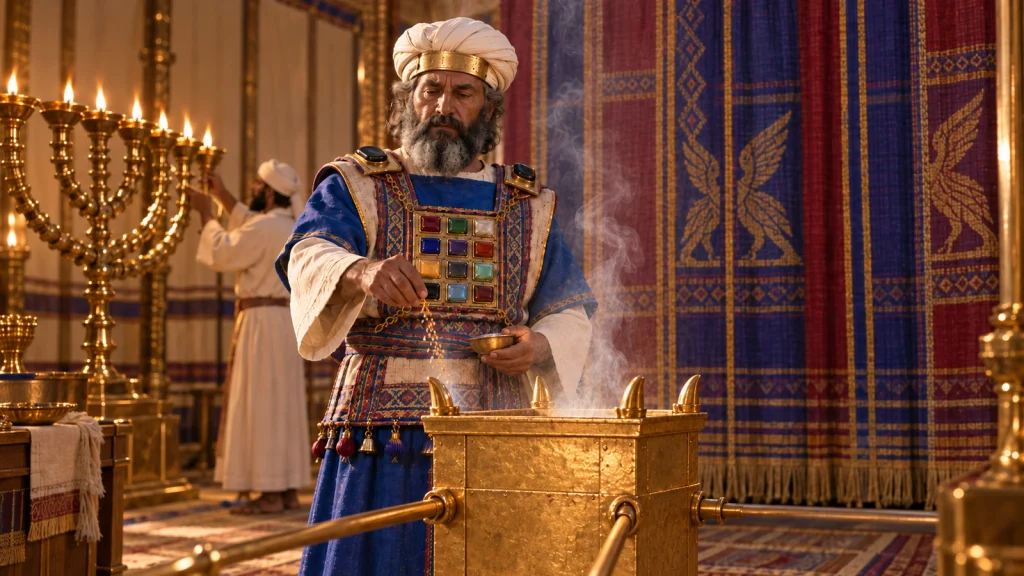
Source: AI-generated image created for Beyond The Known.
Exodus 29 ended with the purpose of the sanctuary stated in unusually direct language.
YHWH would meet Israel there.
He would dwell among them.
The previous study, Why Was Blood Put on the Priests’ Ear, Thumb, and Toe?, followed the installation of Aaron and his sons. The priests were consecrated, the altar prepared, and the morning-and-evening sacrifices established.
Exodus 30 now introduces another altar.
It is much smaller than the bronze altar outside the tent. It is covered with gold. No ordinary burnt offering belongs on it.
Instead, fragrant incense rises from it every morning and evening.
And it stands directly before the veil.
Why did the tabernacle need an altar of incense?
The Golden Altar Stood Before the Veil
The altar is made from acacia wood and overlaid with pure gold.
It measures one cubit square and two cubits high. Its horns are made as part of the altar itself, and gold-covered poles allow it to be transported with the sanctuary.
Its location is more important than its size.
Moses is told to place it before the veil, in front of the ark of the testimony and the cover associated with YHWH’s meeting with him.
The altar therefore remains outside the Most Holy Place.
The veil still marks the boundary.
Yet among the regularly used furnishings of the Holy Place, the incense altar stands in striking proximity to that boundary.
The priest burns incense only a veil away from the ark.
Incense Belonged to the Daily Rhythm of the Sanctuary
The central Hebrew term is:
קְטֹרֶת — qəṭōret — incense / aromatic smoke
Aaron burns the prescribed incense in the morning when he tends the lamps and again toward evening when he prepares them.
The two activities are deliberately paired.
The lampstand and incense altar participate in the same daily rhythm.
Exodus describes the incense as continual or regular before YHWH throughout Israel’s generations. Here the pattern is clear from the instructions themselves: incense returns morning and evening.
This is not an occasional act performed when someone feels especially devout.
It belongs to the sanctuary’s regular service.
Does the Incense Represent Prayer?
Later biblical texts make that connection.
Psalm 141:2 compares prayer rising before God with incense, and later Jewish and Christian traditions developed the imagery extensively.
That is not the explanation Exodus 30 gives.
Within this chapter, incense is first of all a prescribed sanctuary offering made at a particular place, according to a particular formula, at particular times.
The later association with prayer can be discussed as a canonical development.
It should not be presented as though Exodus itself pauses to decode the incense that way.
That distinction lets the chapter speak in its own terms before later theology is brought into the discussion.
The Golden Altar Was Not a Smaller Sacrificial Altar
The restrictions in verse 9 make the altar’s specialized function unmistakable.
Israel must not place unauthorized incense on it.
No burnt offering.
No grain offering.
No drink offering.
The bronze altar in the courtyard and the gold altar before the veil are both called altars, but they are not interchangeable.
Each belongs to a different ritual task.
This is one of the recurring features of the tabernacle instructions: sacred objects receive specific functions, and those functions establish limits on how they may be used.
The gold altar exists for incense.
That purpose cannot be casually expanded.
Once a Year, Blood Reaches Its Horns
The altar’s normal service involves fragrance, but blood is not completely absent from it.
Once each year, Aaron is to make atonement on its horns with blood from the purification offering.
Leviticus 16 later provides the fuller setting for the annual atonement rites. Exodus 30 introduces the requirement without explaining every procedural detail.
That annual use reveals something important about the altar.
It is not merely a stand for producing pleasant fragrance.
It belongs to the sanctuary system that must itself be ritually maintained.
Even an altar devoted to incense participates in atonement.
Why Does the Chapter Suddenly Turn to a Census?
After ten verses about incense, the subject changes abruptly.
When Israel is counted, those enrolled must give YHWH what the text calls:
כֹּפֶר נַפְשׁוֹ — kōfer napšô — ransom for his life / person
The payment is half a shekel according to the sanctuary standard.
The stated consequence is serious.
Without the required payment, a plague may come upon the people during the census.
The relationship between counting and danger is not explained in detail. The passage assumes the connection rather than constructing a theory for it.
That uncertainty has generated many later explanations.
What the text itself establishes is simpler: enrollment creates a situation in which ransom or expiation is required, and the half-shekel addresses it.
The Rich and Poor Pay the Same Amount
Those enrolled from age twenty and above give the same half-shekel.
The wealthy may not increase it.
The poor may not reduce it.
This particular payment does not scale with wealth.
The money is then assigned to the service of the Tent of Meeting and serves as a memorial before YHWH for the Israelites.
That combination is easy to overlook.
The silver is connected both with the lives of those being counted and with the maintenance of the sanctuary.
The census section therefore belongs more naturally beside the tabernacle instructions than it might first appear.
Consecrated Priests Still Have to Wash
The next object is a bronze basin placed between the Tent of Meeting and the altar.
The Hebrew term is:
כִּיּוֹר — kiyyôr — basin / laver
Aaron and his sons wash their hands and feet from it before entering the Tent of Meeting and before approaching the altar to minister.
The warning is repeated:
they wash so that they do not die.
This is not the same washing described during their installation in Exodus 29.
That earlier washing belonged to the process by which they entered priestly service.
The basin establishes a recurring requirement.
Ordination did not make future preparation unnecessary.
A consecrated priest still approaches the sanctuary under prescribed conditions.
Hands and Feet Do Not Need an Invented Symbolic Code
It can be tempting to read the hands as “service” and the feet as “one’s walk,” just as interpreters often assign fixed symbolic meanings to the ear, thumb, and toe in Exodus 29.
Exodus 30 does not require that system.
Hands and feet are simply the body parts specifically named for washing before priestly service.
The larger point is secure without turning each body part into a theological cipher.
Priestly access is regulated.
Being a priest does not mean unrestricted familiarity with sacred space.
Sacred Oil Is Made for Sacred Use
The chapter next gives the formula for a special anointing oil.
Myrrh, cinnamon, aromatic cane, cassia, and olive oil are combined by the work of a skilled perfumer.
The mixture is called:
שֶׁמֶן מִשְׁחַת־קֹדֶשׁ — šemen mišḥat-qōdeš — holy anointing oil
It is used on the Tent of Meeting, the ark, the table, the lampstand, both altars, the basin, their associated utensils, and the priests.
The oil therefore moves across the sanctuary system.
Objects and people are prepared for sacred service through the same prescribed substance.
Exodus is more interested in the oil’s function than in extracting symbolic meanings from each ingredient.
The Formula Could Not Become an Ordinary Fragrance
The oil is not available for unrestricted use.
Israel may not reproduce the same composition for ordinary purposes, nor may it be poured on an unauthorized person.
The prohibition protects a distinction the chapter repeatedly reinforces.
The ingredients themselves are not forbidden substances.
Olive oil and aromatics existed outside the sanctuary.
What is restricted is this particular formula and the use assigned to it.
Sacredness here involves designation.
A substance prepared for sanctuary use is not treated as common perfume.
The Incense Formula Is Also Restricted
The chapter closes where it began: with fragrance.
Moses receives instructions for another perfumer’s mixture, traditionally translated with ingredients such as stacte, onycha, galbanum, and pure frankincense.
Those English names should not create false confidence.
Ancient aromatic vocabulary does not map neatly onto modern botanical or zoological classification. The identification of some terms, especially nataf and sheḥelet, remains debated, while frankincense and galbanum are more securely understood.
The ingredients are combined in prescribed proportions, seasoned with salt, and prepared as something pure and holy.
Part of the mixture is ground finely and placed before the testimony at the Tent of Meeting.
The chapter thus returns the reader to the sanctuary’s inner zone.
Israel Was Forbidden to Copy the Incense for Personal Enjoyment
The restriction is even more striking than the recipe.
The Israelites may not reproduce this incense simply because they enjoy its fragrance.
Anyone who makes an equivalent mixture for personal use violates the distinction established for the sanctuary.
The same logic appeared with the anointing oil.
Aroma itself is not condemned.
The issue is appropriation.
A formula assigned to YHWH’s service cannot be converted into a private luxury.
Exodus 30 Is More Coherent Than It First Appears
At first reading, the chapter can feel like five unrelated instructions placed beside one another:
an incense altar,
a census payment,
a bronze basin,
anointing oil,
and sacred incense.
But they share a practical concern.
Exodus 25–29 largely established the sanctuary, its major furnishings, its priests, and its sacrifices.
Exodus 30 repeatedly asks what happens after those things exist.
Incense must be burned morning and evening.
A census requires a ransom.
Priests must wash whenever they approach.
The sacred oil must remain reserved.
The incense formula must remain reserved.
The sanctuary cannot function merely because it was constructed correctly.
It has to be used correctly.
The Deeper Discovery
There is an important shift between the earlier tabernacle chapters and Exodus 30.
The earlier instructions are dominated by construction:
make the ark,
make the table,
make the lampstand,
make the curtains,
make the altar,
make the garments.
Exodus 30 still includes making, but its distinctive emphasis falls on maintenance and repeated practice.
Burn the incense again tomorrow morning.
Wash again before approaching.
Preserve the oil’s special use.
Preserve the incense’s special use.
When the people are counted, deal properly with the census.
Once the sanctuary has been built, holiness becomes something Israel must continue to navigate.
That observation is especially interesting because scholars have long noticed that the incense altar appears here rather than alongside the other principal furnishings in Exodus 25–27. Some scholars explain that placement through source or compositional history; such proposals belong to historical-critical analysis and should not be confused with what the final form of Exodus explicitly claims.
Read in its final literary setting, however, the effect is striking.
The incense altar appears after the priests have been installed.
That means the reader encounters it not simply as another object to manufacture, but at the point where the sanctuary is becoming an operating institution.
Exodus 30 is therefore less about furnishing sacred space than about living with sacred space once it exists.
That is why its seemingly scattered instructions belong together.
The altar must be used correctly.
The priests must approach correctly.
The oil must be used correctly.
The incense must be used correctly.
The sanctuary’s holiness is sustained through disciplined practice.
FAQ
Why did the tabernacle need an altar of incense?
Exodus 30 places the gold incense altar before the veil and assigns it a regular morning-and-evening service. Its function is distinct from the bronze sacrificial altar: prescribed incense is burned there before YHWH.
Did the incense symbolize prayer?
Exodus 30 does not make that identification. Later biblical texts, especially Psalm 141:2, can connect incense and prayer, but that is a later canonical association rather than the explanation supplied by this chapter.
Why was blood put on the incense altar once a year?
Exodus 30:10 requires annual atonement on the altar’s horns with blood from a purification offering. Leviticus 16 later provides a fuller account of the annual atonement rites.
Why did Israelites pay a half-shekel when they were counted?
The payment is described as a ransom or expiation for the person being counted so that no plague comes upon the people during the census. The passage states the danger and remedy without fully explaining why the census itself creates that danger.
Why did priests wash their hands and feet?
Aaron and his sons had to wash before entering the Tent of Meeting or approaching the altar for ministry. Exodus connects the command directly with survival: they must wash so that they do not die.
Why could the anointing oil not be copied?
Its composition was reserved for sacred use. The same ingredients might exist elsewhere, but this prescribed mixture belonged to the consecration of the sanctuary, its furnishings, and its priesthood.
What was in the holy incense?
Exodus names four aromatic substances traditionally rendered as stacte, onycha, galbanum, and frankincense. Some of those ancient terms cannot be identified with complete certainty in modern botanical or zoological categories.
Exodus 30 has shown how the sanctuary must operate.
Incense rises.
Priests wash.
Sacred formulas remain sacred.
The next chapter turns from ritual practice to the people capable of producing the sanctuary itself.
Two craftsmen are named.
Then Bezalel receives something unexpected.
YHWH fills him with his Spirit.
Not to prophesy.
Not to lead Israel.
But to design, shape, engrave, and build.
Why?
Why Did God Fill Bezalel with His Spirit for Craftsmanship?
Selected Sources
- Brevard S. Childs, The Book of Exodus: A Critical, Theological Commentary. Old Testament Library. Westminster Press, 1974.
- John I. Durham, Exodus. Word Biblical Commentary 3. Word Books, 1987.
- Menahem Haran, “The Uses of Incense in the Ancient Israelite Ritual.” Vetus Testamentum 10.1 (1960): 113–129. DOI: 10.1163/156853360X00157.
- Carol L. Meyers, Exodus. New Cambridge Bible Commentary. Cambridge University Press, 2005.
- William H. C. Propp, Exodus 19–40: A New Translation with Introduction and Commentary. Anchor Bible 2A. Doubleday, 2006.
- Nahum M. Sarna, Exodus: The Traditional Hebrew Text with the New JPS Translation. JPS Torah Commentary. Jewish Publication Society, 1991.
- Hananel Shapira, “Making Sense of the Incense Altar: Location in Sacred Space and Text.” Journal of Biblical Literature 142.1 (2023): 23–42. DOI: 10.15699/jbl.1421.2023.2.