Why Did God Fill Bezalel with His Spirit for Craftsmanship?
Exodus 31 Explained: Bezalel, Oholiab, Spirit-Given Skill, Sabbath Rest, and the Finger of God
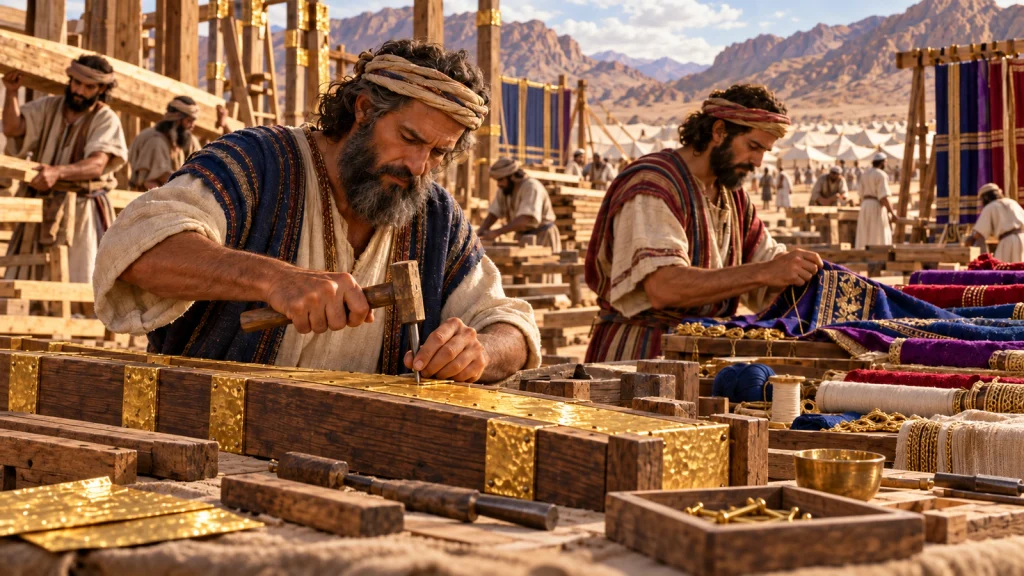
Source: AI-generated image created for Beyond The Known.
The instructions for the tabernacle are almost complete.
Exodus has described its furniture, curtains, altars, priestly garments, sacrifices, anointing oil, and sacred incense. The design has been given in remarkable detail.
The previous study, Why Did the Tabernacle Need an Altar of Incense?, examined the incense altar, priestly washing, sacred oil, holy incense, and the boundaries that governed sanctuary service. Exodus 31 now turns from sacred objects and rituals to the people entrusted with making them.
But a design still has to become wood, metal, stone, fabric, and finished work.
Exodus 31 finally names the people who will make that happen.
Bezalel is singled out from the tribe of Judah. Oholiab is appointed alongside him. Other skilled workers are drawn into the task.
Then YHWH says something remarkable about Bezalel:
He has filled him with the Spirit of God.
The result is not prophecy or military leadership. It is wisdom expressed through design, metallurgy, stonework, woodwork, and craftsmanship.
Why does Exodus describe an artisan this way?
Bezalel Is Chosen for a Specific Work
YHWH introduces him with the words:
קָרָאתִי בְשֵׁם — qārāʾtî ḇəšēm — I have called by name
Bezalel is identified as the son of Uri, grandson of Hur, from the tribe of Judah.
The language marks him out for a defined commission. He is not simply the most convenient craftsman available, nor does the narrative say Moses discovered him through ordinary selection.
His appointment is attributed to YHWH.
That distinction matters because the tabernacle itself has already been presented as a divinely commanded project. The same God who specifies what is to be made now identifies the people responsible for making it.
The biblical text gives us no biography of Bezalel’s earlier life. We do not know where he learned metalwork, carving, or design, and there is no reason to invent an apprenticeship story for him.
What Exodus gives us instead is his vocation.
What Does “Filled with the Spirit of God” Mean Here?
Verse 3 says:
וָאֲמַלֵּא אֹתוֹ רוּחַ אֱלֹהִים — wāʾămallēʾ ʾōtô rûaḥ ʾĕlōhîm — I have filled him with the Spirit of God / a divine spirit
Most traditional English translations render rûaḥ ʾĕlōhîm as “the Spirit of God.” The JPS translation takes the phrase as “a divine spirit” and connects it closely with the skill that follows. Both reflect the same Hebrew construction; the difference lies in how the expression is rendered in English.
Christian readers naturally encounter this language within the Bible’s broader theology of the Spirit.
But Exodus 31 should first be heard in its own context.
Bezalel receives divine empowerment for a specific task: producing the sanctuary and its furnishings according to YHWH’s instructions.
That already expands the reader’s picture of what divine empowerment can involve.
Here, the Spirit’s work is visible in skilled hands.
Wisdom Can Be Technical
The verse continues with a cluster of terms:
חָכְמָה — ḥoḵmâ — wisdom / skill
תְּבוּנָה — təḇûnâ — understanding / discernment
דַּעַת — daʿat — knowledge
These should not be forced into three rigid technical categories.
Their meanings overlap, and the surrounding verses show how they function together: Bezalel is able to conceive designs and execute demanding work in gold, silver, bronze, stone, and wood.
In other words, biblical “wisdom” is not limited to proverbial sayings or abstract reflection.
In this setting it includes practical mastery.
That is one of the chapter’s important theological contributions.
Intelligence expressed through making is still intelligence.
Craftsmanship belongs inside the biblical vocabulary of wisdom.
Bezalel Is More Than a Pair of Skilled Hands
Verse 4 adds another expression:
לַחְשֹׁב מַחֲשָׁבֹת — laḥšōḇ maḥăšāḇōṯ — to devise designs / conceive plans
Bezalel is not described merely as someone capable of following measurements.
He must think.
He must plan.
He must solve material problems.
He must take instructions expressed in words and produce physical objects from them.
The tabernacle instructions are detailed, but they are not the equivalent of modern manufacturing drawings. Materials have to be shaped. Stones must be set. Metal must be worked. Wood must be carved. Textiles must be produced.
There is room here for genuine human expertise.
Yet the final sentence of the section places that expertise under a clear boundary: the artisans are to make what YHWH commanded.
Creativity and obedience are therefore not opposites in this passage.
Bezalel’s creativity serves the commission he has received.
Oholiab and the Craftsmen Around Them
Bezalel is not presented as a solitary genius.
YHWH appoints:
אָהֳלִיאָב — ʾOholiab
son of Ahisamach, from the tribe of Dan.
The text then widens the circle further. Skill is placed in the hearts of other capable workers so that they can produce everything that has been commanded.
This matters for the way the sanctuary is imagined.
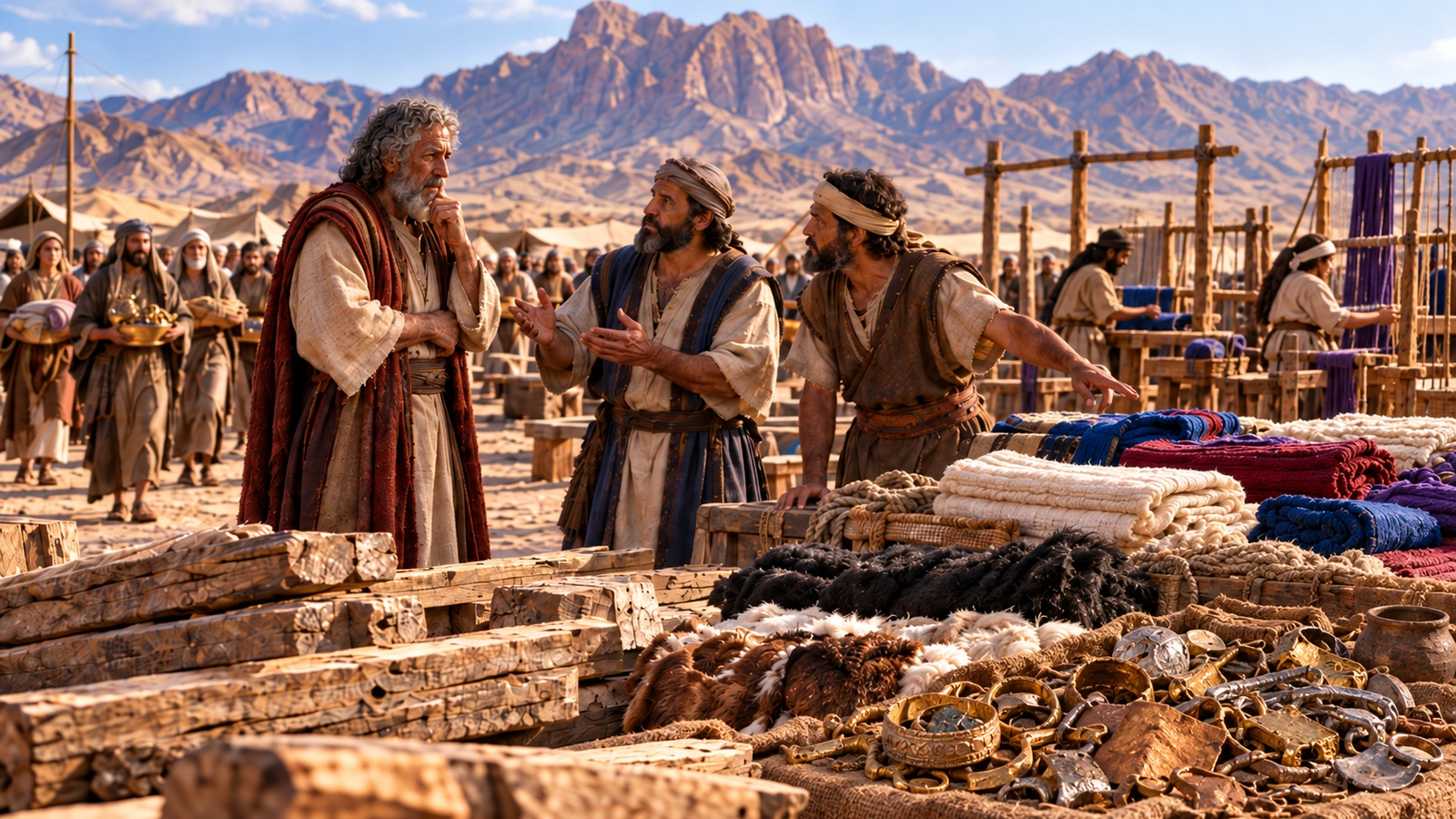
Its construction depends on leadership, but it also depends on collaboration.
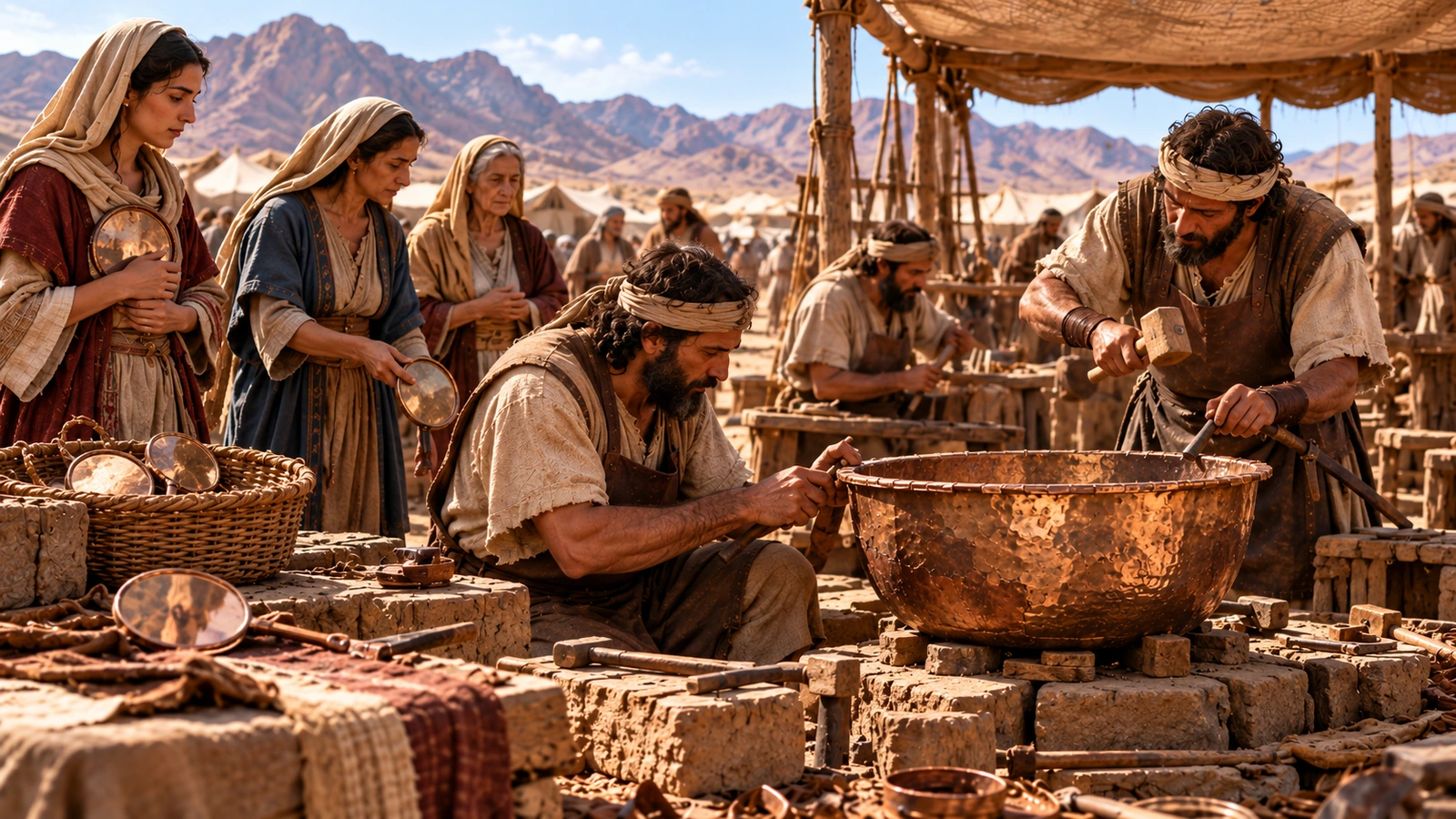
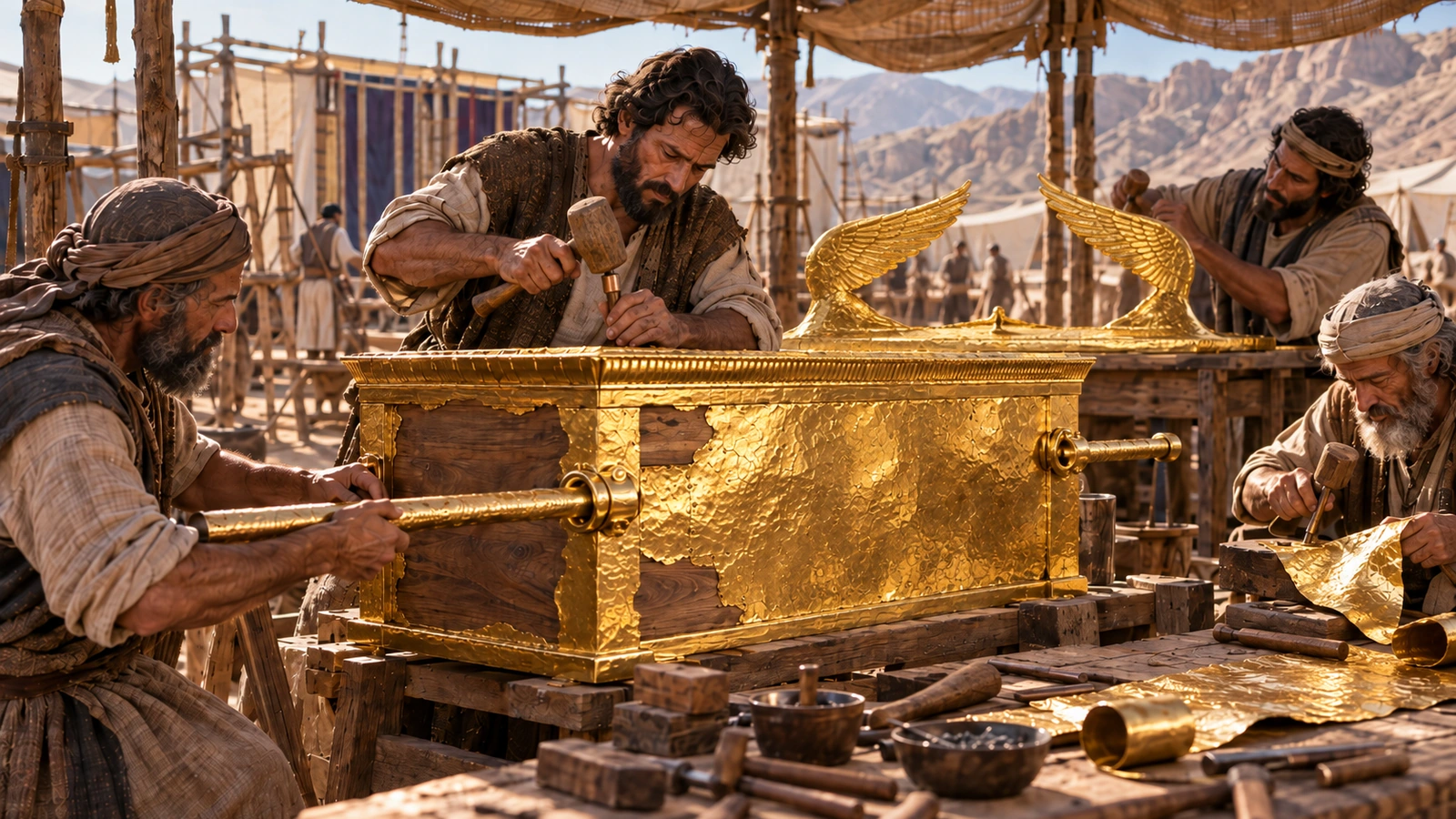
The ark, lampstand, altars, basin, garments, oil, and incense require different kinds of knowledge. No single pair of hands could reasonably embody every part of the work.
Exodus 35 later develops the picture further by describing Bezalel and Oholiab as able to teach others.
The sanctuary is therefore the product of an ordered community of skilled people, not merely one inspired artisan.
Exodus 31 Gathers the Tabernacle Instructions Together
Verses 7–11 summarize what the craftsmen will make:
the Tent of Meeting,
the ark,
the cover over it,
the table,
the lampstand,
the incense altar,
the burnt-offering altar,
the basin,
the priestly garments,
the anointing oil,
and the sacred incense.
The list reads like a compressed review of Exodus 25–30.
That is exactly what it accomplishes.
The design stage has reached its end.
The text has moved from sacred space, to furniture, to clothing, to ritual, and finally to the people capable of producing the whole system.
One statement governs all of it:
they are to make what YHWH has commanded.
Then the subject changes.
The command is no longer to work.
It is to stop.
Why Does the Sabbath Appear Immediately After the Craftsmen?
The placement of Exodus 31:12–17 is one of the chapter’s most important features.
The tabernacle requires an enormous amount of skilled labor, yet the instructions for its construction conclude with a command concerning the Sabbath.
Daniel Timmer’s major study of Exodus 31:12–17 and 35:1–3 examines this Sabbath material precisely within the context of creation and tabernacle construction. The relationship is substantial enough that the Sabbath instructions form a frame around the golden-calf episode: they appear here before the breach of the covenant and again in Exodus 35 as construction finally begins.
The literary effect is powerful.
Israel has been commanded to build the sanctuary.
Israel has not been commanded to build it seven days a week.
Even work directed toward YHWH remains subject to YHWH’s ordering of time.
The Sabbath Is a Covenant Sign
YHWH calls the Sabbath:
אוֹת — ʾôṯ — sign
between himself and Israel throughout their generations.
The passage then explains what Israel is to know through this sign:
יְהוָה מְקַדִּשְׁכֶם — YHWH məqaddišḵem — YHWH who sanctifies you
That declaration deserves attention in a chapter dominated by remarkable human ability.
Israel is building a holy sanctuary.
Its craftsmen possess extraordinary skill.
Its priests have undergone consecration.
Yet YHWH identifies himself as the one who sanctifies Israel.
Human work has a genuine role in covenant obedience.
It is not the source of Israel’s holiness.
Sacred Work Still Has Limits
The chapter therefore refuses to make productivity the measure of faithfulness.
Bezalel’s work matters.
The tabernacle matters.
The objects being produced are described as holy.
Still, the work stops on the seventh day.
That is not because the project has become less important.
Its importance makes the boundary more striking.
If building the sanctuary itself does not override the Sabbath, ordinary necessity cannot automatically be assumed to override it either within the legal world of this passage.
A recent study by Ludwig Beethoven J. Noya has proposed that the Sabbath laws in Exodus 31 and 35 should also be read in relation to the larger flow of labor, resources, and legitimate worship surrounding the tabernacle and golden-calf narratives. That is a scholarly proposal rather than an explicit explanation supplied by Exodus, but it reinforces how tightly the Sabbath text is embedded in the sanctuary material.
Why Are the Sabbath Penalties So Severe?
The legal language is uncompromising.
The Sabbath is holy.
Profaning it brings the death penalty, and the person who works on it is also described as being cut off from the people.
The passage does not present Sabbath violation as poor time management.
The day functions as a sign of the covenant between YHWH and Israel.
Its seriousness must therefore be understood within that covenantal framework.
Modern readers may struggle with the severity of the sanction. A responsible reading should acknowledge that difficulty rather than minimizing the text or pretending its legal world is identical to ours.
Within Exodus 31, however, the logic is clear:
sacred time belongs to the same covenant order as sacred space.
The Sabbath Reaches Back to Creation
Verse 17 gives the reason:
YHWH made heaven and earth in six days and ceased on the seventh.
The vocabulary deliberately evokes creation.
Two verbs are especially important.
שָׁבַת — šāḇaṯ — cease / stop / rest
and:
וַיִּנָּפַשׁ — wayyinnāpaš — was refreshed / took breath
The latter is unusually vivid language when applied to God.
The wording should not be read as though the Creator became exhausted and required physical recovery. It depicts divine cessation in human terms and anchors Israel’s weekly rhythm in God’s own pattern of creation and rest.
This is where the craftsmanship section and Sabbath section begin to illuminate each other.
The God who orders creation also orders Israel’s work.
Creation and Tabernacle: How Far Should the Parallel Go?
Scholars have long observed connections between biblical creation language and sanctuary construction.
Jon Levenson, among others, has explored the broader biblical relationship between cosmos and sanctuary, including the idea that sacred space can function as a microcosmic representation of an ordered world.
Exodus itself provides several points of contact.
The sanctuary is carefully ordered.
Work reaches completion.
The divine presence comes to dwell.
And here, at the end of the instructions, Sabbath language explicitly recalls the six-and-one pattern of creation.
Bezalel is also endowed with wisdom, understanding, and knowledge—terms that elsewhere in biblical literature can be associated with God’s ordering activity.
Those connections justify asking whether creation theology informs the tabernacle narrative.
They do not justify saying that Exodus explicitly identifies Bezalel as a new creator or the tabernacle as a miniature universe.
The distinction is important.
The parallel is literary and theological.
It is not an equation stated by the narrator.
Spirit-Given Skill Is Still Skill
The description of Bezalel also protects against another misunderstanding.
Divine empowerment does not replace craftsmanship.
It enables it.
The narrative does not contrast spiritual gifting with technical expertise. Bezalel possesses both.
He must understand materials.
He must plan.
He must execute.
He must work accurately enough to produce objects designed for sacred service.
Calling his capacity Spirit-given therefore does not make training, knowledge, or excellence unnecessary.
Nor does the passage establish a universal rule that every talented artist should be described as “Spirit-filled.”
Bezalel is a specific person appointed to a specific covenantal commission.
The wider theological implication is more disciplined than the popular slogan.
God’s empowering presence can be expressed through skilled material work.
That is significant enough on its own.
The Final Object Is Not Made by Bezalel
The chapter closes back on Mount Sinai.
When YHWH finishes speaking with Moses, he gives him the two tablets of the testimony.
They are described as:
כְּתֻבִים בְּאֶצְבַּע אֱלֹהִים — kəṯuḇîm bəʾeṣbaʿ ʾĕlōhîm — written by the finger of God
The phrase is anthropomorphic, just as “was refreshed” is anthropomorphic a verse earlier.
Its purpose is not to give God a physical anatomy.
Within Exodus, “the finger of God” communicates direct divine agency and authority. The expression has already appeared during the plague narratives, where Pharaoh’s magicians recognize an act beyond their own power.
The placement is an effective ending.
Bezalel will fashion objects according to divine instruction.
The tablets, however, arrive as divine testimony.
Craftsmanship serves revelation.
It does not create it.
The Deeper Discovery
Exodus 31 places two commands beside each other that initially seem to pull in opposite directions.
One concerns extraordinary work.
The other concerns stopping work.
Bezalel is filled with the Spirit of God and equipped with wisdom, understanding, knowledge, and craftsmanship.
Israel is then commanded to cease labor on the Sabbath.
The relationship between those two sections reveals something deeper than a general lesson about creativity.
Work can be genuinely called by God without becoming ultimate.
The sanctuary is not a hobby.
It is not secular labor accidentally given religious significance.
YHWH commanded it.
YHWH provided its design.
YHWH appointed its craftsmen.
Yet even this work must stop.
That protects the chapter from two distortions.
The first is to treat human craftsmanship as spiritually insignificant.
The second is to treat sacred productivity as though it were itself the source of holiness.
Exodus allows neither.
Bezalel’s ability is honored as divine gift.
The Sabbath reminds Israel that divine gift does not abolish divine limits.
The craftsmen build what is holy.
YHWH is the one who sanctifies his people.
That balance is the theological center of the chapter.
FAQ
Why did God fill Bezalel with the Spirit of God?
Exodus 31 connects Bezalel’s divine empowerment with the wisdom, understanding, knowledge, design ability, and craftsmanship needed to construct the tabernacle and its furnishings. The empowerment serves a specific sanctuary commission.
Was Bezalel filled with the Holy Spirit?
The Hebrew says rûaḥ ʾĕlōhîm, commonly translated “the Spirit of God,” though some translations render it “a divine spirit.” Christian theology may place this passage within a broader doctrine of the Holy Spirit, but Exodus 31 itself focuses on divine empowerment for skilled work.
Was Bezalel the first Spirit-filled person in the Bible?
It is better not to make that claim. Exodus 31 contains an early explicit statement that someone was filled with the Spirit of God, but earlier biblical passages already speak about the divine Spirit, and Exodus 28:3 refers to artisans whom God filled with a spirit of wisdom.
What skills did Bezalel receive?
The passage associates his calling with wisdom, understanding, knowledge, design, metalwork, stonework, woodwork, and craftsmanship more broadly.
Who was Oholiab?
Oholiab son of Ahisamach, from the tribe of Dan, was appointed to work alongside Bezalel. Other skilled artisans also participated, so the tabernacle was a collaborative project rather than the work of one individual.
Why does Exodus 31 discuss the Sabbath after Bezalel?
The Sabbath command comes at the conclusion of the tabernacle instructions and limits the work that is about to begin. Even construction of the sanctuary does not override the seventh-day cessation commanded by YHWH.
What does it mean that God “was refreshed” on the seventh day?
The Hebrew wayyinnāpaš uses strongly human imagery and can be rendered “was refreshed” or “took breath.” It does not require the conclusion that God became physically exhausted. The wording reinforces the pattern of cessation that Israel is commanded to imitate.
Exodus 31 leaves the sanctuary ready to be built.
Its craftsmen have been appointed.
Its work has been bounded by the Sabbath.
Moses holds the covenant tablets.
Then the narrative descends from Sinai to the camp.
There, Israel is also working with precious metal.
But the gold will not become a lampstand, an altar, or the ark.
It will become a calf.
Why Did Israel Make the Golden Calf So Soon After the Covenant?
Selected Sources
- Brevard S. Childs, The Book of Exodus: A Critical, Theological Commentary. Old Testament Library. Westminster Press, 1974.
- John I. Durham, Exodus. Word Biblical Commentary 3. Word Books, 1987.
- Jon D. Levenson, Creation and the Persistence of Evil: The Jewish Drama of Divine Omnipotence. Harper & Row, 1988.
- Carol L. Meyers, Exodus. New Cambridge Bible Commentary. Cambridge University Press, 2005.
- William H. C. Propp, Exodus 19–40. Anchor Bible 2A. Doubleday, 2006.
- Nahum M. Sarna, Exodus. JPS Torah Commentary. Jewish Publication Society, 1991.
- Daniel C. Timmer, Creation, Tabernacle, and Sabbath: The Sabbath Frame of Exodus 31:12–17; 35:1–3 in Exegetical and Theological Perspective. FRLANT 227. Vandenhoeck & Ruprecht, 2009.
- Ludwig Beethoven J. Noya, “‘To Do the Sabbath’: Reassessing the Sabbath Laws (Exodus 31:12–17 & 35:1–3).” Revue Biblique 132.2 (2025): 207–218. DOI: 10.2143/RBI.132.2.3294260.