Why Did Israel Make the Golden Calf So Soon After the Covenant?
Exodus 32 Explained: The Golden Calf, Aaron’s Failure, Moses’ Intercession, the Broken Tablets, and Israel’s Covenant Crisis
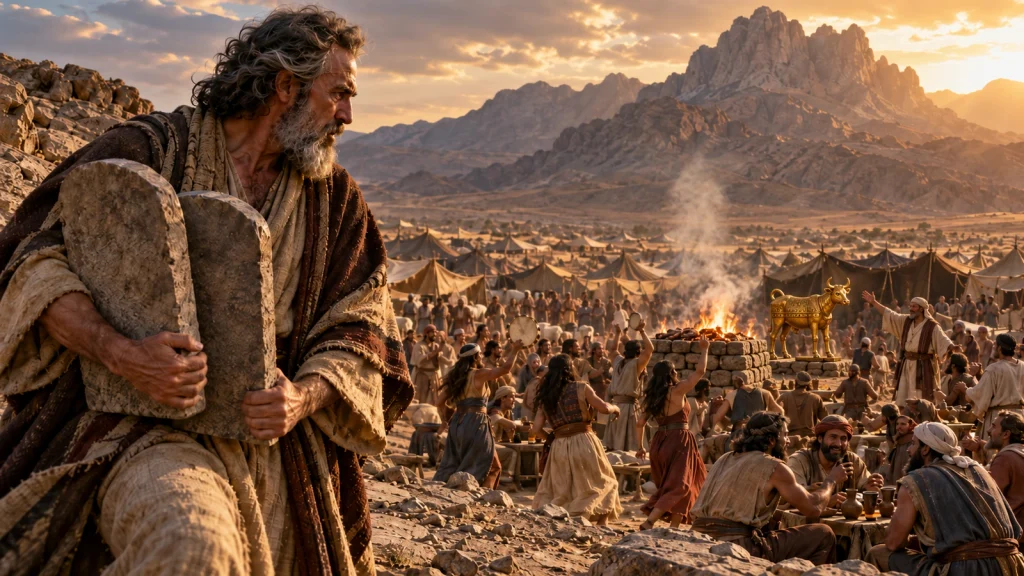
Source: AI-generated image created for Beyond The Known.
The previous study, Exodus 31: Why God Filled Bezalel with the Spirit, ended with Moses receiving the stone tablets written by the finger of God and everything prepared for the construction of the tabernacle.
Exodus 32 turns immediately from the mountain to the camp below.
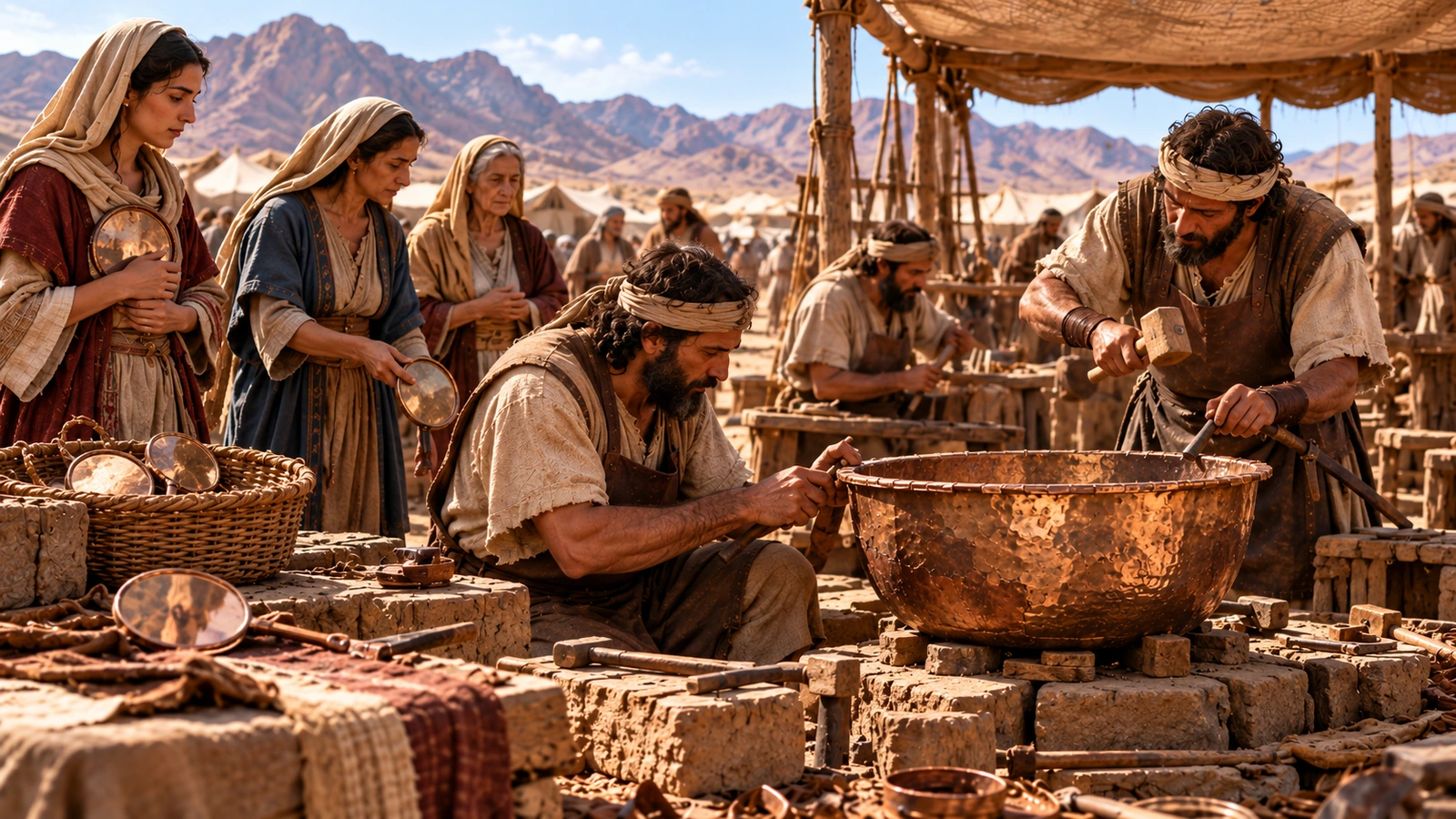
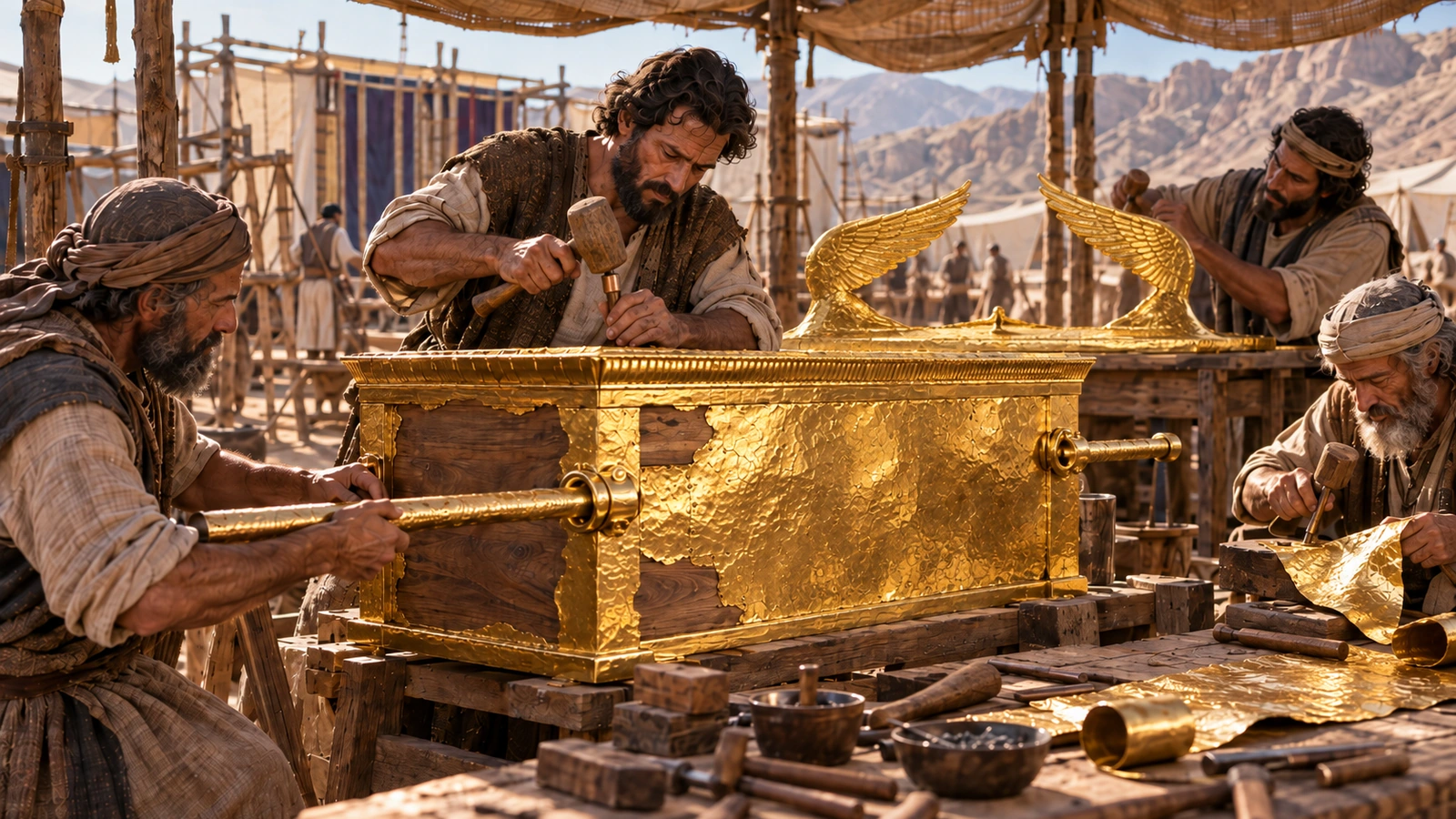
Gold appears again.
Human craftsmanship appears again.
But this time YHWH has not commissioned the object being made.
The people surround Aaron and demand something that can go before them because Moses has disappeared from sight.
Within days of covenant ratification, Israel produces the golden calf.
Why?
Moses’ Absence Exposes the Crisis
The chapter opens with the people watching the mountain.
Moses is taking a long time to return.
The Hebrew verb is:
בֹּשֵׁשׁ — bōšēš — delay / be late
The reader already knows that Moses has been on Sinai for forty days and forty nights.
The camp does not share that perspective.
From below, Moses has simply vanished.
Their anxiety is understandable.
Their response is not.
They do not ask Aaron to organize a search or appoint another human leader.
They tell him:
“Make for us elohim who will go before us.”
The request reveals more than impatience.
Moses had functioned as the visible mediator of YHWH’s guidance. Once he disappears, the people want something tangible to take his place.
What Did the Golden Calf Represent?
This is where careful reading matters.
The word:
אֱלֹהִים — ʾĕlōhîm — God / god / gods / divine beings
can function as either singular or plural depending on context.
In Exodus 32:4 and 8, the declaration about the calf uses plural grammatical language:
“These are your gods, O Israel, who brought you up from the land of Egypt.”
Yet the narrative describes a single calf.
Then Aaron builds an altar and announces:
“Tomorrow shall be a festival to YHWH.”
That combination has generated a long-running debate.
One possibility is that the people have turned toward other gods.
Another is that the calf was intended as a visible representation, support, or mediator of YHWH’s presence.
A third emphasizes the request for something to “go before” Israel and sees the object as replacing Moses’ visible mediating role.
Scholars continue to disagree over the calf’s precise function, and the narrative itself does not settle every aspect of the question. What it does settle is YHWH’s verdict: the object and its worship constitute serious covenant violation.
Aaron’s Festival to YHWH Makes the Sin More Complicated
Aaron’s proclamation is crucial.
He does not announce a feast to Baal, Hathor, or another named deity.
He announces a feast to YHWH.
That means the episode cannot be reduced too quickly to the claim that Israel simply abandoned YHWH for an unrelated god.
It may be worse in a different way.
The people may be trying to worship Israel’s God through a form YHWH has already forbidden.
The commandments at Sinai prohibited the making of an image for worship.
The problem, then, is not solved by good religious intentions.
Invoking YHWH’s name does not turn unauthorized worship into faithful worship.
Why a Calf?
The Hebrew noun is:
עֵגֶל — ʿēgel — calf / young bull
“Calf” can sound almost harmless in English, but the term can refer to a young bovine rather than a tiny newborn animal.
Bovine imagery was common in the religious world of the ancient Near East. Bulls could evoke strength, vitality, royal power, or divine presence. In some iconography, animals could also function as supports or vehicles associated with a deity.
Michael Hundley has argued that the golden-calf episode is best understood within that wider world of ancient divine representation rather than as an isolated act of primitive superstition. That context helps explain the imagery, but it still does not tell us exactly what Aaron or the crowd believed the calf was.
The background gives us possibilities.
Exodus gives us condemnation.
Aaron Does More Than He Later Admits
The people bring their gold earrings to Aaron.
Verse 4 describes him receiving the gold and fashioning it into the calf. The precise technical process is difficult to reconstruct from the Hebrew, and interpreters have debated whether the image was solid metal, cast around a core, or produced in some other way.
The narrative does not need us to solve the metallurgy.
Its emphasis is on agency.
Aaron takes the material.
Aaron makes the object.
Aaron builds the altar.
Aaron announces the festival.
That becomes important later, because his explanation to Moses will sound very different.
The Celebration Becomes Uncontrolled
The next morning the people offer burnt offerings and fellowship offerings.
Then they eat and drink and rise:
לְצַחֵק — ləṣaḥēq — to play / revel / sport
The verb has a broad semantic range. Elsewhere it can refer to laughter, play, mockery, or behavior with sexual overtones.
That means two extremes should be avoided.
Nothing requires us to imagine innocent recreational play.
But Exodus 32:6 alone also does not permit a detailed reconstruction of a sexual orgy.
The later scene includes singing, shouting, and dancing. “Revelry” captures the situation without pretending the text tells us more than it does.
On the Mountain, YHWH Distances Himself from Israel
The perspective returns to Sinai.
YHWH tells Moses:
“Go down, because your people, whom you brought up from Egypt, have corrupted themselves.”
The wording is jarring.
Throughout Exodus, YHWH has claimed Israel as his people and presented himself as the one who brought them out of Egypt.
Now he speaks of:
your people
whom:
you brought up
Moses immediately reverses the language.
Why, he asks, should YHWH’s anger burn against:
your people
whom:
you brought out of Egypt
The exchange dramatizes the rupture.
YHWH speaks as though Israel has put the covenant relationship at risk.
Moses’ intercession responds by insisting on YHWH’s existing relationship with the very people who have rebelled.
Moses Does Not Argue That Israel Is Innocent
This is one of the strongest features of his prayer.
Moses never excuses the calf.
He does not tell YHWH that Israel acted from fear or confusion and therefore should not be held responsible.
Instead, he appeals to YHWH.
He recalls the exodus itself.
He raises the question of what Egypt would say if Israel were destroyed after being rescued.
Then he invokes the promises made to Abraham, Isaac, and Israel.
Moses’ argument rests on YHWH’s acts, reputation, and covenant promises.
Israel’s merit never becomes the basis of the appeal.
What Does It Mean That YHWH “Relented”?
Verse 14 says:
וַיִּנָּחֶם יְהוָה — wayyinnāḥem YHWH — YHWH relented / reconsidered
The verb נחם — nāḥam can carry meanings such as relent, regret, be sorry, or be comforted depending on context.
The narrative sequence itself is clear.
Judgment is announced.
Moses intercedes.
The announced destruction of the nation does not occur.
Theological traditions have interpreted that language differently.
Classical Jewish and Christian theologians have often read such passages alongside claims about God’s constancy and treated the language as accommodated or anthropomorphic. Other theologians, including Terence Fretheim, have emphasized genuine divine responsiveness within covenant relationship.
The article does not need to force one theological system into the verse.
The important exegetical point is that Exodus presents Moses’ intercession as meaningful within the unfolding relationship.
The Tablets Break at the Foot of Sinai
Moses descends carrying the tablets.
Before they are shattered, the narrator reminds us that they are God’s work and that the writing upon them is God’s writing.
Then Moses sees the calf and the dancing.
He throws the tablets down.
They break at the foot of the mountain.
The narrator never stops to explain the action with the sentence:
“this symbolizes the broken covenant.”
Even so, the literary relationship is difficult to overlook.
The physical testimony of the covenant is shattered in the same scene in which Israel’s covenant disloyalty becomes visible.
That is a reasonable literary inference rather than an explicit explanation supplied by Moses.
The Calf Is Reduced to Nothing
Moses takes the calf, burns it, grinds it into powder, scatters the material over water, and makes the Israelites drink.
The procedure has generated several interpretations.
Some scholars have understood the drinking as an ordeal designed to expose guilt.
Others emphasize humiliation of the idol or its total destruction.
Lori Quick has proposed that the sequence functions as a ritual of transformation and desacralization: an object treated as divine is reduced to consumable material and stripped of its claimed sacred status.
Exodus itself does not identify one of these explanations as the official meaning.
What is unmistakable is the completeness of the destruction.
The object that had been treated as capable of leading Israel cannot even preserve its own form.
Aaron Rewrites What Happened
Moses turns to his brother.
Aaron begins by blaming the people:
“You know how prone these people are to evil.”
Then he repeats their demand.
But when he reaches his own role, the story changes.
According to Aaron:
“I threw it into the fire, and out came this calf!”
That is not the account the narrator gave us.
Earlier Aaron received the gold and fashioned the image.
Now the calf sounds almost spontaneous.
No psychological diagnosis is required to see the rhetorical move.
Aaron’s retelling minimizes Aaron.
The narrative has already exposed his responsibility.
The Levites and the Three Thousand
The chapter then reaches its most disturbing scene.
Moses stands at the entrance of the camp and calls those who are for YHWH to gather around him.
The Levites respond.
Moses gives them a command introduced with:
“Thus says YHWH, the God of Israel.”
They move through the camp with swords.
Approximately three thousand die.
The violence should not be hidden behind sanitized language.
Within Exodus, the scene belongs to the judgment following a severe covenant breach.
But recognition of that narrative framework does not make the killing morally effortless for modern readers.
Recent scholarship has paid particular attention to the later biblical association between priestly identity, zeal, and violence. Yonatan Miller examines Exodus 32 as an important early example of that pattern.
Did the Violence Ordain the Levites?
Verse 29 contains striking language.
Moses says:
מִלְאוּ יֶדְכֶם — milləʾû yeḏḵem — fill your hands
The expression is closely associated elsewhere with priestly installation.
That creates an unmistakable verbal resonance with the ordination language we encountered in Exodus 29.
But the verse is difficult, and we should not leap from the phrase to the statement:
“the massacre ordained the Levites as priests.”
The relationship between this violent loyalty and later Levitical status is more complex than that.
The wording creates an association.
It does not provide a complete history of the priesthood.
Moses Returns to Intercede Again
The next day Moses tells Israel plainly:
“You have committed a great sin.”
He then returns to YHWH, hoping that some form of atonement may still be possible.
His second prayer differs from the first.
This time he openly asks for forgiveness.
Then comes one of the chapter’s most remarkable lines:
“If not, erase me from your book that you have written.”
The book is not defined.
Later biblical traditions contain several forms of heavenly books and divine registers, but Exodus 32 should not automatically be made identical with every later “Book of Life” reference.
Here the image most naturally evokes a divine register associated with the lives or standing of persons before God.
Moses’ point is clearer than the book’s precise metaphysics.
He refuses to imagine his own future apart from the people he leads.
Moses Can Intercede, but He Cannot Simply Absorb Their Guilt
YHWH answers:
“Whoever has sinned against me, I will erase from my book.”
Moses’ solidarity has limits.
His willingness to be erased does not automatically transfer Israel’s guilt onto him.
He can plead for them.
He can stand between judgment and destruction.
He can offer himself.
But individual responsibility remains.
Even so, Israel is not annihilated.
Moses is told to continue the journey, and YHWH’s messenger will go before the people.
The covenant crisis has not destroyed Israel’s future.
Neither has it been completely resolved.
Relenting Is Not the Same as Removing Every Consequence
The final verse reports a plague because of the calf.
That prevents the reader from treating verse 14 as though nothing further could happen after YHWH relented from destroying the nation.
Exodus holds several realities together.
Israel survives.
Judgment occurs.
Moses continues to lead.
The journey continues.
The question of divine presence remains unsettled.
That unresolved tension carries directly into Exodus 33.
The golden calf episode therefore does not end with everything restored to normal.
Israel remains alive, but the relationship has been badly damaged.
The Deeper Discovery
The transition from Exodus 31 to Exodus 32 turns on one ordinary Hebrew verb:
עָשָׂה — ʿāśâ — make / do
At the end of Exodus 31, YHWH says that the skilled artisans will make everything he has commanded.
Then Exodus 32 begins with the people telling Aaron:
“Make for us…”
The same human capacity to manufacture sacred objects appears on both sides of the chapter break.
That creates one of the sharpest contrasts in the Sinai narrative.
Bezalel receives skill so that he can make what YHWH has commanded.
Aaron uses human skill to make what the crowd demands.
Both projects involve precious material.
Both produce objects connected with worship.
Both depend on craftsmanship.
Yet one is obedience and the other becomes rebellion.
This matters because Exodus has just spent chapter after chapter celebrating sacred material culture.
Gold is not the problem.
Art is not the problem.
Images as a category are not even the whole problem, since YHWH himself has commanded carved cherubim and woven figures within the sanctuary.
The decisive question is authority.
Who determines how Israel approaches the divine presence?
In the tabernacle instructions, YHWH does.
In Exodus 32, the people do.
The golden calf therefore reveals what happens when worship stops receiving its form from covenant command and begins taking its form from human demand.
That is why Exodus can celebrate Bezalel’s craftsmanship and condemn Aaron’s craftsmanship without contradiction.
The capacity to make is morally neutral.
What governs the making is not.
FAQ
Why did Israel make the golden calf?
The immediate crisis was Moses’ prolonged absence. The people wanted an elohim that could go before them because they did not know what had happened to Moses. The exact identity they attributed to the calf remains debated, but the narrative clearly treats its creation and worship as covenant rebellion.
Was the golden calf supposed to represent YHWH?
Possibly. Aaron announces a festival to YHWH after making the calf, which strongly connects the ritual with Israel’s God. But the plural language surrounding elohim and the wider narrative leave room for debate. The safest conclusion is that the calf was an unauthorized attempt to make divine guidance or presence visible.
Why did Aaron choose a calf or bull?
Bovine imagery was common in the ancient Near East and could communicate power, fertility, or association with deity. Exodus never explains why Aaron selected this particular animal form.
Does “they rose up to play” mean a sexual orgy?
The Hebrew verb ṣāḥaq can carry several meanings and can have sexual overtones in some contexts. Exodus 32 explicitly depicts eating, drinking, celebration, shouting, singing, and dancing, but it does not explicitly describe an orgy. “Revelry” is the more cautious description.
Did God change his mind in Exodus 32:14?
The passage says that YHWH nāḥam—he relented from the destruction he had announced after Moses’ intercession. Different Jewish and Christian traditions explain how this relates to divine constancy. The narrative itself portrays the intercession as consequential.
Why did Moses make the Israelites drink the golden calf?
Exodus does not explain the act directly. Proposed interpretations include ritual ordeal, humiliation of the idol, complete destruction, and desacralization. None should be presented as though the chapter explicitly selects it.
Why did the Levites kill three thousand people?
Exodus presents the killing as judgment during the covenant crisis and attributes the command to Moses speaking in YHWH’s name. The episode remains one of the text’s most severe scenes, and its relationship to later Levitical priestly identity is debated.
What was the book Moses asked to be erased from?
The chapter does not define the book precisely. It most likely represents a divine register associated with life or standing before God. Identifying it directly with every later biblical reference to the “Book of Life” goes beyond what Exodus 32 itself establishes.
Exodus 32 ends with the calf destroyed and Israel still alive.
But the deepest problem has not disappeared.
YHWH has spared the nation from complete destruction.
Then Moses hears something more frightening than the loss of the calf or the breaking of the tablets.
Israel may continue toward the promised land—
without YHWH going among them.
Why Did God Refuse to Go with Israel After the Golden Calf?
Selected Sources
- Brevard S. Childs, The Book of Exodus: A Critical, Theological Commentary. Old Testament Library. Westminster Press, 1974.
- Thomas B. Dozeman, Exodus. Eerdmans Critical Commentary. Eerdmans, 2009.
- Terence E. Fretheim, Exodus. Interpretation. John Knox Press, 1991.
- Michael B. Hundley, “What Is the Golden Calf?” Catholic Biblical Quarterly 79.4 (2017): 559–579.
- J. Gerald Janzen, “The Character of the Calf and Its Cult in Exodus 32.” Catholic Biblical Quarterly 52.4 (1990): 597–607.
- Carol L. Meyers, Exodus. New Cambridge Bible Commentary. Cambridge University Press, 2005.
- William H. C. Propp, Exodus 19–40: A New Translation with Introduction and Commentary. Anchor Bible 2A. Doubleday, 2006.
- Nahum M. Sarna, Exodus. JPS Torah Commentary. Jewish Publication Society, 1991.
- Lori Quick, “Drinking the Golden Calf: Consumption and Transformation in Exodus 32.” In New Perspectives on Ritual in the Biblical World (2022), 71–85.
- Yonatan S. Miller, “Violence and the Israelite Priesthood: Between Sacrifice and Bloodshed.” Harvard Theological Review 118.1 (2025).