Why Does Moses Repeat the Sabbath Command Before Israel Builds the Tabernacle?
Exodus 35 Explained: Sabbath Rest, Willing Offerings, Skilled Artisans, and the Work Israel Could Not Do on Its Own Terms
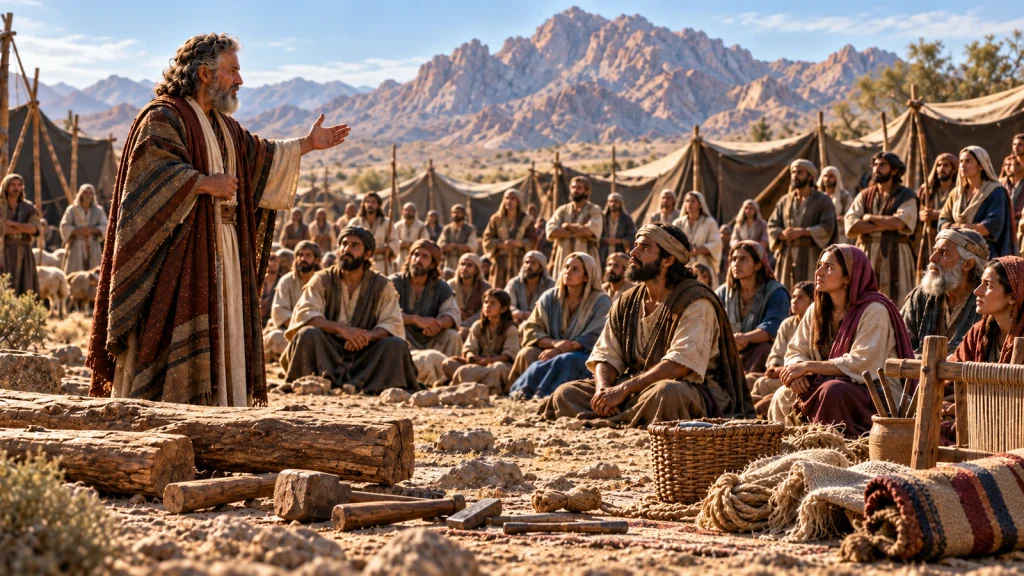
Source: AI-generated image created for Beyond The Known.
Israel is finally ready to build the tabernacle.
The covenant has survived the golden calf. Moses has returned from Sinai with new tablets. YHWH has agreed to remain among his people. The sanctuary instructions given before the crisis can now be carried out.
So Moses gathers the congregation.
And before he asks for gold, wood, fabric, oil, stones, or skilled labor, he speaks about stopping.
Six days are available for work. The seventh is holy to YHWH, a Sabbath of complete rest. Whoever works on that day is liable to death. Israel is not even to kindle a fire in its dwellings.
Only after that does Moses turn to the sanctuary.
The order is difficult to dismiss as incidental. Why repeat the Sabbath command at the precise moment Israel is about to begin one of the most sacred construction projects in the book?
If the tabernacle is the place where YHWH intends to dwell among Israel, why should building it ever have to stop?
The previous study, Why Does God Call Himself Merciful Yet Refuse to Leave the Guilty Unpunished?, ended with covenant renewal after Israel’s rebellion.
Exodus 35 shows what restored obedience looks like when work finally resumes.
The Tabernacle Story Was Interrupted by the Golden Calf
Exodus 25–31 gives detailed instructions for the sanctuary: the ark, the table, the lampstand, the tent, the altars, the priesthood, the anointing oil, the incense, and the artisans who will make them.
Then construction does not begin.
Instead, Exodus 32 opens with Israel gathered around Aaron while Moses remains on the mountain. Before the people build the sanctuary YHWH commanded, they make the golden calf.
The interruption occupies three chapters.
The covenant is violated. Moses shatters the tablets. Judgment follows. Divine presence becomes the central issue. Moses intercedes. The covenant is renewed.
Only after that crisis does Exodus return to the work.
This means Exodus 35 is not simply the next stage of an ancient building project. Israel is resuming a task after demonstrating how quickly religious activity can move beyond divine command.
That makes the first instruction especially important.
Before the people are allowed to build again, Moses reminds them that even sacred activity has a boundary.
The Sabbath Stood Before the Golden Calf Too
The opening of Exodus 35 has an earlier counterpart.
At the end of Exodus 31, after the tabernacle instructions and the appointment of Bezalel and Oholiab, YHWH speaks again about the Sabbath.
Then comes the golden calf.
After the crisis and covenant renewal, Moses repeats the Sabbath command immediately before construction begins.
In the final form of Exodus, the sequence is striking:
Tabernacle instructions → Sabbath → Golden Calf → covenant renewal → Sabbath → Tabernacle construction
Daniel C. Timmer has examined Exodus 31:12–17 and 35:1–3 as a Sabbath frame around the intervening narrative. Historical-critical scholarship does not agree on how these texts reached their present form; Jeffrey Stackert, for example, argues for compositional strata within the Priestly Sabbath material. Those questions concern literary development.
The final-form observation is simpler.
The tabernacle instructions are bounded by Sabbath material on both sides of Israel’s great covenant failure.
Construction is allowed to resume, but not without the reminder that the sanctuary itself does not outrank the command of the God who will dwell there.
“A Sabbath of Complete Rest”
Exodus 35:2 describes the seventh day as:
שַׁבַּת שַׁבָּתוֹן — šabbat šabbātôn — a Sabbath of complete rest
The phrase intensifies the idea of cessation.
The verse first states:
שֵׁשֶׁת יָמִים תֵּעָשֶׂה מְלָאכָה — šēšet yāmîm tēʿāśeh melāʾkhâ — for six days work may be done
Then it gives the prohibition:
כָּל־הָעֹשֶׂה בוֹ מְלָאכָה יוּמָת — whoever does work on it shall be put to death
The severity should not be softened.
In this section of Exodus, Sabbath is not introduced as a wellness practice or a general principle of life balance. Exodus 31:13–17 had already called it a sign between YHWH and Israel and attached the same death penalty to its violation.
The issue is covenantal holiness.
The seventh day belongs to YHWH, and building YHWH’s sanctuary does not create an exemption.
Why Does Moses Specifically Mention Fire?
Verse 3 narrows the command further:
Israel must not kindle a fire in any of its dwellings on the Sabbath.
Why single out fire?
Exodus 35 does not explain.
That is where interpretation needs restraint. Various proposals have been offered: the prohibition may specify an ordinary domestic activity that could otherwise be treated as preparation rather than work; others have tried to relate it more closely to the surrounding tabernacle material.
The text itself does not settle the question.
What it does show is that the Sabbath reaches into ordinary household activity. The command is not limited to public labor at the sanctuary site.
Before Israel begins constructing sacred space, the seventh day already governs life inside the camp.
The Same Word Describes Sabbath Work and Tabernacle Work
The Hebrew vocabulary creates a stronger connection between the opening command and the rest of the chapter.
The noun for the work prohibited on the Sabbath is:
מְלָאכָה — melāʾkhâ — work / occupation / craftsmanship
The same word then follows the reader into the tabernacle project.
In verse 21, the people bring contributions:
לִמְלֶאכֶת אֹהֶל מוֹעֵד — limleʾkhet ʾōhel môʿēd
for the work of the tent of meeting.
Verse 24 uses melāʾkhâ again in connection with the service.
Verse 29 returns to it for everything YHWH had commanded Israel to make.
The lexical continuity matters because it prevents an easy loophole.
The tabernacle project is holy.
It is also melāʾkhâ.
Exodus does not place sanctuary construction in a special category that ceases to count as work simply because its purpose is sacred.
Sacred Work Is Still Work
That point is more demanding than it first appears.
Israel is not building an ordinary dwelling. Exodus 25:8 has already given the reason for the sanctuary: YHWH intends to dwell among his people.
The design has been revealed.
The materials have been specified.
The craftsmen have been chosen.
Yet the importance of the project does not permit continuous labor.
Israel cannot argue that the sanctuary is too important to pause.
It cannot treat urgency as authority.
Even the work associated with divine presence remains subject to divine command.
The Sabbath therefore places a theological limit around productivity before the first construction report appears.
Only Then Does Moses Ask for an Offering
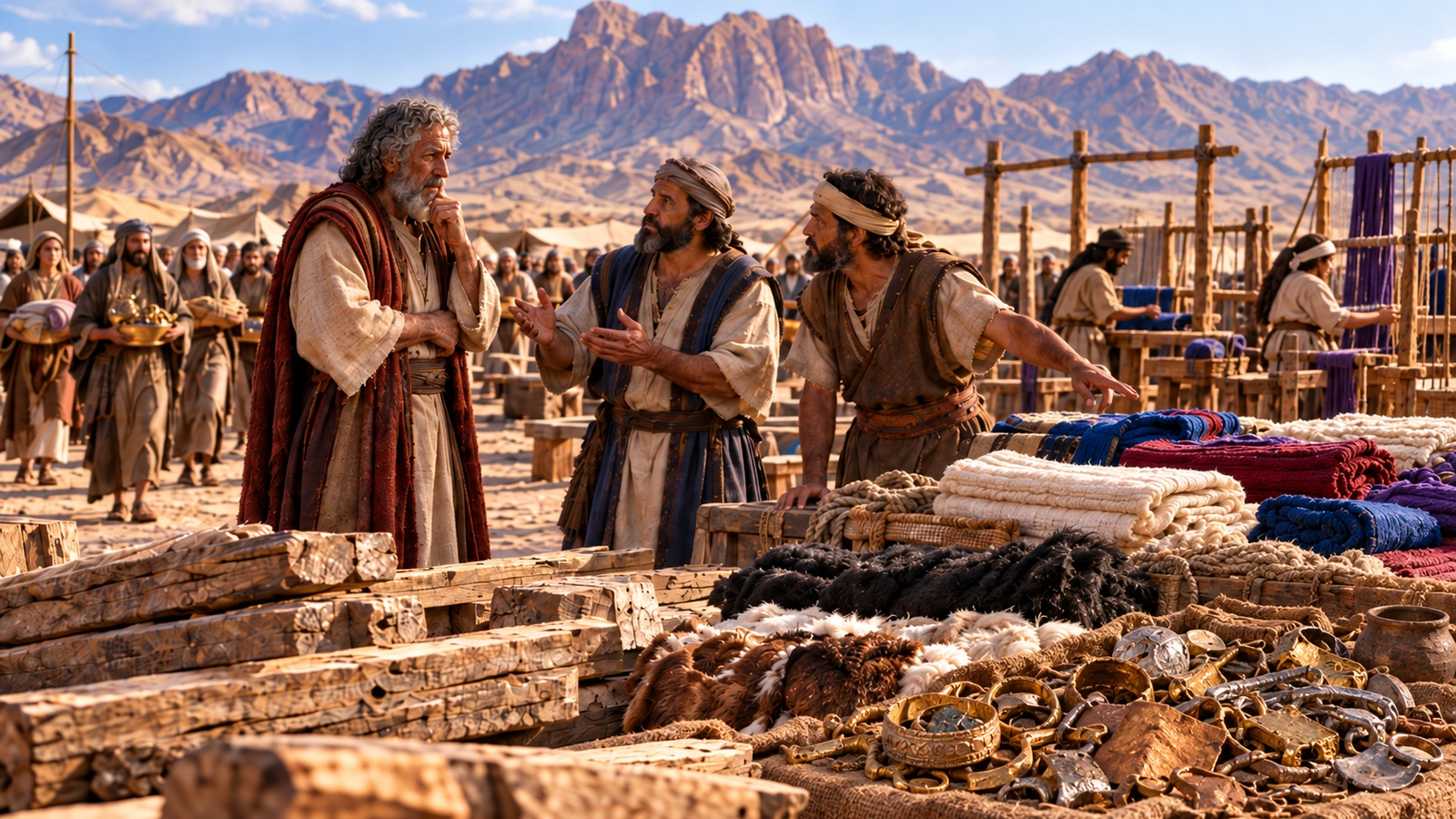
After establishing that limit, Moses turns to materials.
The list recalls the instructions given earlier in Exodus:
gold,
silver,
bronze,
blue, purple, and scarlet yarn,
fine linen,
goat hair,
prepared skins,
acacia wood,
oil,
spices,
onyx,
and other stones.
The inventory is extensive, but the chapter gives equal attention to the people who bring it.
Moses calls for those whose hearts are willing.
“Everyone Whose Heart Is Willing”
Exodus 35:5 describes the giver as:
כֹּל נְדִיב לִבּוֹ — kol nedîb libbô — everyone whose heart is willing
The language of the heart continues through the chapter.
Verse 21 speaks of those whose hearts lifted them and whose spirits moved them.
Verse 22 again describes willing participants.
Verse 26 speaks of women whose hearts moved them with skill.
Verse 29 closes the offering scene with men and women who freely bring what the work requires.
The repetition shapes the episode.
Israel is not shown being stripped of possessions by force. Moses announces what is needed, and the chapter repeatedly emphasizes those who respond willingly.
That voluntariness does not make the project self-directed.
The sanctuary is still built according to command.
The gifts are freely brought into a structure Israel did not invent.
Gold Appears Again After the Golden Calf
Gold deserves attention because Exodus has just shown Israel using it disastrously.
In Exodus 32, Aaron asks for gold jewelry. The people bring it, and a calf is made.
Now gold appears again among the sanctuary offerings.
The text does not say that the people are “undoing” the calf by donating new objects. Nor does it tell us that every ornament in Exodus 35 had been involved in the earlier episode.
The contrast is narrative rather than one-to-one.
Precious material is not the problem.
Human making is not the problem.
The problem is worship detached from command.
The calf and the tabernacle both involve material, craftsmanship, and religious intention. Exodus evaluates them very differently because one emerges from Israel’s initiative during Moses’ absence, while the other follows instructions already given.
That distinction will govern the final chapters of the book.
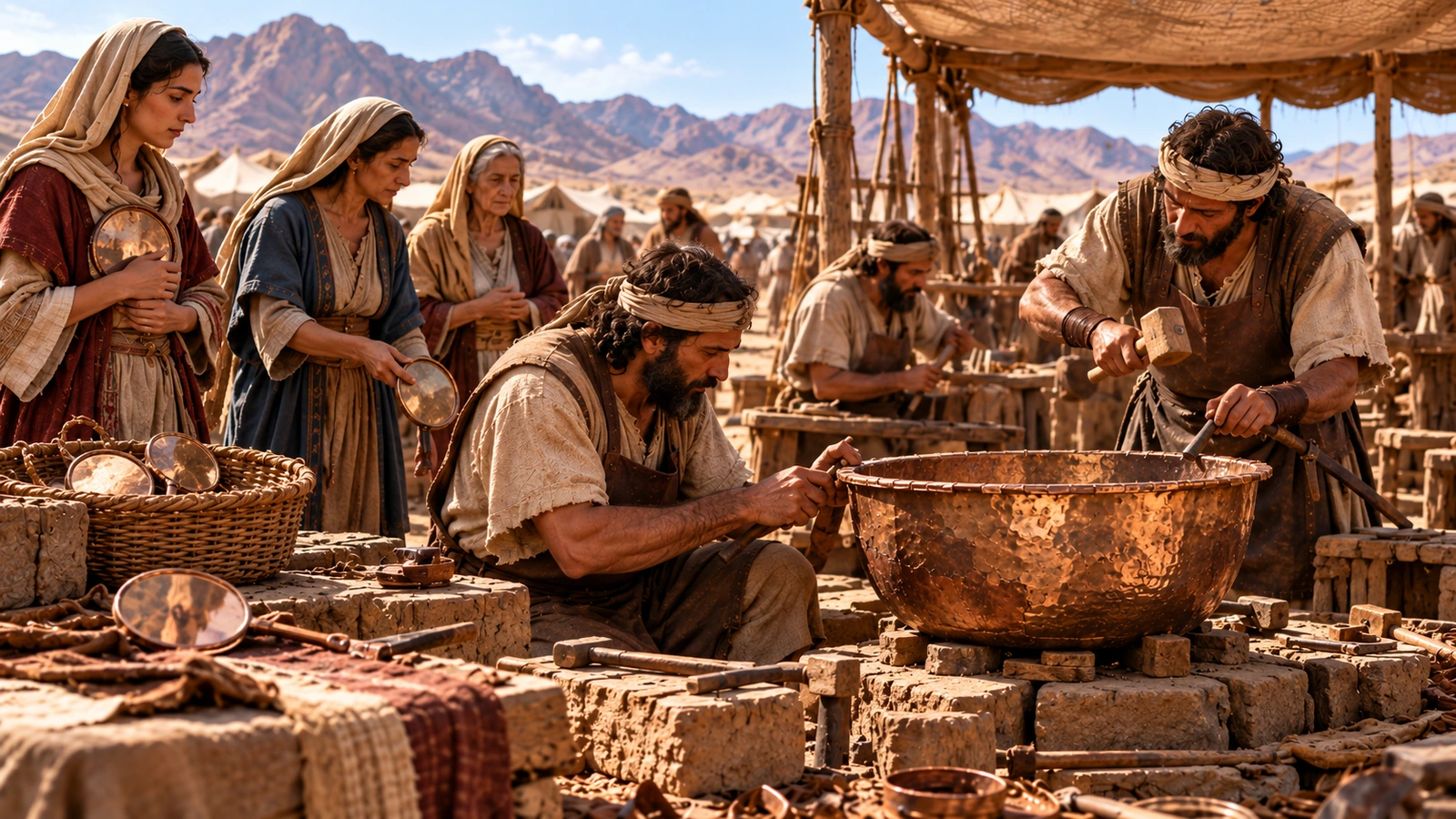
The People Contribute More Than Possessions
Exodus 35 does not reduce participation to donations.
Verses 25–26 specifically describe skilled women spinning the materials needed for the sanctuary.
They produce the blue, purple, and scarlet yarn, the fine linen, and the goat hair used in the project.
This is technical labor.
The women are not merely handing over raw possessions; they are contributing practiced ability.
The chapter presents several forms of participation without collapsing them into one role.
Some bring metals or stones.
Some provide wood and oils.
Some spin.
Some design.
Some teach.
The sanctuary is a communal undertaking, but communal does not mean undifferentiated.
“Wise of Heart” Means More Than Sincere
Verse 10 calls for those described as:
חֲכַם־לֵב — ḥakham-lēb — wise of heart
Modern readers can hear “heart” and assume the phrase is primarily emotional.
That is too narrow for biblical Hebrew.
לֵב — lēb can involve thought, intention, judgment, will, and capacity as well as feeling.
The surrounding context makes the sense especially concrete.
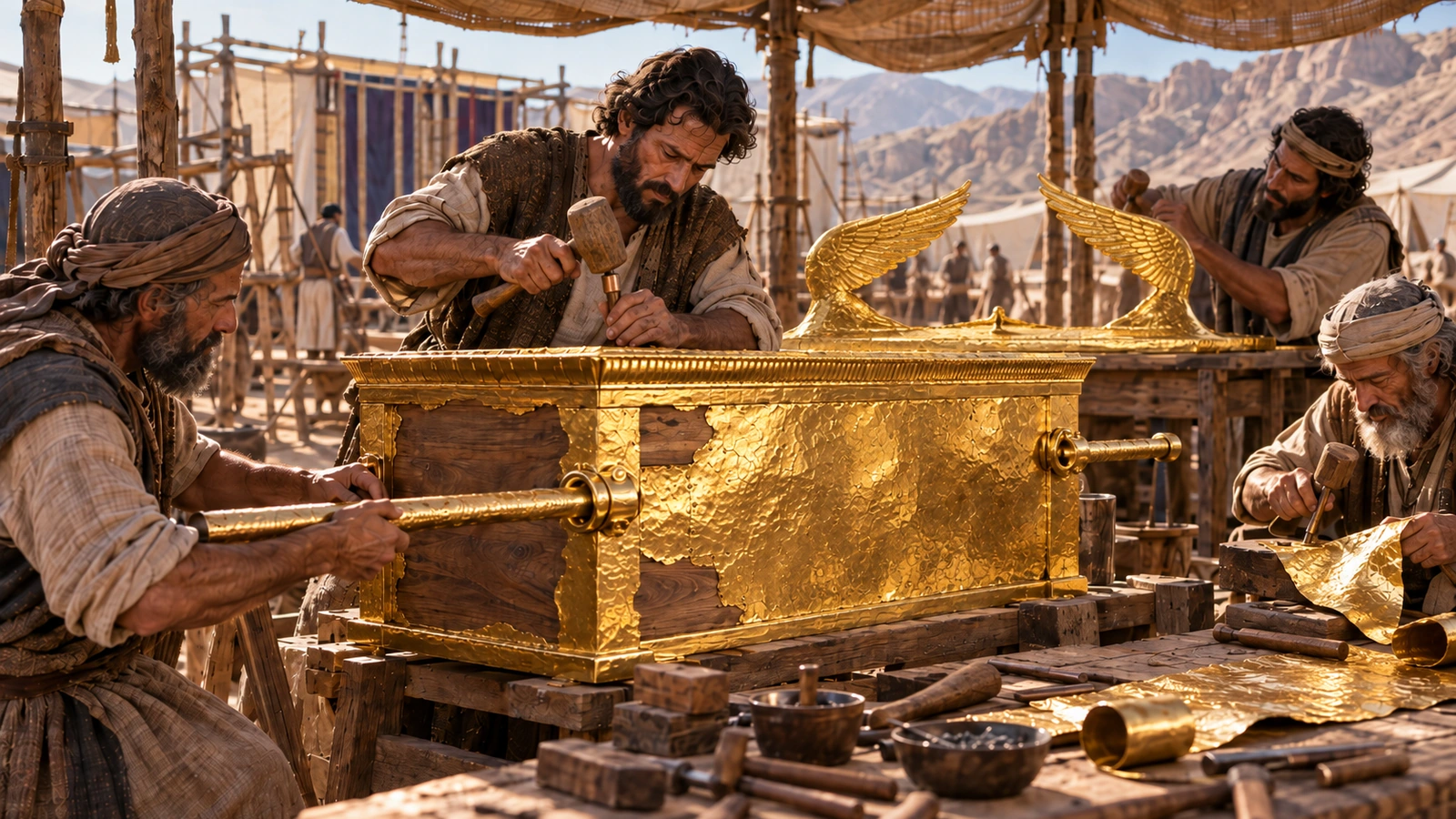
These people must weave, engrave, carve, work metal, set stones, and execute complex designs.
Good intentions cannot build the tabernacle.
The project requires competence.
Bezalel Is Filled with the Spirit of God to Make Things
The chapter eventually turns to Bezalel.
Moses tells Israel that YHWH has called him by name and filled him with:
רוּחַ אֱלֹהִים — rûaḥ ʾĕlōhîm — the Spirit of God
The text immediately explains what that filling enables.
Wisdom.
Understanding.
Knowledge.
Skill in every kind of craft.
Bezalel can design in gold, silver, and bronze. He can cut stones and carve wood.
The connection between divine Spirit and craftsmanship is explicit.
That is easy to miss if spiritual gifting is imagined only in terms of speech, leadership, prophecy, or ecstatic experience.
Exodus 35 locates the Spirit’s work in artistic and technical intelligence.
The ability to measure, shape, combine, carve, and design can be presented as a divine gift.
Oholiab and the Gift of Teaching
Oholiab son of Ahisamach, from the tribe of Dan, is named alongside Bezalel.
He receives less narrative attention, but Exodus does not treat him as a decorative secondary figure.
Verse 34 says that the ability to teach has been placed in them.
That detail matters.
Being able to perform a difficult craft and being able to transmit that craft to someone else are not the same ability.
The sanctuary cannot be constructed by two men working alone. The project requires a larger body of artisans.
Bezalel and Oholiab therefore contribute more than personal expertise.
Their knowledge becomes teachable.
Skill spreads through the community.
The Golden Calf Does Not Lead Exodus to Reject Art
The contrast with Exodus 32 could easily be misunderstood.
After the calf, Exodus does not conclude that religious art is inherently dangerous and should disappear.
The tabernacle will contain elaborate textiles, precious metals, carved forms, ornamentation, and cherubim.
The response to false worship is not artistic emptiness.
It is ordered craftsmanship.
Exodus is therefore making a more careful distinction than “images are bad” or “art is good.”
Artistic skill is honored.
Its use in worship is not autonomous.
Bezalel may be extraordinarily gifted, but he does not receive authority to decide what the sanctuary should mean or whom Israel should worship.
His creativity operates within a received commission.
Restoration Leads Back to Obedience
Exodus 34 ended with covenant renewal.
Exodus 35 shows the restored relationship becoming concrete.
Israel gathers.
The people hear the command.
They bring materials.
Women spin.
Artisans prepare to work.
Bezalel and Oholiab are publicly identified.
The sequence matters.
The people do not build the tabernacle in order to earn restoration after the calf.
Restoration comes first.
Then the interrupted task resumes.
Forgiveness does not leave Israel suspended in abstraction. It returns the community to ordered responsibility.
The Deeper Discovery
The most important word connecting the chapter may be מְלָאכָה — melāʾkhâ.
At the beginning of Exodus 35, melāʾkhâ is what Israel must not do on the Sabbath.
Then the same noun reappears throughout the sanctuary material.
The offerings are brought for the melāʾkhâ of the tent of meeting.
Materials are supplied for the melāʾkhâ.
The people contribute toward all the melāʾkhâ YHWH commanded.
By the end of the chapter, the artisans are equipped for every kind of melāʾkhâ.
The repetition is not decorative vocabulary.
It ties the opening command to everything that follows.
Exodus does not distinguish between “ordinary work” that must stop and “sacred work” that can continue indefinitely.
The construction of the tabernacle itself remains melāʾkhâ.
That means the craftsmen can be filled with the Spirit of God and still have to stop on the seventh day.
The people can give from willing hearts and still remain inside a command they did not create.
The project can concern the place of divine dwelling and still possess limits.
This is why the Sabbath appears before the offerings and before the artisans begin.
Israel must learn that obedience is not measured only by what it can produce for God.
Sometimes obedience is visible in the work.
Sometimes it is visible in putting the work down.
Why Does the Sabbath Come First?
Because the tabernacle cannot be built faithfully by ignoring the command of the God for whom it is being built.
That is the force of the chapter’s opening.
The Sabbath does not compete with the sanctuary.
It governs the people who will construct it.
Their willingness matters.
Their skill matters.
Their generosity matters.
None of those things gives Israel authority to define sacred work on its own terms.
The golden calf has already shown where that kind of autonomy can lead.
Exodus 35 begins again with a community that is free to give, free to create, and called to use real intelligence—yet still bounded by command.
Before Israel builds a place for YHWH’s presence, it must accept that even its best work is not sovereign.
FAQ
Why does Moses repeat the Sabbath command in Exodus 35?
Because the command stands immediately before Israel begins carrying out the tabernacle instructions. In the final form of Exodus, it corresponds to the Sabbath passage at the end of Exodus 31 and makes clear that sanctuary construction remains subject to Sabbath observance.
Could Israel build the tabernacle on the Sabbath?
Exodus 35 gives no exemption for sanctuary construction. The Sabbath command appears immediately before the work begins, and the same noun, melāʾkhâ, is used both for prohibited Sabbath work and for the work associated with the tabernacle.
Why does Exodus 35 forbid kindling a fire on the Sabbath?
The verse states the prohibition but does not explain why fire is singled out. Several interpretations are possible, but the text itself does not provide a specific reason.
What does melāʾkhâ mean?
מְלָאכָה — melāʾkhâ can refer to work, occupation, or craftsmanship depending on context. Exodus 35 uses it for both Sabbath-prohibited work and the labor involved in the sanctuary project.
Were the tabernacle offerings voluntary?
Yes. The chapter repeatedly emphasizes willing hearts. Moses calls on those who are willing to bring materials, and verses 21–29 continue describing voluntary participation by men and women.
What does “wise of heart” mean?
חֲכַם־לֵב — ḥakham-lēb describes people possessing the wisdom or skill needed for the work. In biblical Hebrew, “heart” can include thought, judgment, intention, and capacity, not emotion alone.
Why was Bezalel filled with the Spirit of God?
Exodus 35:31–33 connects the Spirit’s filling with wisdom, understanding, knowledge, design, metalwork, stone cutting, wood carving, and craftsmanship. His technical ability is presented as divinely given.
What role did women play in building the tabernacle?
Exodus 35 explicitly says skilled women spun the colored yarn, fine linen, and goat hair required for the sanctuary. Women also appear among those who brought voluntary contributions.
What was Oholiab’s role?
Oholiab worked alongside Bezalel as a skilled artisan. Exodus 35:34–35 also associates him with the ability to teach others, helping extend craftsmanship beyond the two named leaders.
What Comes Next?
By the end of Exodus 35, Israel knows when work must stop, what materials are needed, and who will lead the craftsmanship.
Then the contributions begin arriving.
They keep coming morning after morning until the artisans themselves tell Moses that the sanctuary already has more than enough.
Moses will have to issue an unusual command:
Stop bringing more.
Why Did Moses Have to Stop Israel from Giving to the Tabernacle?
Selected Sources
- Brevard S. Childs, The Book of Exodus: A Critical, Theological Commentary. Old Testament Library. Westminster Press, 1974.
- Thomas B. Dozeman, Exodus. Eerdmans Critical Commentary. Eerdmans, 2009.
- Carol Meyers, Exodus. New Cambridge Bible Commentary. Cambridge University Press, 2005.
- Nahum M. Sarna, The JPS Torah Commentary: Exodus. Jewish Publication Society, 1991.
- William H. C. Propp, Exodus 19–40. Anchor Bible 2A. Doubleday, 2006.
- Daniel C. Timmer, Creation, Tabernacle, and Sabbath: The Sabbath Frame of Exodus 31:12–17; 35:1–3 in Exegetical and Theological Perspective. Forschungen zur Religion und Literatur des Alten und Neuen Testaments 227. Vandenhoeck & Ruprecht, 2009.
- Jeffrey Stackert, “Compositional Strata in the Priestly Sabbath: Exodus 31:12–17 and 35:1–3.” Journal of Hebrew Scriptures 11 (2011), Article 15.
- Nathan MacDonald, The Making of the Tabernacle and the Construction of Priestly Hegemony. Oxford University Press, 2023.