Why Does Leviticus 4 Require Different Sacrifices for Unintentional Sin?
The anointed priest brings a bull; a leader brings a male goat. Yet the most revealing difference is not the animal. It is how far the sacrificial blood travels into the sanctuary.
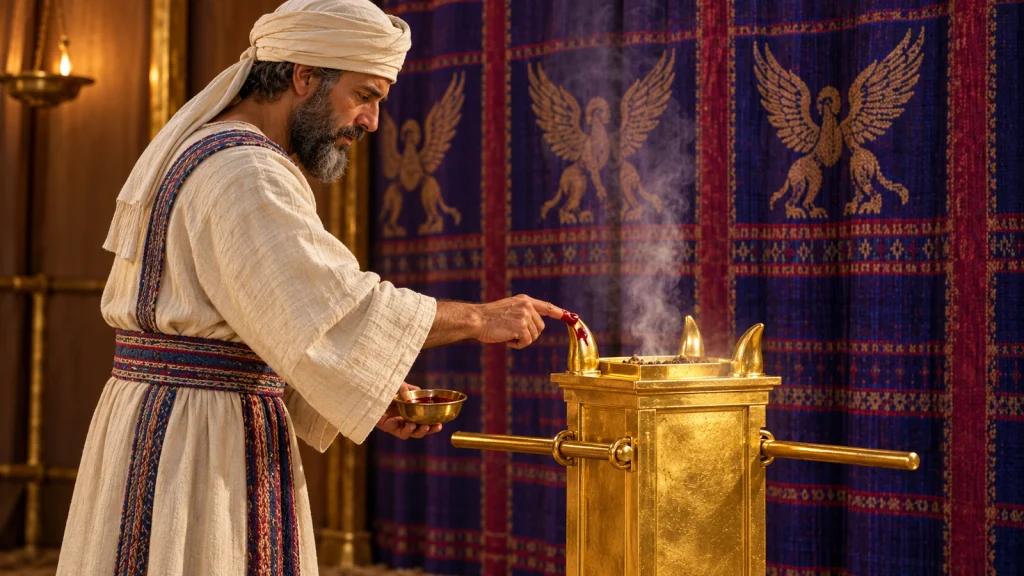
Leviticus 4:5–7.
Source: AI-generated image created for Beyond The Known.
An Israelite leader breaks a command without realizing it. When the offense comes to light, he must bring a male goat, and its blood is applied to the courtyard altar. If the anointed priest commits an inadvertent violation, the required animal is a bull—and the blood enters the Tent of Meeting. Both have sinned. Why does the remedy reach into different parts of Israel’s sanctuary?
Why Does Leviticus 3 Reserve the Fat for the LORD?, our previous study, followed the portions assigned to the altar in the well-being offering. Leviticus 4 retains some of those instructions about fat but places them within a new problem: a divine prohibition has been violated, though the offender may not yet know it.
Four cases follow—the anointed priest, Israel’s congregation, a leader, and an ordinary member of the community. Their repeated instructions can sound interchangeable. They are not: the blood moves along two distinct routes, the remaining meat meets different requirements, and forgiveness is explicitly promised in three of the four cases.
What Makes a Sin “Unintentional”?
Leviticus 4:2 introduces the Hebrew expression bišgāgāh (בִּשְׁגָגָה), commonly rendered “unintentionally,” “inadvertently,” or “unwittingly.” The offense involves doing something prohibited by one of the LORD’s commands. In this setting, an inadvertent sin is not necessarily a movement of the body made by accident. A person may act deliberately while being mistaken about what the command requires or unaware that the circumstances make the action forbidden.
Awareness and guilt are not presented as identical. The entire assembly can become liable while its transgression remains hidden from it; once the offense becomes known, the community must bring its offering (4:13–14). The leader and ordinary Israelite likewise respond when they are made aware of the violation (4:23, 28). Recognition initiates the prescribed remedy. It is not the event that makes an otherwise innocent action wrong.
Numbers 15:22–31 offers a useful comparison. There, inadvertent wrongdoing is contrasted with conduct undertaken “with a high hand,” a description of brazen defiance. That distinction helps explain the scope of the rite without turning it into a complete theory of every sin for which forgiveness might be sought in the Hebrew Bible. Leviticus 4 addresses violations of prohibitions; the following chapter will expand the cases under consideration.
An unwitting breach, then, has consequences without being equated with brazen rebellion. That is why the prescribed response begins when the offense is recognized.
Why Do Some Bibles Say “Sin Offering” and Others “Purification Offering”?
The Hebrew name of this sacrifice is ḥaṭṭāʾt (חַטָּאת), a noun also used for “sin.” Leviticus 4:3 places the related words close together when it speaks of the priest who sins and the offering brought for his offense. Translating the ritual simply as “purification offering” makes that verbal connection less apparent to an English reader.
The alternative has substantial textual grounds. A ḥaṭṭāʾt is also required after childbirth in Leviticus 12, where the issue concerns ritual purification rather than an identified moral transgression. Jacob Milgrom made the purifying function central to his interpretation of the sacrifice. Roy E. Gane likewise uses “purification offering,” while emphasizing that the rite could remedy both inadvertent sins and certain serious ritual impurities. Yitzhaq Feder, arguing from the terminology’s history, cautions against discarding the traditional name “sin offering.” These approaches reflect a real scholarly disagreement, not two names for unrelated ceremonies.
Here “sin offering” keeps the offense in view, while “purification offering” draws attention to the ritual’s broader use. The Hebrew verb kipper (כִּפֶּר), usually translated “make atonement,” becomes more illuminating once we examine the prescribed actions and their result.
Four Offenders, but Not Four Identical Rituals
The Anointed Priest: Blood Inside the Tent (4:3–12)
First comes the “anointed priest,” understood in this context as the high priest. His sin is described as bringing guilt upon the people (4:3), a difficult phrase that at least signals consequences attached to his public office. It need not mean that each Israelite personally performed the priest’s act.
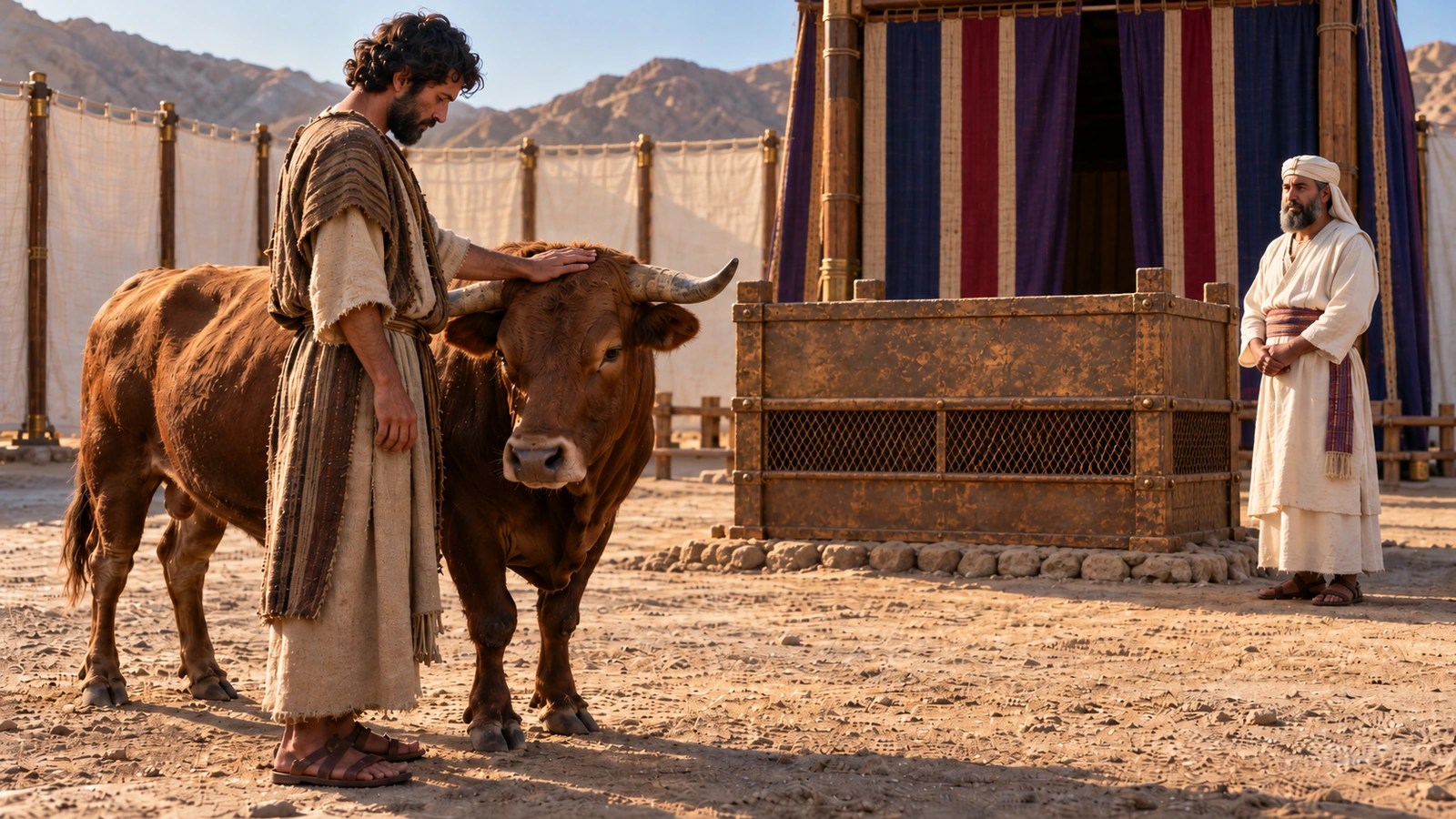
He brings an unblemished bull to the entrance of the Tent of Meeting, lays his hand on the animal’s head, and slaughters it before the LORD. Hand-laying identifies his participation in the offering; the instructions do not explicitly describe sin moving into the bull at that moment.
Then the ceremony departs from the pattern of the previous animal offerings: some of the blood is carried into the tent. The priest dips a finger into it, sprinkles seven times before the LORD toward the sanctuary curtain, and places blood on the horns of the incense altar (4:5–7). Only the remainder is poured at the base of the burnt-offering altar in the courtyard. An action normally associated with slaughter outside the tent has thus led to a rite in its interior.
The curtain marks an important boundary. The blood is sprinkled toward it from the Holy Place; the priest does not enter the Most Holy Place. Entry into that innermost space belongs to the distinct Day of Atonement instructions in Leviticus 16. Seven sprinklings are required here, but the chapter offers no explanation of what the number signifies.
After the internal fat, kidneys, and liver portion are removed and burned on the outdoor altar, the rest of the bull—including its hide and flesh—is taken to a ritually clean place outside the camp and burned there (4:8–12). That location is expressly called clean; it should not be imagined as a polluted refuse heap merely because it lies beyond the encampment.
The horns of the incense altar are also associated with an annual rite of atonement in Exodus 30:10. Readers who followed Why Did the Tabernacle Need an Altar of Incense? will recognize the furnishing. The annual rite and the procedure of Leviticus 4 are related by location, although their instructions are not identical.
The Congregation: Its Elders Lay Hands on the Bull (4:13–21)
When the whole community discovers an inadvertent violation, its representatives bring a bull before the Tent of Meeting. This time the elders place their hands on its head, acting for the assembly. The anointed priest then performs the same type of interior blood rite: seven sprinklings toward the curtain, blood on the incense altar’s horns, and the remainder at the base of the courtyard altar.
As with the priest’s bull, selected fat portions are burned on the altar and the carcass is taken outside the camp. Verse 20 gives the outcome in words absent from the end of the preceding case: the priest makes atonement for the people, and they are forgiven.
Although the priest and the gathered people have very different identities, their blood rites reach the same sacred locations. The elders’ participation also shows that a community can be represented in the sacrificial approach while the priest retains responsibility for administering the blood.
A Leader: A Male Goat at the Outer Altar (4:22–26)
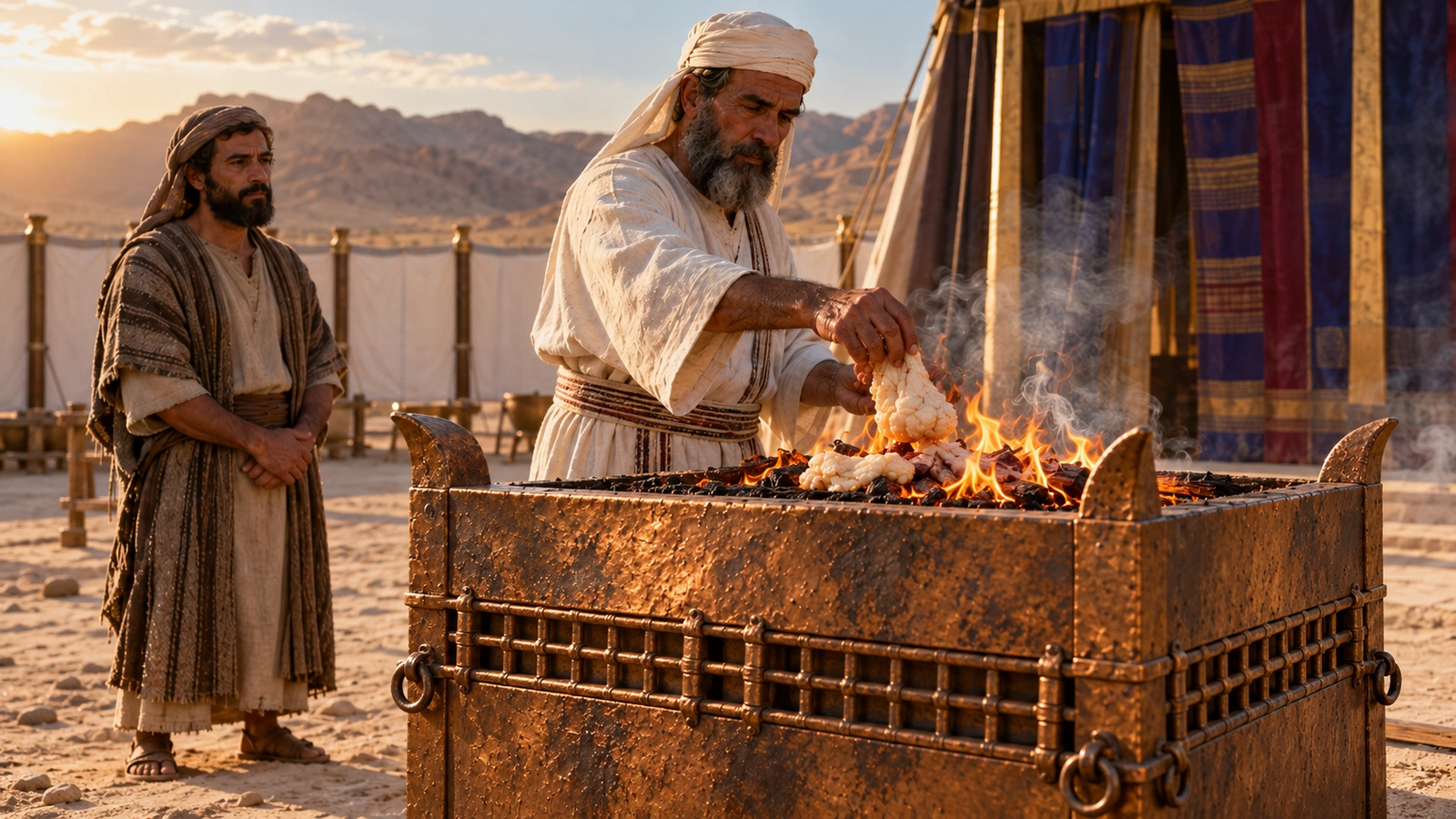
A nāśîʾ (נָשִׂיא)—a leader or chief—brings an unblemished male goat when an inadvertent offense is brought to his attention. The term need not designate a king. The animal is slaughtered where burnt offerings are killed, and the priest uses his finger to put blood on the horns of the courtyard altar. Its remainder is poured at the altar’s base.
Nothing in these directions calls for blood to enter the tent. The fat is burned following the pattern of the well-being offering, and the concluding words promise atonement and forgiveness (4:25–26).
A larger animal and an interior blood rite might suggest that a higher-ranking offender has committed a morally worse sin. Yet the regulation supplies no measure of individual wickedness. It assigns a different procedure to a different position within Israel.
An Ordinary Israelite: A Female Goat or Sheep (4:27–35)
An ordinary Israelite may bring an unblemished female goat or female sheep. Both are genuine options in the passage, not an invitation to speculate about the worshiper’s precise income or social standing.
Here too, blood is applied to the horns of the burnt-offering altar outside the tent, with the remainder poured at its base. The priest burns the selected fat and makes atonement for the individual. Both versions end with the assurance that the person will be forgiven (4:31, 35).
Verse 31 adds an easily missed detail: the burning produces a “pleasing aroma” to the LORD. That description, familiar from the earlier offerings, appears even in a sacrifice occasioned by a violation. It links this new category of rite to the vocabulary of acceptable presentation without making it identical to a burnt or well-being offering.
Blood on the Horns: Why the Location Changes
In Leviticus 1 and 3, Aaron’s sons dash sacrificial blood against the sides of the altar. Leviticus 4 describes a more differentiated series of actions. Blood is sprinkled in the tent for two cases and placed on altar horns in all four. The Hebrew verbs reflect these distinct movements: zāraq is used for dashing in the earlier chapters, whereas hizzâ describes sprinkling in Leviticus 4:6 and 17. The NET Bible’s translators note that contrast.
The sanctuary’s layout clarifies the difference. The burnt-offering altar stands in the open courtyard. The incense altar stands within the Tent of Meeting, in front of the inner curtain. Both the anointed priest’s and congregation’s offerings involve the interior furnishing; the leader’s and ordinary Israelite’s offerings stop at the outer altar.
Substituting a bull for a goat would not explain the different procedures. The location of the blood applications is part of the ritual itself.
What, then, happens when blood touches an altar? Leviticus 8:15 uses related purification language when Moses applies blood to the altar at its consecration, and Leviticus 16 explicitly describes purging sacred space on the Day of Atonement. These parallels help explain why scholars see a purifying function in the ḥaṭṭāʾt. Still, the blood’s movement in Leviticus 4 cannot be reduced to an anatomical diagram of sin traveling through the tent. The chapter describes an appointed action, not the complete invisible mechanics of its effect.
This spatial distinction fits the larger concern with Israel’s priesthood: the anointed priest serves at sacred furnishings inaccessible to ordinary worshipers. His office makes his conduct a matter of more than private concern. That is an inference drawn from the arrangement and wording of the law; it is not presented as a direct speech explaining why God assigned each animal.
Why Are Some Carcasses Burned Outside the Camp?
Once the prescribed fat portions have been removed, both the anointed priest’s bull and the congregation’s bull are burned outside the camp. Leviticus 4 gives no corresponding instruction to destroy the remaining meat from the leader’s goat or the ordinary person’s animal.
Leviticus 6:17–23 in the NABRE—6:24–30 in many other English Bibles—supplies the missing instructions. Ordinarily, the priest who performs a purification offering eats its meat in a holy place. But verse 23 in the NABRE (verse 30 in those other editions) forbids eating the flesh of a sacrifice whose blood has entered the Tent of Meeting for atonement: it must be burned.
That provision is essential to understanding the first two bulls. It also shows why a reading confined to chapter 4 leaves part of the ceremony unexplained. As Zev Farber observes, Leviticus 1–5 and the supplementary priestly instructions in chapters 6–7 address overlapping offerings with different emphases. Farber proposes a historical explanation for their arrangement; the practical connection between their final-form instructions is visible regardless of whether a reader accepts his compositional hypothesis.
The meat priests may eat is still no ordinary food. Leviticus 6 calls the offering “most holy,” requires a sacred location for eating it, and regulates what happens when blood touches a garment or when the flesh is cooked in a vessel. Moses later appeals to the priestly duty to eat such an offering in Leviticus 10:16–20. Within this ritual system, consumption itself belongs to priestly service.
Consequently, the two fates of the carcass should not be confused with a simple contrast between “holy” flesh and “dirty” flesh. Both offerings belong to a sacred rite. Their treatment differs according to the blood procedure and the rules that govern priestly participation.
Hebrews 13:11–12 later draws on sacrificial bodies taken outside the camp and applies the imagery to Jesus’ suffering. That connection matters for Christian reception, but it should not replace Leviticus’ own ritual explanation with a meaning developed in a later text.
Who Makes Atonement—and Who Forgives?
Four times the chapter joins the priest’s action to the assurance of forgiveness: for the community (4:20), the leader (4:26), and the ordinary person offering either a goat or a sheep (4:31, 35). The Hebrew formula uses kipper for the priest’s work of atonement and then a passive form of sālaḥ, “forgive”: the offense will be forgiven. The priest administers the appointed rite; the text does not attribute the power to forgive to him personally. James W. Watts emphasizes this distinction in his analysis of the chapter’s repeated formulas.
One exception demands attention: verses 3–12 have no matching sentence expressly announcing the anointed priest’s forgiveness. That silence deserves to be registered without building an entire doctrine upon it. In verse 20, the community’s bull is handled as the previous bull was, and the formula for the people follows. The law does not explain why a similar concluding statement is absent from the priest’s paragraph.
Scholars disagree about what those actions accomplish. Jacob Milgrom interpreted blood application primarily as the purification of sacred places affected by Israel’s wrongdoing. Gane argues that ordinary purification offerings remove the offerer’s liability or impurity and may also affect the sanctuary, which receives a separate purging on the Day of Atonement. Their disagreement turns partly on how Leviticus 4 relates to chapters 8 and 16 and to the handling of blood and flesh elsewhere.
The competing models have a common evidentiary limit: Leviticus 4 describes the priestly actions and their announced effect without explaining every invisible step by which atonement works.
The Deeper Discovery
Four Cases, Two Routes—and the Fate of the Flesh
At first the sequence appears to be a sliding scale of sacrificial expense: a bull for the anointed priest, another bull for the assembly, a male goat for a leader, and a female goat or sheep for an ordinary worshiper. But the more important division runs across those four cases.
The first pair joins the priest with the congregation. Their blood is taken inside the tent, and their remaining bulls are burned outside the camp. A leader and an ordinary Israelite form the other: blood stays at the courtyard altar, and the general priestly rules permit the corresponding meat to be eaten. The later instruction in Leviticus 6:23 (NABRE; 6:30 in many editions) makes the link between interior blood and uneaten flesh explicit.
Israel’s corporate offering belongs with the anointed priest’s, although the congregation is not a single officeholder. In one case the elders lay hands on the bull; in the other the priest does. The same sanctuary route serves two distinct forms of communal responsibility.
Gane offers a further explanation for why priests did not eat the bulls presented for the high priest or the whole assembly: the officiant was himself the offerer or belonged to the offering community. That explanation makes sense of the ritual’s communal logic, but it is a scholarly account of the rule, not a reason stated in Leviticus 4. The explicit legislation grounds the eating prohibition in the blood’s entry into the tent.
Different routes for the blood are not different grades of divine mercy. The forgiveness formula recurs for the congregation, leader, and ordinary Israelite; its absence from the first case remains an acknowledged limit, not an excuse to infer exclusion.
FAQ
Does “unintentional sin” mean a person had no choice or awareness of the action?
Not necessarily. The expression can describe someone who acted without realizing the action violated a divine prohibition. Leviticus 4:13–14 explicitly distinguishes a community’s existing guilt from its later discovery of the offense.
Why did the high priest bring a bull instead of a goat?
That is the animal required in Leviticus 4:3. The passage links his office to a different blood rite but does not offer a direct explanation of the bull’s monetary or symbolic value.
Did laying a hand on the animal transfer the person’s sin into it?
Hand-laying associates the worshiper with the sacrifice, but Leviticus 4 does not explicitly describe sin passing through the hand. Any fuller interpretation needs evidence from related rituals rather than this gesture alone.
Why was blood sprinkled seven times toward the curtain?
Seven sprinklings are commanded in the priestly and communal cases (4:6, 17). Interpretations of seven as completeness are possible in the wider Bible, but this passage gives no explanation for the number.
Could the priests eat the meat of every purification offering?
No. Leviticus 6:17–23 in the NABRE (6:24–30 in many other editions) permits priestly eating in some cases but forbids it when blood was brought into the Tent of Meeting for atonement.
Did the anointed priest receive a promise of forgiveness?
His instructions in 4:3–12 lack the explicit forgiveness formula found later in the chapter. That omission does not establish that forgiveness was unavailable to him; the passage leaves the reason unstated.
What Comes Next?
Leviticus 4 starts with an offense committed without awareness. The next chapter asks what happens once responsibility becomes personal and specific: a witness who fails to speak, someone who becomes unclean, or a person who makes a rash oath. Confession enters the instructions explicitly in Leviticus 5:5. A further set of cases introduces restitution when sacred property is misused.
An animal offering can address guilt within these laws, but is it always enough? Why does the Torah sometimes require the person to speak the offense aloud—or restore what has been taken?
Why Does Leviticus 5 Require Confession and Restitution?
Selected Sources
- NET Bible: Leviticus 4, with Translators’ Notes. New English Translation.
- Leviticus 4, with Explanatory Notes. New American Bible, Revised Edition. United States Conference of Catholic Bishops.
- Leviticus 6, with Explanatory Notes. New American Bible, Revised Edition. United States Conference of Catholic Bishops.
- Roy E. Gane. “Sacrifice and the Old Testament.” St Andrews Encyclopaedia of Theology. University of St Andrews, August 17, 2022.
- James W. Watts. “Leviticus’ Rhetorical Presentation of the Sin and Guilt Offerings.” TheTorah.com, 2019.
- Yitzhaq Feder. “A Sin Offering for Birth Anxiety.” TheTorah.com, 2016.
- Zev Farber. “‘This Is the Torah’ for the Priests Performing the Offerings.” TheTorah.com, 2017.