Why Does the Book of the Covenant Begin with Hebrew Slavery?
Exodus 21 Explained: Hebrew Slavery, Manumission, Female Servitude, Talion, and Negligence
Source: AI-generated image created for Beyond The Known.
The first major civil case after Sinai concerns an enslaved Hebrew.
That is difficult to miss.
In Why Do the Ten Commandments Begin with Redemption, Not Rules?, YHWH introduced the Decalogue by identifying himself as the God who brought Israel “out of the house of slavery.”
Only a few verses later, Israel hears:
“When you acquire a Hebrew slave…”
A nation rescued from forced labor is now given laws for a society in which human beings can still become the property of other human beings.
Exodus 21 does not resolve that tension for modern readers.
It makes us confront it.
Does the Book of the Covenant Literally Begin with Slavery?
Technically, not quite.
What scholars commonly call the Book of the Covenant or Covenant Code usually begins at Exodus 20:22 and continues through 23:33. Its opening instructions concern worship and altars.
Exodus 21:1 introduces the major sequence of civil case laws:
וְאֵלֶּה הַמִּשְׁפָּטִים — wĕʾēlleh hammišpāṭîm
“And these are the judgments.”
The noun מִשְׁפָּטִים — mišpāṭîm belongs to the judicial vocabulary of שפט — š-p-ṭ, “to judge.”
What follows differs in form from the short prohibitions of the Decalogue.
A situation is presented.
A complication follows.
Then a legal consequence is supplied.
So the title raises a slightly more precise question:
Why does the Covenant Code begin its main sequence of case laws with Hebrew slavery?
Why Is a Hebrew Slave the First Legal Case?
Exodus 21:2 begins:
כִּי תִקְנֶה עֶבֶד עִבְרִי — kî tiqneh ʿeḇeḏ ʿiḇrî
“When you acquire a Hebrew slave…”
The literary proximity to Exodus 20:2 is striking.
Egypt had just been called:
מִבֵּית עֲבָדִים — mibbêt ʿăḇādîm
“the house of slaves.”
Now Israel must regulate the status of an:
עֶבֶד — ʿeḇeḏ
“slave” or “servant,” depending on context.
Both belong to the עבד — ʿ-b-d word family, associated with service and labor.
Exodus never explicitly says, “This case appears first because Israel was enslaved in Egypt.”
That connection should be identified as a final-form literary observation, not as a statement placed in the narrator’s mouth.
Yet the present sequence creates the juxtaposition.
Former slaves are now forced to consider what happens when another Hebrew enters servitude among them.
Was a Hebrew Slave Really Just an Indentured Servant?
Calling the person in Exodus 21 merely an “employee” does not fit the legal conditions.
The semantic range of עֶבֶד — ʿeḇeḏ is broad. Elsewhere it can describe a servant, subordinate, royal official, or slave.
Context decides.
Here a man can be acquired by a master. His family situation can be controlled by the household. He can become permanently attached to that master, and later in the chapter an enslaved person is described as the owner’s “silver.”
“Slave” is therefore a defensible translation.
That does not make this institution identical to Atlantic racial chattel slavery.
The Hebrew male in Exodus 21:2–6 receives a defined route to release. His ethnic status matters. The system belongs to an ancient household economy rather than a modern transatlantic plantation regime.
Historical difference should clarify the institution, not sanitize it.
The person remains under coercive legal and economic control.
Did Hebrew Slavery Usually Begin with Debt?
Poverty and debt provide an important background to ancient servitude.
Across the ancient Near East, indebted households could lose land, labor, and sometimes personal freedom. Other biblical laws also connect economic collapse with forms of dependent service.
Exodus 21:2, however, does not tell us how this particular Hebrew became enslaved.
Another section of the Covenant Code allows a thief who cannot make restitution to be sold for his theft.
That means economic liability could lead to enslavement.
But it would go beyond the evidence to claim that every person in Exodus 21 is simply working off a voluntary loan.
Debt servitude belongs to the historical context.
It is not an explanation supplied for every case in the chapter.
Why Does the Hebrew Slave Go Free in the Seventh Year?
The first restriction is clear:
שֵׁשׁ שָׁנִים יַעֲבֹד וּבַשְּׁבִעִת יֵצֵא לַחָפְשִׁי חִנָּם
“Six years he shall serve, and in the seventh he shall go out free, without payment.”
The release does not require him to purchase himself back.
He leaves:
לַחָפְשִׁי חִנָּם — laḥopšî ḥinnām
“free, without payment.”
A six-plus-one rhythm naturally recalls the Sabbath pattern already established earlier in Exodus.
In Why Did God Give Israel Manna One Day at a Time?, the seventh-day rhythm appeared before Sinai through the manna cycle. Exodus 20 then incorporated Sabbath into the Decalogue.
Exodus 21 now places a seventh-year boundary around the service of a Hebrew male.
The connection is suggestive.
The verse itself does not explicitly say that Sabbath theology explains the manumission rule, so the relationship should not be presented as certain.
Ancient Mesopotamian societies also developed mechanisms limiting some forms of debt bondage. That wider context shows that Israel was not alone in confronting the social danger of permanent dependency.
What Happens to the Slave’s Wife and Children?
The release law immediately becomes more difficult.
If the man entered slavery already married, his wife leaves with him.
But if the master supplied a wife during the period of service and she bore children, Exodus 21:4 states that the wife and children remain with the master.
The man leaves alone.
That provision creates the setting for what follows.
The enslaved man may declare:
“I love my master, my wife, and my children; I will not go out free.”
Because the declaration belongs to him, the narrative presents a decision.
Yet calling it an entirely free choice would obscure the legal pressure built into the situation.
Freedom requires separation from his wife and children.
Remaining with them requires permanent service.
The master then brings him:
אֶל־הָאֱלֹהִים — ʾel-hāʾĕlōhîm
The phrase is interpreted as bringing him before God in some translations and before the judges in others.
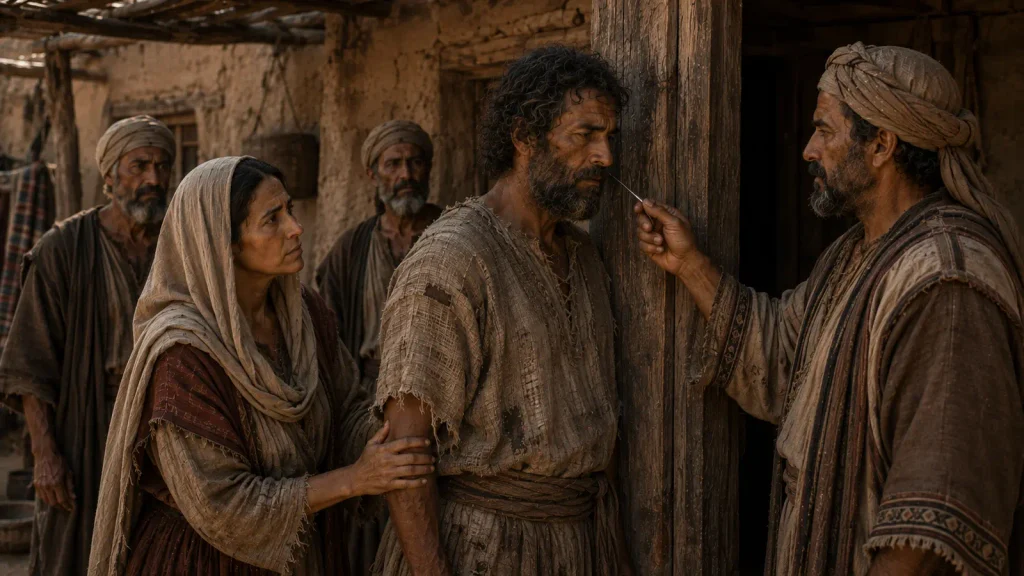
He is taken to the door or doorpost. His ear is pierced with an awl, and he becomes the master’s servant לְעֹלָם — lĕʿōlām, an enduring or permanent status within the legal horizon of the passage.
Exodus does not explain the symbolism of the ear or doorway.
Claims that the ear certainly represents obedience or that the doorpost unquestionably reenacts Passover symbolism are possible later interpretations, not explicit explanations in Exodus 21.
Why Is the Daughter Treated Differently?
Verse 7 introduces another legal category:
“When a man sells his daughter as a female slave…”
The term is:
אָמָה — ʾāmâ
a female slave or bondwoman.
Her situation differs from that of the Hebrew male.
The passage appears to envision a household arrangement in which she may be designated for the purchaser or his son, creating a mixture of economic dependency and prospective marriage or concubinage.
If the intended arrangement fails, she must be allowed redemption.
She may not be sold to foreigners.
If designated for the purchaser’s son, she must be treated according to the rights of a daughter.
If another woman is taken, three obligations toward the first woman cannot be withheld.
The third obligation is expressed by the rare word:
עֹנָתָהּ — ʿōnātāh
Traditional interpretation understands it as conjugal or marital rights.
Shalom M. Paul proposed a material-maintenance interpretation instead, while other scholars continue to defend the sexual or marital sense.
The lexical dispute should remain visible.
If the required provisions are denied, the woman may leave without payment.
These protections matter.
So does the hierarchy that makes them necessary.
The father has sold his daughter, and her legal situation is not identical to the six-year release rule stated for the male servant.
Protection and inequality occupy the same passage.
Does Exodus 21 Approve of Slavery?
The chapter regulates slavery rather than abolishing it.
That formulation is more precise than either extreme.
Regulation is not identical to a philosophical endorsement of every feature of an institution.
But neither can the regulations be rewritten as though slavery were absent.
People are acquired.
Masters exercise authority over them.
Family separation can occur.
Enslaved people possess an economic value belonging to their owners.
At the same time, the master’s power is not unlimited.
One provision is especially significant.
Exodus 21:16 declares that someone who kidnaps a person and sells that person—or is found possessing the kidnapped person—must be put to death.
Human theft for enslavement is treated as a capital offense.
That makes Exodus 21:16 highly relevant when biblical slavery is compared with slave systems dependent on organized kidnapping and trafficking.
It still does not abolish the other forms of servitude recognized in the chapter.
Both realities belong to the same legal collection.
What Does “He Is His Money” Mean?
Exodus 21:20–21 contains one of the chapter’s most disturbing clauses.
If a master strikes a male or female slave with a rod and the person dies under the beating, the death is to be avenged:
נָקֹם יִנָּקֵם — nāqōm yinnāqēm
The exact judicial penalty is not specified in the verse.
If the victim survives for a day or two, however, the master is not subjected to the same vengeance under this provision.
Then comes the explanation:
כִּי כַסְפּוֹ הוּא — kî kaspô hûʾ
“for he is his silver.”
Some interpreters understand the survival period as relevant to determining whether lethal intent can be presumed.
Even so, the final clause cannot be ignored.
The enslaved person is described in economic terms as the master’s asset.
That reflects legal inequality.
Yet verses 26–27 immediately impose another boundary.
If a master destroys the eye of a male or female slave, the injured person must be released.
The same happens for the loss of a tooth.
The chapter can recognize a slave as property while also giving bodily injury the power to terminate the master’s claim.
The tension should not be resolved artificially.
Does “Eye for Eye” Require Personal Revenge?
The famous formula appears in the case of an injured pregnant woman:
נֶפֶשׁ תַּחַת נֶפֶשׁ — nep̄eš taḥat nep̄eš
“life for life”
עַיִן תַּחַת עַיִן — ʿayin taḥat ʿayin
“eye for eye”
שֵׁן תַּחַת שֵׁן — šēn taḥat šēn
“tooth for tooth.”
This principle is commonly called lex talionis.
Its legal force is proportionality.
The response to injury is measured against the injury itself rather than allowed to expand into unlimited retaliation.
Whether every item was intended to require literal physical talion in judicial practice, or whether compensation could operate in some circumstances, remains debated.
The passage is judicial language.
It is not an invitation to private revenge.
Does Exodus 21:22 Describe Miscarriage or Premature Birth?
The case introducing the talionic formula is notoriously difficult.
Two men are fighting.
A pregnant woman is struck.
The Hebrew says:
וְיָצְאוּ יְלָדֶיהָ — wĕyāṣĕʾû yĕlāḏêhā
literally, “her children come out.”
Some English translations understand this as miscarriage.
Others render it as premature birth.
The next word creates another interpretive problem:
אָסוֹן — ʾāsôn
“harm,” “injury,” or “disaster.”
If no ʾāsôn follows, the offender pays a fine.
If harm follows, “life for life” and the other talionic formulas appear.
Scholars disagree about whether the relevant injury concerns the woman, the offspring, or potentially either.
The unusual vocabulary and compressed syntax prevent an effortless conclusion.
For that reason, Exodus 21:22–25 should not be made to solve a modern abortion debate before the ancient legal case itself has been interpreted.
The scenario concerns injury caused during a fight.
Its legal categories deserve to be understood on their own terms first.
Why Do Oxen and Open Pits Belong in the Same Chapter?
The final cases broaden the meaning of responsibility.
Exodus 21 has moved from deliberate homicide to accidental killing, assault, injury to enslaved people, a pregnant woman harmed in a fight, dangerous livestock, uncovered pits, and damage caused by one animal to another.
Intent is no longer the only question.
Foreseeability begins to matter.
If an ox suddenly kills someone without a known history of goring, its owner is treated differently from the owner of an animal already known to be dangerous.
Once the owner has been warned, failure to restrain the animal changes the legal outcome.
An uncovered pit works through the same basic logic.
The owner may not have intended an animal to fall into it.
He was still responsible for a hazard he created or failed to secure.
Modern legal language might call this negligence.
That term can illuminate the reasoning, provided we do not pretend ancient Israel operated with modern tort-law categories.
Did Israel Copy the Laws of Hammurabi?
The similarities between biblical and Mesopotamian law are real.
Dangerous-ox cases appear in the Laws of Eshnunna and the Laws of Hammurabi. Other parallels involve bodily injury, property, slavery, and liability.
The difficult question is how those similarities arose.
David P. Wright argues that the Covenant Code shows direct literary engagement with Hammurabi and that its authors deliberately adapted and transformed cuneiform legal material.
Sara J. Milstein places greater emphasis on the world of ancient legal pedagogy and case exercises, arguing that some biblical sequences resemble the kind of problems used to train scribes rather than a simple copy of one official code.
Other models allow for broader shared legal traditions.
These proposals belong to historical-critical scholarship.
Exodus itself does not tell its readers that Moses consulted Hammurabi.
Nor does similarity between ancient laws, by itself, establish direct borrowing.
The responsible conclusion is narrower.
Israelite law participated in a larger ancient Near Eastern legal world while developing its own literary and theological form.
Was Biblical Law Simply More Humane Than Every Neighboring Code?
That claim is too easy.
Several provisions in Exodus 21 place meaningful restraints on power.
A Hebrew male cannot be held under the six-year arrangement indefinitely.
Certain injuries result in a slave’s release.
Kidnapping a human being for sale or possession is a capital crime.
A negligent owner can be held responsible for a dangerous animal.
Ancient Mesopotamian societies, however, also knew debt release, protections for dependents, liability rules, and limits on some forms of servitude.
Israel did not invent the idea that law could restrain an owner or creditor.
Comparative study is most useful when it allows similarities and differences to remain visible.
The question is not whether every Israelite statute is morally superior to everything surrounding it.
A better historical question is how this collection reshapes the legal possibilities available in its ancient environment.
So Why Does the Book of the Covenant Begin with Hebrew Slavery?
No verse provides a direct explanation for the ordering.
That uncertainty matters.
Still, the final form gives us three strong observations.
Israel has just heard that YHWH brought the nation out of a house of slaves. The first major civil case then concerns a Hebrew slave.
That literary proximity forces the newly liberated community to confront dependency within its own households.
Slavery was also not an abstract problem in ancient agrarian economies. Poverty, debt, labor, family authority, property, and social status could become inseparable.
Beginning the case laws here therefore places one of society’s most unequal relationships immediately before Israel’s legal imagination.
The collection also stands within a broader Near Eastern tradition in which slavery and debt bondage were standard subjects of law.
What makes Exodus distinctive in its present narrative setting is that those regulations are now heard after Egypt.
The people legislating about slaves are themselves the people who were slaves.
The Deeper Discovery
The strongest connection between Exodus 20 and 21 may be hidden inside the verbs.
In Exodus 20:2, YHWH describes the exodus:
הוֹצֵאתִיךָ — hôṣēʾtîḵā
“I brought you out.”
The verb comes from:
יצא — y-ṣ-ʾ
“to go out” or “bring out.”
One chapter later, the Hebrew slave reaches the seventh year:
יֵצֵא לַחָפְשִׁי — yēṣēʾ laḥopšî
“he shall go out free.”
Israel was brought out.
Now the enslaved Hebrew must be allowed to go out free.
Verses 26–27 introduce a second liberation verb.
If a master destroys an enslaved person’s eye or tooth:
לַחָפְשִׁי יְשַׁלְּחֶנּוּ — laḥopšî yĕšallĕḥennû
“he shall send him free.”
The verb belongs to:
שלח — š-l-ḥ
“to send” or “release.”
That verb dominated the confrontation with Pharaoh.
Again and again, YHWH demanded that Pharaoh send Israel away.
Now Israel’s own law can require a master to send an injured slave free.
The lexical pattern does not mean Exodus 21 abolishes slavery.
It does something subtler.
The vocabulary of Israel’s liberation has entered Israel’s legislation about enslaved people.
YHWH brought Israel out.
The Hebrew slave must go out free.
The abusive master may be forced to send the slave free.
The language once directed against Pharaoh now reaches into Israelite households.
That makes the presence of slavery inside the redeemed community harder, not easier, to ignore.
FAQ
Does Exodus 21 actually permit slavery?
Yes. Exodus 21 presupposes and regulates slavery rather than abolishing it. It also places limits on masters and creates specific routes to freedom without eliminating the institution itself.
Was Hebrew slavery the same as Atlantic racial chattel slavery?
No. The historical systems differ substantially in ethnicity, economic structure, duration, and legal regulation. Those differences do not justify describing the Hebrew slave as an ordinary employee.
Why was a Hebrew slave released after six years?
Exodus requires six years of service followed by release in the seventh without payment. The pattern resembles Sabbath structures, although the passage does not explicitly state that Sabbath is the reason for the rule.
Why would a slave choose permanent service?
Exodus 21:4–6 places his wife and children at the center of the decision. If the master supplied the wife, she and the children remain with the household when the man becomes free, making his choice socially constrained rather than simple.
Does Exodus 21 allow a father to sell his daughter?
Yes. Exodus 21:7 explicitly imagines a father selling his daughter as an ʾāmâ. The following verses impose protections and possible release, but they still operate within an unequal household system.
Does “eye for eye” command revenge?
No. The formula occurs within judicial legislation and establishes proportionality between injury and legal consequence. Its precise historical application remains debated.
Does Exodus 21:22 refer to miscarriage?
Possibly, but the Hebrew is disputed. The phrase literally says that the woman’s “children come out,” while the meaning and referent of the subsequent “harm” remain debated.
Exodus 21 begins with vulnerability inside the household.
It then moves through assault, injury, property, dangerous animals, and preventable harm.
Exodus 22 widens the field again.
The law will turn toward theft and restitution, but then toward people with far less social protection: the foreign resident, the widow, the orphan, and the poor borrower.
This time, Israel’s experience in Egypt will no longer remain merely in the narrative background.
The law itself will invoke it.
Israel knows what it means to live as a foreigner under another people’s power.
So what happens when foreigners and the socially vulnerable must now live under Israel’s power?
Why Does Exodus 22 Protect Foreigners, Widows, and Orphans?
Selected Sources
- William H. C. Propp, Exodus 19–40. Anchor Yale Bible. Yale University Press, 2026.
- Carol Meyers, Exodus. New Cambridge Bible Commentary. Cambridge University Press, 2005.
- David P. Wright, Inventing God’s Law: How the Covenant Code of the Bible Used and Revised the Laws of Hammurabi. Oxford University Press, 2009.
- Bernard S. Jackson, Wisdom-Laws: A Study of the Mishpatim of Exodus 21:1–22:16. Oxford University Press, 2006.
- Sara J. Milstein, Making a Case: The Practical Roots of Biblical Law. Oxford University Press, 2021.
- Bernard M. Levinson, “The ‘Effected Object’ in Contractual Legal Language: The Semantics of ‘If You Purchase a Hebrew Slave’ (Exod. xxi 2).” Vetus Testamentum 56 (2006): 485–504.
- Shalom M. Paul, “Exod. 21:10, A Threefold Maintenance Clause.” Journal of Near Eastern Studies 28 (1969): 48–53.
- Raymond Westbrook, ed., A History of Ancient Near Eastern Law. 2 vols. Brill, 2003.