Why Do the Ten Commandments Begin with Redemption, Not Rules?
Exodus 20 Explained: The Decalogue, Redemption, Covenant Loyalty, Sabbath, Divine Fear, and the Logic of Biblical Law
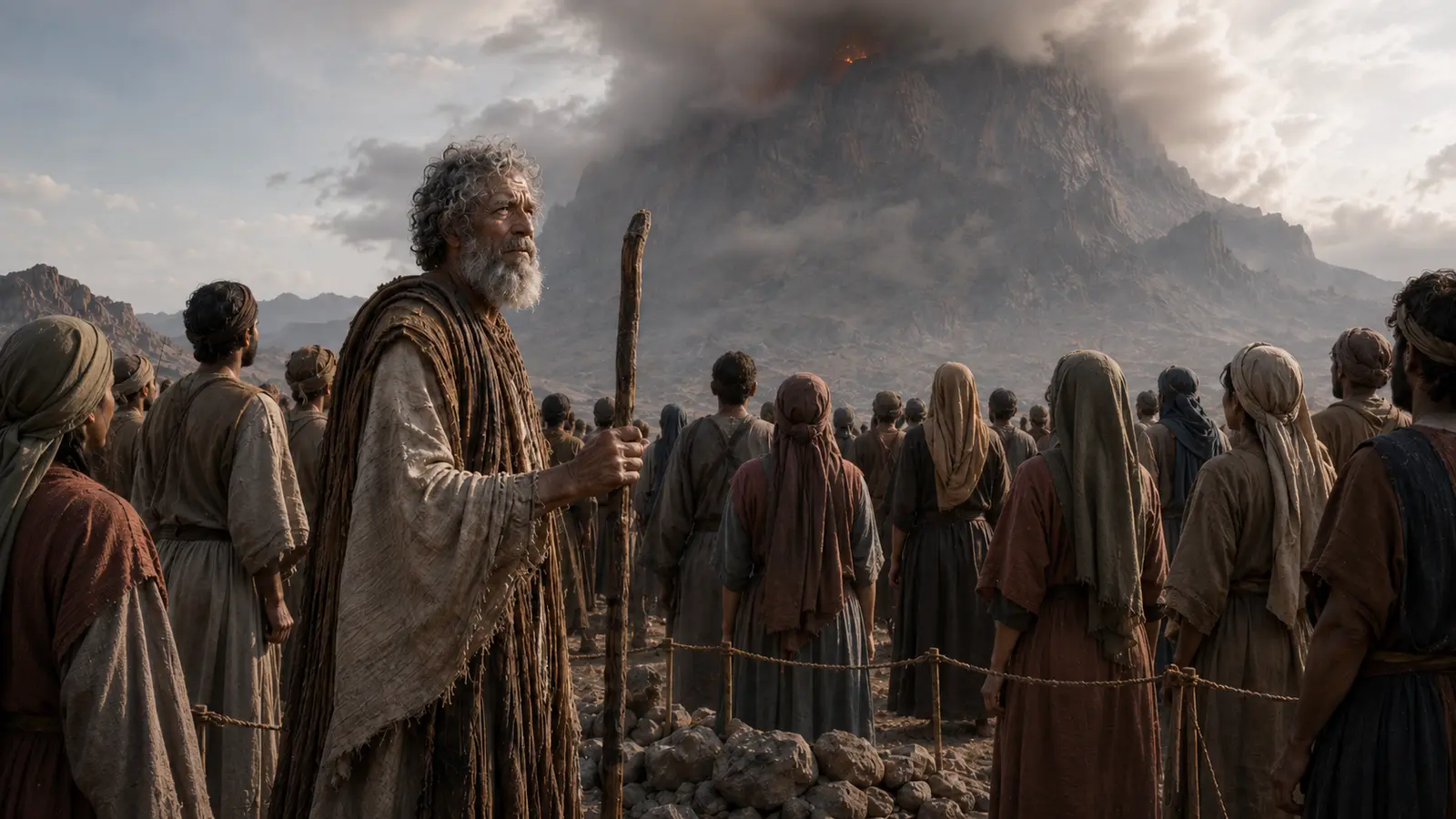
Source: AI-generated image created for Beyond The Known.
Exodus 20 contains the most famous legal speech in the Bible.
Yet it does not begin with a prohibition.
In Why Did Israel Tremble at Mount Sinai?, Exodus 19 ended with Israel standing before a smoking mountain while thunder, lightning, and an intensifying horn announced divine presence. Exodus 20 now reveals what YHWH says when the voice finally addresses the nation.
Before “You shall not.”
Before Sabbath.
Before murder, adultery, theft, false testimony, or coveting.
YHWH identifies himself:
“I am YHWH your God, who brought you out of the land of Egypt, out of the house of slavery.”
The noun redemption does not occur in Exodus 20:2. The title of this article uses it as theological shorthand for the historical rescue the verse explicitly recalls.
That distinction matters.
The Decalogue begins with what YHWH has already done before stating what Israel must now do.
Why?
Are These Really the “Ten Commandments”?
Exodus 20:1 introduces the scene with:
וַיְדַבֵּר אֱלֹהִים אֵת כָּל־הַדְּבָרִים הָאֵלֶּה — wayĕdabbēr ʾĕlōhîm ʾēt kol-haddĕḇārîm hāʾēlleh
“And God spoke all these words.”
Later biblical passages call the collection:
עֲשֶׂרֶת הַדְּבָרִים — ʿăśeret haddĕḇārîm
“the ten words.”
That terminology explains why Decalogue, from Greek for “ten words,” remains an especially useful scholarly label.
The traditional phrase “Ten Commandments” is still appropriate in ordinary usage. Yet the passage includes more than ten grammatical imperatives. It also contains divine self-identification, historical memory, motivations, warnings, and explanations.
Exodus itself does not number each individual “word.”
That helps explain why Jewish, Catholic-Lutheran, and Reformed-Anglican-Orthodox traditions divide the material differently while still arriving at ten.
For that reason, this article will usually speak of prohibitions or commands rather than assuming one later numbering tradition at every point.
Why Does God Speak About Egypt Before Giving a Command?
The first divine utterance begins:
אָנֹכִי יְהוָה אֱלֹהֶיךָ — ʾānōḵî YHWH ʾĕlōheḵā
“I am YHWH your God.”
Then comes the historical identification:
אֲשֶׁר הוֹצֵאתִיךָ מֵאֶרֶץ מִצְרַיִם — ʾăšer hōṣēʾtîḵā mēʾereṣ miṣrayim
“who brought you out of the land of Egypt”
and:
מִבֵּית עֲבָדִים — mibbêt ʿăḇādîm
“out of the house of slavery.”
The verb behind “brought you out” comes from:
יצא — y-ṣ-ʾ
The causative form here describes YHWH as the one who caused Israel to leave Egypt.
That grammatical detail anchors the Decalogue in the narrative that precedes it.
Israel does not obey in order to make the exodus happen.
The exodus has happened.
The commands address a community already removed from Pharaoh’s domination.
Law enters the story after liberation.
Does the Opening Resemble an Ancient Treaty Historical Prologue?
The comparison is worth making—with limits.
Classic scholarship on ancient Near Eastern treaties observed that some vassal agreements identify the superior ruler and recount previous acts of benefaction before listing obligations.
George Mendenhall made this comparison influential in biblical studies. Dennis McCarthy later subjected treaty-and-covenant parallels to more extensive form-critical analysis.
Exodus 20 has an obvious point of contact with that broad pattern.
First:
I am YHWH your God.
Then:
I brought you out of Egypt.
Only afterward come covenant demands.
The comparison helps explain why historical memory and obligation belong together.
It does not prove that the Decalogue copied a particular Hittite treaty.
Nor does resemblance establish a date for the text by itself.
Comparative ancient literature provides context, not verification.
The final form of Exodus makes its own theological point: the authority demanding allegiance is the same authority Israel knows through deliverance.
What Does “No Other Gods Before Me” Actually Mean?
The first prohibition after the historical declaration reads:
לֹא־יִהְיֶה לְךָ אֱלֹהִים אֲחֵרִים עַל־פָּנָי — lō-yihyeh lĕḵā ʾĕlōhîm ʾăḥērîm ʿal-pānāy
“You shall have no other gods before me.”
The final phrase עַל־פָּנָי — ʿal-pānāy is not perfectly captured by one English expression.
Proposals include “before me,” “besides me,” “in my presence,” or language emphasizing preference for another deity over YHWH. What remains clear across the options is the demand for exclusive allegiance.
The verse should not be forced to answer a different historical question by itself.
Does this line alone tell us precisely how its earliest hearers understood the ontological status of every deity named in the ancient world?
No.
The wording regulates Israel’s loyalty.
Within Exodus, rival worship is incompatible with the covenant relationship announced in verse 2.
Pharaoh no longer owns Israel.
No other deity may now claim Israel’s worship.
Why Does the Decalogue Forbid Divine Images?
The next prohibition introduces:
פֶּסֶל — pesel
a carved or sculpted image.
Exodus then forbids bowing down to such images or serving them.
That context is important because the command should not be reduced to a ban on artistic creativity in general. The concern is cultic representation and worship.
Ancient Near Eastern image theology was more sophisticated than the caricature that worshipers simply mistook a piece of stone for a living god.
Mesopotamian, Egyptian, Anatolian, and Levantine traditions could treat cult statues as material manifestations or authorized embodiments of divine presence within ritual systems. Scholarship on ancient cult images documents this distinction clearly.
That makes the biblical prohibition more, not less, significant.
Israel is forbidden to construct and serve an image as a material representation of deity.
The God who spoke from Sinai determines how his presence will be mediated.
Israel cannot manufacture that mediation for itself.
What Does It Mean That YHWH Is “Jealous”?
Exodus 20 describes YHWH as:
אֵל קַנָּא — ʾēl qannāʾ
a “jealous God.”
Modern English can make the word sound like insecurity or petty envy.
The covenant setting points elsewhere.
Here jealousy concerns exclusive claim.
YHWH has identified Israel as the people he delivered. Rival worship violates that relationship.
The same sentence, however, introduces one of the Decalogue’s hardest ethical problems.
YHWH describes himself as:
פֹּקֵד עֲוֹן אָבֹת עַל־בָּנִים — pōqēḏ ʿăwōn ʾāḇōt ʿal-bānîm
“visiting the iniquity of fathers upon children.”
Does Exodus 20 Teach That Children Are Punished for Their Parents’ Sins?
The text should not be softened before it is understood.
Exodus 20:5 speaks of YHWH “visiting” parental iniquity across the third and fourth generations and places the warning in the context of those who hate him. Verse 6 then contrasts that horizon with חֶסֶד — ḥesed extended to “thousands” who love YHWH and keep his commands.
Scholars disagree about how the intergenerational language functions.
It has sometimes been interpreted mainly as the social consequences of parental wrongdoing. Thomas Egger’s extensive study argues that the Hebrew construction more directly describes divine punitive visitation rather than merely automatic natural consequences.
The passage does not support the popular idea that every present misfortune can be diagnosed as a mysterious “generational curse.”
Nor should the tension be erased.
Later canonical texts such as Deuteronomy 24 and Ezekiel 18 develop strong statements about individual responsibility. Those are later voices within the canon and should be labeled as such rather than silently imported into Exodus 20.
Here the warning belongs specifically to covenant infidelity and idolatry across generations.
The asymmetry is still striking:
judgment to the third and fourth generation,
ḥesed to thousands.
What Does “Take the Name in Vain” Mean?
The next prohibition reads:
לֹא תִשָּׂא אֶת־שֵׁם־יְהוָה אֱלֹהֶיךָ לַשָּׁוְא — lō tiśśāʾ ʾet-šēm-YHWH ʾĕlōheḵā laššāwʾ
“You shall not bear/take the name of YHWH your God laššāwʾ.”
The noun שָׁוְא — šāwʾ can carry senses such as emptiness, falsehood, worthlessness, or deception.
That makes the command broader than the modern shorthand “do not use God’s name as a swear word.”
False invocation is especially important.
In an ancient setting where invoking a deity could authenticate an oath or claim, using YHWH’s name for falsehood treated divine authority as a tool of deception.
The text certainly demands reverence for the name.
It does not justify turning every behavior performed “in God’s name” into the lexical meaning of this one phrase.
The Hebrew is narrower than that claim.
Why Is Sabbath Already Familiar in Exodus 20?
The Sabbath command does not appear from nowhere.
Why Did God Give Israel Manna One Day at a Time? examined Exodus 16, where Israel had already experienced a six-day gathering pattern followed by a seventh day without manna collection.
Exodus 20 now says:
זָכוֹר אֶת־יוֹם הַשַּׁבָּת לְקַדְּשׁוֹ — zāḵôr ʾet-yôm haššabbāt lĕqaddĕšô
“Remember the Sabbath day, to keep it holy.”
The instruction extends beyond the household head.
Son.
Daughter.
Male servant.
Female servant.
Livestock.
Resident outsider.
All are included in the cessation from work.
Exodus 20 grounds this rhythm in creation: YHWH made heaven, earth, sea, and their inhabitants in six days and rested on the seventh.
The command links Israel’s weekly life to a pattern larger than Sinai itself.
Why Does Deuteronomy Give a Different Reason for Sabbath?
The later canonical parallel in Deuteronomy 5 preserves the Sabbath command but changes its explicit rationale.
Exodus 20 points to creation.
Deuteronomy 5 points to Israel’s former slavery in Egypt and deliverance from it.
The difference is real and has generated extensive discussion about the literary history of the two Decalogue forms.
Historical-critical scholars propose different developmental relationships between the versions.
A final-form reading can make a more modest observation.
Exodus situates Sabbath within creation.
Deuteronomy places special emphasis on liberation and the extension of rest to dependents.
The two texts should not be made verbally identical when the canonical versions themselves are not.
Why Do the Commands Move from Worship to Human Relationships?
After commands concerning YHWH, images, the divine name, and Sabbath, the Decalogue turns toward household and communal relationships.
Honor father and mother.
Do not murder.
Do not commit adultery.
Do not steal.
Do not testify falsely.
Do not covet what belongs to a neighbor.
The familiar division into a “Godward” and “neighborward” section is useful as a broad description, but the boundary should not be made too rigid.
Sabbath concerns worship and social rest.
Honoring parents carries both household and covenant implications.
The text joins religious allegiance to social order rather than treating them as separate moral worlds.
Does “You Shall Not Murder” Really Mean “You Shall Not Kill”?
The Hebrew is:
לֹא תִּרְצָח — lō tirṣāḥ
from the root רצח — r-ṣ-ḥ.
Modern English translations commonly use “murder,” and that is more precise in this context than a universal prohibition expressed simply as “kill.” The same Hebrew root, however, can occur in texts dealing with both intentional and unintentional homicide.
That lexical range matters.
One word in Exodus 20 cannot by itself settle every biblical question about warfare, capital punishment, manslaughter, or self-defense.
The prohibition protects human life against culpable homicide.
Broader ethical systems must be constructed from more than one English gloss.
Why Does the Final Prohibition Reach Into Desire?
Exodus 20:17 uses:
חמד — ḥ-m-d
“to desire” or, in this context, “to covet.”
The root itself is not inherently evil in every biblical occurrence.
Context determines whether desire is legitimate.
Here the object belongs to another person.
House.
Wife.
Servants.
Livestock.
Anything belonging to the neighbor.
The Decalogue has moved from acts visible in public life to desire capable of generating those acts.
That is unusual for a text often described simply as a legal code.
Law has reached beyond observable injury into the orientation that threatens another household before property is taken or adultery occurs.
Why Does Testing Return at Sinai?
The people now encounter the thunder, flashes, horn, and smoking mountain.
They retreat and tell Moses:
“You speak with us, and we will listen. But do not let God speak with us, lest we die.”
Moses gives an answer containing two important Hebrew roots:
אַל־תִּירָאוּ — ʾal-tîrāʾû
“Do not fear.”
Then:
לְבַעֲבוּר נַסּוֹת אֶתְכֶם — lĕḇaʿăḇûr nassôt ʾetkem
“in order to test you.”
And:
תִּהְיֶה יִרְאָתוֹ עַל־פְּנֵיכֶם — tihyeh yirʾātô ʿal-pĕnêḵem
“that his fear may be before you.”
The root ירא — y-r-ʾ appears in both the negative command and the positive purpose.
Do not fear.
Yet let the fear of God remain before you.
The verse distinguishes the people’s immediate terror from an enduring fear that restrains sin.
A second root reconnects Sinai with the wilderness:
נסה — n-s-h
“to test.”
At Marah, Israel was tested.
Through manna, Israel was tested again.
At Massah, Israel tested YHWH.
Now at Sinai, testing returns.
The sequence begun in the wilderness has reached the covenant mountain.
Why Does Moses Approach While the People Remain Far Away?
After the exchange, Exodus says:
“The people stood at a distance, while Moses drew near to the thick darkness where God was.”
This continues the access pattern established in Exodus 19.
Israel genuinely hears divine speech.
Yet proximity remains differentiated.
The people stand back.
Moses approaches.
Nothing in the text requires us to imagine Moses as intrinsically superhuman.
He functions as mediator.
The scene also prepares the transition from direct divine speech to the legal material communicated through Moses in the chapters that follow.
Why Does Exodus 20 Continue After the Decalogue?
The chapter does not end with coveting.
YHWH returns immediately to the problem of images:
“You yourselves have seen that I have spoken with you from heaven.”
Because the people have heard divine speech, they must not make gods of silver or gold alongside YHWH.
Then come instructions for altars.
An altar of earth is permitted.
If stones are used, they must not be worked with a tool because the text says that doing so profanes them.
Steps are prohibited because the worshiper’s nakedness must not be exposed upon the altar.
We should resist adding explanations Exodus does not give.
The chapter does not say uncut stone symbolizes humility.
It does not explicitly contrast the altar with Egyptian monumental architecture.
Those may become comparative questions, but they are not the narrator’s stated rationale.
The final text ties worship practice to the same revelation that delivered the Decalogue.
Israel cannot determine worship solely through its own design.
Is the Decalogue a Single Composition from One Historical Moment?
That question remains disputed.
Exodus 20 and Deuteronomy 5 preserve closely related Decalogues, but they are not word-for-word identical.
The Sabbath rationale differs.
The treatment and ordering of coveting differs.
Other smaller expansions and formulations vary as well.
Historical-critical scholarship has proposed many reconstructions of an earlier shorter Decalogue, later expansions, and relationships between Exodus and Deuteronomy.
No reconstruction has become a recovered transcript of the text’s editorial history.
William H. C. Propp’s recent Exodus 19–40 treats the Sinai law material alongside textual evidence, ritual, covenant, literary formation, and the wider history of Israelite religion, illustrating how many questions remain open at this point in Exodus research.
Final-form interpretation asks a different question.
What does Exodus 20 as we now have it accomplish?
Its answer is visible in the sequence.
The speaker identifies himself.
Rescue is remembered.
Loyalty is demanded.
Worship is regulated.
Time is ordered.
Human relationships are protected.
Desire itself is addressed.
Fear is transformed into a test of obedience.
So Why Do the Ten Commandments Begin with Redemption, Not Rules?
Because Exodus places divine action before covenant demand.
The text begins:
“I am YHWH your God.”
Then:
“I brought you out.”
Only afterward does the sequence of prohibitions and commands unfold.
Israel is not told to obey so that Pharaoh will release them.
Pharaoh has already lost his claim.
Nor is obedience presented as the mechanism by which YHWH becomes Israel’s God for the first time.
The speech addresses Israel as:
“your God.”
The law regulates life inside a relationship the narrative already depicts as established through rescue and covenant.
That does not make the commands optional.
It explains why they appear where they do.
Biblical law begins here not with an anonymous authority demanding compliance, but with a speaker whose identity is tied to an act of liberation.
Redemption precedes obligation.
Obligation gives redeemed life a covenant shape.
The Deeper Discovery
The opening and the Sabbath command contain a lexical connection that is easy to miss.
Exodus 20 begins by calling Egypt:
מִבֵּית עֲבָדִים — mibbêt ʿăḇādîm
“from the house of slaves.”
The root is:
עבד — ʿ-b-d
associated with work and service.
A few verses later, Sabbath explicitly includes:
עַבְדְּךָ — ʿaḇdĕḵā
“your male servant”
and:
אֲמָתְךָ — ʾămāṯĕḵā
“your female servant.”
The people brought out of a house of slaves now receive a weekly command that restricts their power to demand continuous labor from people inside their own households.
Exodus 20 does not abolish slavery.
The next chapter makes that ethical difficulty impossible to avoid.
But the literary relationship is still striking.
Former slaves are not given permission to construct a society in which work has no boundary.
Even the servant rests.
Even the animal rests.
Even the resident outsider rests.
The Decalogue begins by remembering slavery and then places a limit on the labor Israel may extract from others.
That discovery also creates the next problem.
Immediately after the Ten Words and the altar regulations, the Book of the Covenant begins.
Its first laws concern Hebrew slaves.
Why would a people introduced as liberated from the “house of slavery” receive slave legislation almost immediately afterward?
Why Does the Book of the Covenant Begin with Hebrew Slavery?
FAQ
Are the Ten Commandments actually called the “Ten Words”?
Yes. Later biblical passages use עֲשֶׂרֶת הַדְּבָרִים — ʿăśeret haddĕḇārîm, “the ten words.” Exodus 20 itself does not number each individual command, which helps explain differing Jewish and Christian numbering traditions.
Does “no other gods before me” mean Exodus accepts that other gods really exist?
The phrase demands exclusive allegiance to YHWH. The wording by itself does not settle every later philosophical question about the ontological status of other deities, so claims beyond covenant loyalty should be made cautiously.
Does Exodus 20:5 teach “generational curses”?
The verse contains serious intergenerational judgment language in the context of idolatry and covenant hatred. It does not provide a method for diagnosing present suffering as an inherited spiritual curse, and interpretations of the exact mechanism remain disputed.
What does taking God’s name “in vain” mean?
The Hebrew שָׁוְא — šāwʾ can mean emptiness, falsehood, or deception. The prohibition includes false or empty use of YHWH’s name and is broader than the modern reduction of the command to profanity alone.
Does “You shall not murder” forbid every kind of killing?
The Hebrew רצח — r-ṣ-ḥ is commonly translated “murder” in Exodus 20:13. Its biblical range means the verse should not be used by itself to resolve every question about homicide, warfare, self-defense, or capital punishment.
Why is the Sabbath rationale different in Deuteronomy 5?
Exodus 20 grounds Sabbath in creation. Deuteronomy 5 emphasizes Israel’s liberation from slavery. These distinct canonical formulations have become an important part of scholarly discussion about the literary development and theological framing of the Decalogue.
Why does Moses say “Do not fear” if God wants Israel to fear him?
Exodus 20:20 uses the same Hebrew root ירא — y-r-ʾ in both statements. Moses contrasts immediate terror with an enduring fear of God intended to restrain sin.
Selected Sources
- William H. C. Propp, Exodus 19–40. Anchor Yale Bible. Yale University Press, 2026.
- Carol Meyers, Exodus. New Cambridge Bible Commentary. Cambridge University Press, 2005.
- Nahum M. Sarna, The JPS Torah Commentary: Exodus. Jewish Publication Society, 1991.
- Patrick D. Miller, The Ten Commandments: Interpretation: Resources for the Use of Scripture in the Church. Westminster John Knox Press, 2009.
- Dennis J. McCarthy, Treaty and Covenant: A Study in Form in the Ancient Oriental Documents and in the Old Testament. Analecta Biblica 21. Biblical Institute Press, 1981.
- Moshe Weinfeld, “The Decalogue: Its Significance, Uniqueness, and Place in Israel’s Tradition.” In Religion and Law: Biblical-Judaic and Islamic Perspectives, edited by Edwin B. Firmage, Bernard G. Weiss, and John W. Welch. Eisenbrauns, 1990, 3–47.
- Neal H. Walls, ed., Cult Image and Divine Representation in the Ancient Near East. ASOR Books 10. American Schools of Oriental Research, 2005.
- Thomas J. Egger, “Visiting Iniquity of Fathers Against Sons” in Exodus. PhD dissertation, Concordia Seminary, 2019.