Why Did Israel Tremble at Mount Sinai?
Exodus 19 Explained: Covenant Identity, Treasured Possession, Kingdom of Priests, Sacred Boundaries, and the Sinai Theophany
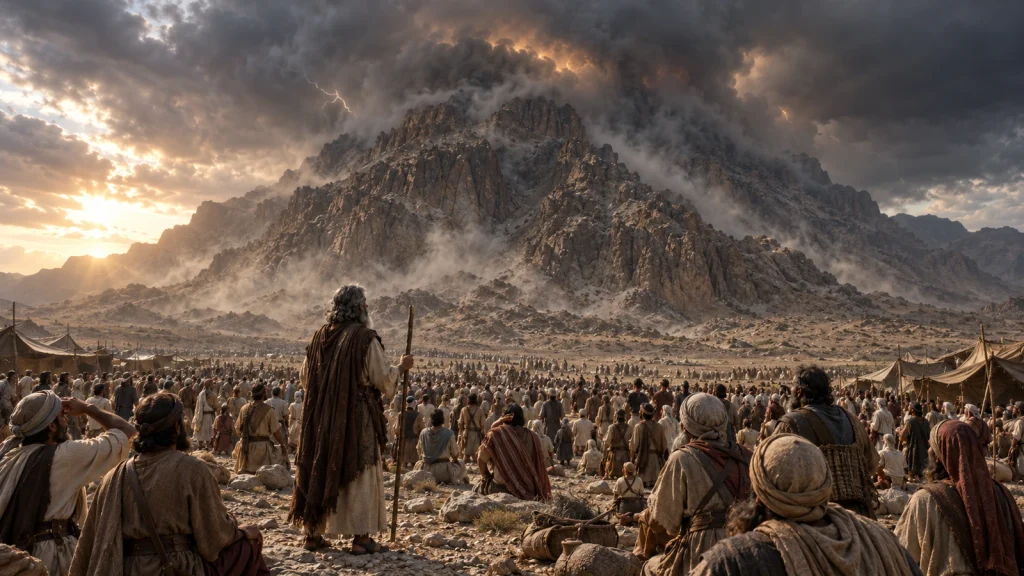
Source: AI-generated image created for Beyond The Known.
Israel finally reaches the mountain.
In Why Did Moses Need Jethro to Reorganize Israel?, Exodus 18 prepared the community to carry responsibility through a broader structure of leadership. Exodus 19 now shifts from human organization to divine encounter.
The change is immediate.
No one is hungry.
No enemy attacks.
No judicial dispute dominates the camp.
Instead, YHWH announces that Israel will become his treasured possession, a kingdom of priests, and a holy nation.
Then Moses is ordered to establish a boundary around the mountain.
Unauthorized approach may result in death.
By the third morning, thunder erupts, lightning flashes, smoke covers Sinai, the ground shakes, and a horn grows increasingly loud.
The people tremble.
Why would the God who says he has brought Israel to himself make approaching him so dangerous?
That tension controls Exodus 19.
Why Does Israel Arrive at Sinai Only After Being Rescued?
Exodus 19 opens with a chronological marker.
Israel reaches the Wilderness of Sinai in the third month after leaving Egypt and camps directly in front of the mountain.
The sequence matters.
Israel does not receive covenant obligations while still enslaved to Pharaoh.
Deliverance comes first.
Before YHWH states what he expects from the nation, he reminds them of what they have already witnessed:
“You have seen what I did to the Egyptians.”
Then comes one of the chapter’s most memorable images:
וָאֶשָּׂא אֶתְכֶם עַל־כַּנְפֵי נְשָׁרִים — wāʾeśśāʾ ʾetkem ʿal-kanp̄ê nĕšārîm
“I carried you on the wings of eagles.”
The Hebrew נֶשֶׁר — nešer can designate an eagle or another large soaring bird. The metaphor is more important here than precise zoological identification.
YHWH portrays the exodus as an act of carrying and protection.
Yet the destination matters even more.
He says:
וָאָבִא אֶתְכֶם אֵלָי — wāʾāḇiʾ ʾetkem ʾēlāy
“and I brought you to myself.”
Egypt was not merely something Israel had to escape.
Sinai reveals what liberation was moving toward.
Is Exodus 19 Describing a Covenant Before the Ten Commandments?
Yes.
Before a single command of the Decalogue is spoken, YHWH presents the covenant relationship.
Exodus 19:5 begins:
אִם־שָׁמוֹעַ תִּשְׁמְעוּ בְּקֹלִי — ʾim-šāmōaʿ tišmĕʿû bĕqōlî
“If you truly listen to my voice.”
The construction combines forms of the same verb:
שמע — š-m-ʿ
“to hear,” “listen,” or “heed.”
The repetition intensifies the expression.
This is not merely acoustic hearing.
Within the sentence, listening concerns responsive attention to YHWH’s voice.
Israel is also called to keep:
בְּרִיתִי — bĕrîtî
“my covenant.”
Then the passage announces three descriptions of Israel’s identity:
סְגֻלָּה — sĕgullâ
a treasured or special possession
מַמְלֶכֶת כֹּהֲנִים — mamleḵet kōhănîm
a kingdom of priests
גּוֹי קָדוֹשׁ — gôy qādôš
a holy nation.
These expressions are not disconnected religious slogans.
Together they describe what covenant relationship is meant to make of the people who have left Egypt.
What Does “Treasured Possession” Actually Mean?
The first designation is:
סְגֻלָּה — sĕgullâ
English translations use expressions such as “treasured possession,” “special possession,” or “peculiar treasure.”
The noun can refer to valuable property held as someone’s distinctive possession. Elsewhere in biblical Hebrew, related usage can describe royal treasure.
Yet Exodus immediately prevents the phrase from suggesting that YHWH owns only Israel.
The next clause says:
“for all the earth is mine.”
Israel is distinguished within a world already claimed by YHWH.
That combination matters.
The text does not portray Israel’s God as a regional deity whose authority stops at national borders.
Universal ownership forms the background for particular covenant status.
Israel is not YHWH’s only possession.
It is his sĕgullâ among the nations.
What Is a “Kingdom of Priests”?
The expression:
מַמְלֶכֶת כֹּהֲנִים — mamleḵet kōhănîm
has generated substantial discussion.
The familiar translation is:
“a kingdom of priests.”
Its precise grammatical force is less certain.
Some interpreters understand Israel as a kingdom composed of priests.
Others prefer “priestly kingdom” or emphasize the nation’s privileged proximity to YHWH.
Another influential line of interpretation sees a representative or mediating role in relation to the wider world.
The immediate context supplies an important control.
Israel receives a priestly designation in a chapter that is about to demonstrate that not everyone may approach YHWH in the same way.
The nation receives extraordinary status.
The mountain remains restricted.
That tension belongs to the text.
It should not be erased by assuming that “kingdom of priests” means unrestricted access to divine presence.
What Does It Mean to Be a “Holy Nation”?
The final description is:
גּוֹי קָדוֹשׁ — gôy qādôš
a “holy nation.”
Modern readers often hear “holy” primarily as a synonym for moral goodness.
Exodus 19 immediately gives holiness a spatial and relational dimension.
People must be consecrated.
Clothes must be washed.
The mountain is set apart.
A boundary must be established.
Access differs according to role.
Holiness in this chapter concerns belonging to YHWH and the regulation of proximity to his presence.
That is why extraordinary privilege and dangerous boundaries can appear in the same narrative.
Being chosen does not make divine presence ordinary.
Did Israel Agree to the Covenant Before Hearing the Ten Commandments?
Moses reports YHWH’s words to Israel’s elders.
The people respond together:
כֹּל אֲשֶׁר־דִּבֶּר יְהוָה נַעֲשֶׂה — kōl ʾăšer-dibber YHWH naʿăśeh
“All that YHWH has spoken, we will do.”
Exodus 20 has not yet begun.
The Decalogue has not been delivered.
That does not require us to imagine Israel signing a modern contract without seeing its terms.
The narrative presents an initial acceptance of the covenant relationship YHWH has proposed.
More detailed commands follow.
Scholars have long compared this sequence with ancient Near Eastern treaty traditions.
In some treaty forms, a superior ruler recalls previous benefaction before stating obligations.
That comparison helps explain why Exodus first recalls deliverance from Egypt and then introduces covenant loyalty.
The resemblance should not be exaggerated.
No ancient treaty provides a template that explains every feature of Sinai.
Similarity does not prove literary borrowing.
The biblical text must still be interpreted on its own terms.
Why Does God Come in a Thick Cloud?
After Israel responds, YHWH tells Moses that he will come:
בְּעַב הֶעָנָן — bĕʿaḇ heʿānān
“in a thick cloud.”
The stated purpose is unusually specific.
The people are to hear YHWH speaking with Moses so that Moses’ mediating role will be established among them.
The cloud does not indicate divine absence.
It accompanies revelation while also concealing.
That combination will become increasingly important in Exodus.
Presence can be real without becoming fully exposed to human sight.
The people will hear.
They will see manifestations around the mountain.
Yet the encounter remains controlled.
Why Must Israel Wash Its Clothes?
Moses is told to consecrate the people for two days.
They wash their garments.
They prepare for the third day.
Verse 15 also requires temporary sexual abstinence.
None of these instructions requires the conclusion that normal clothing, marriage, or sexuality are inherently impure.
Ancient ritual systems often marked entry into sacred occasions through washing, abstention, special preparation, or temporary changes in ordinary behavior.
The biblical narrative is preparing an entire community for an extraordinary encounter.
The separation between ordinary life and sacred event begins before the thunder.
Consecration precedes manifestation.
Why Is There a Boundary Around Mount Sinai?
Moses is commanded to establish limits around the mountain.
The people must not simply rush upward.
Touching the restricted area carries a severe penalty.
At first, the command may sound as though YHWH wants Israel kept at a distance.
That interpretation does not fit the entire chapter.
Only a few verses earlier, YHWH said:
“I brought you to myself.”
The boundary regulates approach rather than canceling relationship.
Divine descent has changed the meaning of ordinary geography.
A wilderness mountain becomes sacred space because of who is present there.
The danger does not come from rock, altitude, or terrain.
Within the narrative, it comes from unauthorized contact with holiness.
Why Does Exodus 19:13 Say They May “Go Up to the Mountain”?
One detail complicates the boundary instructions.
After warning against touching the mountain, Exodus 19:13 says:
בִּמְשֹׁךְ הַיֹּבֵל הֵמָּה יַעֲלוּ בָהָר — bimšōḵ hayyōḇēl hēmmâ yaʿălû ḇāhār
“When the ram’s horn is prolonged, they may go up to the mountain.”
At first glance, that statement appears to conflict with the restrictions surrounding it.
Verse 12 prohibits unauthorized approach.
Later, verses 21–24 warn the people and priests again not to break through toward YHWH.
Yet verse 13 seems to envision some type of ascent after the signal.
The Hebrew does not eliminate the difficulty.
יַעֲלוּ בָהָר — yaʿălû ḇāhār can be understood as going “up the mountain,” although interpreters have debated how far the phrase implies the people may advance.
One reading understands the prohibition as temporary. The horn signal marks the point at which an earlier restriction changes.
Another possibility is that the people may approach the lower portion or base of the mountain without crossing the restricted area closer to the divine presence.
The later warnings make unrestricted ascent difficult to sustain within the final narrative.
Exodus does not resolve every spatial detail.
One conclusion is secure:
access is regulated rather than simply nonexistent.
Israel is invited toward the divine presence.
The same narrative determines when, how far, and under what conditions that approach may occur.
Does the Sinai Boundary Resemble Ancient Sacred-Space Practices?
Sacred locations throughout the ancient Near East could involve distinctions of access, preparation, rank, ritual status, and permitted zones.
Such comparisons help make Exodus 19 historically intelligible.
They do not identify one external ritual that Israel simply copied.
Temple complexes elsewhere in the ancient world often distinguished between spaces available to larger populations and areas reserved for particular ritual specialists or officials.
Exodus develops a related concern in its own theological framework.
The remarkable feature here is that no permanent temple yet stands.
A mountain in the wilderness temporarily functions as restricted sacred space because YHWH descends upon it.
The geography becomes holy through presence.
Why Does the People Tremble?
The third morning begins with sensory overload.
There are:
thunders,
lightnings,
a thick cloud,
and an extraordinarily loud horn.
Then Exodus says:
וַיֶּחֱרַד כָּל־הָעָם — wayyeḥĕrad kol-hāʿām
“and all the people trembled.”
The verb comes from:
חרד — ḥ-r-d
It can describe trembling, shaking, fearful agitation, or startled movement.
Exodus does not require us to invent the people’s hidden thoughts.
Their physical reaction is explicit.
They shake.
That response occurs before the Decalogue is spoken.
Until this moment, Israel has primarily watched YHWH act against enemies, reshape environmental threats, and supply needs.
Sinai changes the direction of the encounter.
The divine manifestation is now immediately before them.
Is Sinai Described Like an Ancient Storm-God Theophany?
Parts of the scene resemble imagery found across the ancient Near East.
Thunder.
Lightning.
Dense cloud.
Mountain.
Divine arrival.
Storm deities in Mesopotamia, Anatolia, Syria, and the Levant could be portrayed through similar natural imagery.
Comparative evidence helps modern readers recognize that thunderstorm language carried associations of divine power in the ancient world.
Yet comparison must remain controlled.
Exodus does not say YHWH is Baal, Hadad, or another regional storm deity.
Similarity of imagery does not establish identity.
Nor does it prove that the biblical writer copied a single neighboring myth.
The Sinai scene combines storm imagery with historical deliverance, covenant obligation, holiness, sacred boundaries, and YHWH’s claim over all the earth.
Cultural background sharpens interpretation.
It does not replace it.
Was Mount Sinai a Volcano?
Exodus 19:18 introduces another set of dramatic images.
Sinai is covered in smoke.
YHWH descends in fire.
Smoke rises “like the smoke of a furnace.”
The mountain shakes violently.
Those descriptions have encouraged modern volcanic theories.
Some reconstructions relocate Sinai to areas with known volcanic geology and interpret the biblical account through eruption phenomena.
The text itself never identifies Sinai as a volcano.
Thunder, lightning, and cloud in verse 16 also fit storm-theophany language.
Older source-critical scholarship sometimes separated these phenomena into different traditions, assigning storm imagery and fire imagery to separate literary strands.
Whatever the chapter’s compositional history, the received narrative combines them.
A natural geological hypothesis should not be presented as though Exodus itself supplied that explanation.
The text states that YHWH descends in fire.
It does not explain a mechanism.
Does the Mountain Tremble Too?
Two verses after the people tremble, the same verb returns.
Exodus 19:18 says:
וַיֶּחֱרַד כָּל־הָהָר מְאֹד — wayyeḥĕrad kol-hāhār mĕʾōd
“and the whole mountain trembled greatly.”
The repetition of חרד — ḥ-r-d creates a striking literary relationship.
First:
the people tremble.
Then:
the mountain trembles.
Human reaction and landscape are drawn into the same manifestation.
The text does not merely say that Israel becomes frightened by unusual weather.
The environment itself responds.
Sinai shakes beneath the descent of YHWH just as the people shake before the mountain.
That parallel expands the scale of the scene.
What Is the Trumpet Sound?
Exodus describes:
קֹל שֹׁפָר — qōl šōp̄ār
“the sound of a horn.”
The sound begins very loud.
Then it grows stronger and stronger.
No human trumpeter is identified in the scene.
Moses speaks.
God answers him “in a voice.”
The increasing horn sound makes hearing just as important as seeing.
That detail connects back to verse 9.
YHWH had said the people would hear him speaking with Moses.
Sinai is not only spectacle.
It is auditory revelation.
Why Does Moses Bring the People Toward the Mountain If They Cannot Touch It?
Verse 17 stages the central paradox physically.
Moses brings Israel out from the camp:
לִקְרַאת הָאֱלֹהִים — liqraʾt hāʾĕlōhîm
“to meet God.”
The people move toward Sinai.
Then they stand at its base.
The covenant requires approach.
Holiness regulates that approach.
Neither principle cancels the other.
If Exodus 19 were only about divine remoteness, Moses could have left Israel inside the camp.
If the chapter were about unrestricted access, no boundary would be necessary.
Instead, the narrative creates controlled nearness.
Israel comes close enough to encounter.
Not close enough to define the terms of the encounter.
Why Does God Warn Them Again?
After the manifestation has begun, Moses ascends.
YHWH immediately tells him to go back down.
The people must not break through in an attempt to see YHWH.
Moses responds that the mountain has already been bounded.
The command is repeated anyway.
That repetition has long attracted historical-critical attention.
Exodus 19 contains several movements up and down the mountain, repeated access restrictions, different manifestations, and the unexpected appearance of “priests” before the formal Aaronic consecration narrated later.
Scholars have proposed multiple compositional explanations.
Those remain models of how the passage may have developed.
The final text creates a clear literary effect regardless of the precise reconstruction.
As divine presence intensifies, the warning intensifies with it.
The boundary is not forgotten once the manifestation begins.
It becomes even more important.
Who Are the Priests in Exodus 19?
The text does not identify them.
That uncertainty should be preserved.
Exodus has not yet narrated the formal consecration of Aaron and his sons to the priesthood described later.
Calling these figures “Aaronic priests” without qualification would import later information into an earlier scene.
Some scholars regard the reference as evidence for a tradition in which priestly figures existed before the later system was formalized.
Others explain the verses through compositional development.
Exodus 19 itself gives no genealogy or institutional description.
What matters within the scene is the warning.
Even those described as priests who “come near YHWH” must consecrate themselves.
Religious status does not remove the danger associated with holiness.
Where Was Mount Sinai?
No proposed identification has achieved archaeological certainty.
Traditional identification centers on the southern Sinai Peninsula, especially the region around Jebel Musa and neighboring peaks.
Other proposals locate the mountain elsewhere in Sinai, the Negev, Edom, or northwestern Arabia.
Geographical reconstructions can be compared against travel routes, water availability, terrain, and later itinerary notices.
None currently provides direct archaeological proof of Exodus 19.
No inscription identifies a mountain as the site of this theophany.
No excavated object can securely be connected with Moses standing before Sinai.
Archaeology provides context, not verification.
Geography can make certain proposals more or less plausible.
It cannot transform an uncertain location into established fact.
Is Exodus 19 Based on One Literary Layer?
Many historical-critical scholars think the chapter reflects compositional development.
Several features encourage that conclusion:
repeated ascents and descents,
duplicate warnings,
variations in theophanic imagery,
the sudden reference to priests,
and shifts in how divine and human positions are described.
Scholars do not agree on one reconstruction.
Some identify priestly, deuteronomistic, holiness, or older narrative elements in different combinations.
Others place greater emphasis on the coherence of the received chapter.
Source-critical analysis asks:
How might this text have developed?
Final-form interpretation asks:
What does the chapter now communicate as a literary whole?
Those questions should not be collapsed.
Whatever its compositional history, the final narrative presents a coherent sequence:
YHWH rescued Israel.
He claims Israel.
He calls Israel near.
He consecrates the encounter.
He establishes limits.
Then he descends.
So Why Did Israel Tremble at Mount Sinai?
Because Exodus 19 portrays divine presence as neither abstract nor controllable.
Israel has already seen YHWH act against Egypt.
They have crossed the sea.
They have received water.
They have gathered manna.
They have survived Amalek.
Sinai introduces something different.
The people are no longer primarily watching what YHWH does to an enemy or for their survival.
They are standing before the place where YHWH comes toward them.
The chapter joins extraordinary privilege with dangerous nearness.
Israel is YHWH’s treasured possession.
Yet the boundary remains.
They are called a kingdom of priests.
Yet access is differentiated.
They are named a holy nation.
Yet they must be consecrated before the encounter.
The trembling does not contradict the covenant.
It reveals what kind of presence the covenant brings near.
The Deeper Discovery
The chapter begins with YHWH interpreting the entire exodus in a surprising way.
He does not merely say:
“I brought you out of Egypt.”
He says:
וָאָבִא אֶתְכֶם אֵלָי — wāʾāḇiʾ ʾetkem ʾēlāy
“I brought you to myself.”
Later, Moses brings Israel from the camp:
לִקְרַאת הָאֱלֹהִים — liqraʾt hāʾĕlōhîm
“to meet God.”
Those two movements frame the chapter.
YHWH interprets the exodus as movement toward himself.
Moses then physically leads Israel toward the encounter.
That makes Sinai far more than a convenient location where laws happen to be delivered.
Within Exodus, liberation has been moving toward relationship.
Yet the relationship begins with a paradox.
Israel has been brought close.
A boundary still stands.
The people are invited to meet YHWH.
Their access remains regulated.
Egypt answered one question:
Whom will Israel serve?
Sinai introduces another:
What does life with the one who rescued them require?
The first answer is not a commandment.
It is a carefully controlled encounter with divine presence.
FAQ
Why did the Israelites tremble at Mount Sinai?
Exodus 19:16 directly connects their trembling with thunder, lightning, a thick cloud, and an extraordinarily loud horn. The Hebrew root חרד — ḥ-r-d describes trembling or fearful agitation. Two verses later, the same root describes the mountain itself shaking.
What does “treasured possession” mean in Exodus 19:5?
The Hebrew סְגֻלָּה — sĕgullâ describes a valued or specially held possession. Exodus pairs Israel’s distinctive status with the declaration that the entire earth already belongs to YHWH.
What is a “kingdom of priests”?
The Hebrew מַמְלֶכֶת כֹּהֲנִים — mamleḵet kōhănîm can be rendered “kingdom of priests” or “priestly kingdom.” Scholars debate its exact nuance, including whether it emphasizes priest-like status, privileged proximity, or a broader representative function.
Why could Israel not touch Mount Sinai?
Within the narrative, YHWH’s descent transforms Sinai into sacred space. The boundary regulates access to divine presence. It does not cancel the covenant invitation to approach God.
Does Exodus 19:13 allow the Israelites to climb Mount Sinai?
The verse appears to permit some type of ascent after a prolonged horn signal, creating tension with surrounding restrictions. Interpretations differ over whether the prohibition was temporary or whether the people could approach only a lower portion of the mountain. The final narrative does not support unrestricted access.
Was Mount Sinai a volcano?
Exodus describes fire, smoke, shaking, thunder, lightning, and cloud, but never identifies Sinai as a volcano. Volcanic interpretations are modern hypotheses rather than explanations supplied by the text.
Where is the biblical Mount Sinai?
Its location remains uncertain. Southern Sinai is one major proposal, while other candidates have been suggested in Sinai, the Negev, Edom, and northwestern Arabia. No archaeological evidence securely identifies one mountain as the site of Exodus 19.
Exodus 19 ends with Moses descending once more.
The people remain below.
The mountain still burns.
The voice has not finished speaking.
Then Exodus 20 opens with words that are easy to overlook because readers rush toward the commandments themselves.
Before YHWH says:
“You shall not…”
he says who he is.
Before demanding anything from Israel, he recalls what he has already done:
“I am YHWH your God, who brought you out of the land of Egypt.”
The most famous legal text in the Bible does not begin with a rule.
It begins with rescue.
Why?
Why Do the Ten Commandments Begin with Redemption, Not Rules?
Selected Sources
- William H. C. Propp, Exodus 19–40. Anchor Yale Bible. Yale University Press, 2026.
- Carol Meyers, Exodus. New Cambridge Bible Commentary. Cambridge University Press, 2005.
- Nahum M. Sarna, The JPS Torah Commentary: Exodus. Jewish Publication Society, 1991.
- James K. Hoffmeier, Ancient Israel in Sinai: The Evidence for the Authenticity of the Wilderness Traditions. Oxford University Press, 2005.
- Alberto R. W. Green, The Storm-God in the Ancient Near East. Eisenbrauns, 2003.
- Janusz Adam Lemański, “Israel as the Living Temple of God (Exod 19:5–6).” Verbum Vitae 41.1 (2023): 17–31.
- Kyu Seop Kim, “The Meaning of ‘mamleket kohanim’ in Exodus 19:6 Revisited.” Journal of Biblical Text Research 35 (2014): 249–267.
- Carey Walsh, “Where Did God Go? Theophanic Shift in Exodus.” Biblical Theology Bulletin 43.3 (2013): 115–123.