Why Did Moses Need Jethro to Reorganize Israel?
Exodus 18 Explained: Jethro, Midianite Wisdom, Judicial Delegation, and the Limits of Moses’ Leadership
 |
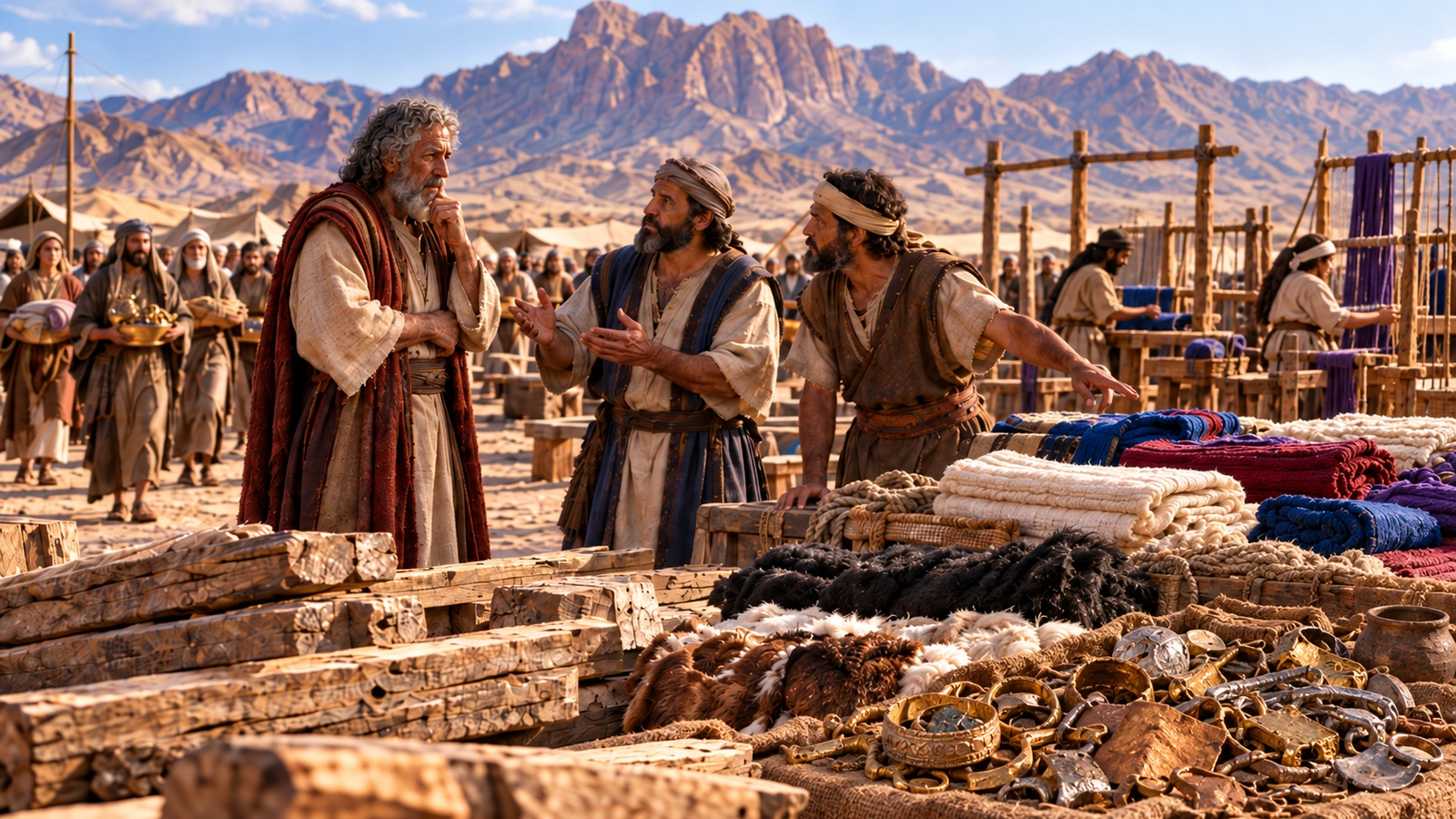
| Figure 1 — Moses judges disputes from morning until evening while a long line of Israelites waits in the wilderness camp and Jethro observes the unsustainable system. The scene reflects Exodus 18:13–18, immediately before Jethro advises Moses to share judicial responsibility. Source: AI-generated image created for Beyond The Known. |
Israel has survived thirst, battle, and the uncertainty of the wilderness. Yet Exodus 18 introduces a crisis with no enemy army and no missing resource.
In Why Did Israel Face Thirst and War at Rephidim?, Moses needed Aaron and Hur simply to keep his hands steady while Joshua fought Amalek below. The next chapter exposes a related limitation. Moses is now seated alone from morning until evening while an entire people waits for him to resolve disputes and make God’s instructions known.
The surprising person who identifies the problem is not Aaron.
It is not Joshua.
It is Jethro—the priest of Midian and Moses’ father-in-law.
His verdict is blunt:
“What you are doing is not good.”
Why does Israel’s central leader need an outsider to tell him how leadership must change?
Why Does Jethro Arrive at This Exact Point in Exodus?
Exodus 18 opens by looking backward.
Jethro has heard what God has done for Moses and Israel, especially the deliverance from Egypt. He brings Zipporah and Moses’ two sons back to the wilderness camp.
The sons’ names themselves recall Moses’ earlier story.
Gershom preserves the memory that Moses had lived as an outsider in a foreign land.
Eliezer recalls another confession: the God of Moses’ father had been his help and had delivered him from Pharaoh’s sword.
Before the chapter begins reorganizing Israel’s future, it briefly gathers Moses’ past around him.
That placement makes Exodus 18 an unusual literary hinge. The chapter looks backward toward deliverance while anticipating the institutions and revelation that dominate the Sinai material ahead.
It is not merely an interruption between Amalek and Sinai.
It stands between rescue and governance.
Why Is Jethro’s Identity So Important?
Exodus repeatedly identifies Jethro as:
כֹהֵן מִדְיָן — kōhēn Midyān
“priest of Midian.”
That detail makes his role more striking.
He is not introduced as an Israelite elder.
He belongs to Midian, the region where Moses fled after killing an Egyptian and where Moses built a life before returning to Egypt.
Now a Midianite priest enters Israel’s camp, hears the story of the exodus, blesses YHWH, participates in sacrifice and a meal, and later advises Moses on the administration of justice.
Modern scholarship has often connected Jethro with the broader Midianite-Kenite hypothesis, which proposes some relationship between early Yahwistic worship and southern groups associated with Midian, Kenites, Seir, Edom, or neighboring regions.
Joseph Blenkinsopp notes that such proposals draw on several kinds of evidence, including Moses’ Midianite connections, early biblical poetry locating YHWH in southern regions, and Egyptian references that some scholars connect with the name YHWH.
That remains a historical model.
Exodus 18 does not say that Jethro taught Moses who YHWH was.
Nor can the chapter establish that Israel acquired the worship of YHWH from Midian.
The text gives us a Midianite priest who recognizes YHWH’s acts.
Anything beyond that requires reconstruction.
Did Jethro Convert to Israel’s Religion?
After Moses recounts what YHWH did to Pharaoh and how Israel was delivered, Jethro rejoices.
Then he declares:
“Now I know that YHWH is greater than all gods.”
The statement is significant, but its theological precision should not be exaggerated.
Exodus does not say, “Jethro converted.”
It does not explain whether he previously worshiped YHWH.
It does not describe him formally renouncing other deities.
His words acknowledge YHWH’s superiority in response to the events Moses has described.
Verse 12 then reports sacrifice and a meal “before God,” attended by Aaron and Israel’s elders.
Some scholars have detected covenant or treaty-making features in Exodus 18:1–12. Phillip Lerner, for example, examines the language of the episode within what he describes as Jethro’s covenant and argues that several expressions in the passage contribute to that interpretation.
That remains a scholarly reconstruction of the ritual setting.
Exodus itself does not explicitly call the meal a covenant ceremony, nor does it describe Jethro undergoing a formal conversion.
The safest conclusion is narrower.
Jethro hears.
Jethro blesses YHWH.
Jethro participates in sacrifice and fellowship before God.
The narrative presents him positively before he offers any administrative advice.
Why Does the Chapter Move from Worship to Management?
The transition is almost abrupt.
One day Jethro is eating with Aaron and Israel’s elders before God.
The next day he watches Moses work.
From morning until evening, people stand around the leader waiting for judgment.
Jethro asks two questions:
Why are you doing this?
Why are you sitting alone while everyone waits?
Moses’ explanation sounds reasonable.
The people come to him to inquire of God.
When disputes arise, he judges between the parties.
He also makes known God’s statutes and instructions.
Nothing in Moses’ description sounds corrupt.
Nothing suggests laziness.
The problem is structural.
One man has become the point through which legal disputes, divine inquiry, and instruction must all pass.
Jethro does not accuse Moses of judging badly.
He says the system itself is unsustainable.
What Does “You Will Surely Wear Yourself Out” Mean in Hebrew?
Jethro’s warning in Exodus 18:18 is unusually forceful:
נָבֹל תִּבֹּל — nāḇōl tibbōl
The construction combines an infinitive absolute with a finite verb from the same root.
That repetition intensifies the statement.
English translations render the phrase with expressions such as:
“you will surely wear yourself out”
or
“you will certainly wear away.”
The root:
נבל — n-b-l
can describe fading, withering, drooping, or wasting away.
Jethro’s warning reaches beyond Moses.
He says:
“both you and this people who are with you.”
The system damages the judge and those waiting for judgment.
That second half matters.
Exodus 18 is sometimes reduced to a modern lesson about personal burnout. The text describes something broader.
People are standing from morning until evening because access to judgment depends on one person.
The structure is exhausting both sides.
Why Is the Work Called “Too Heavy”?
Jethro continues:
כִּי־כָבֵד מִמְּךָ הַדָּבָר — kî-kāḇēḏ mimmĕkā haddāḇār
“The matter is too heavy for you.”
The adjective comes from the Hebrew root:
כבד — k-b-d
which can carry the idea of weight or heaviness.
Here the meaning is practical.
The assignment exceeds what Moses can carry alone.
Jethro states the limitation directly:
לֹא־תוּכַל עֲשֹׂהוּ לְבַדֶּךָ — lō-tûḵal ʿăśōhû lĕḇaddeḵā
“You are not able to do it by yourself.”
The chapter never suggests that a divinely chosen leader must possess unlimited human capacity.
Moses can remain Israel’s mediator without remaining its sole adjudicator.
That distinction becomes the heart of Jethro’s proposal.
What Does Jethro Tell Moses to Keep Doing?
Delegation does not remove Moses from leadership.
Jethro first defines the responsibilities that should remain his.
Moses is to stand for the people before God.
He must bring difficult matters before God.
He must teach the statutes and instructions.
He must show Israel:
the way they should walk,
and the work they should do.
Only after preserving those responsibilities does Jethro redistribute routine judgment.
This matters because Exodus 18 is not advocating leadership by disappearance.
Moses’ role becomes more focused.
He remains responsible for mediation and instruction while others handle disputes that do not require his direct intervention.
Božo Lujić’s narrative analysis emphasizes this redistribution of authority in Exodus 18:13–27, where Jethro’s proposal separates functions rather than abolishing Moses’ distinctive role.
The change is not:
Moses → no authority
It is:
Moses → differentiated authority
What Kind of Leaders Does Jethro Tell Moses to Choose?
Exodus 18:21 does not begin with technical credentials.
Jethro calls for:
אַנְשֵׁי־חַיִל — ʾanšê-ḥayil
“capable men,” “men of ability,” or “men of strength.”
The expression can carry different nuances depending on context, including ability, competence, valor, or substantial capacity.
Here the following qualifications explain what judicial competence must include.
They must be:
יִרְאֵי אֱלֹהִים — yirʾê ʾĕlōhîm
“fearers of God”
אַנְשֵׁי אֱמֶת — ʾanšê ʾĕmet
“men of truth” or trustworthy men
שֹׂנְאֵי בָצַע — śōnĕʾê ḇāṣaʿ
“haters of dishonest gain.”
The noun בָצַע — bāṣaʿ can refer to profit or gain acquired unjustly.
That qualification directly addresses the possibility of judicial corruption.
The selection standard combines capability with character.
A judge who can resolve cases but can be bought is not qualified.
Neither is a sincere person who lacks the capacity to judge.
Why Thousands, Hundreds, Fifties, and Tens?
Jethro proposes officials over:
thousands,
hundreds,
fifties,
and tens.
Modern readers sometimes imagine a rigid corporate pyramid in which every ten individuals report to one leader, who then reports to another level above.
The text does not describe the mechanics in that level of detail.
David Henshke notes that later calculations, if the numbers are treated as literal administrative ratios against a population of 600,000 men, can produce tens of thousands of judges.
That raises an interpretive question.
Were these exact numerical headcounts?
Administrative groupings?
Military-social units?
Conventional labels for subdivisions of the population?
The chapter does not settle the issue.
Its final form is clearer about function than mathematics.
Smaller matters remain at lower levels.
Hard cases move upward to Moses.
Authority becomes distributed without becoming disconnected.
Did Jethro Invent Bureaucracy for Israel?
That would overstate the evidence.
Delegated judicial administration was not unique to ancient Israel.
Egypt, the society Israel has just left in the narrative, possessed systems in which groups of officials handled legal and administrative matters.
Sandra Lippert’s study of Egyptian courts describes councils of officials serving judicial and administrative functions. Different settings could involve local bodies handling lesser disputes and higher authorities dealing with more serious cases.
That comparison supplies ancient context.
It does not prove that Exodus 18 copied an Egyptian institution.
Nor do we possess evidence that Jethro imported the precise structure of thousands, hundreds, fifties, and tens from a known Midianite administrative system.
Complex communities regularly require distributed judgment because one leader cannot personally hear every case.
The distinctive feature of Exodus 18 is not the invention of delegation.
It is the narrative claim that Moses learns to distribute judicial authority through the counsel of a Midianite outsider.
Archaeology provides context, not verification.
Ancient administrative parallels illuminate what organized adjudication could look like.
They cannot reconstruct the exact historical origin of Israel’s system from this chapter alone.
Why Would Moses Need an Outsider to See the Problem?
Exodus never answers that question directly.
It does not say Moses was arrogant.
It does not say he distrusted other Israelites.
It does not say he believed only he was spiritually qualified.
Those explanations would manufacture psychology.
The narrator gives observable facts.
Moses is judging alone.
The people wait all day.
Jethro sees the arrangement.
He calls it “not good.”
Moses explains his reasoning.
Jethro proposes another structure.
Moses listens.
That last action is significant.
The central human figure of the exodus accepts correction from someone outside Israel’s formal leadership.
Authority in this chapter includes the capacity to receive counsel.
Does Jethro Claim Divine Authority for His Plan?
No.
This is one of the most important controls on the passage.
Jethro advises Moses strongly, but Exodus 18:23 includes a condition:
וְצִוְּךָ אֱלֹהִים — wĕṣiwwĕḵā ʾĕlōhîm
“and God commands you.”
Jethro’s logic is conditional.
If Moses adopts the arrangement and God commands it, he will be able to endure and the people can go to their places in peace.
The proposal does not place Midianite wisdom above divine command.
It submits the plan to divine authorization.
The narrator then says Moses listens to Jethro and implements the system.
Curiously, Exodus does not record a separate divine speech between the advice and Moses’ action.
That silence should remain visible.
The text reports Jethro’s condition and Moses’ implementation without narrating every step between them.
Did Moses Create Israel’s Legal System Before Sinai?
This question creates a chronological difficulty.
Exodus 18 says Moses is already making known:
חֻקֵּי הָאֱלֹהִים — ḥuqqê hāʾĕlōhîm
“the statutes of God”
and:
תּוֹרֹתָיו — tôrōtāyw
“his instructions” or “his laws.”
Yet the major Sinai legislation begins in the following chapters.
The episode also places Moses near “the mountain of God,” while Exodus 19 narrates Israel’s formal arrival at Sinai afterward.
Scholars have long noticed this tension.
Some historical-critical reconstructions propose that the Jethro tradition once occupied a different literary position and was later placed before the Sinai revelation.
Others emphasize the coherence of its present location.
These are models of textual development.
They should not be presented as recovered editorial history.
The final text deliberately places judicial organization before the Sinai theophany.
That sequence produces a meaningful literary effect.
Israel begins developing structures capable of receiving, interpreting, and applying law immediately before covenant legislation expands dramatically.
What About Deuteronomy’s Version of the Story?
Deuteronomy 1:9–18 retells the appointment of leaders.
The version differs in an important way.
In Deuteronomy, Moses recalls saying that he could not bear the people alone. He then tells Israel to choose wise and respected men.
Jethro is not mentioned.
That variation is one reason source and tradition critics have argued that Israel’s judicial origins circulated in more than one literary form.
The accounts should not be flattened into identical reports.
Exodus 18 foregrounds the outsider whose observation exposes the problem.
Deuteronomy 1 foregrounds Moses’ recollection of the burden and Israel’s participation in choosing leaders.
Historical-critical study asks how those traditions developed.
Canonical interpretation asks what each final version accomplishes in its own setting.
Those questions overlap, but they are not identical.
So Why Did Moses Need Jethro to Reorganize Israel?
Because the system Moses was using required one human mediator to perform work that had grown beyond one person’s capacity.
Exodus never says Moses lacked wisdom in every area.
It shows that he lacked an adequate structure for administering judgment at scale.
Jethro sees what the arrangement is doing to both leader and people.
His solution preserves Moses’ distinctive responsibilities:
represent the people before God,
bring weighty matters before God,
teach divine instruction,
clarify the path Israel should follow.
Routine adjudication can be shared.
The text does not celebrate delegation because efficiency is the highest value.
Jethro’s stated goal is that Moses can stand and that the people can go to their places in peace.
Good administration serves justice by making access to judgment sustainable.
The Deeper Discovery
One phrase makes Exodus 18 more interesting than a simple leadership manual.
Jethro looks at Moses working alone and says:
לֹא־טוֹב — lō-ṭôḇ
“not good.”
Then he explains:
“You are not able to do it alone.”
The combination invites comparison with an earlier biblical scene.
Genesis 2:18 contains the first “not good” in the biblical narrative:
לֹא־טוֹב הֱיוֹת הָאָדָם לְבַדּוֹ
“It is not good for the human to be alone.”
Exodus 18:17 repeats:
לֹא־טוֹב — lō-ṭôḇ
Verse 18 then uses:
לְבַדֶּךָ — lĕḇaddeḵā
“by yourself” or “alone.”
The lexical relationship is striking.
We should not claim certainty that Exodus deliberately quotes Genesis 2.
Still, the final texts create a suggestive echo.
In Genesis, being alone is “not good.”
In Exodus 18, attempting the work alone is “not good.”
The solution in each narrative is not the removal of individual responsibility.
It is the creation of shared human participation.
That makes Jethro’s critique more than a lesson in organizational efficiency.
Moses’ limitation is not treated as a defect to hide.
It becomes the reason a broader structure of responsibility must exist.
FAQ
Was Jethro an Israelite?
No. Exodus identifies him as a priest of Midian and Moses’ father-in-law. His outsider status is one of the chapter’s most striking features.
Did Jethro worship YHWH before Exodus 18?
The text does not tell us clearly. He blesses YHWH, declares YHWH greater than all gods, and participates in sacrifice and a meal before God. Exodus never narrates a formal conversion or explains his earlier theology.
Did Israel learn about YHWH from Jethro?
Some scholars have proposed versions of the Midianite-Kenite hypothesis, connecting early Yahweh traditions with southern groups associated with Moses and Midian. Exodus 18 alone cannot establish that historical reconstruction.
What does “able men” mean in Exodus 18:21?
The Hebrew is אַנְשֵׁי־חַיִל — ʾanšê-ḥayil, describing men of ability or capacity. The following qualifications show that competence also includes fear of God, truthfulness, and rejection of dishonest gain.
Was Moses wrong to judge the people himself?
The text does not condemn his judicial function. Jethro criticizes the concentration of every case in one person because the load is too heavy for Moses and burdens the people waiting for judgment.
Did Jethro invent Israel’s court system?
Exodus presents Jethro proposing this system to Moses. Delegated judicial structures existed elsewhere in the ancient world, but the evidence does not show that Israel simply copied a specific Midianite or Egyptian model.
Why does Exodus 18 come before the giving of the law at Sinai?
The final narrative places judicial organization immediately before Sinai. Scholars debate whether the Jethro episode occupied another position during the book’s literary development, but its present placement functions as a bridge from deliverance to covenantal governance.
Exodus 18 ends quietly.
No sea divides.
No rock breaks open.
No enemy falls.
A Midianite priest returns to his land, leaving behind a changed structure of leadership.
Moses no longer stands as the only human judge through whom every dispute must pass.
Israel is becoming organized enough to carry law.
Then the landscape changes.
In the third month after leaving Egypt, the people arrive at Sinai.
A boundary is placed around the mountain.
Cloud descends.
Thunder sounds.
A trumpet grows louder.
The people tremble.
The God who has rescued, provided, tested, and organized Israel is about to address the nation from the mountain itself.
Why does the arrival of YHWH produce fear rather than simple celebration?
Why Did Israel Tremble at Mount Sinai?
Selected Sources
- William H. C. Propp, Exodus 1–18: A New Translation with Introduction and Commentary. Anchor Bible 2. Doubleday, 1999.
- Carol Meyers, Exodus. New Cambridge Bible Commentary. Cambridge University Press, 2005.
- Nahum M. Sarna, The JPS Torah Commentary: Exodus. Jewish Publication Society, 1991.
- Joseph Blenkinsopp, “The Midianite-Kenite Hypothesis Revisited and the Origins of Judah.” Journal for the Study of the Old Testament 33.2 (2008): 131–153.
- Sandra Lippert, “Law Courts.” UCLA Encyclopedia of Egyptology (2012).
- Božo Lujić, “Separating Legislation from Charisma in Israel: A Narrative Analysis of Ex 18:13–27.” Bogoslovska smotra 76.4 (2006): 795–815.
- David Henshke, “The Number of Judges in Ancient Israel.” In The Jewish Law Annual, Vol. 17. Taylor & Francis, 2008, 27–62.
- Phillip Lerner, “Redefining התלאה: An Assurance of Israel’s Return to the Land in Jethro’s Covenant.” Biblica 87.3 (2006): 402–411.