Why Does Exodus 23 Command Israel to Help Its Enemy?
Exodus 23 Explained: Enemy Ethics, Impartial Justice, Sabbath Rest, Israel’s Festivals, the Divine Messenger, and the Road to Canaan
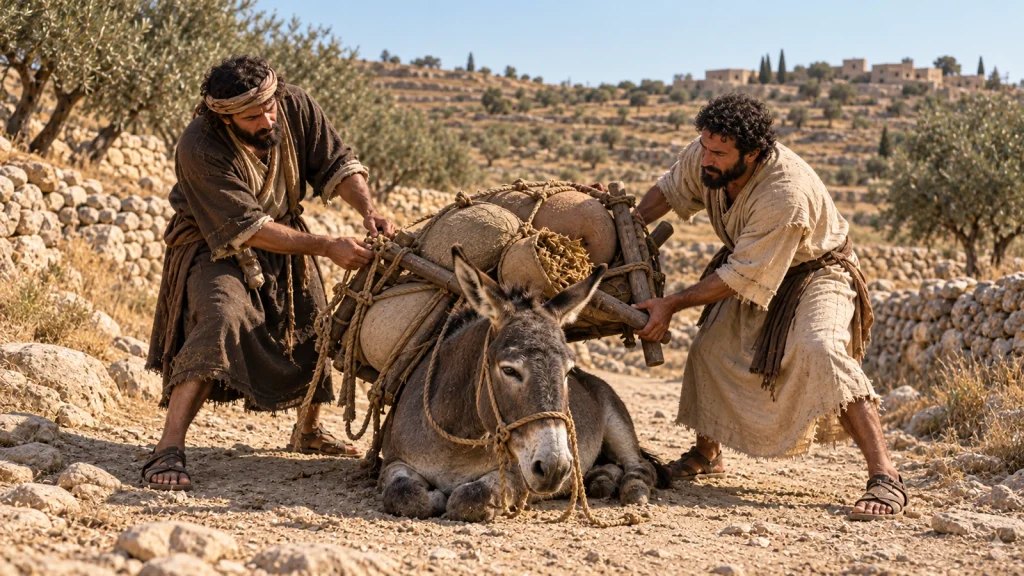
Source: AI-generated image created for Beyond The Known.
Exodus 23 opens with corrupted testimony and closes with Israel facing the peoples of Canaan.
Between those settings appears an unexpected command.
If an enemy’s animal wanders away, return it.
If the donkey of someone who hates you collapses beneath its load, do not walk past.
In Why Does Exodus 22 Protect Foreigners, Widows, and Orphans?, covenant law restricted the use of social and economic power against vulnerable people.
Exodus 23 asks a harder question.
What does justice require when the person who needs help is someone you resent?
Why Does Exodus 23 Begin with Legal Pressure?
The first verses concentrate on forces that can distort judgment.
False reports.
Malicious testimony.
Majority pressure.
Sympathy.
Poverty.
Bribery.
Exodus even warns against favoring a poor litigant merely because he is poor.
A few lines later, it prohibits denying that same poor person justice.
Together, the commands reject two opposite distortions.
Poverty cannot justify mistreatment.
It cannot determine the verdict either.
A righteous judgment must survive pressure from both power and sympathy.
Why Are an Enemy’s Ox and Donkey Placed Here?
Between courtroom commands, Exodus introduces two ordinary encounters.
A wandering animal belongs to:
אֹיִבְךָ — ʾōyibḵā
“your enemy.”
A burdened donkey belongs to:
שֹׂנַאֲךָ — śōnaʾăḵā
“the one who hates you.”
These are unusually sharp descriptions for laws about livestock.
The placement is revealing.
A judge must not let pressure determine a verdict.
Outside court, personal hostility must not determine conduct either.
An adversary remains entitled to what is his.
What Must You Do with an Enemy’s Lost Animal?
Exodus 23:4 says:
כִּי תִפְגַּע שׁוֹר אֹיִבְךָ אוֹ חֲמֹרוֹ תֹּעֶה
“If you encounter your enemy’s ox or donkey wandering…”
The command that follows is emphatic:
הָשֵׁב תְּשִׁיבֶנּוּ לוֹ — hāšēḇ tĕšîḇennû lô
“You shall surely return it to him.”
The Hebrew combines an infinitive absolute with a finite verb from the same root.
That construction intensifies the obligation.
The animal cannot simply be ignored because its owner is disliked.
Resentment does not turn another person’s property into abandoned property.
Nor may the finder quietly benefit from an adversary’s loss.
Does Exodus Command Israel to Love Its Enemy?
Not in those words.
Exodus 23 commands actions rather than feelings.
Return the animal.
Assist with the burden.
The law does not require the Israelite to claim affection that may not exist.
It places a boundary on what hostility is allowed to control.
Later biblical and Christian traditions develop broader commands concerning love for enemies.
Those are later canonical developments and should not be read backward as though Exodus 23 had already stated them.
What Exodus requires is concrete enough on its own.
An adversary’s need can create an obligation.
What Does Exodus 23:5 Actually Say?
The second case is linguistically more difficult.
An Israelite sees the donkey of someone who hates him lying under its load.
Then comes:
וְחָדַלְתָּ מֵעֲזֹב לוֹ עָזֹב תַּעֲזֹב עִמּוֹ
The root:
עזב — ʿ-z-b
normally means “leave,” “abandon,” or “forsake.”
That makes the wording unusually compact and difficult.
Translations often render the final command with language such as “help,” “release,” or “assist,” because the context clearly requires participation rather than abandonment.
The precise lexical force of the repeated verb remains debated.
The practical outcome is less obscure.
You see the animal.
You know who owns it.
You have every personal reason to keep walking.
You do not.
Why Does Helping the Donkey Help the Enemy?
A working donkey represented labor capacity.
It carried produce, equipment, and other loads.
Its injury could mean economic loss to the owner.
Relieving the burden therefore protects more than an animal.
The action preserves an adversary’s property and livelihood.
That is what gives the command its edge.
Exodus does not merely forbid active revenge.
It requires effort that prevents someone you dislike from suffering avoidable loss.
Must the Two Enemies Reconcile?
The passage never says so.
We are not told why the relationship is hostile.
The owner may have wronged the Israelite.
The Israelite may have wronged him.
Both possibilities remain open.
Exodus refuses to make the history of the dispute the deciding factor in the present case.
When the animal is in front of you, the obligation is immediate.
Reconciliation may or may not follow.
Right action cannot always wait for it.
Why Does Exodus Warn Against Following the Majority?
Verse 2 states:
לֹא־תִהְיֶה אַחֲרֵי־רַבִּים לְרָעֹת
“You shall not follow the many for evil.”
The larger verse contains syntactical difficulties, but the surrounding context concerns pressure on legal testimony and judgment.
A majority can be wrong.
A crowd can normalize falsehood.
Collective agreement does not transform injustice into justice.
Exodus then names other pressures capable of bending judgment:
wealth,
poverty,
hatred,
false accusation,
bribery,
and outsider status.
No single social force is allowed to replace truth.
Why Does the Resident Alien Appear Again?
Verse 9 returns to the gēr:
וְגֵר לֹא תִלְחָץ — wĕgēr lō tilḥāṣ
“You shall not oppress a resident alien.”
Then Exodus adds a distinctive phrase:
וְאַתֶּם יְדַעְתֶּם אֶת־נֶפֶשׁ הַגֵּר — wĕʾattem yĕḏaʿtem ʾet-nep̄eš haggēr
“You know the nep̄eš of the resident alien.”
English versions use expressions such as “life,” “feelings,” or “heart” to capture נֶפֶשׁ — nep̄eš here.
No single gloss reproduces the phrase perfectly.
Its force is experiential.
Israel knows what outsider existence feels like because Israel lived as a gēr in Egypt.
Exodus 22 appealed to that history.
Exodus 23 turns memory into knowledge.
Why Does the Land Rest in the Seventh Year?
The focus then shifts from legal cases to agricultural time.
For six years Israel may sow and harvest.
During the seventh, cultivation is suspended so that:
“the poor of your people may eat.”
Wild animals receive what remains.
Vineyards and olive groves fall under the same rule.
Exodus 23 does not yet provide the fuller sabbatical-year system found elsewhere in the Pentateuch.
Here the stated purpose is concrete.
Ordinary control over agricultural production is relinquished so that people without comparable access to land can eat.
Ownership remains intact.
Exclusive use does not.
Why Must Animals and Outsiders Rest on the Sabbath?
Verse 12 brings the six-and-seven rhythm into each week.
Israel works for six days and stops on the seventh so that the ox and donkey may rest and dependent members of the household may recover.
Among them is the gēr.
The Sabbath therefore limits the labor that one person may extract from another.
The household head’s rest is not the only concern.
His decision to stop working creates rest for those whose time and bodies may otherwise be controlled by him.
Animals.
Dependent laborers.
Resident outsiders.
Sabbath becomes a restriction on productivity as well as a sacred rhythm.
Why Do Festivals Follow Laws About Justice?
Three annual festivals appear next:
the Festival of Unleavened Bread,
the Festival of Harvest,
and the Festival of Ingathering.
Modern readers may experience the transition as abrupt.
The Covenant Code does not organize life according to modern divisions between civil law, labor regulation, religion, and agriculture.
Fields, courts, animals, debt, worship, harvest, and memory all belong within the same covenantal world.
The Festival of Unleavened Bread explicitly returns to Egypt:
“for in it you came out of Egypt.”
Israel may acquire fields and harvests in the land ahead.
Its agricultural success is not supposed to erase the memory of departure.
Why Not Boil a Young Goat in Its Mother’s Milk?
Exodus 23:19 ends with:
לֹא־תְבַשֵּׁל גְּדִי בַּחֲלֵב אִמּוֹ — lō-tĕḇaššēl gĕḏî baḥălēḇ ʾimmô
“You shall not boil a young goat in its mother’s milk.”
The command is explicit.
Its original rationale is not.
Later Jewish law developed these words into a much broader separation of meat and dairy.
That belongs to subsequent legal interpretation.
Proposals about the original setting range from culinary and symbolic explanations to theories involving ritual practice.
The often-repeated claim that the prohibition certainly attacks a known Canaanite fertility rite is more confident than the evidence permits.
Stefan Schorch has offered another reading connected with the preparation of a still-suckling young animal.
Other interpretations remain in circulation.
Exodus itself gives no explanation.
Who Is the Messenger Sent Ahead of Israel?
Verse 20 marks another transition:
הִנֵּה אָנֹכִי שֹׁלֵחַ מַלְאָךְ לְפָנֶיךָ — hinnēh ʾānōḵî šōlēaḥ malʾāḵ lĕp̄āneḵā
“Behold, I am sending a messenger before you.”
מַלְאָךְ — malʾāḵ means “messenger.”
Depending on context, the word can refer to a human or supernatural envoy.
Here the figure guards Israel on the journey and leads the people toward the place YHWH has prepared.
The description becomes more enigmatic when YHWH says:
“My name is in him.”
The messenger carries extraordinary delegated authority.
Israel must obey his voice.
Yet the passage never supplies a personal name or a complete explanation of his identity.
Later Jewish and Christian traditions proposed various identifications.
Those belong to reception history.
Does “My Name Is in Him” Make the Messenger YHWH?
The phrase creates a deliberate tension.
YHWH sends the messenger.
The two are therefore distinguished.
At the same time, the divine name is said to be “in” him, and rebellion against his authority is treated with exceptional seriousness.
The passage does not resolve that relationship in later metaphysical categories.
Its emphasis lies on representation and authority.
The messenger bears the sender’s commission in an unusually concentrated form.
How Can Israel Help an Enemy and Fight Other Enemies?
This is the chapter’s sharpest internal tension.
At the beginning, an Israelite must return the animal of “your enemy.”
Near the end, YHWH promises:
“I will be an enemy to your enemies.”
Then follow statements about Canaanite peoples, expulsion, destruction of cult objects, territorial possession, and divine terror.
The same English word can conceal two different settings.
Verses 4–5 concern interpersonal hostility.
A person meets the livestock of someone he knows as an adversary.
Verses 20–33 concern collective conflict connected with Israel’s movement into Canaan.
Recognizing those distinct contexts does not remove the ethical difficulty of the conquest material.
It does prevent one category from being carelessly imposed on the other.
Exodus 23 does not treat every kind of “enemy” through one undifferentiated rule.
Is the Conquest Supposed to Happen Immediately?
No.
YHWH explicitly says the inhabitants will not be driven out in a single year.
The stated reason is practical:
the land would become desolate,
and wild animals would multiply.
Removal is described as gradual:
“little by little.”
The narrative imagines Israel expanding as its population becomes sufficient to occupy the territory.
That qualification does not erase the displacement described in the passage.
It does show that the final picture differs from an instantaneous emptying of the land.
What Is the “Hornet” Sent Before Israel?
Verse 28 mentions:
הַצִּרְעָה — haṣṣirʿâ
usually rendered “the hornet.”
Its precise referent is uncertain.
Readers have proposed literal insects, figurative panic, or some other expression of divine disruption.
The chapter does not specify a mechanism.
Attempts to identify the “hornet” with a particular military campaign, Egyptian symbol, or historical event require evidence beyond the verse itself.
The safer observation is literary.
Israel’s future possession of the land is not presented as the result of unaided human strength.
Did Exodus 23 Develop in More Than One Literary Stage?
Historical-critical scholarship offers competing reconstructions.
The chapter combines judicial prohibitions, humane obligations, agricultural rhythms, festivals, a difficult ritual command, a divine messenger, and land promises.
John Van Seters interprets the Covenant Code within a broader theory of literary development in relation to other biblical legal corpora.
David P. Wright proposes a different history, emphasizing extensive engagement with Mesopotamian legal traditions and Neo-Assyrian scribal culture.
These models ask how the collection reached its present form.
Exodus itself does not narrate that editorial process.
A final-form reading asks what the received chapter does with the material now placed together.
Its recurring concern is the responsible use of power.
A witness has power through speech.
A judge through judgment.
A landholder through land.
A master through labor.
An Israelite through the opportunity to ignore an enemy.
The chapter repeatedly restricts what may be done simply because one possesses the opportunity to do it.
So Why Does Exodus 23 Command Israel to Help Its Enemy?
Because hostility does not suspend responsibility.
Exodus does not deny that enemies exist.
It names the relationship directly:
“your enemy.”
“the one who hates you.”
Then the law removes one of resentment’s easiest excuses.
You did not steal the animal.
You did not overload the donkey.
You did not cause the problem.
Yet once the situation comes within your reach, indifference is no longer morally neutral.
Return what wandered.
Help with what collapsed.
The demand is modest in scale but radical in implication.
Justice may require action for someone whose welfare you would otherwise have no desire to protect.
The Deeper Discovery
A subtle lexical connection links Israel’s memory of outsider life with the Sabbath command.
Verse 9 says:
נֶפֶשׁ הַגֵּר — nep̄eš haggēr
“the nep̄eš of the resident alien.”
Three verses later, Sabbath exists partly so the dependent worker and the gēr may:
וְיִנָּפֵשׁ — wĕyinnāp̄eš
“be refreshed,” “catch breath,” or “recover.”
The noun נֶפֶשׁ — nep̄eš and the verb נפשׁ — n-p-š belong to the same lexical family.
The proximity creates a suggestive effect.
Israel knows the nep̄eš of the outsider.
Then Israel must arrange work so that the outsider can yinnāp̄eš.
Experience becomes schedule.
Memory becomes rest.
Protection of the gēr is not limited to preventing spectacular abuse.
His body must also be allowed to stop.
That link helps explain why seemingly unrelated laws belong together.
Courtroom pressure, enemy livestock, land use, Sabbath, and treatment of outsiders all ask variations of the same question:
What will you do when circumstances give you leverage over someone else?
Sometimes justice requires refusing to exploit that leverage.
Sometimes it requires doing more.
Sometimes it requires helping.
FAQ
What does “enemy” mean in Exodus 23:4?
The Hebrew אֹיֵב — ʾōyēḇ means an enemy or adversary. The immediate context concerns an individual whose livestock has wandered away, not one of the nations discussed later in the chapter.
Does Exodus 23 command Israelites to love their enemies?
Not explicitly. Exodus requires concrete assistance to an enemy or someone who hates you. Later commands concerning love of enemies are subsequent canonical developments.
What does Exodus 23:5 mean by helping the fallen donkey?
The Hebrew uses the difficult root עזב — ʿ-z-b in a compressed construction. Its exact lexical nuance is debated, but the required action is clear: the Israelite must assist rather than abandon the animal and its owner.
Why does Exodus forbid favoring the poor in court?
Because poverty must not determine the verdict. The same chapter also prohibits denying justice to the poor, showing that impartiality works in both directions.
Why are crops left for the poor in the seventh year?
Exodus 23:10–11 suspends ordinary cultivation so that the poor may eat what the land produces and wild animals may consume what remains.
Who is the messenger in Exodus 23?
The passage calls him a מַלְאָךְ — malʾāḵ, “messenger.” He bears exceptional divine authority, but Exodus does not provide his personal identity or fully explain the statement that YHWH’s name is in him.
Why can Israel help an enemy in verse 4 but oppose enemies later in the chapter?
The contexts differ. Verses 4–5 concern interpersonal hostility, while the later section describes collective conflict associated with Canaan. The distinction does not remove the moral difficulty of conquest language, but it prevents the two settings from being treated as identical.
Exodus 23 completes the Covenant Code with movement.
Israel will not remain indefinitely at Sinai.
The messenger goes ahead.
The land lies before them.
But the words of Exodus 20–23 have not yet been ceremonially enacted.
That happens next.
Moses will build an altar.
Sacrificial blood will be divided.
Part will be placed on the altar.
Part will be thrown on the people.
Then Moses, Aaron, Nadab, Abihu, and Israel’s elders will ascend and share a meal in the presence of God.
The next question is not what the covenant requires.
It is how that covenant becomes binding.
Why Was Israel’s Covenant Sealed with Blood?
Selected Sources
- William H. C. Propp, Exodus 19–40. Anchor Yale Bible. Yale University Press, 2026.
- Carol Meyers, Exodus. New Cambridge Bible Commentary. Cambridge University Press, 2005.
- Herbert B. Huffmon, “Exodus 23:4–5: A Comparative Study.” In A Light Unto My Path: Old Testament Studies in Honor of Jacob M. Myers, edited by Howard N. Bream, Ralph D. Heim, and Carey A. Moore. Temple University Press, 1974.
- David P. Wright, Inventing God’s Law: How the Covenant Code of the Bible Used and Revised the Laws of Hammurabi. Oxford University Press, 2009.
- John Van Seters, A Law Book for the Diaspora: Revision in the Study of the Covenant Code. Oxford University Press, 2003.
- Stefan Schorch, “‘A Young Goat in Its Mother’s Milk’? Understanding an Ancient Prohibition.” Vetus Testamentum 60.1 (2010): 116–130.