Why Was Israel’s Covenant Sealed with Blood?
Exodus 24 Explained: Covenant Blood, Israel’s Oath, the Vision of God, the Sinai Meal, and Moses in the Cloud
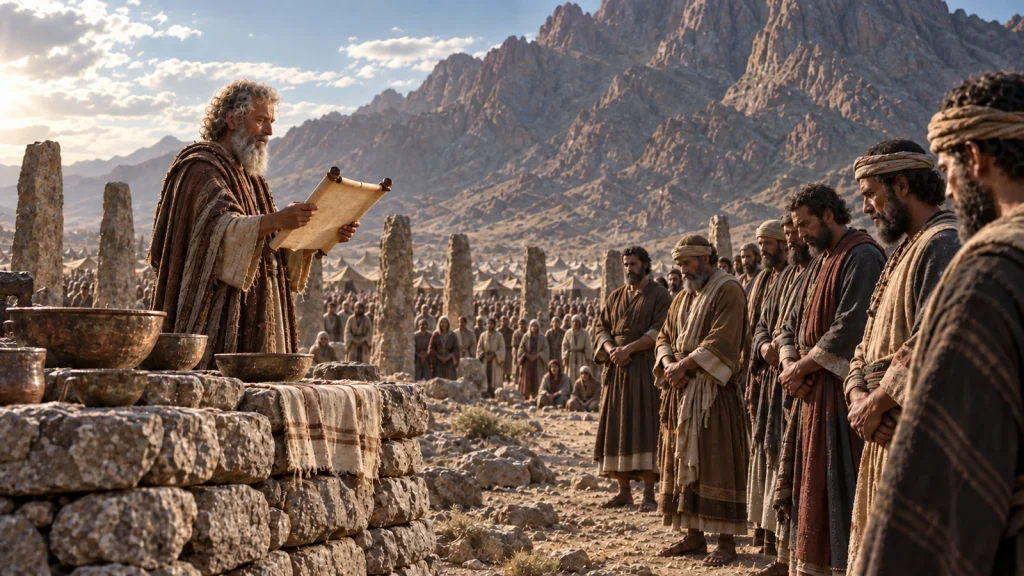
Mount Sinai after the public reading of the Book of the Covenant in Exodus 24.
Source: AI-generated image created for Beyond The Known.
Exodus 24 is one of those chapters whose familiarity can hide how strange it actually is.
So why was Israel’s covenant sealed with blood? The answer lies in the sequence Exodus carefully constructs around the ceremony.
There is blood in bowls. Twelve stone pillars stand at the foot of Sinai. A written scroll is read before an entire nation. Seventy elders climb the mountain, encounter the God of Israel, survive, and then eat and drink in his presence.
At the center of it all stands Moses with sacrificial blood.
He dashes one portion against the altar. Later he turns toward the people and declares:
“This is the blood of the covenant that the Lord has made with you in accordance with all these words.”
Why blood?
Nothing in Exodus 24 suggests that Israel has entered a primitive ceremony whose meaning can be reduced to violence or death. Nor does the chapter say that Moses is performing an ordinary sin offering.
The ritual belongs to something more specific.
Words have been spoken. Israel has heard them. The nation has agreed to obey. Those words are written and publicly read. Sacrifices are offered, and the relationship announced at Sinai is formally enacted.
Then the story moves upward.
The blood ceremony is followed by something no reader should treat casually: representatives of Israel enter the divine presence.
Exodus 24 Completes What Began at Sinai
The previous study, Why Does Exodus 23 Command Israel to Help Its Enemy?, examined part of the legal material Israel was being called to obey.
Exodus 24 now gives those commands a public, ceremonial setting.
The sequence began earlier.
In Exodus 19, YHWH reminds Israel that he brought them out of Egypt and carried them to himself. The Decalogue follows in chapter 20. Exodus 20:22–23:33 develops laws concerning worship, property, justice, social responsibility, festivals, enemies, and Israel’s future in the land.
Then Moses comes to the people and reports YHWH’s words and ordinances.
The nation answers “with one voice.”
They will do what YHWH has spoken.
Only afterward does the blood appear.
That order protects the ceremony from a serious misunderstanding. Israel is not entering an unexplained ritual first and learning its obligations later.
Instruction precedes ratification.
The people hear before they commit themselves.
A Mountain Where Nearness Has Boundaries
The chapter opens by dividing Israel into levels of access.
The people remain below.
Aaron, Nadab, Abihu, and seventy elders are permitted to ascend, but they must worship at a distance.
Moses alone may come near YHWH.
The arrangement establishes one of the chapter’s central tensions. Israel has been brought into relationship with God, yet holiness has not become casual accessibility.
Nearness is possible.
It is also ordered.
That pattern continues after the ceremony. The elders eventually climb higher and experience an extraordinary encounter. Joshua accompanies Moses during the next ascent. Moses himself goes farther still and finally enters the cloud.
Sinai is not merely a mountain where God is distant.
It is a mountain where approach is granted by degrees.
Israel Agrees Before Moses Applies the Blood
When Moses reports YHWH’s instructions, the people respond together:
They will do everything YHWH has spoken.
Moses then writes the divine words.
Early the next morning, he builds an altar at the foot of Sinai and erects twelve standing stones corresponding to the twelve tribes.
That detail gives the scene a national scale.
The ceremony is not a private agreement between God and Moses. Nor is it limited to the leaders who will later climb the mountain.
All Israel is represented.
The twelve pillars are explicitly connected with the twelve tribes.
The altar is part of the sacrificial action directed toward YHWH. Some interpreters understand altar and pillars as visibly representing the two parties to the agreement, but Exodus itself identifies only the pillars in that way.
The inference is reasonable.
It should not be turned into something the narrator explicitly says.
Why Do Young Israelites Offer the Sacrifices?
Moses sends young Israelite men to offer burnt offerings and sacrifice bulls as well-being offerings to YHWH.
The narrator does not tell us why these particular men perform the task.
They are not called priests here.
It would also be premature to identify them with the later Aaronide priesthood, whose consecration has not yet occurred in the story.
Exodus directs our attention elsewhere.
Animals are sacrificed.
Their blood is collected.
Then Moses takes control of it.
What Does Moses Actually Do with the Blood?
Verse 6 says that Moses places half of the blood in basins and applies the other portion to the altar.
The Hebrew verb is:
זָרַק — zāraq — throw / dash / splash
Many English Bibles use “sprinkle.”
That translation is familiar, but it can suggest a gentler motion than the Hebrew verb requires. In sacrificial contexts, zāraq commonly refers to throwing or dashing liquid.
The same verb returns when Moses turns toward the assembled Israelites.
That gives the ritual a physical force easily lost in English.
This is not presented as a quiet symbolic gesture performed somewhere out of sight.
The difficulty comes when we imagine the size of the assembly. Did Moses somehow reach every individual person?
Exodus does not explain the mechanics.
The Hebrew construction can allow the action to be understood as directed on or toward the people. Whatever its exact execution, the narrator is more interested in Moses’ interpretation of the act than in reconstructing its logistics.
Moses tells us what the blood means in this setting:
It is the blood of the covenant.
Was the Blood for the Forgiveness of Israel’s Sins?
Exodus 24 never says so.
That restraint is essential.
Sacrificial blood does not carry one identical function everywhere in the Hebrew Bible. Depending on the ritual, it can appear in contexts of purification, consecration, protection, altar service, atonement, or other sacred acts.
Here, no sin is confessed.
No declaration of forgiveness follows.
The passage does not call the ceremony an atonement rite.
Moses instead names the blood according to the relationship being established: “the blood of the covenant.”
William K. Gilders’ study of biblical blood ritual warns against treating every use of sacrificial blood as though one explanation automatically governs them all.
Amy Peeler, examining Exodus 24 within its narrative setting, argues that the application of blood can be understood as sealing the covenant and consecrating the community while also contributing to the movement toward divine nearness that follows.
That last observation deserves attention.
Before the ceremony, Israel is kept at carefully marked distances.
Afterward, representatives climb the mountain.
Why Is the Blood Divided?
Moses does something unusually precise.
One portion goes to the altar.
The other remains in basins.
Then he pauses.
Before the remaining blood is applied, the Book of the Covenant is read and Israel responds again.
Only after that second declaration does Moses take what remains and direct it toward the people.
Exodus never provides a symbolic dictionary explaining each movement.
Many interpreters understand the two applications as ritually relating the parties within the same sacrificial event: the altar on one side, Israel on the other.
That reading is plausible, but it is still interpretation.
The more secure observation comes directly from the sequence.
The same sacrificial blood is associated first with the altar and then with the covenant community. Immediately afterward, Moses identifies the rite as the blood by which YHWH has made the covenant with Israel.
The animals have not merely died.
Their blood has entered the public enactment of the relationship.
Why Is the Book of the Covenant Read Again?
Israel has already heard YHWH’s instructions once.
The people have already agreed to obey.
Yet Moses now takes the written document and reads it aloud before them.
Their second response contains one of the most famous Hebrew expressions associated with Sinai:
נַעֲשֶׂה וְנִשְׁמָע — naʿaseh wenishmaʿ — we will do and we will hear / obey
Later Jewish interpretation would devote enormous attention to the surprising order of those verbs, sometimes seeing “we will do” before “we will hear” as an extraordinary declaration of trust.
Within Exodus 24 itself, however, Israel is not agreeing to an undisclosed set of requirements.
The nation has already heard YHWH’s words.
Moses has written them.
Now the document is publicly read.
The response is better understood here as a renewed declaration of committed obedience than as blind acceptance of unknown commands.
The ceremony depends on more than sacrifice.
It is anchored in intelligible words.
What Was the Book of the Covenant?
Exodus does not provide a table of contents.
In the chapter’s present literary setting, the natural association is with the body of instruction immediately preceding the ceremony, particularly Exodus 20:22–23:33.
Scholars differ over the precise historical extent of the collection and its relationship to surrounding material.
For the final form of the story, a narrower point is enough.
The commands have become a document.
They can be read publicly.
Israel can hear them, affirm them, and be held to them.
The covenant is not sustained by ritual ambiguity.
It has content.
What Does “Blood of the Covenant” Mean?
The Hebrew expression is:
דַּם הַבְּרִית — dam habberit — blood of the covenant
The phrase identifies the blood by its role in this particular ceremony.
The passage also uses the standard Hebrew expression for establishing a covenant:
כָּרַת בְּרִית — kārat berit — cut a covenant
Because kārat literally means “cut,” it is tempting to assume that every occurrence of the idiom refers to a ceremony involving animals being divided into pieces.
That conclusion goes beyond the evidence.
Genesis 15 contains such a scene.
Exodus 24 does not.
Here bulls are sacrificed, blood is divided, the altar receives one portion, a written document is read, the nation gives its assent, and the rest is directed toward the people.
Sinai has its own ritual form.
Why Did Blood Seal Israel’s Covenant?
SEALED turns the complete movement of Exodus 24 into a seven-day guided study. Examine the covenant words, Israel’s two declarations, the divided blood, the twelve pillars, the mountain meal, and Moses’ entrance into the cloud—while carefully distinguishing what the passage states from what readers may responsibly infer.
Print + Fillable Digital PDFs • 50 pages • 7 days • 20–30 minutes per day
Get the Complete Study — $7.99Then the Elders See the God of Israel
After the ceremony below, Moses, Aaron, Nadab, Abihu, and the seventy elders ascend.
What follows is one of the boldest statements in Exodus:
They saw the God of Israel.
The Hebrew does not initially soften the claim.
Yet when the narrator begins describing what was visible, something remarkable happens.
There is no description of God’s face.
No body is outlined.
No attempt is made to tell the reader what God “looked like.”
The attention moves downward.
Under his feet is something resembling a pavement of sappîr, brilliant like the heavens themselves.
The encounter is affirmed.
The divine form remains undescribed.
Was the Pavement Sapphire or Lapis Lazuli?
The Hebrew term is:
סַפִּיר — sappîr — sapphire / lapis lazuli
Ancient gemstone vocabulary does not always correspond exactly to modern mineral classifications.
For that reason, translations differ.
“Sapphire” follows a long tradition.
“Lapis lazuli” may better evoke the rich blue stone prized throughout the ancient Near East.
Trying to settle the verse primarily through mineral identification, however, risks missing its literary effect.
The narrator compares what lies beneath the divine presence with the clarity or brilliance of the sky.
Color and radiance fill the scene.
God himself is still not described.
How Could They See God and Survive?
Verse 11 acknowledges the danger.
YHWH does not stretch out his hand against the leaders.
That statement would be unnecessary if the encounter carried no risk.
Then Exodus says again that they beheld God.
And they ate and drank.
The scene becomes even more striking when read beside Exodus 33:20, where Moses will be told that a human cannot see YHWH’s face and live.
Yet Exodus 24 never claims that the elders saw God’s face.
Exactly what they perceived is left undefined.
Ancient translators were already uncomfortable with the direct wording. The Greek Septuagint renders the scene more cautiously, referring to the place where the God of Israel stood.
The Hebrew remains more daring.
They saw.
They were spared.
And the encounter did not end with their deaths.
Why Do They Eat and Drink?
After everything that has happened, the next action sounds almost ordinary.
They eat.
They drink.
No menu appears.
No speech interprets the meal.
Nothing elaborate is said about the food.
Its significance comes from where it occurs in the story.
Sacrifices have been offered.
The agreement has been publicly accepted.
The blood has been applied.
Representatives of Israel have ascended into the divine presence and survived.
A shared meal in this setting is naturally understood as covenant fellowship. Meals could accompany agreements and sacrificial occasions elsewhere in biblical and ancient Near Eastern settings.
That background provides context, but Exodus should not be forced into a single reconstructed treaty template.
Its own narrative is enough.
The men who were first ordered to worship from a distance are now eating in the presence of Israel’s God.
Holiness has not disappeared.
Fellowship has become possible within the boundaries YHWH established.
Later Canonical Interpretation: Why “Blood of the Covenant” Appears Again
The phrase does not remain isolated in Exodus.
Later biblical writers return to it.
Most directly, Hebrews 9 retells the Sinai ceremony and quotes the declaration about the “blood of the covenant.” Hebrews interprets that earlier event as part of its larger argument about covenant inauguration, sacrifice, sanctuary, and the work of Christ.
The Gospel tradition also uses covenant-and-blood language at Jesus’ final meal with his disciples.
That later Christian reception is theologically significant, but the direction of interpretation must remain clear.
We should first ask what Exodus 24 communicates in its own literary setting.
Only then should we examine how later canonical writers reuse its language.
Doing so prevents a later theological development from being silently imported backward into Moses’ ceremony.
It also makes the later echoes more meaningful.
The New Testament writers are not choosing covenant language from nowhere.
They are drawing on one of Sinai’s most memorable scenes.
Is Exodus 24 a Single Literary Composition?
Historical-critical scholarship has long noticed tensions and repetitions within the chapter.
Verses 1–2 appear to anticipate the ascent narrated in verses 9–11, while verses 3–8 form a substantial covenant-ratification account between them.
Different source- and redaction-critical models have been proposed to explain that arrangement.
None should be narrated as though we possess a documentary history of the chapter.
The evidence supports discussion and reconstruction, not certainty.
A historical-critical analysis asks how traditions may have developed or been combined.
A final-text reading asks what the chapter in its received form now accomplishes.
Read in that final form, the movement is strikingly coherent:
restricted approach, public assent, sacrifice, ratification, representative ascent, a meal before God, and Moses moving farther into the cloud.
Whatever history lies behind the arrangement, the received narrative invites us to read those scenes together.
Moses Goes Where the Others Cannot
The elders’ meal is not the end of the ascent.
YHWH calls Moses farther up and promises him stone tablets containing instruction and commandment.
Joshua accompanies him for part of the journey.
The elders remain behind.
Aaron and Hur are left available to handle disputes.
Then the cloud covers Sinai.
Six days pass.
On the seventh day, YHWH calls Moses from within it.
From below, the Israelites see the glory of YHWH on the summit like consuming fire.
Moses enters the cloud.
He remains there forty days and forty nights.
The man who was allowed to “come near” at the beginning of the chapter now disappears into the place from which divine instruction will continue.
The Deeper Discovery
One of the easiest details to overlook in Exodus 24 is that writing happens twice.
In verse 4, Moses writes down “all the words of YHWH.”
That written material becomes the document read before Israel.
Later, in verse 12, YHWH summons Moses and promises to give him stone tablets containing “the instruction and the commandment” that he has written for the people’s instruction.
The chapter moves from Moses writing divine words below the mountain to Moses ascending to receive writing attributed to God above it.
The narrator never says that the scroll and the stone tablets contain exactly the same material.
They should not simply be collapsed into one document.
But their placement is difficult to overlook.
At the foot of Sinai, revelation is written, read aloud, and accepted by the nation.
Higher on the mountain, Moses is called to receive inscribed instruction from YHWH himself.
That observation changes the way we understand the blood ceremony.
The covenant is not magic.
It is not an emotional bond without definition.
The blood solemnizes a relationship whose obligations can be spoken, written, heard, remembered, and obeyed.
Blood gives the ceremony its gravity.
Words give the covenant its content.
Follow the Covenant from Blood to Divine Presence
SEALED — A Seven-Day Guided Study of Exodus 24 explores how words, sacrifice, public commitment, covenant blood, ordered access, and fellowship belong together at Sinai.
Study why Israel answers twice, what Moses does with the divided blood, why the ceremony is not automatically an atonement rite, what the elders may have seen, why they ate and drank before God, and how Moses’ ascent prepares the way for the sanctuary.
Print + Fillable Digital PDFs • 50 pages • 7 complete studies • Immediate download
Start the 7-Day Study — $7.99FAQ
Why was Israel’s covenant sealed with blood?
Exodus 24 uses sacrificial blood within the formal ratification of the Sinai covenant. Moses associates it with the altar and the people and then explicitly calls it “the blood of the covenant” made according to YHWH’s words.
Does Exodus 24 say the blood forgave Israel’s sins?
No. The chapter does not describe the ceremony as an act of forgiveness or explicitly identify it as atonement. Its immediate setting concerns covenant ratification and consecration. Other biblical rituals assign different functions to sacrificial blood.
Did Moses sprinkle blood on every Israelite?
The Hebrew verb zāraq can mean “throw,” “dash,” or “splash.” Given the size of the assembly, interpreters differ over the physical execution of the act. The wording can be understood as blood applied on or directed toward the gathered people; Exodus does not explain the mechanics.
Did the seventy elders literally see God?
The Hebrew account twice states that they saw or beheld God, yet it gives no description of his face or form. The only visual detail concerns what was beneath his feet. The encounter is presented as real while its precise nature remains undefined.
Was the pavement sapphire or lapis lazuli?
The Hebrew sappîr may be rendered “sapphire” or “lapis lazuli.” Ancient gemstone terminology does not correspond perfectly to modern categories. In context, the comparison emphasizes a brilliant, sky-like appearance beneath the divine presence.
Why did the elders eat and drink?
The meal follows Israel’s acceptance of the covenant, the sacrifices, and the blood ceremony. In that sequence, it is naturally understood as an act of covenant fellowship in the divine presence.
Why does Moses enter the cloud after the covenant is confirmed?
Sinai has more revelation to come. Moses is summoned higher to receive the stone tablets and then instructions concerning the sanctuary. Exodus 24 therefore becomes the bridge between the Book of the Covenant and the tabernacle material that follows.
Israel has now heard the terms.
The nation has pledged obedience.
The covenant has been enacted in blood.
Its representatives have climbed Sinai, beheld the God of Israel, survived, and eaten in his presence.
But the people cannot remain at the mountain forever.
Moses enters the cloud, and the next divine instructions introduce a startling development: instead of Israel continually approaching Sinai, a sacred dwelling will be constructed in the middle of the camp.
The question now changes.
How can the presence encountered on the mountain dwell among the people below?
Why Did God Ask Israel to Build Him a Sanctuary?
Selected Sources
- Brevard S. Childs, The Book of Exodus: A Critical, Theological Commentary. Old Testament Library. Westminster Press, 1974.
- John I. Durham, Exodus. Word Biblical Commentary 3. Word Books, 1987.
- William K. Gilders, Blood Ritual in the Hebrew Bible: Meaning and Power. Johns Hopkins University Press, 2004.
- E. W. Nicholson, “The Covenant Ritual in Exodus XXIV 3–8.” Vetus Testamentum 32.1 (1982): 74–86.
- Amy L. B. Peeler, “Desiring God: The Blood of the Covenant in Exodus 24.” Bulletin for Biblical Research 23.2 (2013): 187–205.
- William H. C. Propp, Exodus 19–40: A New Translation with Introduction and Commentary. Anchor Bible 2A. Doubleday, 2006.
- Nahum M. Sarna, Exodus: The Traditional Hebrew Text with the New JPS Translation. JPS Torah Commentary. Jewish Publication Society, 1991.