Why Does Ishmael Leave Only After Isaac Is Declared the Heir?
The Separation Framed by Two Promises, Not One
Source: AI-generated image created for Beyond The Known.
After God prevented Abimelech from touching Sarah, as examined in Why Did God Stop Abimelech Before He Touched Sarah?, Genesis records the event toward which the Abraham story has been moving for years: Sarah gives birth to Isaac.
But Isaac’s arrival does not resolve every tension inside Abraham’s household. It brings one of them into the open. At the feast celebrating Isaac’s weaning, Sarah sees Hagar’s son and demands that the slave woman and her son be driven out because Ishmael must not inherit with Isaac.
Abraham does not send them away immediately. He is deeply distressed, and God speaks before the separation occurs.
The reason for that order is not simply that Isaac needs to be identified as the chosen son. Genesis 17 had already distinguished Isaac as the one with whom God would establish the covenant. In Genesis 21, God reaffirms that the family line will be reckoned through Isaac and then immediately promises that Ishmael will also become a nation because he is Abraham’s offspring.
The departure is therefore framed by two declarations, not one. Isaac will carry the covenant line, but Ishmael will not leave without a future under God’s care.
What Triggers the Separation?
Isaac’s birth changes the household
Genesis 21 opens with fulfillment rather than suspense. The LORD attends to Sarah “as he had said,” and she bears Abraham a son at the appointed time. Abraham names him Isaac and circumcises him on the eighth day, just as God commanded.
Sarah responds with laughter. The son whose name is connected with laughter has transformed her earlier disbelief into public joy. Abraham then holds a great feast when Isaac is weaned.
The celebration marks more than survival through infancy. Isaac is now moving beyond his earliest dependence upon Sarah, and his place within the household is becoming publicly visible. At precisely that moment, Sarah looks at Hagar’s son.
The narrative turns from laughter to conflict through a single difficult word.
Was Ishmael mocking Isaac?
Genesis 21:9 describes Hagar’s son as מְצַחֵק — meṣaḥēq. The word comes from the same Hebrew root associated with Isaac’s name, but its meaning in this verse is debated.
English translations illustrate the difficulty. Some render it “laughing,” others “playing,” and others “mocking.” The Hebrew participle has no stated object. It does not explicitly say that Ishmael was laughing at Isaac, physically attacking him, or threatening him.
The ancient Greek Septuagint makes the scene more specific by portraying Hagar’s son as playing with Isaac. That wording influenced later interpretation, but the name “Isaac” does not appear as the object of the verb in the Masoretic Hebrew text.
Context may support a negative nuance because Sarah reacts by demanding expulsion. Even so, her reaction does not by itself prove precisely what Ishmael was doing. The narrator reports what Sarah saw and what she demanded without explaining the action further.
For that reason, “mocking” is a possible interpretation rather than an uncontested translation. Claims that Ishmael was assaulting, persecuting, or attempting to kill Isaac go beyond what Genesis 21:9 explicitly states.
The ambiguity may itself contribute to the narrative. A word built from the same root as Isaac’s name appears at the moment when the futures of the two sons must be separated.
Sarah makes the conflict about inheritance
Whatever Sarah believes she has seen, her demand is not framed only as protection from bad behavior. She speaks directly about inheritance:
“Get rid of that slave woman and her son, for that woman’s son will never share in the inheritance with my son Isaac.”
Genesis 21:10, NIV
Her language is severe. Hagar is “that slave woman,” and Ishmael is “her son.” Sarah does not use either name. She defines the two by social status and by the threat she believes Ishmael presents to Isaac’s inheritance.
Ishmael is Abraham’s firstborn son. Isaac is the son God promised through Sarah. The household now contains two sons with claims upon Abraham, but Genesis has already distinguished their roles.
In Genesis 17, Abraham pleaded, “If only Ishmael might live under your blessing!” God answered by promising to bless Ishmael, make him fruitful, and turn him into a great nation. Yet God also declared that the covenant would be established with Isaac, the son Sarah would bear.
Genesis 21 does not introduce that distinction for the first time. It brings the earlier declaration into a painful domestic crisis.
What God Declares Before Ishmael Leaves
Abraham is distressed because Ishmael is his son
Sarah’s demand greatly distresses Abraham. Genesis explains why: the matter concerns his son.
That description quietly resists Sarah’s attempt to define Ishmael only as the slave woman’s child. Ishmael is Hagar’s son, but he is also Abraham’s. The emotional conflict cannot be reduced to a disagreement between Sarah and Hagar because Abraham’s own child is about to leave his household.
God tells Abraham not to remain distressed and instructs him to listen to Sarah. But the command is followed by two reasons that must be read together:
“It is through Isaac that your offspring will be reckoned. I will make the son of the slave into a nation also, because he is your offspring.”
Genesis 21:12–13, NIV
The first declaration confirms Isaac’s distinctive place. The Hebrew construction can be rendered along the lines of “through Isaac offspring shall be named for you.” It identifies the line through which Abraham’s covenant family will continue.
This is related to inheritance, but it is not a formal ceremony in which Isaac receives the title “heir.” Sarah speaks of inheritance; God speaks of the line that will be named through Isaac. Calling Isaac “the heir” is useful shorthand, provided those two statements are not treated as identical.
The second declaration changes the meaning of the first
The next verse is essential. God does not finish speaking after identifying Isaac’s line.
Ishmael will also become a nation because he is Abraham’s offspring. The same relationship that causes Abraham pain becomes the stated basis for Ishmael’s promised future. Isaac carries the covenant line associated with Sarah and the promised birth; Ishmael receives the separate national future already announced in Genesis 17.
This is why the order of events matters. Sarah demands the expulsion first, but Abraham acts only after God’s speech has defined its limits. The sons will no longer remain together in Abraham’s household, yet Ishmael has not ceased to be Abraham’s offspring, and the promises concerning him have not been withdrawn.
The text does not explain why separation had to take this painful form. Nor does it invite readers to treat Hagar’s enslavement and expulsion as morally insignificant. It narrates a household shaped by unequal power, rivalry, fear, and grief. God’s promise to Ishmael does not make the suffering unreal.
What it does establish is that the suffering will not have the final word over his future.
Was Ishmael a small child?
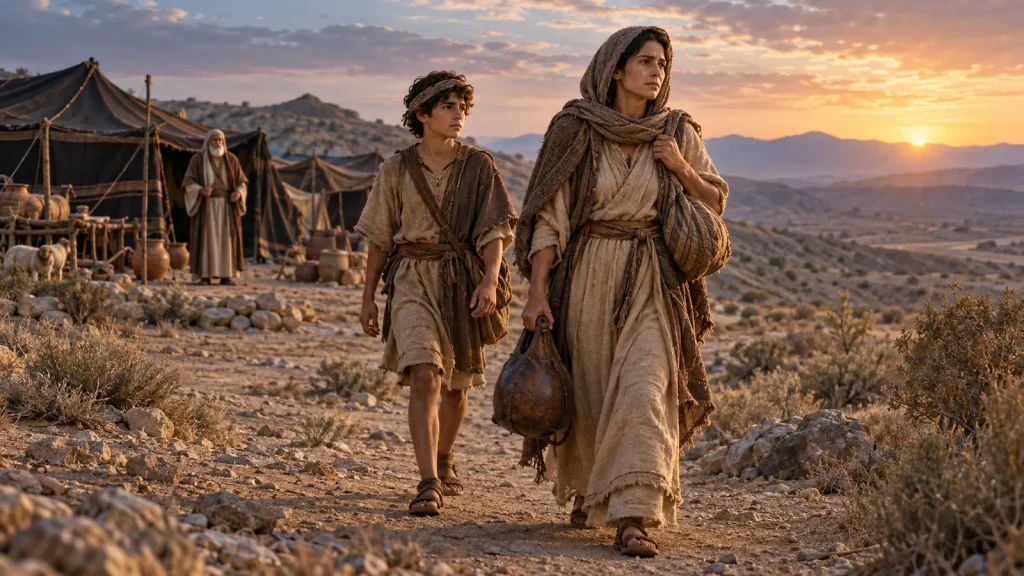
Art and popular retellings often portray Ishmael as a toddler whom Hagar carries into the wilderness. The chronology provided by Genesis points elsewhere.
Abraham was eighty-six when Ishmael was born and one hundred when Isaac was born. Ishmael was therefore about fourteen at Isaac’s birth and older by the time Isaac was weaned.
Genesis calls him a “boy” or “child,” but those terms can describe someone older than a small child. The scene should therefore be read as involving an adolescent, perhaps in his mid-teens, rather than an infant.
This does not lessen the danger. Hagar and her son are sent into the wilderness with limited provisions. When the water is gone, Ishmael becomes so weak that Hagar places him under a bush and moves away because she cannot bear to watch him die.
The promised future now appears impossible.
Separation is not abandonment
At the point of greatest danger, Genesis says that God hears the boy’s voice.
The moment recalls the name Ishmael, יִשְׁמָעֵאל — yišmāʿēʾl, associated in Genesis 16 with God hearing Hagar’s affliction. Ishmael’s name is not spoken in the wilderness scene, but its meaning is enacted again: God hears.
The messenger of God calls to Hagar, tells her not to fear, and repeats the promise that the boy will become a great nation. God opens her eyes to a well. The account then summarizes Ishmael’s future with a concise but decisive statement:
“God was with the boy as he grew up.”
Genesis 21:20, NIV
Ishmael grows in the wilderness, becomes an archer, lives in the Wilderness of Paran, and receives an Egyptian wife chosen by Hagar. His departure ends his place in Abraham’s immediate household, but it does not end his story or God’s involvement with him.
Genesis later lists twelve sons of Ishmael and describes them as tribal rulers, fulfilling the earlier promise. Ishmael also appears with Isaac at Abraham’s burial in Genesis 25:9. Whatever distance separates the brothers, Ishmael is not erased from Abraham’s family history.
How does Galatians interpret the scene?
Galatians 4 later interprets the two mothers and sons allegorically and describes the son born according to the flesh as persecuting the son born according to the Spirit. Within Christian Scripture, that is an important later canonical interpretation serving Paul’s argument about slavery and freedom.
It does not remove the ambiguity of the earlier Hebrew narrative. Genesis 21:9 does not explicitly describe physical harm or use a word meaning “persecute.” Paul’s theological reuse should therefore be acknowledged without being silently inserted into Genesis as though the original narrator had supplied the same explanation.
The Deeper Discovery
Sarah describes Ishmael only as the slave woman’s son. Abraham’s distress restores one relationship: the boy is his son. God’s speech goes further by calling Ishmael Abraham’s offspring, the very relationship Sarah’s language had pushed aside.
The deeper discovery is that Isaac’s status does not depend upon Ishmael’s erasure. Genesis can distinguish one son as the covenant line while still portraying the other as heard, promised a future, and accompanied by God.
The household will divide, but Sarah’s anger and Abraham’s decision will not be allowed to define Ishmael’s entire identity. Outside Abraham’s encampment, he remains inside the reach of the promise God made concerning him.
The next chapter will place Isaac himself in danger. Scholars have observed important narrative parallels between Hagar’s ordeal with Ishmael in the wilderness and Abraham’s ordeal with Isaac on Mount Moriah: a parent faces the apparent loss of a son, a divine messenger calls from heaven, and death is averted through divine provision.
That parallel creates the next question:
Why Did God Provide the Ram Only at the Last Moment?
Ishmael’s departure distinguishes the two sons without erasing either one. The Moriah story will now test whether the promised line can survive at all.
Selected Sources
- Il-Seung Chung, “Hagar and Ishmael in Light of Abraham and Isaac: Reading Gen. 21:8–21 and Gen. 22:1–19 as a Dialogue,” The Expository Times 128.12 (2017), pp. 573–582. DOI: 10.1177/0014524617702005.
- Victor P. Hamilton, The Book of Genesis: Chapters 18–50. New International Commentary on the Old Testament. Eerdmans, 1995.
- Scott Nikaido, “Hagar and Ishmael as Literary Figures: An Intertextual Study,” Vetus Testamentum 51.2 (2001), pp. 219–242. DOI: 10.1163/156853301300102110.
- James C. Okoye, “Sarah and Hagar: Genesis 16 and 21,” Journal for the Study of the Old Testament 32.2 (2007), pp. 163–175. DOI: 10.1177/0309089207085881.
- Vincent Chukwuma Onwukwe, “Looking into Sarah’s Eyes: The Meaning of מְצַחֵק in Genesis 21.9,” The Bible Translator 73.1 (2022), pp. 89–103. DOI: 10.1177/20516770211066930.
- Nahum M. Sarna, Genesis: The Traditional Hebrew Text with the New JPS Translation. The JPS Torah Commentary. Jewish Publication Society, 1989.
- Gordon J. Wenham, Genesis 16–50. Word Biblical Commentary 2. Word Books, 1994.