Why Did God Provide the Ram Only at the Last Moment?
Genesis 22 and the Provision Abraham Saw Only After the Test Reached Its Climax
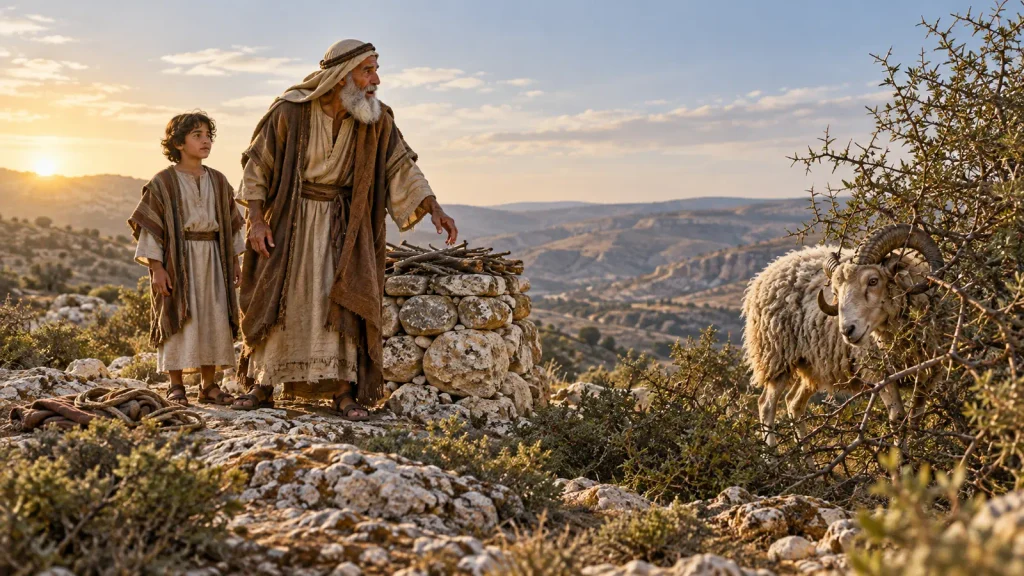
Source: AI-generated image created for Beyond The Known.
Genesis 22 follows the separation of Hagar and Ishmael, examined in Why Does Ishmael Leave Only After Isaac Is Declared the Heir?. Isaac now stands as the son through whom the covenant line will continue, making the command that follows even more severe.
God’s provision appears at the last possible moment because Genesis allows Abraham’s test to reach a real point of decision before revealing its resolution. Yet the text makes a more careful claim than the familiar retelling. It does not say that the ram suddenly arrived when Abraham raised the knife. It says that the divine messenger stopped Abraham, and only then Abraham looked up and saw a ram already caught in the thicket.
The timing therefore concerns revelation more clearly than arrival. The animal enters Abraham’s awareness after Isaac has been spared. That sequence turns the ram into both a substitute and the visible answer to words Abraham had spoken earlier: “God himself will provide the lamb for the burnt offering.”
What Genesis Actually Describes
Genesis 22 begins by telling the reader something Abraham is never explicitly told:
“God tested Abraham.”
That opening controls the entire account. The command is a test, but the narrative does not disclose its resolution to Abraham. He travels for three days, leaves the servants behind, places the wood on Isaac, builds the altar, arranges the wood, binds his son, and reaches for the knife.
Only then does the angel of YHWH call from heaven:
“Abraham! Abraham!”
The repeated name interrupts the action. Abraham answers with the same expression he used when God first addressed him: “Here I am.” The messenger then forbids him to harm Isaac and interprets the test: Abraham has demonstrated that he fears God because he has not withheld his son.
Verse 13 begins after that prohibition:
“Abraham looked up and saw a ram caught in the thicket by its horns.”
The order matters. The voice stops the sacrifice before the ram is mentioned. Isaac is not spared because Abraham happens to notice another victim. He is spared because God explicitly commands Abraham not to touch him. The ram then becomes the offering “instead of his son.”
Genesis Never Says the Ram Arrived Late
Popular retellings often imagine the animal running onto the mountain at the final second. Genesis provides no such scene.
The Hebrew says that Abraham lifted his eyes and saw:
וְהִנֵּה־אַיִל אַחַר נֶאֱחַז בַּסְּבַךְ בְּקַרְנָיו
wəhinnēh-ʾayil ʾaḥar neʾĕḥaz bassəḇaḵ bəqarnāyw
The phrase introduces “a ram caught in the thicket by its horns.” The passive form neʾĕḥaz describes the animal as caught. It does not explain when the ram reached the place, how long it had been there, or how it became entangled.
The small word hinnēh, often translated “behold” or “look,” directs attention to what Abraham now perceives. The narrative camera turns with him. Readers see the ram when he sees it.
That distinction prevents us from claiming more than the passage reveals. God may have directed the animal there before Abraham arrived. The ram may have become caught during the final moments. Genesis does not say. Its concern is not the animal’s travel history. Its concern is the moment when provision becomes visible.
Why Must the Test Reach the Knife?
If the ram had been introduced earlier, Abraham could have interpreted it as an alternative before the command had reached its decisive point. The narrative instead withholds every visible substitute.
Isaac notices the absence. He identifies the fire and wood, then asks the question the reader has been carrying:
“Where is the lamb for the burnt offering?”
Abraham answers:
“God will provide for himself the lamb for the burnt offering, my son.”
The two then continue together.
Genesis does not tell us precisely what Abraham expected. His reply could express trust, hope, restraint, or a conviction that God would resolve the contradiction between the command and the promise. Hebrews 11 later interprets Abraham as reasoning that God could raise the dead. That is an important canonical interpretation, but Genesis itself keeps Abraham’s inner calculation largely hidden.
What the narrative does show is action without an available substitute. The altar is completed. Isaac is bound. The knife is taken. The test reaches the point at which Abraham’s intention can no longer be dismissed as hypothetical.
The last-moment intervention therefore does not portray divine forgetfulness. It makes the test narratively complete without allowing the death to occur.
Abraham Had Already Spoken About Provision
The most important verbal connection appears between verses 8 and 14.
In verse 8 Abraham says:
אֱלֹהִים יִרְאֶה־לּוֹ הַשֶּׂה
ʾĕlōhîm yirʾeh-lô haśśeh
Literally, the verb rāʾâ means “to see.” In this construction, translations commonly render the sense as “God will see to it” or “God will provide for himself the animal.” The language joins sight with provision: God sees what is needed and attends to it.
After the ram is offered, Abraham names the place:
יְהוָה יִרְאֶה
YHWH yirʾeh
The phrase is traditionally rendered “The LORD will provide,” though its most literal form is “The LORD will see.” The narrator then preserves a related saying about YHWH’s mountain.
The account is therefore saturated with seeing.
- Abraham first sees the place from a distance.
- He tells Isaac that God will see to the offering.
- After the intervention, Abraham lifts his eyes and sees the ram.
- He names the place with the same Hebrew root.
Provision is not added as a detached miracle at the end. The final sight resolves a verbal pattern that has been developing throughout the journey.
Isaac Asked About a Lamb, but Abraham Found a Ram
Another detail deserves precision. Isaac asks about a śeh, a general term for an animal from the flock and often translated “lamb.” Verse 13 identifies the actual animal as an ʾayil, an adult male sheep or ram.
Abraham’s answer is therefore not a zoologically exact prediction. He does not tell Isaac that a horned ram will be waiting in a thicket. He says that God will attend to the missing sacrificial animal.
The narrative fulfills the substance of his statement without reproducing every noun. God’s provision is more specific than Abraham’s words: the visible offering is a ram, and its horns are caught in the vegetation.
That detail also reinforces the difference between promise and mechanism. Abraham speaks trust before he knows how the need will be met. The form of the answer becomes clear only afterward.
The Ram Is Explicitly a Substitute
Genesis does not leave the ram’s function ambiguous. Abraham offers it:
תַּחַת בְּנוֹ
taḥat bənô
The phrase means “instead of his son” or “in place of his son.”
The animal is not a second offering added after Isaac’s release. It occupies the sacrificial place from which Isaac has been removed. The sequence contains three distinct actions:
- God prohibits Abraham from harming Isaac.
- Abraham sees and takes the ram.
- Abraham offers the ram in his son’s place.
This is why the timing is theologically important. The ram becomes intelligible only after the son has been spared. Its meaning comes from substitution, not merely from its presence on the mountain.
Michael Lyons identifies testing, divine provision, and substitution as central themes that made Genesis 22 productive for later biblical narratives. Jon Levenson likewise treats the beloved son and the substitute victim as part of a larger biblical transformation of sacrificial themes. Neither observation removes the disturbing force of the command. The ram resolves the immediate danger without making the preceding verses emotionally simple.
Does the Story Abolish Child Sacrifice?
The ending clearly presents an animal dying instead of Isaac. It is therefore understandable that many readers see the account as a rejection or transformation of human sacrifice.
The historical claim requires caution.
Later Torah texts explicitly condemn giving children in sacrifice and describe such acts as abhorrent. Genesis 22, however, does not pause to issue a general law. It does not say that Abraham’s willingness was immoral. On the contrary, the heavenly speech commends his refusal to withhold Isaac.
Modern scholars consequently disagree about how directly the chapter functions as a polemic against child sacrifice. Thomas Römer reads the story within the broader problem of human sacrifice in ancient Israel and Judah. Other interpreters warn that the narrative lacks the formal features of a universal prohibition and concentrates instead on Abraham’s test, Isaac’s deliverance, and the substitute offering.
The safest conclusion stays close to the episode itself. This son is not to be killed. God stops the human sacrifice. A ram is offered in Isaac’s place. The larger biblical rejection of child sacrifice becomes explicit elsewhere.
“Behind Him” or “One Ram”?
Genesis 22:13 contains a small textual question that affects translation but not the article’s main conclusion.
The Masoretic Text can be read as Abraham seeing a ram “behind” him. Several Hebrew manuscripts, along with the Septuagint, Syriac tradition, and Samaritan Pentateuch, support a reading translated “one ram.” The two Hebrew words differ only slightly in spelling.
Neither reading says that the ram materialized at that instant.
- “A ram behind him” describes location.
- “One ram” identifies the animal.
In both forms, Abraham sees the ram after the divine command has stopped him. The textual variant changes the picture’s angle, not the narrative sequence.
The Delay Belongs to Abraham’s Experience
Calling this a “last-minute provision” is accurate from Abraham’s point of view. Until the voice speaks, he has no revealed alternative. Until he looks up, he has no visible animal.
It is less accurate if the phrase implies that God was improvising.
The reader was told at the beginning that the event was a test. That disclosure creates dramatic irony. Abraham moves through uncertainty while the audience knows that the command belongs to a testing episode. Even so, the audience does not know exactly how the crisis will end. The ram remains hidden from everyone’s view until verse 13.
The story therefore holds two kinds of knowledge apart:
- God knows the purpose of the test.
- Abraham knows only the command before him and the promise already attached to Isaac.
The provision appears late within human perception, not necessarily within divine preparation.
The Deeper Discovery
Why did God provide the ram only at the last moment?
Genesis presents the timing this way so that the test reaches its decisive boundary before its resolution becomes visible. Abraham is stopped by a word from heaven, Isaac is explicitly spared, and the ram is then offered in his place.
But the deeper discovery is that the passage never actually says the provision itself was late.
The ram may already have been nearby. What changes in verse 13 is Abraham’s sight. He lifts his eyes, and the substitute that had not been available to him becomes visible.
That movement completes the chapter’s repeated language of seeing and providing. Abraham had said that God would see to the offering. At the climax, he sees the animal. He then gives the place a name declaring that YHWH sees or provides.
The final answer is therefore not simply that God sent help before disaster. It is that divine provision and human perception meet at the exact boundary established by the divine command.
Isaac lives. The ram occupies his place. The promise can continue.
Genesis then adds what initially looks like an unrelated genealogy. One name inside it will determine Isaac’s future: Rebekah. Why does the book introduce her before Sarah has even died?
Why Does Genesis Introduce Rebekah Before Sarah Dies?
Selected Sources
- Chung, Il-Seung. “Hagar and Ishmael in Light of Abraham and Isaac: Reading Gen. 21:8–21 and Gen. 22:1–19 as a Dialogue.” The Expository Times 128.12 (2017): 573–582. DOI: 10.1177/0014524617702005.
- Hamilton, Victor P. The Book of Genesis: Chapters 18–50. New International Commentary on the Old Testament. Eerdmans, 1995.
- Levenson, Jon D. The Death and Resurrection of the Beloved Son: The Transformation of Child Sacrifice in Judaism and Christianity. Yale University Press, 1993.
- Lyons, Michael A. “The Aqedah as ‘Template’? Genesis 22 and 1 Kings 17–18.” Journal for the Study of the Old Testament 46.2 (2021): 161–176. DOI: 10.1177/03090892211013837.
- Römer, Thomas. “Sacrifice of the Son or Sons? Genesis 22 and the Question of Child Sacrifice in Ancient Israel.” Jewish Studies 23 (2024).
- Sarna, Nahum M. Genesis. JPS Torah Commentary. Jewish Publication Society, 1989.
- Sefaria. “Genesis 22,” Hebrew text and Jewish Publication Society translations.
- The NET Bible. Genesis 22:8, 13–14, translation and textual notes.
- Wenham, Gordon J. Genesis 16–50. Word Biblical Commentary 2. Word Books, 1994.