Why Does Genesis Introduce Rebekah Before Sarah Dies?
Genesis 22:20–24 and the Genealogy That Quietly Prepares Isaac’s Future
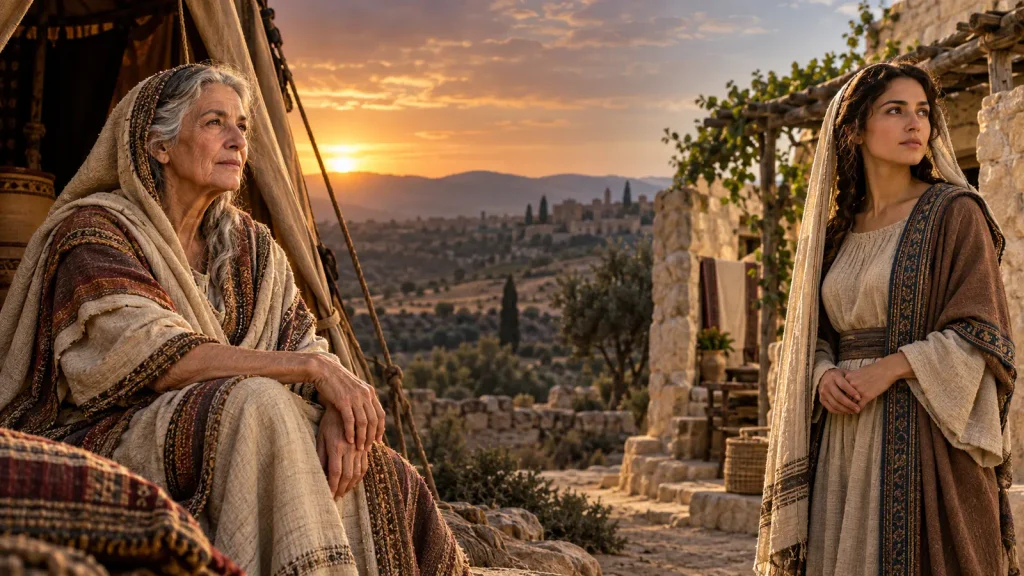
Source: AI-generated image created for Beyond The Known.
Genesis introduces Rebekah before Sarah dies because the brief genealogy at the end of Genesis 22 prepares the reader for Genesis 24 and begins the narrative transition from Abraham and Sarah’s household to Isaac and Rebekah’s. This is a strong literary conclusion drawn from the sequence of the chapters, not an explanation the narrator states directly. It does not mean Rebekah had just been born, nor does it reduce her to a replacement for Sarah.
Genesis 21 had already distinguished Isaac as the son through whom Abraham’s family line would be reckoned, while preserving a separate future for Ishmael. That painful separation is examined in Why Does Ishmael Leave Only After Isaac Is Declared the Heir?.
Genesis 22 then places Isaac himself under mortal threat. As examined in Why Did God Provide the Ram Only at the Last Moment?, the divine messenger stops Abraham before he harms Isaac, and only then does Abraham see the ram caught nearby. He offers it in Isaac’s place and later returns to Beersheba. The account could have ended there.
Instead, four unexpected verses follow.
Abraham receives news about the family of his brother Nahor. The report contains a succession of names that may seem unfamiliar and incidental to modern readers.
Then one name suddenly matters:
Rebekah.
She does nothing in Genesis 22. She speaks no words and never enters the scene. Isaac will not meet her until Genesis 24, and Sarah has not yet died.
So why does Genesis introduce Rebekah at this point?
The answer begins with an apparently misplaced genealogy.
Figure 1. Artistic representation of Rebekah within an ancient Near Eastern household setting, reflecting her quiet introduction in Genesis 22:20–24 before she becomes central to Isaac’s story. The biblical text does not describe her appearance or the precise setting in which Abraham received the report.
Source: AI-generated image created for Beyond The Known.
Why Does a Genealogy Follow the Moriah Story?
Genesis 22:19 already provides a natural ending to the account on Moriah. Abraham returns to his servants, and they travel together to Beersheba.
Then the narrative begins another movement.
The Hebrew of Genesis 22:20 opens with:
וַיְהִי אַחֲרֵי הַדְּבָרִים הָאֵלֶּה
wayhî ʾaḥărê haddəḇārîm hāʾēlleh
The phrase means approximately, “After these things, it happened.” Genesis 22:1 opened Abraham’s test with a closely related formula, although the Hebrew forms are not identical.
Verse 20 then says Abraham was told about Nahor’s household. This detail matters because the passage presents news reaching Abraham after the preceding events. It does not say that every birth mentioned in the report occurred at that moment.
The report begins with the sons of Milcah and Nahor. Uz comes first, followed by Buz, Kemuel, and several others. The list eventually reaches Bethuel.
Genesis then adds one short statement:
וּבְתוּאֵל יָלַד אֶת־רִבְקָה
ûḇəṯûʾēl yālaḏ ʾeṯ-Riḇqâ
“Bethuel fathered Rebekah.”
Nothing in the verse explains why readers should remember her. Genesis simply gives her name.
Chapter 24 will reveal why it mattered.
Rebekah Matters, but the Genealogy Is More Careful Than It Looks
It is tempting to describe Rebekah as completely unique within the list. The text does not quite allow that.
Kemuel is also identified through a descendant. Genesis calls him “the father of Aram.” Rebekah is therefore not the genealogy’s only named grandchild.
Her importance comes from what follows.
Bethuel receives no further role in Genesis 22. Rebekah, however, will become Isaac’s wife and the mother of Jacob and Esau. Her name points beyond the genealogy toward the continuation of the family’s story.
At this stage, a first-time reader cannot yet know her significance. The narrator has placed a future central character on the page without explaining the role she will play.
The genealogical statement is explicit. The conclusion that it prepares readers for Genesis 24 is a literary inference based on the way the later narrative develops her identity.
Genesis Introduces Rebekah Here, Not Necessarily Her Birth
This distinction prevents a serious chronological mistake.
Genesis 22 does not describe Rebekah’s birth as a new event. It reports that Abraham received information about developments within Nahor’s household.
The verb יָלַד (yālaḏ) identifies Bethuel as Rebekah’s father. The clause does not provide Rebekah’s age or date her birth.
Genesis 22:23 therefore cannot be used by itself to calculate how old Rebekah was when she married Isaac. The narrative tells us when Abraham received the report, not when every event contained in that report occurred.
Later traditions developed detailed chronological calculations from the surrounding chapters. Those calculations belong to later interpretation. Genesis itself does not supply Rebekah’s age here.
The safest conclusion is simple: Rebekah enters the narrative in Genesis 22:23, while her biological chronology remains unspecified.
Why Place Rebekah Before Sarah’s Death?
The placement becomes striking when the three chapters are read together.
- Genesis 22 names Rebekah.
- Genesis 23 records Sarah’s death.
- Genesis 24 sends Abraham’s servant to find a wife for Isaac.
The chapters form a connected sequence. One generation is approaching its close while the next household begins to emerge.
Sarah leaves Abraham’s household through death. Rebekah later enters Isaac’s household through marriage.
That does not make Rebekah merely Sarah’s replacement. Genesis gives each woman a distinct identity, history, and role. Sarah’s life cannot be reduced to a position that another woman fills, and Genesis 24 presents Rebekah as an active character rather than a passive narrative device.
Even so, the text eventually creates an explicit connection between them.
Isaac brings Rebekah into the tent of Sarah, his mother. He marries her, loves her, and is comforted after his mother’s death (Genesis 24:67).
That final detail makes the relationship between the chapters difficult to dismiss. Sarah’s death and Rebekah’s arrival belong to the same family transition, even though the two women are not interchangeable.
Genesis 22 begins preparing that transition before Sarah dies.
Isaac Survived, but the Promise Still Needed a Future
The location of the genealogy also matters.
Genesis has just placed Isaac’s life under extraordinary threat. If Isaac dies, the promised line through him faces an obvious crisis.
Isaac survives, but survival alone does not produce another generation. At this point in the story, he has no wife and no children.
The promise therefore still faces a future question: how will Abraham’s family continue through Isaac?
Genesis 22 does not answer that question directly. Instead, it quietly introduces the woman who will become part of that answer.
This is first a literary observation and only then a theological one.
The text never says Rebekah was born during Abraham’s test. It does not describe two simultaneous events arranged behind the scenes. Such a picture may appear in later theological reflection, but it is not an explicit statement of Genesis 22.
What the narrative actually does is more precise:
Isaac survives. Then Rebekah’s name appears.
A Deeper Seven-Day Study
Continue the Story Across Genesis 22–24
Rebekah’s name appears before Sarah dies, but the transition involves far more than a simple change of generations.
CONTINUED develops this question through a structured study of genealogy, grief, land, providence, Rebekah’s willingness, and Isaac’s consolation after loss.
50 pages • Print and fillable editions • Seven guided study days
Explore the Complete Study — $7.99The Reader Knows Something Isaac Does Not
Genesis 24 reveals the narrative function of this small detail.
Abraham sends his servant toward his extended family. The servant reaches the region, stops beside a well, and prays for guidance. Before he finishes speaking, Rebekah arrives.
Genesis immediately identifies her ancestry. She is Bethuel’s daughter, and Bethuel belongs to the family of Milcah and Nahor.
The reader has already encountered that connection. Isaac has not, and the servant has not yet confirmed who Rebekah is.
Genesis 22 therefore gives the reader advance knowledge. The earlier genealogy now pays off.
Rebekah does not appear as an unrelated woman beside a well. She comes from the family network already introduced to Abraham. Genesis 24 develops what Genesis 22 only announced.
The earlier passage tells readers where Rebekah belongs. The later one shows who she is.
At the well, she responds quickly to the traveler’s request for water and volunteers to draw water for his camels. Her actions display effort and hospitality.
Later, when her family asks whether she will go with the servant, Rebekah answers, “I will go” (Genesis 24:58). She is not merely moved from one household to another without a voice in the narrative. Genesis presents her decision directly.
Her departure can be read as echoing Abraham’s earlier journey away from land and kindred, although Genesis does not explicitly make that comparison.
A Small Hebrew Detail Signals New Information
Genesis 22:20 contains another useful word:
הִנֵּה
hinnēh
Translations may render it “behold,” “look,” or leave it implicit. In Hebrew narrative, hinnēh can draw attention to new or newly perceived information.
Here, Abraham learns that Milcah has borne children to Nahor. The word helps mark the report as noteworthy information reaching him.
We should not force it beyond that function.
Hinnēh does not secretly identify Rebekah as the climax of the passage. Her importance becomes visible through the larger story.
This distinction matters for responsible Hebrew interpretation. A Hebrew word can sharpen an observation, but it should not be made to carry an argument the context cannot support.
An Ancient Near Eastern Parallel, with Important Limits
The family network in Genesis 22–24 also fits a recognizable ancient social world.
The archives discovered at Mari preserve extensive Old Babylonian correspondence from northern Mesopotamia. These texts discuss tribal relationships, marriage negotiations, dowries, and alliances formed across distance. They demonstrate the importance kinship networks could have in ancient Near Eastern societies.
This cultural background can help modern readers understand why Abraham’s extended family matters in Genesis 24. Abraham refuses a Canaanite wife for Isaac and directs his servant toward his wider kinship network.
The comparison must remain limited.
The Mari documents do not verify Rebekah, Bethuel, or the events of Genesis 24. They cannot establish the date of the patriarchal narratives. Similarities in social practice provide comparative context, not archaeological proof of the biblical account.
Older scholarship sometimes pressed connections between Genesis and Mari much further, especially when discussing names such as Harran and Nahur. Jack M. Sasson has documented and reassessed the history of those comparisons.
Mari is therefore valuable for understanding an ancient social environment. It is not a historical certificate for Genesis.
Does Rebekah’s Early Appearance Point to Providence?
Many readers understand Rebekah’s early introduction as part of a larger pattern of divine providence. Before Abraham’s household knows how Isaac’s family will continue, the woman who will become his wife is already present within the wider family.
Genesis 24 gives substantial support to a theological reading of divine guidance. Abraham’s servant prays for direction, praises Yahweh for leading him, and interprets the successful journey as an expression of covenant faithfulness. Rebekah’s family also concludes that the matter has come from Yahweh.
Genesis 22:20–24 is more restrained.
It reports that Abraham received family news. It does not include a divine speech explaining that God caused the report to arrive at that precise moment. Nor does it explain why Rebekah is named there.
We can therefore say confidently that the notice prepares the narrative. When Genesis 24 is taken into account, we can also understand Rebekah’s arrival within the book’s wider presentation of divine guidance.
What we should not claim is that Genesis 22 explicitly reveals everything God was doing behind the scenes.
What Does the Placement Actually Tell Us?
The evidence becomes clearer when textual observation is separated from interpretation.
What Genesis Explicitly Says
Genesis 22 says that Abraham receives news about Nahor’s family. The report identifies Bethuel as Rebekah’s father.
Genesis 23 then records Sarah’s death.
Genesis 24 presents Rebekah as Isaac’s future wife. At the end of the chapter, she enters Sarah’s tent, becomes Isaac’s wife, and is connected with his consolation after his mother’s death.
These are textual observations. They require no reconstructed chronology.
What the Sequence Strongly Suggests
Rebekah’s early appearance prepares readers for Genesis 24. Her placement also contributes to a transition between generations.
The Abraham and Sarah household is approaching a major change. Isaac’s future household is beginning to emerge.
This conclusion comes from the literary sequence. Genesis never states it as an explanatory sentence.
What We Should Not Claim
Genesis does not say Rebekah was born during the Moriah episode. It does not reveal her age in Genesis 22, and it does not say Sarah’s death caused Rebekah’s introduction.
Nor does Genesis call Rebekah a replacement for Sarah.
Those claims go beyond the available evidence. A strong interpretation does not need them. The sequence itself is already remarkable.
Why the Genealogy Is Exactly Where Genesis Needs It
The genealogy initially looks like an interruption. Genesis 24 reveals that it functions as preparation.
Without Genesis 22:20–24, Rebekah’s ancestry would arrive without prior narrative groundwork. With those verses, her appearance belongs to an established family connection already known to Abraham and the reader.
The placement is economical.
Genesis closes the Moriah episode. It then plants one piece of information that will become necessary later. Only after that does the story move into Sarah’s death.
Rebekah remains offstage, but her name has entered the reader’s memory.
The genealogy’s importance therefore lies less in the relatives behind Abraham than in the future ahead of Isaac.
The Seven Days In Collection
The Article Ends. The Study Continues.
Explore Genesis 22–24 through seven days of close reading, guided reflection, and responsible biblical interpretation.
50 pages • Print and fillable PDFs • Immediate digital access
Begin CONTINUED — $7.99The Deeper Discovery
The mystery first appears to concern timing.
Why mention Rebekah two chapters before Isaac meets her?
The deeper pattern concerns transition.
Genesis does not wait for Sarah’s story to close completely before introducing the next household. It places Rebekah’s name within the narrative while Sarah is still alive.
Moriah establishes that Isaac will live. Rebekah’s introduction quietly shows where his story will soon move.
The effect is subtle. Genesis never announces, “Now the next generation begins.” It allows a family report, a death, and a marriage account to create that movement together.
The future does not erase the loss that comes before it. Genesis 23 gives Sarah’s death, Abraham’s grief, and her burial sustained attention. Rebekah’s arrival in Genesis 24 does not undo that sorrow.
Instead, the narrative holds grief and continuity together.
One matriarch’s story reaches its close. Another woman enters the family with her own voice, decisions, and future. The promise continues, not because Sarah becomes unimportant, but because death does not bring the family’s calling to an end.
That is why Rebekah’s quiet appearance matters. Before Genesis narrates what the household is about to lose, it has already introduced the person whose significance will become visible afterward.
Sarah’s death then creates the next question.
God has repeatedly promised Abraham the land of Canaan. Yet when Sarah dies, Abraham owns no recorded burial property there. He must negotiate and pay for a field and cave at Machpelah.
The next investigation therefore emerges directly from Genesis 23:
Why Does Abraham Buy the Land God Had Already Promised?
Selected Sources
- Hamilton, Victor P. The Book of Genesis, Chapters 18–50. New International Commentary on the Old Testament. Eerdmans, 1995.
- Mathews, Kenneth A. Genesis 11:27–50:26. New American Commentary. Broadman & Holman, 2005.
- Sarna, Nahum M. Genesis. JPS Torah Commentary. Jewish Publication Society, 1989.
- Sasson, Jack M. “The Servant’s Tale: How Rebekah Found a Spouse.” Journal of Near Eastern Studies 65.4 (2006): 241–265. https://doi.org/10.1086/511101.
- Sasson, Jack M. “Comparative Bible Research and the Mari Archives: Comments and Reflections.” Claroscuro 18 (2019): 1–35. https://doi.org/10.35305/cl.vi18.76.
- Wenham, Gordon J. Genesis 16–50. Word Biblical Commentary 2. Word Books, 1994.