Why Do the Holy Angels Bring Humanity’s Cry Before God in 1 Enoch 9?
The victims’ appeal becomes a heavenly accusation, but the angels still wait for authority to act.
The holy angels bring humanity’s cry before God in 1 Enoch 9 because the victims appeal for their case to be heard and the violence requires a response from the Most High. The angels identify the wrongdoing, name its heavenly instigators, and ask what they should do. They do not supply information to an ignorant deity: their prayer explicitly affirms that God sees everything and knows events before they occur. The unresolved problem is the absence of an announced intervention, not the absence of divine knowledge.
The preceding study, Why Does 1 Enoch 8 Name the Watchers Who Taught Forbidden Arts?, traced the attribution of dangerous disclosures to particular rebellious angels. Chapter 9 changes the setting and the speakers. Faithful heavenly beings now describe the damage and place responsibility before God. The catalog of teachers becomes part of an accusation.
This reading uses R. H. Charles’s English translation of 1 Enoch 9 as its main text, compared with the translation and textual notes in George W. E. Nickelsburg and James C. VanderKam’s 1 Enoch: A New Translation. The editions differ in some names and details. Those differences matter, but they do not erase the common movement from human suffering to angelic petition.
Four witnesses look down on the earth
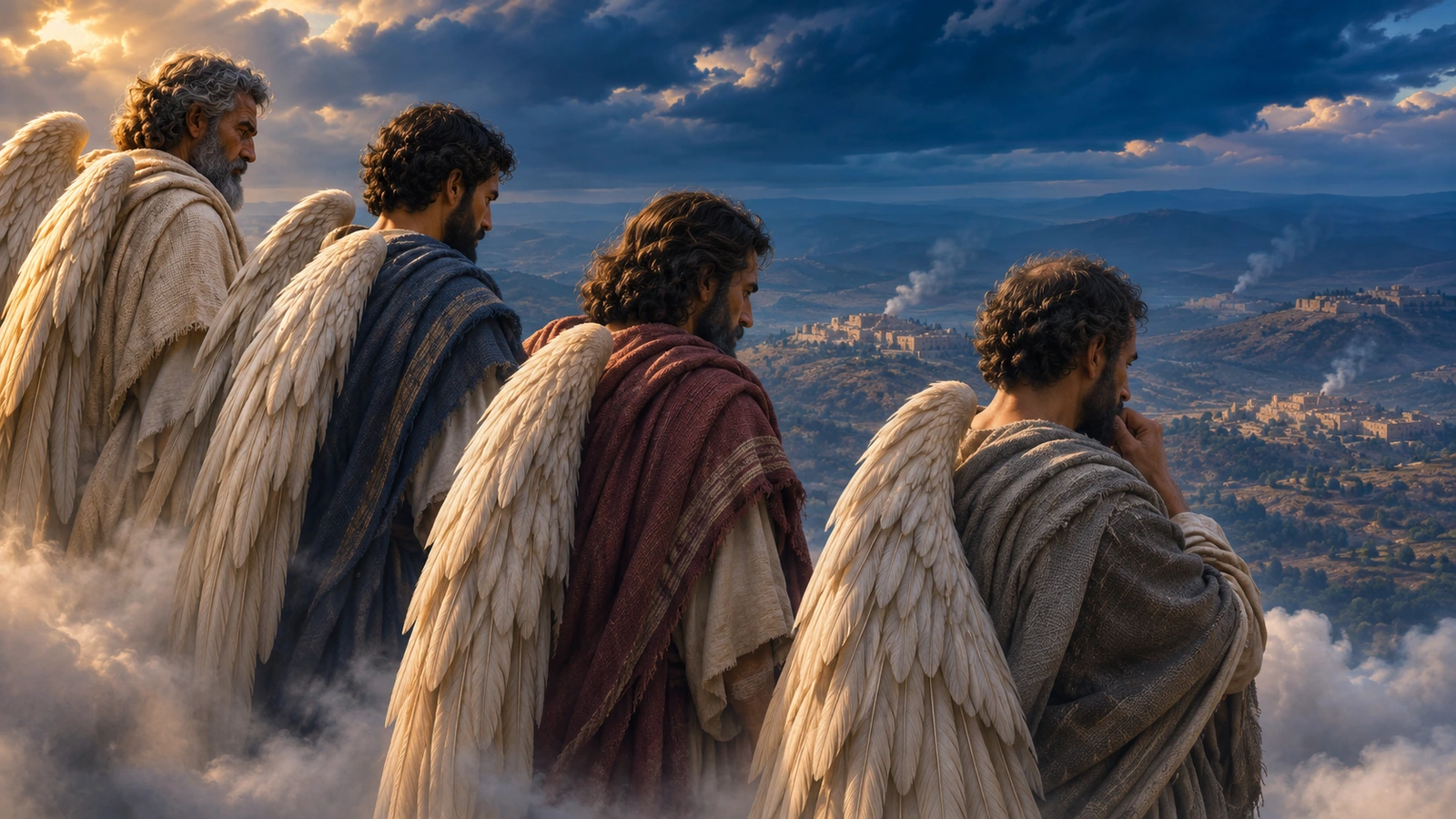
The chapter begins with Michael, Uriel, Raphael, and Gabriel looking down from heaven in Charles’s translation. What they see is bloodshed and lawlessness. Their first recorded activity is observation, followed by speech to one another. The narration does not begin with a battle, an arrest, or a declaration that they have already received orders to punish the offenders.
These are not four human sages who discover that society has become violent. Their location, designation as holy heavenly beings, and address to the Most High identify them as angels within the story. They must also be distinguished from the angels accused later in the prayer. Shared heavenly origin does not mean shared conduct or allegiance.
The difference is visible in the direction of their activity. The rebellious Watchers crossed into human life and disclosed knowledge associated with corruption. The four holy angels witness the consequences and carry the victims’ plea toward the divine court. The narrative uses heavenly agency on both sides of the crisis, so an account that simply says “the angels caused the violence” is too imprecise.
The initial perspective also changes the scale of the report. Chapters 7–8 describe relationships, instruction, and the destructive activity of giants. From heaven, the effects appear as widespread bloodshed. This is a literary widening of the field of view. It does not require the interpreter to map a particular ancient city onto the unnamed landscape.
The victims ask for a hearing
In verse 3, human souls ask the holy ones to bring their cause before the Most High. The legal force of the appeal is important. The victims are not merely providing background noise for an angelic conversation. They seek judgment, and the prayer that follows gives their suffering a place in the account of responsibility.
Verse 10 makes the connection with death explicit by referring to the souls of those who have died. A summary should therefore avoid reducing the cry to the voices of frightened survivors alone. The narrative gives the dead an ongoing claim: killing them has not removed their case from consideration.
That statement concerns the representation of the dead in this passage. It does not by itself establish a complete account of the afterlife, the geography of the soul, or the later destinations of every person. Those subjects require other passages. Here the persistence of the cry serves the immediate problem of violence that would otherwise seem to silence its own witnesses.
The repeated movement toward heaven gives the chapter continuity with the earlier study of the earth’s accusation in 1 Enoch 7. What had appeared as a charge arising from the violated earth is now articulated through human petition and angelic speech. The stages are connected, but their speakers should not be collapsed into a single voice.
There is textual difficulty in verse 2. Charles marks part of its wording with critical symbols, and the awkward English should not become the foundation for a confident demographic claim that every human being has already died. The surrounding narrative still anticipates action concerning Noah in chapter 10. The secure observation is that devastation produces a cry reaching heaven; the disputed phrasing requires more restraint.
Why praise precedes accusation
The prayer in verses 4–5 opens by naming God’s sovereignty and enduring rule. It then affirms his creation of all things, authority over them, and unrestricted sight. This order is relevant to the question raised by the title. The angels do not approach a ruler who needs to learn that another province exists. They appeal to the one whose authority already encompasses the whole scene.
The language of universal knowledge makes their later question sharper. If God lacked information, a report could solve the problem by supplying it. The prayer excludes that explanation before it asks for intervention. Its tension emerges precisely because the suffering is fully visible to the one capable of responding.
Calling this a judicial scene is an interpretive description of the petition, accusation, and request for action. The chapter does not provide a complete architectural tour of heaven or a transcript of a trial with separate legal offices assigned to every participant. Its courtroom-like features can illuminate the prayer without licensing invented furniture, procedures, or gestures.
There is a related distinction between mediation and persuasion. The holy angels speak for the victims, but the passage does not say that they must overcome God’s ignorance or teach him to care. Their words place the unresolved catastrophe before the authority they acknowledge. The ending leaves that unresolved tension audible instead of explaining it away.
Responsibility is named rather than generalized
Verses 6–9 connect the visible destruction with particular agents and actions. Charles names Azazel as a teacher of unrighteousness and a revealer of heavenly secrets. Semjaza appears in connection with authority over his associates. The prayer then describes the angels’ relations with human women, their disclosures, and the birth of giants.
The order does not make every actor interchangeable. The heavenly teachers, the women, the giants, and the human victims occupy different positions in the account. The passage’s charge against the Watchers cannot be transferred indiscriminately to all humans, nor can the giants be treated simply as another name for their angelic fathers.
Semjaza’s authority creates a difficult detail: the prayer addresses God as the one who gave him authority over his companions. The text therefore does not treat every form of angelic authority as originally self-created or inherently illegitimate. The charge concerns what those agents have done with their position. Authority given does not amount to permission for every subsequent action.
That distinction allows the accusation to remain specific. It does not need to claim that God commanded the rebellion, and the prayer does not make that claim. It names delegated standing alongside misconduct. The reader is confronted with an abuse of agency within an ordered world, rather than a conflict between two equally sovereign creators.
The accusation also summarizes earlier material for a new purpose. Its references to instruction and giants are not a second full narrative of chapters 6–8. They assemble the reasons why action is being requested. This is why the names introduced earlier matter: a catalog that might initially seem miscellaneous becomes a means of assigning responsibility.
A documentary example: what 4Q201 can and cannot show
A useful check on this discussion comes from a real manuscript, not an imagined ancient illustration. The Library of Congress exhibition page preserved by ibiblio identifies 4Q201, an Aramaic Enoch manuscript, as parchment copied approximately 200–150 BCE. Its displayed translation includes a passage about the taking of wives, instruction in sorcery, and the birth of giants.
Three details deserve separate attention. In the displayed column iii, line 14 includes the taking of wives; line 15 preserves instruction in sorcery while additional wording is supplied in brackets; and line 16 preserves the pregnancy wording, while the reference to giants falls within the bracketed reconstruction. The editorial brackets are not optional punctuation. They tell the reader that not every printed English word represents continuously preserved ink.
This is relevant to chapter 9 because the accusation revisits that same cluster of actions: relations with women, disclosure, and giant offspring. The manuscript example helps establish the antiquity of an underlying narrative sequence. It does not prove that the displayed fragment contains the prayer in chapter 9, and this study does not claim that it does.
The date is also a date assigned to the copy, not a certificate establishing the date of the events described. A manuscript can document the circulation of a story without verifying its supernatural events. Keeping those claims apart makes the example useful: the object supports a history of textual transmission, while the literary account supplies the angelic setting.
The comparison sharpens how the accusation should be read. Rather than treating the prayer’s summary as an isolated late invention about anonymous teachers, we can compare it with an attested earlier portion of the Enochic tradition. The evidence supports continuity of narrative material. It does not remove the need to identify the edition when quoting the exact wording of chapter 9.
Uriel or Sariel: a small name with a real textual history
The Nickelsburg–VanderKam translation, printed page 26, reads Sariel where Charles reads Uriel in 9:1. Its note reports Aramaic support for Sariel and distinguishes Greek and Ethiopic forms. This is a documented difference between textual presentations, not evidence that one of the four heavenly witnesses must be deleted from the story.
For this article, Uriel remains the name used when summarizing Charles’s version; Sariel is identified when discussing the comparison. Silently moving between them would make it appear that the chapter names five participants. The narrative role in question remains one position within a group of four.
Other differences concern Azazel and Asael, and Semjaza and Shemihazah. These forms should be attached to their editions rather than treated automatically as separate characters. A reader encountering another translation needs a way to recognize the corresponding figures without assuming every difference in spelling creates another actor.
There is also a more consequential limit in 9:6. The modern edition’s note marks the line concerning what humans sought to learn as textually corrupt and presents an editorial reconstruction. Accordingly, the argument here does not depend on proving a particular human motive from that line. The surrounding accusation clearly concerns disclosed heavenly mysteries; the finer wording should not carry more weight than its condition permits.
The comparison with Abel’s blood
Genesis 4:9–12 offers a useful biblical comparison. Abel has been killed, yet his blood cries from the ground to God. Cain’s attempt to evade responsibility does not make the crime inaccessible. The ground that received the blood participates in the language of accusation.
In 1 Enoch 9, the scale expands from one murdered brother to widespread killing. Human souls appeal, and holy angels articulate the case. The shared pattern is that violent death does not abolish the victim’s claim before God. The comparison helps explain the narrative force of a cry that persists after the person has died.
The differences are equally instructive. Genesis presents God confronting Cain directly. Enoch gives the holy angels an explicit role and joins the bloodshed to disclosures and the generation of giants. Treating the later scene as an exact reproduction would conceal the features that make this chapter distinctive.
The parallel is therefore strongest at the level of imagery and moral logic. It is not necessary to invent a missing quotation or identify every detail as a deliberate borrowing. What can be demonstrated from the two passages is the relation among death, earth, an accusation that cannot be suppressed, and divine accountability.
The final question is about permission to act
Verse 11 brings the prayer to its most difficult point. The angels affirm that God knows events beforehand, sees what is happening, permits it, and has not told them what to do about the offenders. They do not offer a theory that makes the delay painless. The question remains a protest within their acknowledgment of divine sovereignty.
Charles’s older English uses “suffer” in this sentence in the sense of allowing something to occur. Reading the word as a statement that God physically suffers would misidentify the question being asked. The issue is permitted continuation of violence and the absence of instructions to these agents.
The narrative boundary between chapters 9 and 10 is consequently important. Chapter 10 begins with divine speech and commissions. Noah is warned, Raphael receives an assignment concerning Azazel, and further actions address the destructive crisis. The intervention responds to the problem raised by the petition, although its full execution is not narrated in chapter 9.
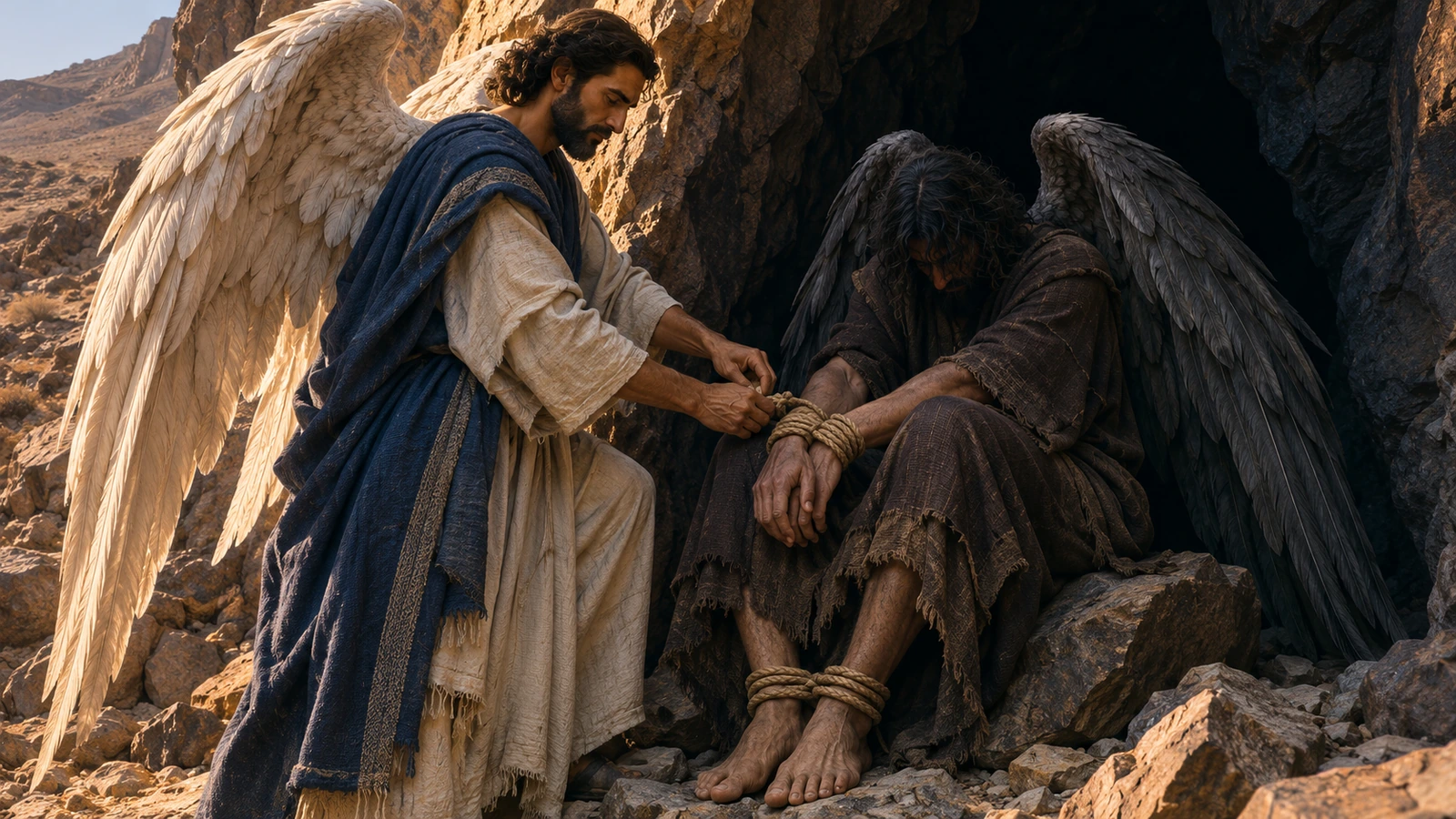
A summary that places bound offenders before God during the prayer moves later actions backward. The holy angels present an accusation; the accused do not have to be physically present for their conduct to be named. Preserving that distinction keeps the petition and the subsequent judgment in their proper order.
The Deeper Discovery
The chapter is organized around a difference between what is already known and what has not yet been said. God’s knowledge is repeatedly affirmed. The missing element, in the closing sentence, is an instruction telling the angels what to do. The plot can therefore move forward without a discovery of new facts: what changes is the authorization of action.
This creates a contrast with the earlier disclosures. The rebellious teachers crossed a boundary in making heavenly knowledge available within the corrupting sequence. The holy angels, despite seeing the devastation, ask for direction before acting. As a literary inference, the juxtaposition distinguishes unrestrained disclosure from accountable service.
The insight does not mean the chapter teaches passive indifference toward suffering. The four witnesses observe, listen, name the perpetrators, and speak. Their restraint concerns the execution of judgment, not whether the victims deserve to be heard. The prayer itself is already a refusal to let the violence become an unchallenged description of the world.
FAQ
Are the four holy angels fallen Watchers?
No. In this scene they appeal against the wrongdoing of the rebellious angels. Their role and allegiance differ from those of the accused.
Why do some translations name Sariel instead of Uriel?
The editions reflect differences in the transmitted names and editorial choices. Nickelsburg and VanderKam explain their reading in the note to 9:1; Charles prints Uriel.
Does God learn about the violence from the angels?
The prayer explicitly denies that anything is hidden from God. Its request concerns judgment and instructions, rather than supplying missing information.
Does 4Q201 preserve the whole prayer?
The exhibition passage analyzed here does not. It documents earlier narrative material that the prayer recalls, with damaged wording distinguished through brackets.
Does chapter 9 describe the angels’ wings?
No. Wings in the accompanying artwork distinguish the heavenly figures visually; they are an artistic convention, not a detail stated in these verses.
What Comes Next?
The holy angels give the victims’ claim an explicit hearing and ask for authority to confront its causes. The next chapter turns from petition to commissioned action, joining punishment with the preservation of life. Continue with Why Does 1 Enoch 10 Join the Judgment of the Watchers to the Healing of the Earth?
Explore the series: Ancient Texts.
Selected Sources
R. H. Charles, translation of 1 Enoch 9, Internet Sacred Text Archive. Primary English text used for the chapter’s progression and the names Uriel, Azazel, and Semjaza.
George W. E. Nickelsburg and James C. VanderKam, 1 Enoch: A New Translation, Fortress Press, publisher’s excerpt, printed pages 26–27. Comparison of 9:1–11 and notes on names and difficult wording.
Library of Congress exhibition, “Enoch,” preserved by ibiblio. 4Q201, its assigned copying date, and the displayed translation credited to J. C. Greenfield, with transcription by J. T. Milik amended by Greenfield.
Genesis 4:9–12, King James Version. Comparison with Abel’s blood crying from the ground.
R. H. Charles, translation of 1 Enoch 10, Internet Sacred Text Archive. The response and commissions following the prayer.