Why Does Leviticus 27 Put a Value on What Is Dedicated to God?
Vows create obligations, but the final chapter of Leviticus carefully limits what can be valued, reclaimed, or offered at all.
Leviticus 27 assigns values to certain dedications so that a promise to God can become a defined obligation and, where the law permits, property can be redeemed at an established cost. The amounts are not a scale of human dignity, nor does payment make every sacred commitment reversible. The chapter distinguishes persons represented by a monetary assessment, animals that cannot be exchanged, property that can be reclaimed, and things that already belong to the Lord. Its valuations make dedication accountable while its exceptions limit the worshiper’s control.
The previous study, Why Does Leviticus 26 Say the Land Will Enjoy Its Sabbaths?, examined the loss of residence and the persistence of covenant remembrance. The final chapter returns to ordinary transactions: a promise, a house, a field, a flock. After the warnings about the land, the question becomes how a person may dedicate something without ignoring obligations already attached to it.
This study follows Leviticus 27 in the King James Version. Its older terms, especially “estimation,” “redeem,” and “devoted,” need to be read within their individual legal cases. They do not describe one interchangeable procedure.
A voluntary promise with consequences
The opening addresses a special vow involving the valuation of persons. It does not command every Israelite to make such a vow. That distinction has an explicit counterpart in Deuteronomy 23:21–23: failure to fulfill a vow incurs responsibility, while refraining from making one is not itself a sin. Voluntary entry and binding consequences can coexist.
This helps explain why the rules are so practical. An impressive declaration is not enough to settle what the sanctuary receives. A vow must be translated into a determinate obligation, and the person who made it cannot simply redefine the gift after the fact. The chapter supplies fixed amounts in some cases and priestly assessment in others.
It also assumes differences among the things dedicated. A person’s valuation is prescribed by age and sex; a house must be assessed; a field requires attention to its sowing capacity and the remaining years before Jubilee. Applying the same pricing procedure to every case would undo the distinctions that organize the legislation.
The text does not give us a diary of actual transactions or describe how frequently these vows were made. Its detailed rules show the legal world it envisages. They cannot, by themselves, establish the annual income of a historical sanctuary or the percentage of households participating in this practice.
Why are people assigned different amounts?
Verses 3–7 prescribe fifty shekels for a male aged twenty to sixty and thirty for a female in that range. Between five and twenty, the amounts are twenty and ten; between one month and five years, five and three. For those sixty and older, they are fifteen and ten. The distinctions are explicit and should not be concealed because modern readers find them uncomfortable.
What the passage calculates, however, is an obligation arising from a vow. It does not claim that one person’s life possesses a greater moral worth before God, and it does not describe an auction or negotiation with a buyer. The schedule is a legal valuation within a particular institution. Reading it as a complete account of human value gives these numbers a function the passage never assigns them.
The changing amounts invite an economic explanation. The highest assessments fall in adult years, with lower amounts for children and older people. It is reasonable to infer some relationship to the economic capacities assumed by this society. Yet the chapter supplies no wages, productivity measurements, or explanation of the precise ratios. “Expected labor value” is an interpretive proposal, not the wording of verse 3.
That limitation matters especially for the different amounts assigned to men and women. The schedule reflects a differentiated ancient social order; it should not be rewritten as though it were an egalitarian tariff. Equally, the difference cannot be turned into a general theological claim that women have less dignity. The responsible reading identifies the inequality in the prescribed payment without extending it into a statement the law does not make.
Verse 8 prevents the standard schedule from becoming the only relevant consideration. When the person making the vow cannot afford the assessment, the priest determines an amount according to that person’s ability. The law explicitly names the capacity of the one who vowed. Poverty therefore changes the financial obligation without requiring a claim that the person represented by the vow has become less human or less significant.
The priest assesses more than a price
The priest’s discretion is not identical in every section. The opening schedule sets ordinary amounts, with an adjustment for poverty. An animal unsuitable for sacrifice is presented for assessment in verses 11–12. A house receives a priestly valuation in verses 14–15. These are distinct tasks, even though the English word “estimation” connects them.
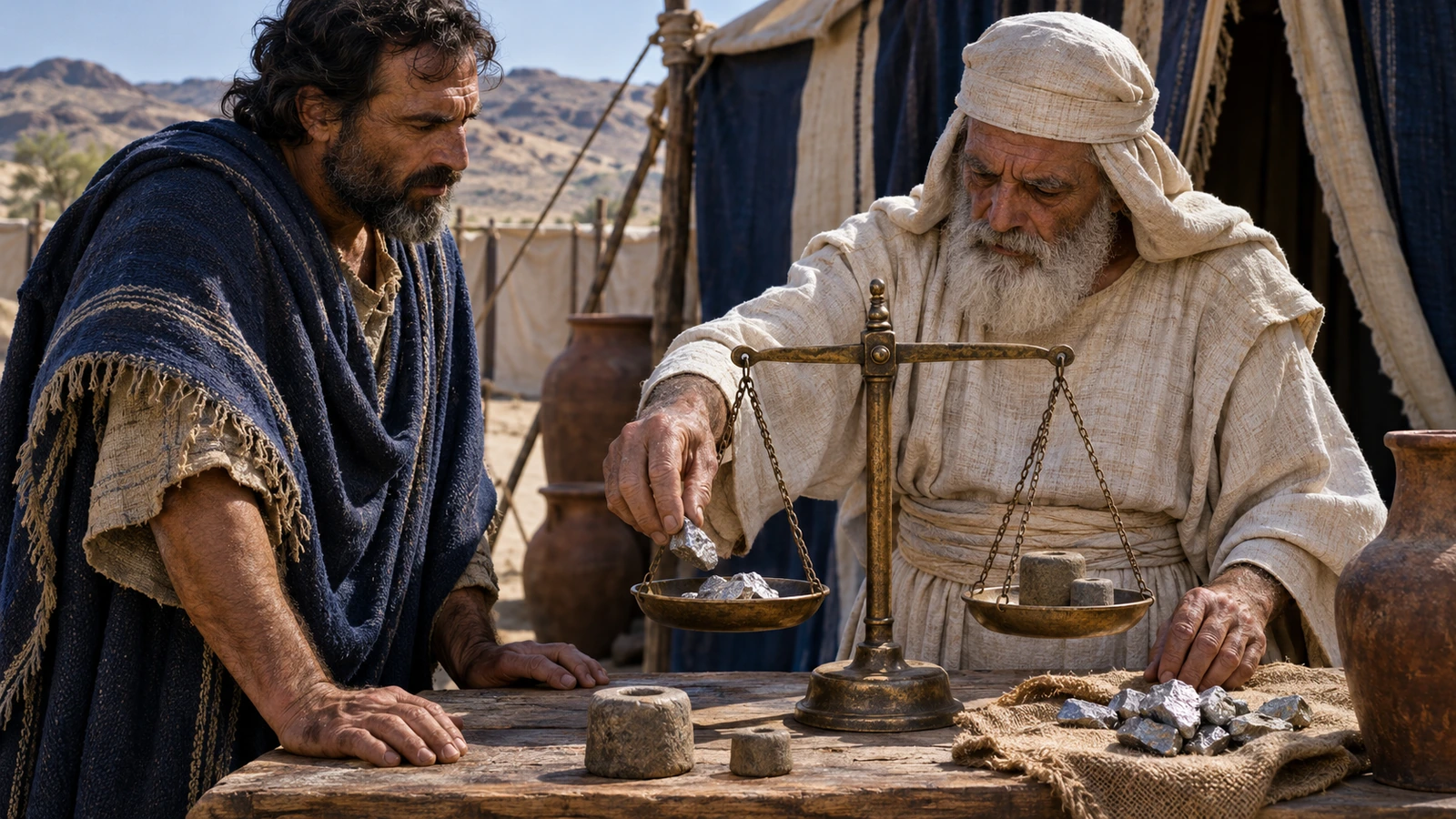
Verse 25 provides a common monetary standard: the sanctuary shekel, defined as twenty gerahs. The verse stabilizes the unit used for the assessments. It does not require us to imagine a pile of minted coins. The accompanying artwork uses irregular silver pieces as an illustrative reconstruction; neither the balance nor the particular transaction depicted is narrated as a historical episode in the chapter.
Nor can a modern dollar equivalent solve the interpretive problem. Converting a proposed silver weight at today’s market price would say little about a household’s purchasing power, labor obligations, or access to land in the world of the legislation. The useful information is the relationship among the prescribed amounts and the explicit adjustment for inability to pay.
The priest consequently serves as an assessor within rules, rather than an unrestricted seller of religious privileges. The chapter states which objects can be redeemed and which cannot. His valuation does not erase those boundaries. A valid assessment is one part of the transaction, not permission to turn every dedication into cash.
Why exchanging an animal can cost both animals
Verses 9–10 treat an animal of a kind offered to the Lord. Once given, it is holy. The owner may not replace a good animal with a bad one, or a bad animal with a good one. If an exchange is attempted, both animals acquire the sacred status. The prohibition is broader than a rule against handing over an inferior substitute.
That detail identifies the issue as control after dedication. Even an apparently beneficial substitution does not restore unilateral authority to the giver. The law does not ask whether the replacement would improve the original donation; it denies that the owner may treat the dedicated animal as still freely interchangeable.
The case changes when the animal is unclean and therefore not offered in sacrifice. Verses 11–13 introduce priestly valuation and allow redemption with an additional fifth. An animal’s inability to serve as a sacrificial victim does not make it economically unusable. Yet this procedure must not be transferred back into the preceding case as though every vowed animal could be bought back.
These rules also prevent a misleading equation between dedication and killing. Some animals are suitable for offerings; others are assessed. Houses and fields enter the chapter without becoming sacrificial victims. The category of what belongs to the Lord is wider than the category of what is placed on an altar.
What does the additional fifth accomplish?
The additional fifth appears in the redemption of an assessed animal, a house, an ancestral field, and agricultural tithes. Its effect is straightforward: the person reclaiming the dedicated asset must provide more than its basic valuation. Reversal is available in specified cases, but it is not financially neutral.
For a simple illustration, suppose a house receives an assessment of ten shekels. Adding one fifth produces a redemption payment of twelve. This is an example of the arithmetic in verse 15, not an ancient transaction preserved in an inscription. It shows why an assessment and a redemption price are related but not identical.
The surcharge may discourage casual promises or opportunistic withdrawal; that is a reasonable inference from its effect. The chapter itself does not state a single psychological motive for imposing it. It is safer to describe what the rule does than to invent what every donor was thinking when deciding to reclaim a house.
The fifth is also not a universal religious service charge. It is absent from the schedule for persons, and certain things cannot be redeemed at all. Readers should follow each condition before calculating. A formula repeated in several cases remains subject to the legal boundaries surrounding those cases.
A field is valued within the Jubilee calendar
Land brings another variable into the calculation: time. Verse 16 relates the assessment of an ancestral field to its sowing capacity, assigning fifty shekels to the amount associated with a homer of barley seed. The rule does not simply price every field at fifty shekels, regardless of size.
Verses 17–18 then distinguish dedication at Jubilee from dedication later in the cycle. The priest reduces the assessment according to the years remaining until the next Jubilee. The gift cannot be understood apart from the period for which the relevant rights extend. A field’s physical dimensions remain the same while the duration attached to the transaction changes.
This belongs beside the earlier study, Why Can Land Never Be Sold Permanently in Leviticus 25? In Leviticus 25:23–28, ordinary land sale and redemption operate under God’s claim to the land and the return associated with Jubilee. Chapter 27 applies related concerns to consecration, but it also introduces a severe distinction.
If the ancestral field is not redeemed under the conditions in verses 20–21, its Jubilee outcome is consecration to the Lord as a devoted field, becoming the priest’s possession. It is therefore inaccurate to say that Jubilee automatically restores every consecrated field to the original household. The ordinary sale provisions of chapter 25 do not erase the special consequences stated here.
The following case concerns a purchased field rather than an ancestral holding. Verses 22–24 require assessment until Jubilee and specify that the field returns to the person whose inherited possession it was. A purchaser cannot dedicate away someone else’s permanent inheritance. The giver’s present access to land is not the same as unrestricted ownership of its future.
The two cases should be compared before drawing a conclusion about sanctuary landholding. One allows a field to become priestly property; the other preserves the return to the ancestral owner. The chapter regulates dedication through the kind of title involved. Ignoring that distinction turns a carefully differentiated law into a blanket claim about religious confiscation.
Some things are already the Lord’s
Verse 26 prohibits treating the firstborn of an ox or sheep as a fresh dedication, because it already belongs to the Lord. The obstacle is not insufficient generosity. It is the attempt to give something whose sacred status precedes the supposed gift. A vow cannot create a new donation merely by renaming an existing obligation.
The tithe of land produce likewise belongs to the Lord in verse 30. Agricultural tithes can be redeemed with the additional fifth, but the tenth animal passing under the rod is treated differently. Verses 32–33 forbid selecting by quality and forbid substitution; an attempted exchange again makes both animals holy.
These distinctions explain why “everything has a price” is such a poor summary of the chapter. Some assessments facilitate redemption; some provisions prevent it; others deny that a particular dedication can be made in the first place. Valuation operates inside sacred obligations rather than overruling them.
The difficult boundary in verses 28–29
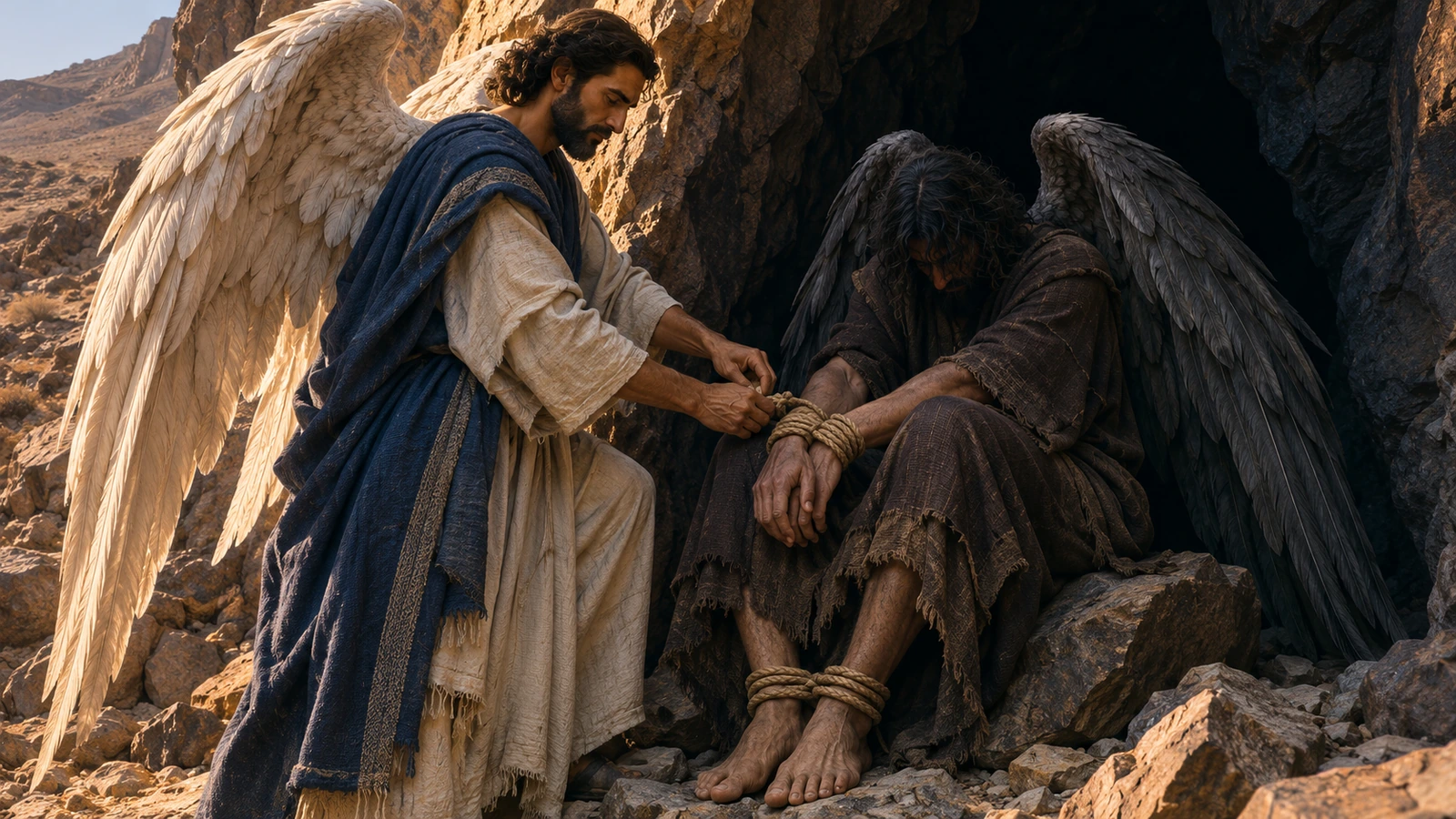
Verses 28–29 introduce devoted things that cannot be sold or redeemed. The Hebrew category is commonly transliterated ḥerem, often rendered “ban” or “devoted.” Verse 28 includes persons, animals, and ancestral land; verse 29 states that a human being under this devotion cannot be ransomed and must be put to death. The lethal wording cannot responsibly be softened into a statement about ordinary lifelong service.
A.J.K. Hattingh and E.E. Meyer examine the problem in “‘Devoted to destruction’. A case of human sacrifice in Leviticus 27?” Their discussion, especially pages 648–652, contrasts readings that understand verse 29 as judicial punishment with readings that connect it directly to the dedication in verse 28. They favor the latter connection and challenge the assumption that the passive verb alone establishes a criminal proceeding.
The difference is substantial: one interpretation distinguishes a condemned person from the preceding gift; the other sees verse 29 specifying the fate of a person already mentioned. The brief law supplies no courtroom scene, named offense, or sacrificial procedure. Those absences limit confident reconstruction. The authors’ argument is a scholarly interpretation, not an explicit explanation supplied by the verse.
What remains clear for the present question is that verses 28–29 are not another version of the redeemable valuations in verses 2–8. Payment does not function as an escape here. Recognizing that boundary does not resolve the ethical difficulty or establish how often such a practice occurred. It prevents a comforting but false summary in which every dedication can be undone with money.
The Deeper Discovery
The repeated quality test changes direction
The phrase “good or bad,” and its reversed order, tracks a distinction across the chapter. In verse 10, quality does not authorize exchanging a dedicated sacrificial animal. In verse 12, assessing an unsuitable animal requires the priest to determine its value. Verse 14 uses the same quality language for a house. Finally, verse 33 forbids inspecting the tenth animal in order to select or exchange it.
The repeated terms therefore do different legal work. In one setting, quality must be assessed; in another, it must not become a reason to retain control. The decisive question is not simply whether something is valuable. It is who is authorized to evaluate it, for what purpose, and after which obligation has already taken effect.
This pattern makes the chapter’s ending coherent with its beginning. The person who makes a vow enters a regulated relationship; the livestock owner cannot manipulate the tenth animal after the counting has identified it. Between those scenes, houses and fields require careful assessment. Precision protects both the possibility of lawful redemption and the limits beyond which valuation cannot go.
FAQ
Does Leviticus 27 command everyone to make a vow?
No. It regulates vows and dedications when they occur. Deuteronomy 23:22 explicitly distinguishes refraining from a vow from failing to fulfill one.
Are the shekel amounts modern coin prices?
No. The chapter specifies a sanctuary monetary standard. Converting it into today’s currency would not establish its ancient purchasing power.
Can every sacred animal be bought back?
No. The rules differ for sacrificial animals, assessed unclean animals, and the animal tithe. Redemption language in one case does not cancel a prohibition in another.
Does verse 29 describe the same procedure as verses 2–8?
No. The opening provides monetary assessments; verse 29 explicitly excludes ransom and prescribes death. Its precise historical setting remains disputed.
Does the extra fifth apply to every valuation?
No. It appears in specified redemption cases. The law does not add it universally to the opening schedule for persons.
What Comes Next?
Leviticus ends by making dedication concrete without making everything negotiable. The next book moves from valuations to a different kind of counting: a census organized by households and military eligibility. The next study will examine that change of purpose: Why Does Numbers 1 Begin with a Census of Israel’s Fighting Men?
Explore the series: Leviticus Studies.
Selected Sources
Leviticus 27, King James Version. Primary text for the valuation schedules, redemption conditions, and exceptions.
Deuteronomy 23:21–23, King James Version. The distinction between making a vow voluntarily and fulfilling an obligation already undertaken.
Leviticus 25:23–28, King James Version. Land redemption and Jubilee as the background to the field provisions.
A.J.K. Hattingh and E.E. Meyer. “‘Devoted to destruction’. A case of human sacrifice in Leviticus 27?” Journal for Semitics 25, no. 2 (2016): 630–657. Pages 648–652 consulted for the relationship between verses 28 and 29 and the competing judicial interpretation.
Numbers 1:1–3, King James Version. The census that opens the next stage of the biblical sequence.