Why Can Land Never Be Sold Permanently in Leviticus 25?
The Jubilee joins a family’s return to its fields with limits on what a buyer can acquire.
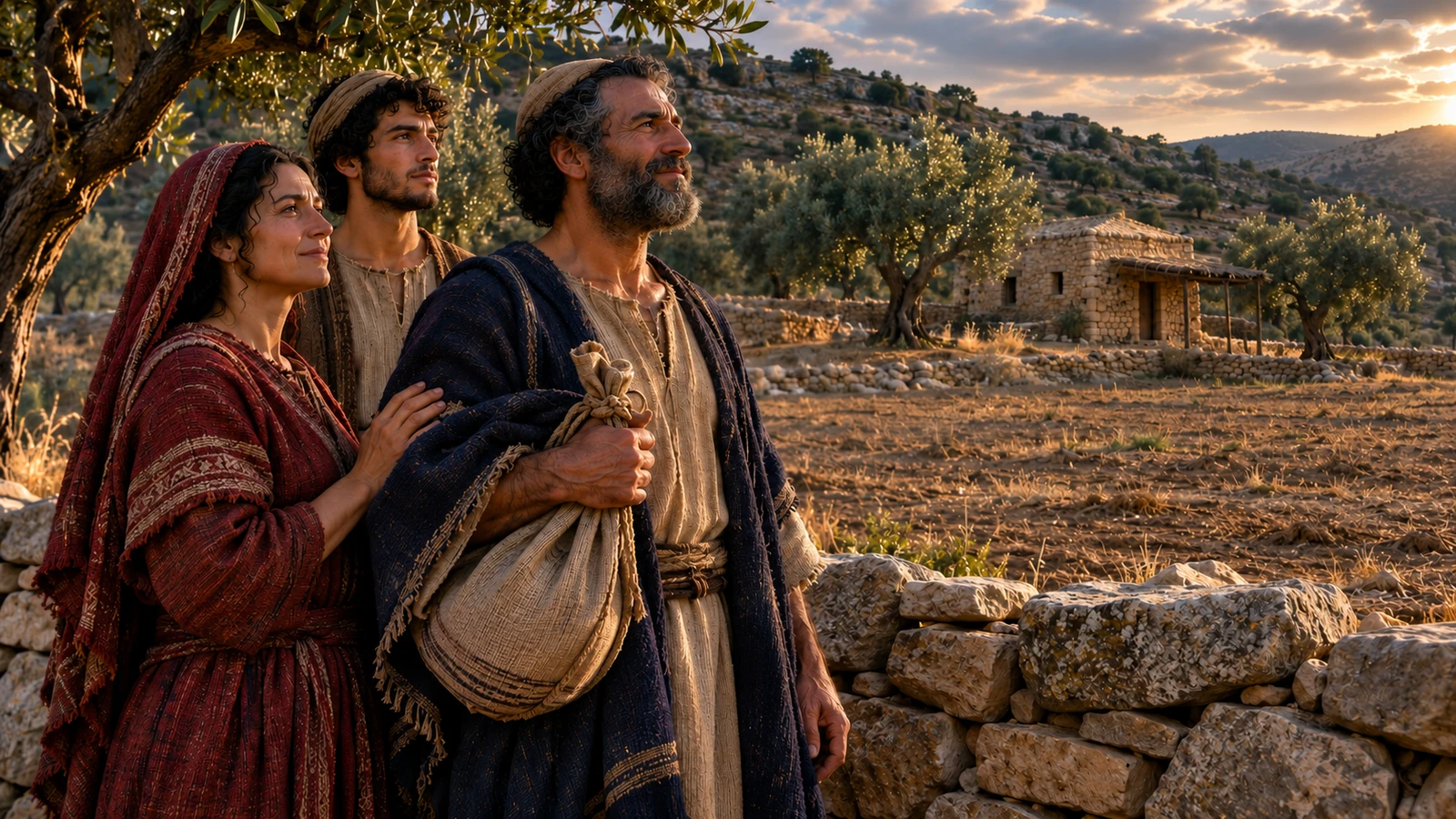
Source: AI-generated image created for Beyond The Known.
Land cannot be sold permanently in Leviticus 25 because God claims ownership of it and gives Israel possession under conditions that a sale cannot cancel. Verses 23–28 preserve a family’s route back through redemption and, finally, the Jubilee. A purchaser acquires a limited number of harvests. The rule concerns ancestral agricultural holdings, with distinct provisions for houses in walled towns and for Levitical property. Those exceptions are essential to understanding the title’s claim.
The previous study, Why Is Fresh Bread Set Before the Lord Every Sabbath in Leviticus 24?, followed the weekly renewal of an offering in the sanctuary. The seventh-day rhythm now expands into years and reaches the fields that produce Israel’s food. A family can lose access to its holding through poverty. Leviticus asks how that loss can be prevented from determining the future of every generation that follows.
This study follows Leviticus 25 in the King James Version, with its older economic vocabulary explained in contemporary English. The New American Bible, Revised Edition supplies a useful comparison at verse 23, rendering the restriction in terms of an irrevocable sale. The question is the permanence of a transfer, rather than whether people can enter a transaction at all.
A field has a Sabbath before it has a price
The chapter opens on Mount Sinai and looks ahead to entry into the land. Six years of sowing and pruning are followed by a seventh in which those activities stop. The land itself receives rest. This carries the Sabbath principle beyond the person who owns the tools. Even a willing worker cannot treat every year as equally available for agricultural production.
Verses 5–7 require careful reading together. The prohibition on reaping the spontaneous growth and gathering the untrimmed vineyard stands beside permission to eat what the land produces. The passage allows food for the household, servants, hired workers, resident outsiders, livestock, and wild animals. An interpretation that requires every edible plant to rot would make the permission unintelligible. Read together, these verses suggest a distinction between the normal agricultural harvest and gathering spontaneous produce for sustenance.
The list of eaters widens the view beyond the landholder. People with very different positions within the household economy share in the provision, and the sentence continues beyond people to animals. The owner has responsibilities toward a field whose life cannot be reduced to his income. Before any sale is discussed, the law has already limited what possession entitles someone to do.
There is an obvious difficulty. If cultivation stops, what supplies the next meal? Verses 20–22 acknowledge that question and answer it with God’s promised provision in the sixth year, sustaining the people through the interruption and into the arrival of the next crop. This is a theological promise within the legislation. Describing it as a measured agricultural result would require evidence the passage does not provide.
Why the Jubilee changes a sale before it happens
After seven cycles of seven years, the law calls for the sanctification of the fiftieth year. The horn is to sound on the Day of Atonement, on the tenth day of the seventh month. The public proclamation announces return to property and family. Sacred time now affects the duration of another person’s control over a household’s livelihood.
The wording explicitly distinguishes the forty-nine years counted in verse 8 from the fiftieth year named in verses 10–11. Working out how successive cycles were historically coordinated is a separate calendrical problem. The immediate legal argument does not require a reconstructed calendar. Its operative fact is a known endpoint that must govern a transaction made before that endpoint arrives.
Verses 14–17 address the seller and buyer together. The price rises when more productive years remain and falls when fewer remain. Both parties must account for the approaching return. A buyer cannot price the holding as though it will stay in the buyer’s family forever, then complain that the Jubilee has unexpectedly removed something already purchased.
Consider a simplified illustration of the pricing principle. Suppose two otherwise comparable holdings offer twenty remaining harvests and ten remaining harvests. The first offers twice as many harvest opportunities. Actual yields and conditions would affect their value, and the passage supplies no fixed price per acre. The illustration shows what must enter the calculation. The number of productive years limits the thing being valued.
That also explains why calling the transaction a sale can mislead modern readers. Leviticus itself uses the language of selling, yet defines its object through the produce of a bounded period. The Theology of Work Project describes this economic arrangement as functioning like a term lease. That comparison clarifies the time limit, provided it remains an analogy rather than a claim that the ancient agreement followed a modern lease contract. The Sabbath Year and the Year of Jubilee discusses this protection of access to productive land.
The owner’s claim and the occupant’s position
Verse 23 gives the controlling reason in a short divine declaration, “the land is mine.” The next clause describes Israel as strangers and sojourners with God. Within the chapter’s argument, the people who might call themselves established owners are themselves dependent occupants in relation to the ultimate owner.
This language does not erase family holdings. The law repeatedly speaks of returning to one’s possession, and its redemption procedures depend on identifying the holding from which a family has been separated. Divine ownership establishes the limits within which those family claims operate. It prevents a private agreement from extinguishing the relationship the legislation intends to preserve.
The position of the wealthy purchaser deserves attention. The buyer may have enough resources to acquire several families’ harvest rights, but greater purchasing power does not confer greater authority over the land’s final destination. That limit is attached to the holding before the buyer enters the transaction. It cannot be removed simply because a seller, pressed by immediate need, agrees to unfavorable terms.
The prohibition against oppression in verses 14 and 17 therefore has practical content. Reverence for God is connected to the calculation of a price and to respect for the return. In this setting, an apparently private economic agreement is already a matter of covenant conduct. The person with money must reckon with obligations that money cannot buy away.
Three routes back to the family holding
The first route begins when an impoverished person sells part of a possession and a relative redeems it. Verse 25 places kinship inside the remedy. Someone with resources can intervene on behalf of the person whose need caused the sale. Family solidarity is given an economic task, with a particular piece of land as its object.
The second route applies when there is no such intervention but the seller later obtains sufficient means. Verses 26–27 allow the seller to recover the holding after accounting for the years already elapsed and paying the remaining balance. The purchaser’s use of the land matters to that calculation. Redemption is connected to the original transaction and its remaining duration.
The third route becomes decisive precisely when neither of the others succeeds. Under verse 28, the buyer retains possession until the Jubilee, and then the land returns. A family whose poverty continues still has a legally defined future. If every return depended on producing enough money, the poorest seller would have no effective remedy.
These routes should be distinguished when imagining the scene. A relative’s payment may restore access before the Jubilee. A seller’s own recovery of means may do the same. The Jubilee supplies the final release when the holding remains with the purchaser. Treating every return as a paid redemption would obscure the point of verse 28.
The law also recognizes that exclusion has duration. Until redemption or Jubilee, the purchaser really possesses what was acquired. The family does not simply resume cultivation whenever it wishes. Protection of eventual return coexists with a temporary right that the law recognizes. This is why the price and the redemption balance require explanation.
The house that does remain sold
The most direct challenge to an overbroad reading of verse 23 appears a few sentences later. A house in a walled city can be redeemed within one year of sale. After that period, verse 30 establishes the purchaser’s enduring right and explicitly excludes the house from Jubilee release. The legal category of the property changes the outcome.
A village house outside such walls follows a different rule. Verse 31 counts it with the fields of the countryside, so it can be redeemed and returns at the Jubilee. A reasonable inference is that the legislation treats rural housing as part of the agricultural holding’s working life. The verse itself establishes the classification, even though it supplies no extended explanation of village economics.
Levitical cities introduce a further qualification. Verses 32–33 preserve redemption rights and Jubilee release for the Levites’ houses because those houses constitute their possession among Israel. Their urban location does not remove the protection. The text names the reason for treating them differently from the ordinary walled-town house.
Verse 34 is stricter about the pastureland attached to their cities. It is to remain their possession and may not be sold. A reader who reduces the whole chapter to one rule for all real estate loses three different arrangements. Ordinary farmland can change hands temporarily. Certain town houses can be alienated permanently after the redemption period. Levitical pastureland is withheld from sale.
The opening question must therefore retain its scope. Leviticus restricts the permanent loss of the ancestral agricultural holding while drawing explicit boundaries around that protection. A modern summary should preserve those distinctions even if a simpler slogan would be easier to remember. The exceptions help identify the family and productive interests the law is organized to protect.
When poverty reaches the person as well as the field
The chapter moves from property to a neighbor whose means are failing. Verses 35–38 require support and prohibit taking interest or profit from the vulnerable person’s money and food needs. The stated aim is continued life alongside the community. The law intervenes before distress becomes an opportunity for another household’s gain.
Verses 39–43 address an Israelite who has sold himself into service. The buyer must treat him according to the model of a hired worker or resident, and his service ends at the Jubilee. He departs with his children and returns to his family and ancestral possession. The land rules and the labor rules meet in that return. Recovering a field would be of limited use if its family remained indefinitely subject to another household.
The explanation recalls the exodus. God brought the Israelites out of Egypt and claims them as his servants. Their service to another Israelite is bounded by that prior claim. The command against harsh rule belongs to this relationship and should be read alongside the actual terms of release.
A difficult limitation follows in verses 44–46. The legislation permits the acquisition of foreign slaves and their inheritance by the owner’s children. It distinguishes them from Israelite kin protected by the release provisions under discussion. Any claim that this chapter abolishes slavery for everyone contradicts these verses. The proclamation of liberty must be interpreted with the legal distinctions that the chapter itself retains.
The final case, in verses 47–55, concerns an impoverished Israelite sold to a prosperous resident outsider or that person’s family. Kin may redeem him, or he may redeem himself if able. Again the remaining years determine the payment, and Jubilee supplies release if redemption has not occurred. Changing the buyer’s identity does not cancel the protected Israelite’s route home.
Jeremiah’s purchase makes redemption concrete
A later biblical account puts several elements of a family land transaction into view. In Jeremiah 32:6–15, Hanamel asks Jeremiah to buy a field at Anathoth because the right of redemption belongs to him. Jeremiah weighs seventeen shekels of silver, completes a witnessed purchase, and gives the documents to Baruch for preservation in an earthen vessel.
The details are worth following. Kinship explains why this particular buyer is approached. Weighed silver makes the exchange a material transaction. Witnesses and documents establish a record that can outlast the people standing at the purchase. Storing those records assumes that future possession will matter.
The setting makes that future difficult to imagine. Jerusalem is under siege, and Jeremiah is confined. The promise that houses, fields, and vineyards will again be possessed gives the purchase its prophetic force. Preserving the documents becomes intelligible because the land has a future beyond the immediate military crisis.
This episode illustrates a family redemption right and a documented sale. It supplies no Jubilee date and records no nationwide redistribution. It therefore cannot establish that every provision of Leviticus 25 was regularly enforced. Its value is more precise. It shows how a claim of kinship, a price, and a durable record can belong to the same biblical account of threatened possession.
The Deeper Discovery
The same remaining years price a field and a person’s release
The chapter uses a strikingly similar calculation twice. In verses 15–16, remaining harvest years govern the price of land. In verses 50–52, remaining service years govern the redemption payment for an Israelite sold to a resident outsider. Both transactions must be measured backward from the same approaching release.
That correspondence makes the final section part of the land argument. The household’s working future can be placed in another person’s hands through the sale of a field or through the sale of labor. In each case, the law requires the purchaser to acknowledge how much time remains before the protected relationship is restored.
The parallel also clarifies the force of the divine ownership statements. Verse 23 claims the land for God. Verse 55 claims the Israelites as servants whom God brought out of Egypt. These declarations surround detailed calculations concerning possession and work. God’s claim is expressed in the expiration of another person’s control.
A family returning to its holding is therefore the meeting point of two protections. Its land has a destination, and its members have a route back to it. That does not remove the chapter’s unequal treatment of foreign slaves. It does explain the unusually close relationship between family, labor, and inheritance within the Israelite cases the law protects.
FAQ
Does the Jubilee cancel every kind of debt?
Leviticus 25 specifies property restoration, redemption, and release from the service described in its laws. It does not provide a general formula canceling every possible monetary debt. A claim about universal debt cancellation needs additional texts and argument.
Can a buyer recover payment when land is redeemed early?
Verses 26–27 require an accounting for elapsed years and repayment of the balance in the seller’s own redemption. The transaction’s remaining term governs the calculation.
Is every fiftieth year a Jubilee in the text?
Verses 8–11 count forty-nine years and designate the fiftieth as sacred. Reconstructing ancient observance and the coordination of successive cycles requires further historical evidence.
Does the chapter prove that Israel regularly practiced the Jubilee?
The chapter gives legislation. It does not narrate a sequence of completed Jubilees. The existence of a command and the extent of its enforcement are different historical questions.
Why is a family shown beside a field in the illustration?
Return to family possession is the action prescribed in verses 10, 13, and 41. The particular family, clothing, house, and landscape are artistic reconstruction.
What Comes Next?
Leviticus 25 limits a sale because the land remains God’s and the protected family retains a future claim to its possession. Redemption can bring that future forward. Jubilee makes provision for the family unable to purchase its own return.
The next chapter asks what happens when Israel refuses the covenant’s demands. Its account of a desolate land taking its Sabbaths places the interruption of cultivation within judgment. Continue with Why Does Leviticus 26 Say the Land Will Enjoy Its Sabbaths?
Previous study. Continue through the Leviticus Studies reading map.
Selected Sources
Leviticus 25, King James Version. Primary text for the Sabbath year, Jubilee, redemption, property distinctions, and service provisions.
Leviticus 25, New American Bible, Revised Edition, USCCB. Translation comparison for the restriction on irrevocable sale in verse 23.
Theology of Work Project, “The Sabbath Year and the Year of Jubilee (Leviticus 25)”. The term-lease analogy and the protection of access to productive land.
Jeremiah 32:6–15, King James Version. Hanamel’s field, Jeremiah’s redemption right, weighed silver, witnesses, and preservation of the purchase documents.
Leviticus 26:34–35, King James Version. The land’s Sabbaths in the next chapter’s account of judgment.