Why Does 1 Enoch 8 Name the Watchers Who Taught Forbidden Arts?
Weapons, adornment, spells, and celestial signs turn a list of angelic teachers into an account of responsibility.
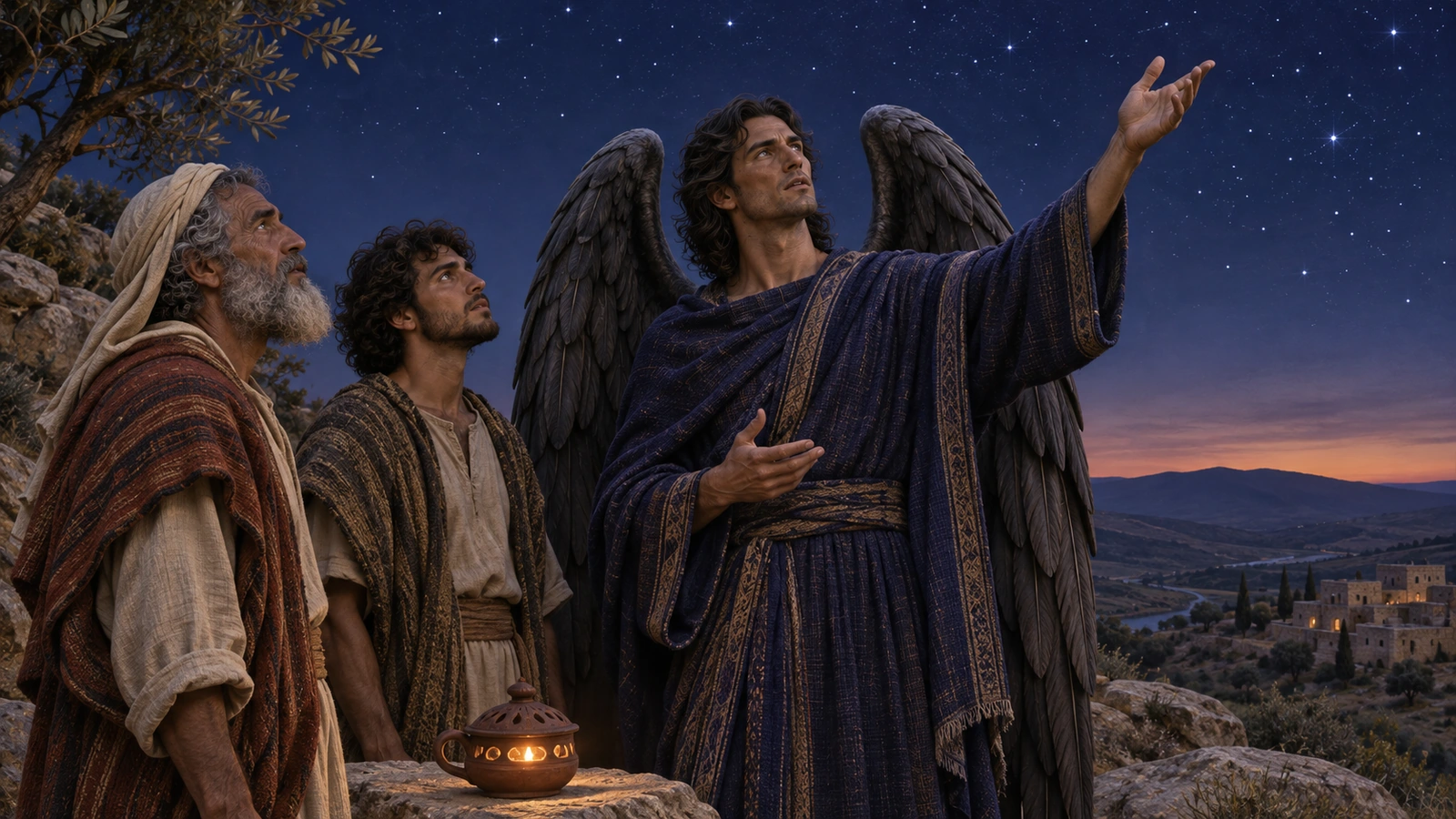
Source: AI-generated image created for Beyond The Known.
1 Enoch 8 names the Watchers to connect particular teachings with particular angelic agents and with the corruption that follows their disclosure. The catalog gives the later heavenly accusation identifiable subjects. Its teachers are rebellious angels, while the people who receive their instruction are human beings. The list explains how harmful knowledge spreads within the story, and the chapter’s final cry measures its consequences through human suffering.
The previous study, Why Does the Earth Bring an Accusation in 1 Enoch 7?, examined the devastation caused by the giants. Chapter 8 returns attention to the fallen angels who taught human beings. A world can be damaged through bodies that consume and kill, but also through instruction that equips other people to act. The named teachers carry responsibility for that second process.
The primary reading here is R. H. Charles’s translation of 1 Enoch 8, compared at specific points with George W. E. Nickelsburg and James C. VanderKam’s 1 Enoch: The Hermeneia Translation. Charles’s spellings are simplified below for readability. Where the editions materially differ, the difference is identified. This is a study of the Watchers narrative in 1 Enoch, with its own wording and literary claims.
Why the teachers are angels
Chapter 8 inherits its cast from the descent narrated in chapter 6 and the unions and instruction described in chapter 7. The Watchers cross the boundary between their heavenly position and human life. Their human wives and the giants born from those unions occupy different roles. Calling all three groups “men” would erase distinctions on which the account depends.
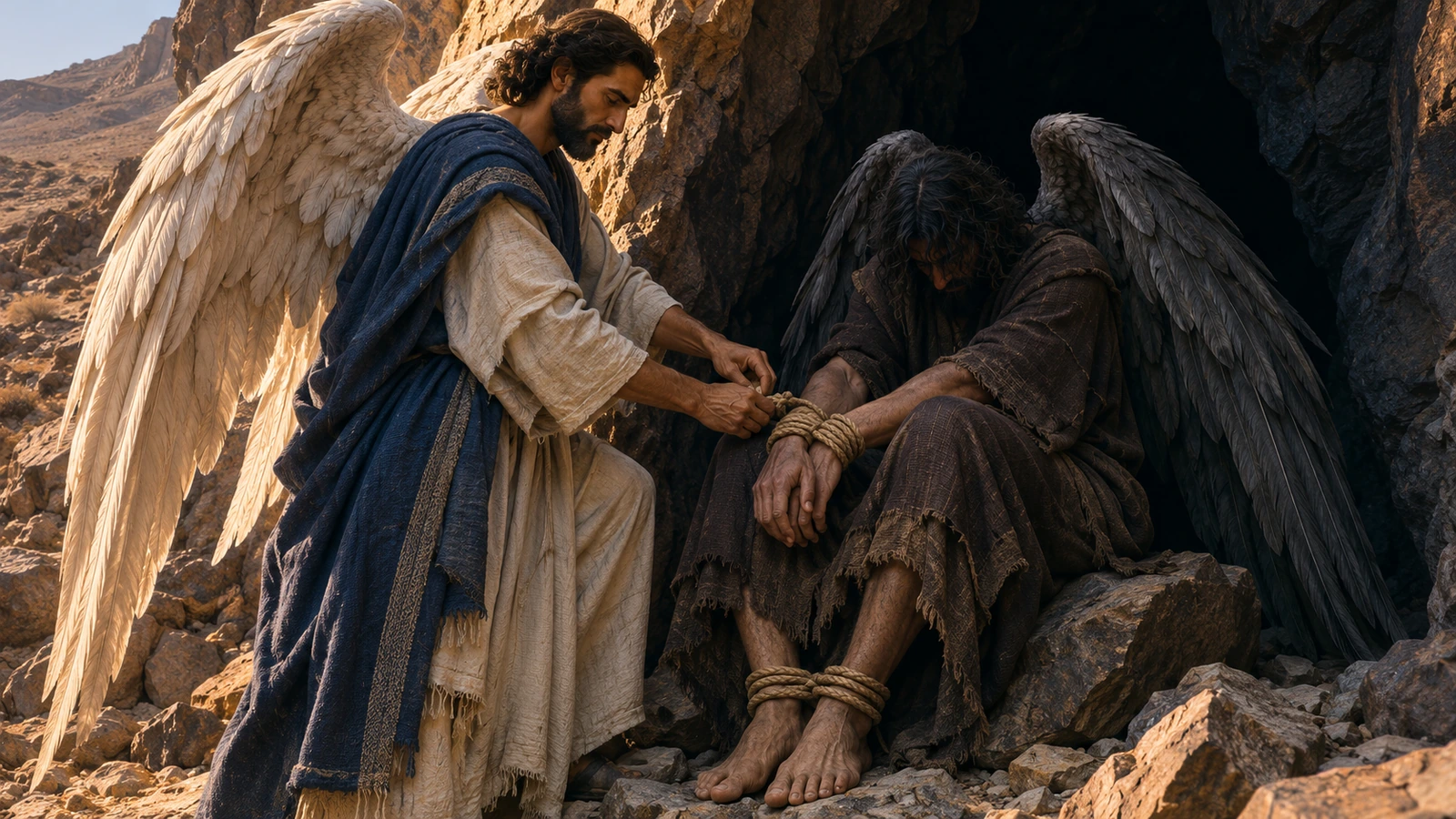
The scene of teaching does not change the nature of the teacher. Azazel’s knowledge of metals is presented as an angelic disclosure to human recipients. Semjaza’s instruction is likewise part of the conduct of the rebellious company. Their activities can resemble those of a craftsman or specialist while remaining actions attributed to angels within the narrative.
That distinction also governs the illustration. A visibly angelic figure teaches two ordinary human learners about the stars. Wings provide an artistic convention by which viewers can recognize the difference. Chapter 8 does not describe the shape, color, or presence of wings, and the caption identifies that choice. The teaching scene is a reconstruction of the chapter’s subject.
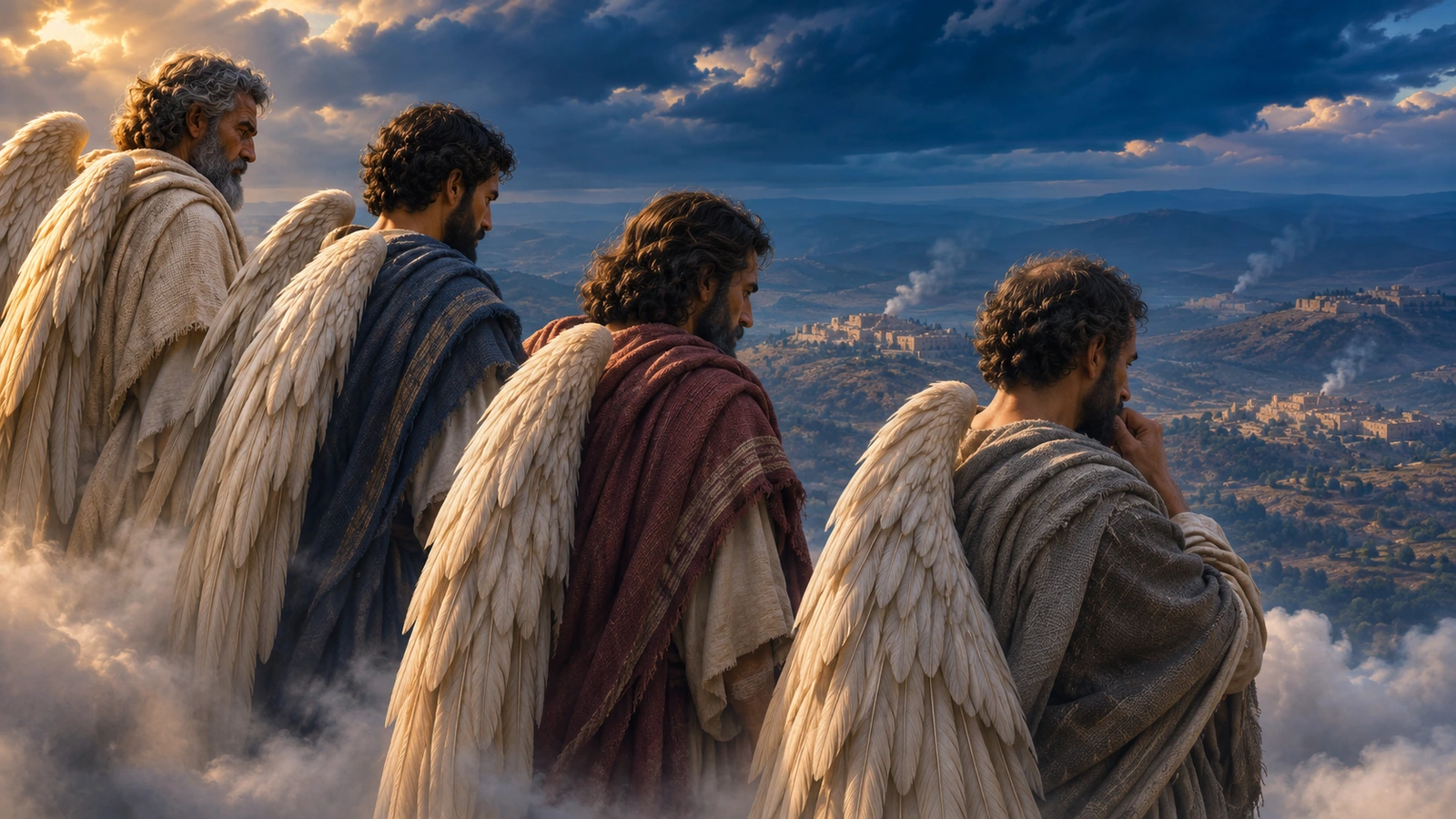
There is a second distinction to retain as the story proceeds. The holy angels who present the case in chapter 9 belong to the heavenly response to the crisis. They should not be confused with the Watchers accused of causing it. Recognizing an angel in a picture or sentence is only the first step. The reader also needs to know that angel’s role in the action.
A catalog that assigns responsibility
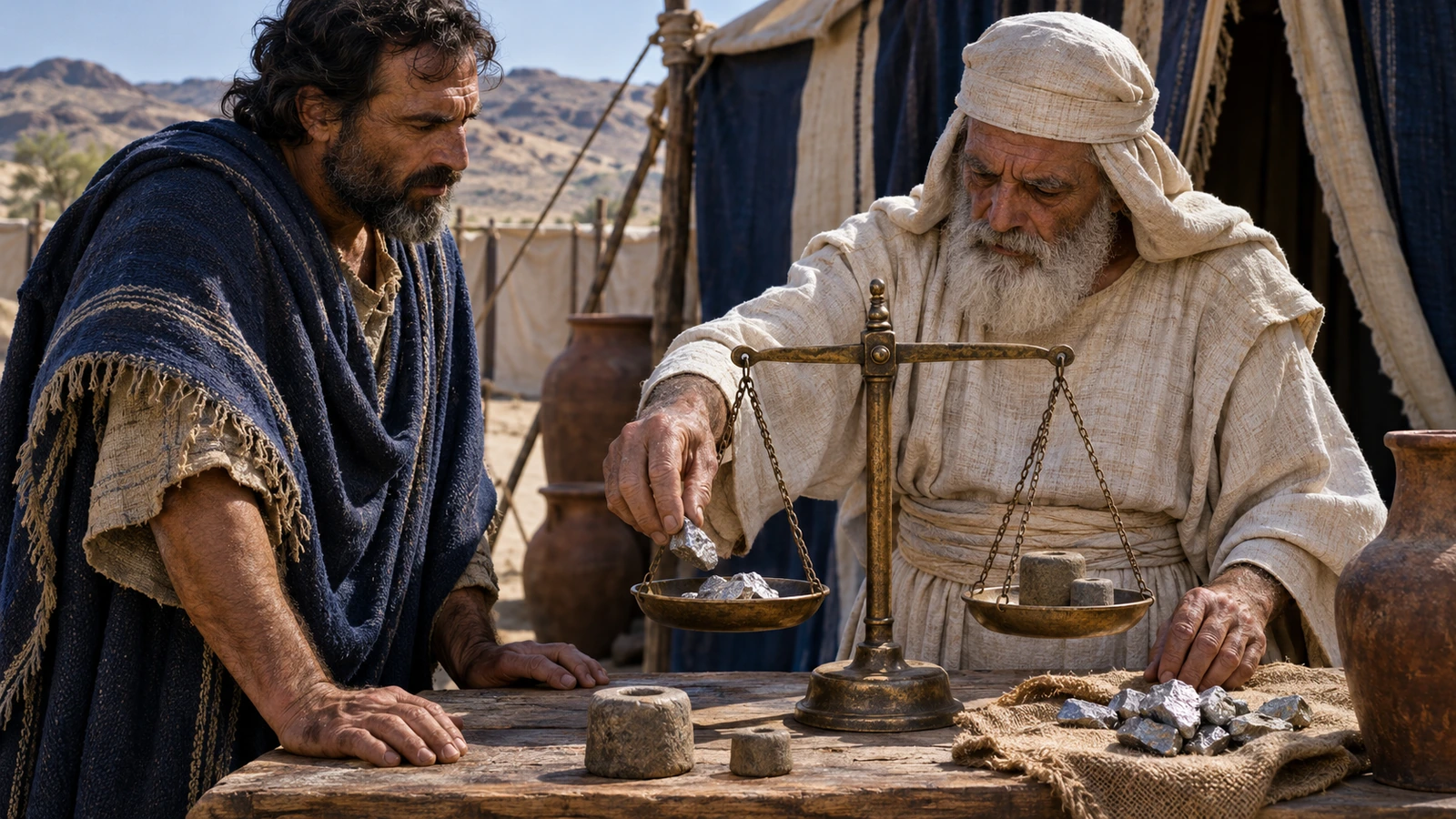
The first teacher receives the longest description. Charles names Azazel and associates him with weapons, metalworking, ornaments, eye decoration, precious stones, and dyes. The catalog then turns to other named instructors and their domains. This distribution gives the account more specificity than a collective statement that the Watchers taught evil.
A name allows the narrative to connect a disclosure with a later accusation. In 1 Enoch 9:6–8, the holy angels name Azazel and Semjaza in their appeal to God, reporting their actions rather than bringing the accused into his presence. The former is associated with the revelation of heavenly secrets. The latter is identified through his authority over his companions. Chapter 8 has prepared the reader to understand those references.
The list also makes responsibility more complicated than one leader giving one command. Several teachers contribute different forms of expertise. The corruption spreads through a network of instruction, and the narrative can attribute particular parts of that process. Participation in a collective rebellion does not prevent the story from distinguishing individual activities.
This is a literary explanation of the catalog’s function. The chapter supplies neither biographies for all the named angels nor a complete history of every art it mentions. Expanding each name into an elaborate profile would move beyond the evidence. A named instructor and a domain of teaching can establish responsibility without supplying an invented life story.
Why weapons and adornment appear together
The opening inventory moves from objects used in conflict to objects worn on the body. Swords and shields are easy to associate with violence. Bracelets, eye decoration, and dyes require more thought. The narrative places them in a context of godlessness and sexual wrongdoing, so their appearance cannot be treated as a neutral catalog of attractive possessions.
The movement from weapon to ornament widens the account of danger. A weapon can change what someone is able to do to another person’s body. Adornment can change how a body is presented and desired. Within this story, technical knowledge reaches both coercion and attraction. That reading follows the sequence and its moral setting, although the text does not provide a separate explanation for each item.
The distinction between material and use also matters. Metal occurs here in weapons and in objects of display. The passage is interested in the transformation of materials into socially consequential things. It gives the human world capacities whose effects extend beyond the person who first learned a technique.
A reader should resist supplying a modern manufacturing manual behind the brief list. Charles’s passage names swords, knives, shields, and breastplates, but gives no furnace design, alloy recipe, or workshop procedure. The imagery is sufficient to invoke armed conflict. It cannot establish a specific archaeological industry or date an excavated weapon.
Nor does the catalog explain every historical use of adornment. Its condemnation belongs to an account of angelic rebellion and the corruption that follows. Turning that account into a claim that every cosmetic object in every ancient society had the same purpose would exceed its scope. The material evidence can test that leap.
A documented cosmetic set and what it establishes
The Metropolitan Museum of Art records a cosmetic set containing a kohl tube and applicator, razor, tweezers, whetstone, and mirror, object number 26.7.837-related. It dates the group to approximately 1550–1458 BCE and locates it in burial 16 of Tomb CC 37 at Asasif, Thebes, excavated by Carnarvon and Carter in 1911. The objects were found together in a rush basket.
Two details make the comparison useful. Eye cosmetic belonged to an assemblage of grooming equipment, and the set combines several materials, including copper alloy, stone, ivory, and wood. The tube’s function helps explain how eye decoration could belong to a technical inventory. Its archaeological context documents human practices and equipment. It does not identify an angelic teacher or demonstrate that this Egyptian set supplied 1 Enoch’s author with a source.
This comparison also changes the question a serious reader asks. The useful issue is how the narrative makes familiar practices part of its explanation of corruption. Finding an ancient cosmetic container establishes that people used such equipment. Determining what an author thought those practices meant requires reading the author’s sequence, judgments, and attribution of responsibility.
Spells and the interpretation of signs
After the opening catalog, Charles associates Semjaza with enchantments and root-cuttings and Armaros with the resolving of enchantments. The second activity adds an important complication. The dangerous knowledge includes an apparent remedy for something within the same sphere of practice. The story’s criticism reaches the acquisition of this expertise as a whole.
The mention of roots needs restraint. The passage places root-cuttings beside enchantments, which establishes its immediate literary context. It provides no botanical identification and no basis for declaring every use of a plant forbidden. A modern reader who substitutes “all medicine” for the actual wording has widened the claim without textual support.
The celestial entries likewise concern particular kinds of knowledge. Charles’s version names astrology, constellations, clouds, signs of the earth and sun, and the moon’s course. These subjects can be associated with interpreting the natural world for knowledge beyond ordinary perception. The surrounding account of forbidden disclosure gives that interpretation its force.
Yet observation of the sky is not uniformly condemned throughout this work. The opening chapters ask readers to observe the regularity of creation, including heavenly bodies. The earlier study of the seasons before the Watchers descend examined that appeal. Attending to ordered creation can teach obedience within the book’s own argument.
The tension requires a narrower formulation than “Enoch opposes astronomy.” In the early exhortation, creation’s order serves as a witness against human disobedience. In chapter 8, specific angelic instructors disclose knowledge within a rebellious movement. Authority, purpose, and consequences shape the narrative judgment. Similar objects of attention can appear in very different relationships to the divine order.
This difference keeps the account from becoming a simple contest between intelligence and ignorance. The work expects its readers to understand, compare, and discern. Its criticism concerns knowledge acquired and transmitted within transgression. That still leaves interpretive questions about individual entries, especially where the transmitted wording differs.
Why English lists of the Watchers disagree
Comparison with Nickelsburg and VanderKam’s Hermeneia translation, printed pages 25–26, shows why a list should always identify its edition. They use Asael where Charles has Azazel, and their celestial catalog includes signs of lightning flashes and shooting stars where Charles gives different names and assignments. Their note describes the chapter’s textual evidence as complex.
Their translation also includes a sentence about humans making adornments and leading the holy ones astray. The accompanying note identifies support in a Greek witness while recording its omission in other Greek and Ethiopic evidence. That difference affects how readers reconstruct the relationship between revelation and seduction. A single seamless chronology would conceal the variation.
These observations justify consulting the edition’s notes before building a detailed argument from a name or sequence. They do not authorize assigning every difference to an identified ancient manuscript without checking the supporting evidence. The broader study of Enoch’s Aramaic, Greek, and Ethiopic witnesses explains why an English translation is the outcome of textual decisions.
A practical consequence follows for popular charts. A chart assembled from several translations can accidentally create a list that no consulted edition actually prints. Differences in spelling may be harmless for ordinary reading, but differences in assigned expertise can affect the argument. Keeping one base edition visible makes comparison possible and prevents an editorial combination from masquerading as a primary text.
The same discipline applies to missing words. Brackets and editorial symbols are part of an edition’s information. Removing them from a reproduced passage without explanation can make reconstructed wording appear physically preserved. Responsible reading follows the surviving evidence and the editor’s intervention separately.
What an Aramaic fragment can contribute
The Dead Sea Scrolls exhibition’s presentation of 4Q201, “Enoch (Hanokh)”, dates the copy to approximately 200–150 BCE. In its translated column iii, line 15 includes teaching sorcery, followed by bracketed restoration concerning spells, roots, and herbs. The displayed selection concerns the preceding narrative in chapter 7, rather than a complete surviving copy of chapter 8’s catalog.
That placement is useful. Teaching is already embedded in the account of the unions before the separate list of named instructors appears. The fragment provides early manuscript evidence for that broader instructional theme. Its damaged condition also shows why a reader must distinguish visible wording from restoration.
The fragment cannot verify every teacher and assignment in the next chapter. Its evidentiary value comes from the actual passage it preserves. Applying it to a different sentence simply because both concern Watchers would turn a relevant document into misleading proof.
Read alongside the continuous translation, the fragment encourages a more exact question. Which portion of the narrative is independently witnessed here, and which portion is being read from another transmitted form? That question is more productive than treating the phrase “found among the Dead Sea Scrolls” as a blanket guarantee for every detail in a modern retelling.
Genesis gives another account of human craft
A comparison with Genesis 4:19–24 sharpens the specificity of Enoch’s explanation. Genesis associates forms of life and skill with human descendants of Cain. Tubal-cain is linked with working bronze and iron. The passage does not name a Watcher as his teacher.
The neighboring speech of Lamech brings violence into the same genealogy. That proximity makes a comparison with Enoch’s association of culture and wrongdoing worth exploring. It still leaves important differences. Genesis does not explicitly say that Tubal-cain made the weapon used by Lamech, or that the craft itself caused his boast.
Enoch supplies an angelic account of disclosed expertise with named teachers. Genesis supplies a genealogy that includes human practitioners and an escalating claim to vengeance. A reader can place the passages in conversation while preserving their separate claims. Combining them into an undocumented meeting between Tubal-cain and Azazel would add a scene to both.
The comparison tests a common assumption about the chapter’s subject. Enoch’s catalog is not simply a longer version of a biblical list with missing names filled in. It offers its own explanation of how certain arts belong within the growth of wrongdoing. Its differences are part of what makes it historically and literarily interesting.
The Deeper Discovery
Knowledge descends, but the victims’ cry ascends
The catalog moves information from angelic teachers toward human recipients. Its final sentence reverses the direction. As people perish, their cry goes up to heaven. The movement carries the reader from the transmission of expertise to an appeal for judgment.
That reversal gives the ending a force a mere list would lack. The chapter could have closed with the last instructor’s specialty. Instead, it closes with suffering people, whose voices begin the transition into the heavenly hearing. The names identify agents of disclosure, while the cry identifies those who must live with the consequences.
Chapter 9 develops the other side of this exchange. Holy angels present the human case before God and name the responsible figures. Heaven is therefore involved in two opposed kinds of mediation within the narrative, the rebellious disclosure and the appeal for a divine response. Their direction and purpose help the reader distinguish the angels more clearly than a generic visual label could.
Chapter 10 then links judgment with healing the earth and the survival of human beings endangered by the disclosed secrets. The response reaches beyond identifying the teachers. The earth on which the instruction took effect must become habitable again. Charles’s translation of 1 Enoch 10:4–8 makes that connection explicit.
The catalog’s deeper function is thus visible in what follows it. Naming the instructors makes an accusation possible, but the victims’ cry determines why the accusation matters. The narrative evaluates knowledge through the world it helps create and through the appeal of those harmed within that world.
FAQ
Is Azazel a human metalworker in this chapter?
Azazel is an angelic teacher within the Watchers narrative. Humans receive the teaching. The activity of demonstrating a craft does not make the instructor human.
Are Asael and Azazel interchangeable spellings in every ancient text?
The compared editions use those forms for the figure in this passage. That observation should not be turned into a claim that every occurrence of either name across ancient literature has an identical history or meaning.
Does the chapter describe the Watchers’ wings?
It gives no description of wings in the teaching scenes. Wings in the illustration are a visual convention, identified as such in the caption.
Does the museum cosmetic set prove the Watchers existed?
It documents ancient grooming equipment and its archaeological context. It supplies material context for a reader of the catalog without verifying its supernatural account.
Should every named art be treated as a modern scientific discipline?
Modern categories can obscure the passage’s setting. Root-cuttings, celestial signs, and enchantments should be interpreted in their literary context and with attention to the edition’s wording.
What Comes Next?
The Watchers are named because the story traces disclosure to accountable teachers and follows its effects into human life. The final cry moves the narrative toward a hearing in heaven, where another group of angels must respond.
Continue with Why Do the Holy Angels Bring Humanity’s Cry Before God in 1 Enoch 9?
Previous study. Explore the Ancient Texts collection.
Selected Sources
R. H. Charles, The Book of Enoch, Internet Sacred Text Archive. Chapter VIII is the primary reading for the catalog, with chapter IX and chapter X consulted for accusation, judgment, and healing.
George W. E. Nickelsburg and James C. VanderKam, 1 Enoch: The Hermeneia Translation, printed pages 25–26. Comparison of names, assigned teachings, and the textual note concerning adornment and the seduction of the holy ones.
Metropolitan Museum of Art, “Cosmetic set of Kohl Tube and Applicator, Razor, Tweezers, Whetstone, and Mirror,” object 26.7.837-related. Documented material comparison, dated approximately 1550–1458 BCE.
Dead Sea Scrolls exhibition, “Enoch (Hanokh),” 4Q201. Column iii, line 15 and its context, translated by J. C. Greenfield from J. T. Milik’s transcription with amendments.
Genesis 4:19–24, King James Version. Human craft traditions and Lamech’s speech in the Cainite genealogy.