The Manuscripts of 1 Enoch: Aramaic Fragments from Qumran, Greek Witnesses, and the Ethiopic Text
A torn scroll can preserve the order of a passage. A bound manuscript can show where a reader encountered the end of the book.
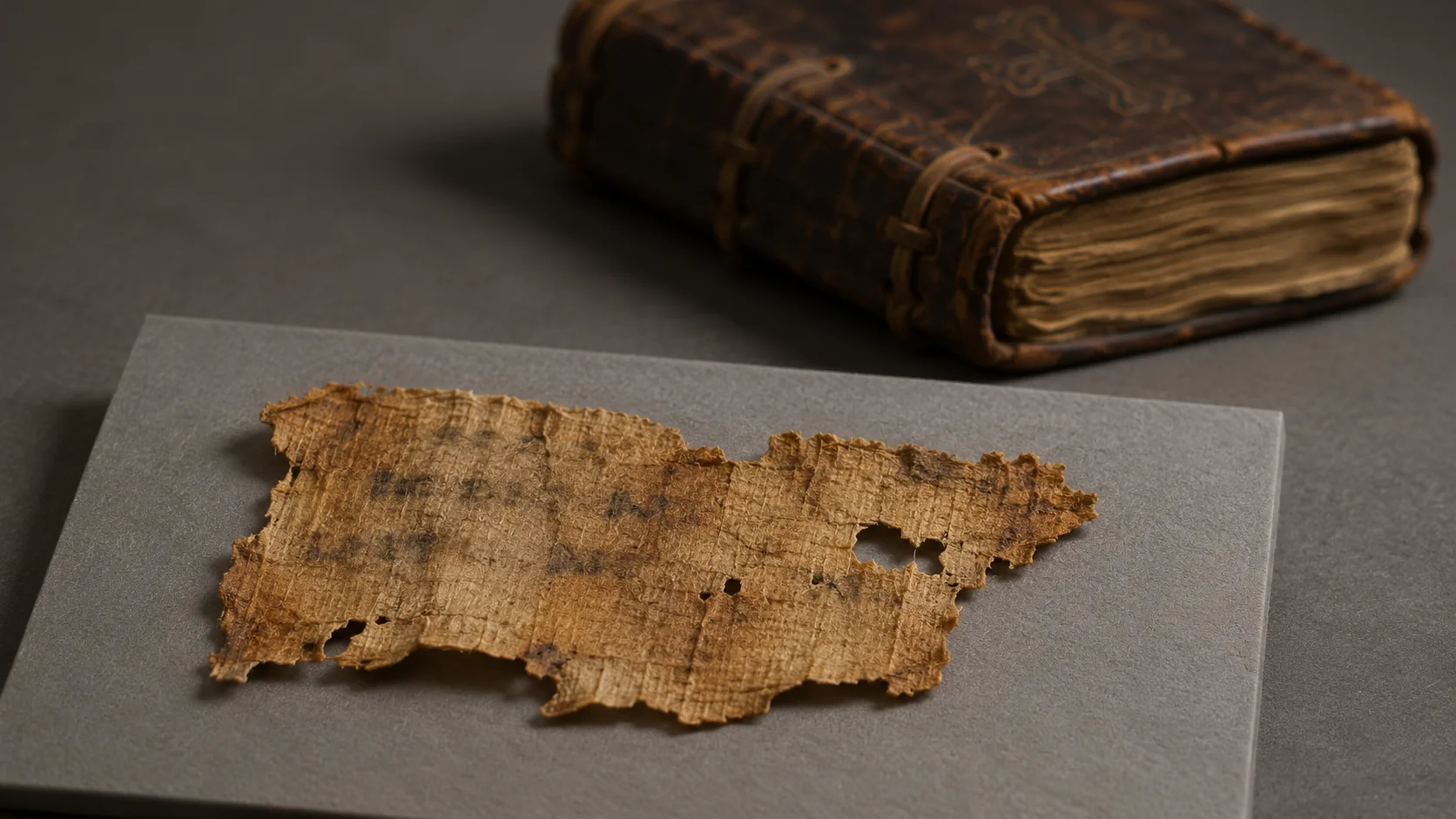
Source: AI-generated image created for Beyond The Known.
A reader can open an English edition of 1 Enoch and turn from the first chapter to the last. No surviving Aramaic scroll or Greek codex allows that journey. The continuous collection is preserved in Geʿez, the classical language of Ethiopia. Aramaic fragments from Qumran establish that several of its constituent writings circulated much earlier, and surviving Greek manuscripts let us compare particular passages across languages. Which witness matters most depends on the question. To date a copy, read a whole work, or recover the order of a damaged passage is to undertake three different investigations.
The Book of Enoch: What It Is, When It Was Written, and Why It Matters introduced the collection and its major parts. Here we can begin with one actual piece of parchment. The Library of Congress exhibition entry for 4Q201 identifies the material, gives the fragment’s measurements, and assigns the copy an approximate date. None of those details requires us to assume that its scribe knew all 108 chapters familiar to a modern reader.
What one fragment from Cave 4 can tell us
The designation 4Q201 is a catalog identifier. The 4 points to Cave 4 at Qumran. The object described in the exhibition is parchment, and the assigned copying date is approximately 200–150 BCE. That date has a fairly narrow implication. A form of the material on those pieces already existed when the scribe copied it. The date cannot be transferred to an unrelated section just because both sections eventually appeared under Enoch’s name.
The exhibition label emphasizes the order of nature in the opening of the Book of the Watchers. The translated columns give a sharper picture of the surviving evidence. In one, a speaker accuses human hearers of wrongdoing. In another, heavenly beings take wives and teach forbidden arts. Both passages belong to the same cataloged manuscript. Anyone interested in the Watchers can follow the story on these pieces, provided they pay attention to where the parchment breaks.
A visitor can compare the exhibition’s translation of the Enoch fragment with the object description. They answer different questions. A photograph records visible marks and breaks in the material. A transcription identifies those marks as letters. A translation gives those letters meaning in another language and may represent an editor’s restoration where a line is broken. Read the editorial signs before treating a smooth English phrase as a line of continuous ancient ink.
Reading one broken line of 4Q201
Take column iii, lines 13–16, in J. C. Greenfield’s English translation of the exhibited fragment. In line 14 the words concerning the choice of wives are printed outside square brackets. The description that follows, concerning the unions and the defilement associated with them, is enclosed in brackets. Farther down, a break cuts through the statement about the children born to the women. One sentence of English thus contains evidence of different strengths. A person citing it needs to decide which part of the sentence the claim actually depends on.
Consider two captions someone might write for this piece. A caption saying that the manuscript preserves part of the account of the Watchers taking wives rests on surviving wording in line 14. A caption claiming that the enormous height assigned to their offspring can be read from the ink on this piece would go too far. Greenfield prints the height inside a restoration. The translation gives the reader access to a proposal for the missing line; the brackets disclose the cost of printing it. This difference is especially easy to miss when a quotation circulates without the signs used by its editor.
The earlier column matters to the interpretation as well. Its charge of wrongdoing is addressed to an audience as “you.” The narrative about the heavenly beings speaks about what “they” did. A reader who knows the work only as the story of the fallen angels might treat every surviving accusation as a charge against the Watchers. Paying attention to who speaks and to whom leaves room for a less comfortable possibility. The opening addresses human accountability before the narrative turns to heavenly disobedience.
Several Enochic writings shared the cave
Other Cave 4 copies preserve material far removed from those opening exhortations. For the closing chapters in particular, Loren Stuckenbruck’s inventory of the surviving witnesses identifies 4Q204 with portions of the Epistle and the birth of Noah, and 4Q212 with material from the Apocalypse of Weeks and its literary surroundings. These are separate cataloged manuscripts. Their contents give us evidence about which passages circulated together on particular copies.
Even the chapter numbers require care. The numbers used to identify a passage in a catalog usually direct the modern reader to a corresponding place in an edition. They do not mean that the same numbers were visible on the Aramaic parchment. That distinction becomes consequential in 4Q212. Stuckenbruck’s inventory moves from material corresponding to chapter 93 to material numbered 91:11–17. Anyone following the references in simple numerical order would miss evidence about the arrangement of the weeks. A small physical witness can bear on the structure of a substantially longer composition.
One familiar division, the Parables or Similitudes (chapters 37–71), has no identified Aramaic manuscript among the Qumran finds. Absence matters here because it leaves that section without the kind of dated evidence available for the opening material. It does not furnish a date of composition. A cave preserves what happened to reach it, survive there, be recovered, and be identified. Arguments about the Parables must therefore do more than point to a gap in the inventory.
Why week eight turns up in chapter 91
The Apocalypse of Weeks tells the history of the world in numbered periods. Try reading it with two bookmarks. Put one at 1 Enoch 93:3, where Enoch places his birth in the first week. Follow the successive periods down to 93:9–10. The seventh week brings a corrupt generation and the choice of people who receive wisdom. Where is the eighth? In the chapter numbering used for the Ethiopic tradition, the reader has already passed it. The explicit announcement of week eight is at 91:12, followed by week nine in verse 14 and week ten in verse 15. The difficulty lies in the arrangement of two stretches of writing long enough to carry their own internal sequence.
That sequence gave scholars a way to test an explanation before the Qumran finds. A numbered series beginning with one and reaching seven supplies a reason to look for its continuation; a passage beginning with eight supplies a candidate. A further check is whether the subject develops intelligibly across the join. Taken alone, these are literary reasons to read the passages together. They could support an editorial rearrangement even if no ancient manuscript in that order were known. What they could not establish by themselves was that an ancient copy circulated with the material in the proposed sequence.
Here 4Q212 changes the argument. In his study of the Apocalypse of Weeks, pp. 81–84, Loren Stuckenbruck dates the Aramaic manuscript to the first century BCE and explains how its remains confirm the relative order scholars had inferred. The surviving material is fragmentary. An edition that places 93:1–10 before 91:11–17 gives readers a reconstructed literary sequence. It does not reproduce an unbroken column containing every English word on the page. Even the join deserves precision: the eighth week is named in 91:12. Stuckenbruck sees the judgment in the preceding verse as the likely resolution of the seventh.
What changes when the weeks run forward?
Read the end of the seventh week alongside the opening of the eighth. Wisdom is given to the chosen in the midst of a generation whose conduct the seer condemns (93:9–10). By 91:12–13 the righteous are entrusted with judgment, oppressors face a reckoning, and a house is built for the great king. Week nine broadens the horizon to the world. In week ten judgment reaches the angels, and even the heavens give way to renewal. The sequence carries the reader from a community trying to understand its predicament to a vision in which the order of the cosmos will change. The arrangement matters to the argument Enoch makes about justice, quite apart from any interest in identifying the manuscript.
There is also an unexpected ending. After ten carefully enumerated periods, the seer speaks of further weeks beyond counting (91:17). Read beside the opening, that last turn places a limit on the usefulness of the calendar the vision has constructed. Numbers let a hearer locate injustice within a history that has direction. The life of righteousness envisaged at its end exceeds the scheme used to describe the journey. This is a literary reading of the sequence. It does not require assigning a fixed number of solar years to a week or turning the vision into a timetable for modern events.
To check the argument, compare the English reading text of the Apocalypse of Weeks, pp. 139–142, with Stuckenbruck’s chart. The first lets you follow the changes of subject and the week numbers. The second shows how a specialist divides the events within the weeks. A modern edition may already arrange the units in their reconstructed order and retain the familiar verse numbers in its margins. The backward jump from 93 to 91 on such a page tells readers exactly where the editorial decision has been made.
Two Greek witnesses, two different stretches of text
The Greek Codex Panopolitanus, associated with Akhmim in Egypt, preserves much of the opening Book of the Watchers. Stuckenbruck describes its coverage as reaching from 1:1 into 32:6. Readers studying that part of the work can sometimes set the Greek beside the Ethiopic and, where enough ink survives, the Aramaic. Turn to the later chapters, however, and the same codex can no longer answer the question. Its surviving coverage ends.
A different witness becomes especially valuable near the end. The Chester Beatty–Michigan papyrus contains Greek material corresponding to parts of chapters 97–104 and 106–107. The catalog record and photographs for Chester Beatty Biblical Papyrus XII identify the Dublin material as fourth-century papyrus. Compare that description with the one for 4Q201. The objects differ in date, language, writing material, and the part of Enoch they can document. Saying simply that “the manuscripts agree” leaves out nearly everything a reader would need to test the claim.
Consider the birth of Noah in chapter 106. The Greek papyrus reaches that story. Fragments of 4Q204 also preserve portions of it, and the Geʿez text gives it a continuous setting. That overlap makes a comparison possible, but its reach changes from line to line. Where the Aramaic breaks, the Greek and Ethiopic can still be compared with each other. Agreement between two translations may support a proposed sense without securing every word of the earlier Aramaic.
A Greek papyrus and the limits of agreement
Suppose a reader wants to compare witnesses to Noah’s birth rather than to the weeks. A reference to “the Greek Enoch” is too broad to be useful. Codex Panopolitanus preserves a section near the beginning of the collection. The Chester Beatty–Michigan papyrus, by contrast, preserves Greek text extending into chapters 106–107. The appropriate comparator in Aramaic is 4Q204. This is almost the reverse of the procedure for the Apocalypse of Weeks, where 4Q212, rather than either of these Greek copies, supplied the evidence relevant to sequence.
The surviving ranges in Stuckenbruck’s commentary make the difference tangible. In his inventory, fragments of 4Q204 reach from parts of 104–105 to the opening of 106 and preserve portions farther along in the birth narrative. The Greek coverage he lists runs through 104:13 and resumes at 106:1. A single range written as “97–107” would hide what happens at 105. Anyone investigating a sentence there must check the individual witness before reporting agreement. A gap in a catalog of parallel texts should invite inspection, not a theory about a scribe’s intention.
For chapters where Greek and Ethiopic can be compared continuously, Stuckenbruck sometimes sets separate English translations alongside one another. It can be slower to read than a single polished paragraph, but it protects an important piece of information. An editor who silently chooses one reading wherever two versions differ can create a smooth account that no individual manuscript actually transmits. Parallel translations allow a reader to ask which version supports the wording cited in an argument and where the other witness says something different.
Why the Ethiopic manuscripts belong at the center
Open the catalog description of Bodleian Bruce 74. The entry identifies Enoch in Geʿez and records how the manuscript marks its sections and chapters. It even notes interruptions in the sequence of chapter numbers. A reader encountering a numbering irregularity has a concrete question to investigate: did the wording move, did a number go astray, or are two systems of division being compared? The catalog draws attention to a feature of this particular copy. It does not authorize a general conclusion about every Ethiopic manuscript.
A shelfmark identifies an object. “The Ethiopic version” refers to a textual tradition carried by many such objects. The distinction is easy to overlook when an English edition prints only one column of text. An editor must decide which readings to follow even within Geʿez. For a reader interested in the collection as Ethiopian readers transmitted it, the wording, divisions, and company a work keeps in a codex all deserve attention in their own right.
A small but telling example is the final chapter. In his introduction to 1 Enoch 91–108, Stuckenbruck observes that chapter 108 is attested in Ethiopic while the surviving Greek and Aramaic material he discusses ends with the birth of Noah. He proposes that the final admonition reflects a later stage in the collection’s growth. The distribution of witnesses is an observation; the account of how the admonition entered the collection is his historical inference. Both are worth reporting, but the fragments do not narrate that history themselves.
What an Ethiopian codex can show that a fragment cannot
The Bodleian’s digital copy of Bruce 74 lets the reader turn from the description of Enoch to the manuscript as a physical book. Consider what a shelfmark can track that a chapter citation cannot. A reference to 1 Enoch 93:10 will direct readers using different editions to the seventh week. A reference to Bruce 74 directs them to a particular volume that can be examined for layout, divisions, and the other writings bound with Enoch. The same printed verse number can take a reader to the same passage without preserving any of those features.
The Deeper Discovery
Imagine two readers at adjacent desks. One is investigating the order of the Apocalypse of Weeks and keeps returning to a few damaged Aramaic lines. The other wants to know what a reader encountered after Noah’s birth in the transmitted collection and turns to Geʿez. Both have chosen their evidence well. An early fragment can preserve a crucial sequence. A much later codex can preserve a conclusion for which no corresponding fragment has survived.
That is why the history of 1 Enoch cannot be reduced to the discovery of a lost book in a desert cave. Ethiopian readers and scribes had transmitted a continuous text. The Qumran finds changed what scholars could demonstrate about particular writings before the Common Era. The Greek copies offer a further check where their coverage overlaps. Together they allow a more precise answer to a better question: which form of which passage can we read, in whose copy?
FAQ
Was there a complete Aramaic Book of Enoch in Cave 4?
The finds are parts of several manuscripts. Individual copies attest particular Enochic writings. No complete Aramaic counterpart to the 108-chapter Ethiopic collection survives there.
Why do editions sometimes print chapter 93 before part of chapter 91?
In the Apocalypse of Weeks the week numbers continue across those chapter divisions. Some editors follow the reconstructed sequence and keep the conventional verse references so readers can check their decisions.
Can two different objects be witnesses to the same passage?
Yes. A Greek papyrus and an Ethiopic codex can both preserve a form of the same passage. Each can also preserve readings or surrounding material absent from the other.
Which manuscript is shown in the opening illustration?
The illustration represents different forms of manuscript evidence. For images of identified objects, use the linked catalog records for the Dublin papyrus and Bodleian Bruce 74.
What Comes Next?
The fragment displayed by the Library of Congress points back to an often overlooked opening. Before the Watchers descend, the audience is told to watch the sky, the trees, and the changing seasons. Continue with Why Does 1 Enoch Ask Its Readers to Watch the Seasons Before the Watchers Descend?
Explore the Ancient Texts collection.
Selected Sources
Library of Congress, “The Enoch Scroll,” in Scrolls from the Dead Sea. Exhibition entry for 4Q201, with its approximate copying date, physical description, and companion translation.
Loren T. Stuckenbruck, 1 Enoch 91–108, introduction, especially pp. 13–18. Manuscript coverage, the Ethiopic basis of the commentary, and the comparison of overlapping witnesses.
Center for the Study of New Testament Manuscripts, Chester Beatty Biblical Papyrus XII. Catalog information and images of the Dublin leaves.
Beta maṣāḥǝft, Oxford, Bodleian Library, Bruce 74. Description of the Geʿez text and its internal divisions.
J. C. Greenfield, translation of 4Q201, columns ii–iii, based on J. T. Milik’s transcription as amended by Greenfield. Brackets distinguish restorations in the exhibition text.
Loren T. Stuckenbruck, “The Apocalypse of Weeks: Periodization and Tradition-Historical Context,” in Four Kingdom Motifs before and beyond the Book of Daniel, pp. 81–95. See especially the opening discussion and chart of the ten weeks.
English selections from 1 Enoch, hosted by St. Mary’s University. Text and translation notes for comparing 93:1–10 and 91:11–17.
Digital Bodleian, MS. Bruce 74. Digitized Ethiopic manuscript.