Why Is Fresh Bread Set Before the Lord Every Sabbath in Leviticus 24?
A loaf taken off the sanctuary table still has a prescribed destination. David’s request at Nob shows why that matters.
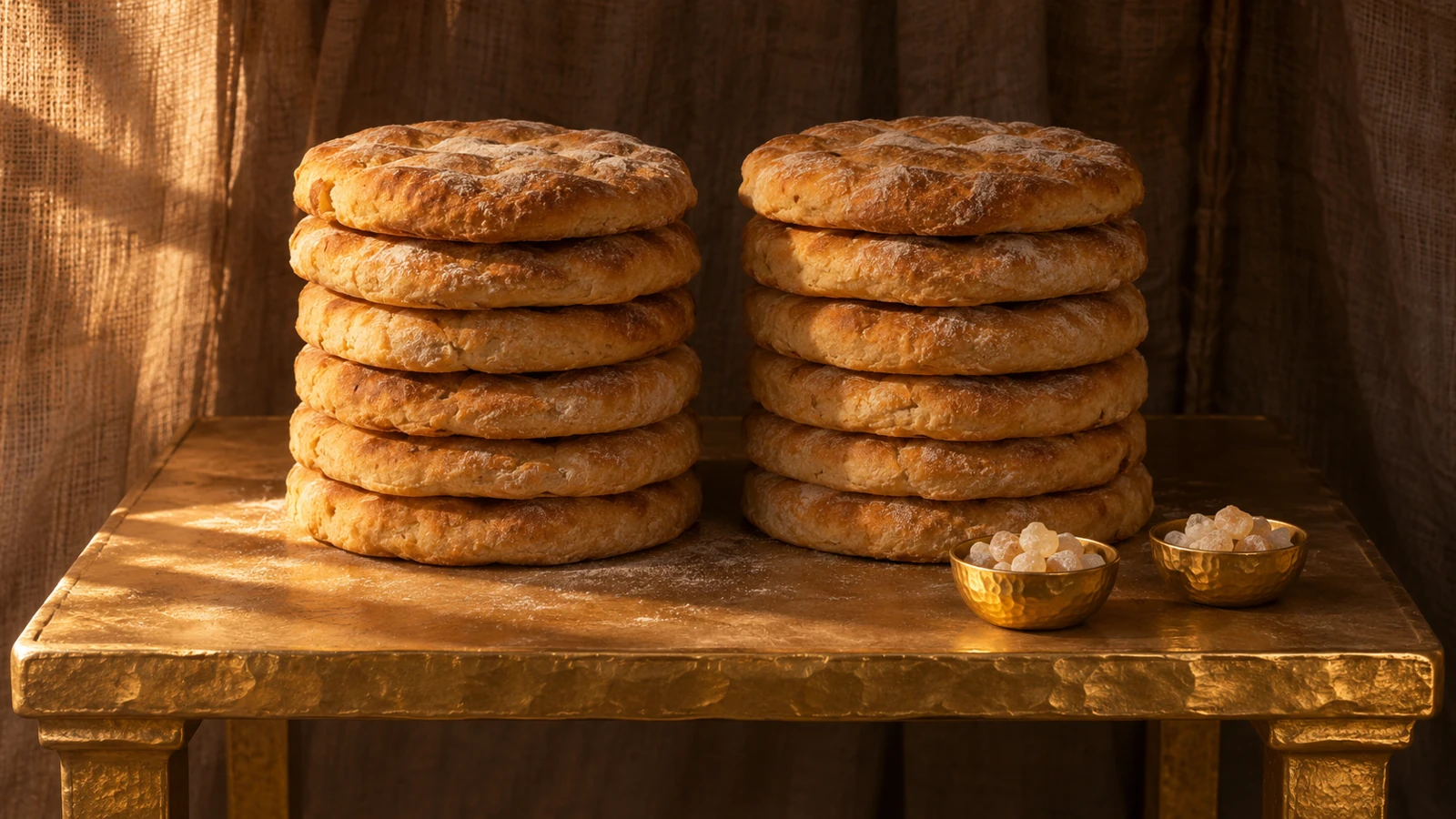
Source: AI-generated editorial illustration for Beyond The Known.
Every Sabbath the priests put bread before the Lord because Israel owes a continuing covenant offering, and Leviticus 24:8 assigns its renewal to the seventh day. The loaves represent a gift made on behalf of the people. After their time on the table, Aaron and his sons eat them in a sacred place. Those two destinations explain why the bread must be replaced. The table is to remain furnished even as the priests receive what God has assigned them. The chapter gives a reason grounded in covenant and a timetable for carrying it out. It leaves open why God chose bread for this purpose in the first place.
In Why Does Leviticus 23 Begin Its Festival Calendar with the Sabbath?, the seventh day reached the farmer in a field ready for harvest. Follow that same day into the tent and someone has work to do. Twelve loaves must be ready, the old bread must have somewhere to go, and the next week’s offering must take its place. A rule about rest in Israel’s settlements and a rule about service at its sanctuary describe the same Sabbath from opposite ends of the road.
What the lamp can tell us about the table
Read the first nine verses of Leviticus 24 in the New American Bible, Revised Edition as a pair of instructions. Before anyone measures out flour, ordinary Israelites must bring oil. Aaron has the narrower responsibility of tending the light outside the inner veil. The location matters. A reader picturing a lamp burning over the ark has carried the light past the boundary the chapter expressly gives it. The furnishings stand before the Lord even though a curtain still separates the outer room from the innermost space.
Oil and bread keep different hours. Verse 3 specifies the interval from evening to morning. Verse 8 singles out a day in a cycle of seven. Both instructions describe regular service and both look beyond the present generation. If regularity meant that each individual act went on without interruption, Aaron could never finish tending a lamp, and nobody could remove a loaf. The passages give a more practical account of duration. Night after night someone tends the light. Sabbath after Sabbath someone provides for the table. The provision survives a particular night’s oil and a particular week’s bread.
There is also a difference in what happens to the supplies. The lamp consumes its fuel in the course of doing its work. Bread can remain available for someone to eat after its service on the table. Had the chapter stopped at verse 8, a reader might reasonably ask whether the previous week’s bread was discarded, burned, or returned to whoever supplied the flour. The answer in verse 9 changes the meaning of the whole transaction. Eating the bread is itself regulated sanctuary service. Its withdrawal from the table is one of the things the arrangement was designed to allow.
What twelve loaves establish
The amounts in verses 5–6 are unusually helpful. Each cake requires two tenths of an ephah of flour. That amount applies to each loaf individually. A baker who divided two tenths among twelve cakes could present the required number while missing the measure by a factor of twelve. The whole batch calls for twenty-four tenths. The direction then divides the finished batch equally between two piles. The total, the portion, and the arrangement are three distinct features of the offering. Counting to twelve settles only one of them.
Why twelve? Israel has twelve tribes, and verse 8 expressly identifies the people on whose behalf the offering is made. A representative reading therefore makes sense. Yet the instructions offer no tribal names, no order in which to arrange them, and no provision for returning a particular loaf to members of a particular tribe. Verse 9 assigns the bread to Aaron and his sons as a group. Reading twelve as a fitting number for Israel leaves all of that intelligible. Assigning each loaf a tribal owner would invent a second distribution system that the passage never uses.
Consider how the wording would change if the purpose were to feed a set number of priests. One would expect either a quantity per person or some direction about increasing the amount when more people were serving. Instead, the number is fixed before the recipients are even mentioned. Likewise, if the bread were a household donation whose size depended on what a giver could afford, the fixed measure would be surprising. The quantities make best sense as specifications for the common offering. They do not tell us how an individual family contributed its share or who controlled a store of flour.
The illustration follows the NABRE’s arrangement in two piles. Its round loaves and small vessels make the arrangement visible, but the dimensions of a finished loaf, the profile of its crust, and the shape of an incense dish cannot be recovered from these verses. The law is exact about matters a painter cannot show, such as the measure of flour before baking. It leaves considerable freedom about things that a painter has to decide. A reconstruction can help count the cakes without settling an ancient baking technique.
The frankincense and the food have different destinations
In verse 7 each pile receives pure frankincense. The verse gives the incense a representative role in the bread offering. It is easy to miss the importance of that detail by imagining a single sacrifice in which everything on the table eventually goes into a fire. Such a reading leaves the priests with nothing to eat. Another reading, in which the whole arrangement is simply a weekly food allowance for priests, has the opposite difficulty. It leaves the frankincense and the presentation before the Lord unexplained.
Look instead at the route taken by each material. Flour becomes bread. The bread is arranged on the table with frankincense associated with each group. The text identifies a token for the Lord and grants the edible portion to named recipients. One need not imagine the Lord physically eating a meal in order to give the words about presentation their full force. The bread has been offered before him, and it is precisely as an offering that he assigns it to the priests. A gift can change hands without ceasing to bear the conditions under which it was given.
That last qualification is visible in the restriction on place. It would be quite possible to convey the same nutritional benefit by giving a priest flour to take home or by letting him sell a loaf and purchase some other food. Neither would carry out verse 9. The verse calls for consumption in a sacred location and grounds that rule in the bread’s degree of holiness. Someone who has permission to eat it still has an obligation concerning where to eat. The earlier study of who may eat sacred offerings explains why membership in a priestly household cannot be used as a single answer for every kind of holy food.
How long may the table stand empty?
Exodus 25:23–30 approaches the problem as an instruction to furnish a room. The table is to be made of acacia wood overlaid with gold, equipped for transport, and supplied with utensils. The passage ends by specifying what is to be there before God continually. A perfectly constructed table standing empty would fulfill the instructions for manufacture while falling short of its purpose. Leviticus adds the interval for replacement. Read together, the passages raise a question that neither answers in units of time. What happens during the exchange itself?
A later Jewish discussion preserves two answers worth testing against the biblical wording. In Mishnah Menahot 11:7, priests carrying fresh bread face priests ready to remove the old. In the first account, they coordinate their movements so that the incoming bread occupies the space as the outgoing bread leaves it. Rabbi Yosi allows the removal to be completed before the new bread is placed. His ruling makes room for a brief interval even though the obligation of continuous presentation remains in force. The difference could be observed only by someone watching the exchange. A visitor arriving later would see the same furnished table under either procedure.
What does this disagreement establish? The two readings share a commitment to continuity but locate it differently. The first asks what is present on the surface of the table at each moment. The second treats withdrawal and replacement as successive parts of one service. Both can appeal to fresh bread arriving at the appointed time. This is evidence for a question later Jewish readers asked of the law. It gives us no timed observation of Aaron’s hands in the wilderness, and Leviticus itself makes neither sequence of hand movements a condition of acceptance.
Menahot 11:9 draws a second distinction that the English word “fresh” can obscure. Its ordinary example reckons from baking before the Sabbath to eating on the following Sabbath, counting the days inclusively. Baking and setting out are separate events. A reader who takes “fresh bread every Sabbath” to mean that the oven must be lit that morning has added a requirement to verse 8. The biblical instruction fixes the day of presentation. The later discussion works through the consequences for the baker when festival days come close together. Those are questions about two different jobs.
The priest who had no ordinary bread
At Nob, a fugitive asks for food, and the distinction between the two jobs becomes a matter of immediate consequence. In 1 Samuel 21:2–7, NABRE, David asks Ahimelech for five loaves or whatever is available. The priest answers in terms of the bread’s status. He has holy bread on hand and makes a condition concerning the men who will eat it. If the account were only about a storeroom running low, that exchange would be an odd delay. It matters because the food that can be found is subject to an obligation that ordinary bread does not carry.
Verse 7 supplies a detail without which the scene is easily misrepresented. David receives bread that has already been removed and replaced. The young men have no need to enter the sanctuary to help themselves to the loaves on display. Nor does the priest have to leave the table bare in order to meet David’s request. The exchange has already created the possibility of a meal. It has not made the old bread ordinary. That is why the priest can speak of holy bread even when he can offer it to someone standing before him.
There are limits to what follows from the episode. David’s request for five gives the reader a sense of the scale of his need. It does not establish that the sanctuary kept five loaves on its table, or even specify the exact number Ahimelech ultimately handed him. His concern about the men’s condition tells us what he asks on this occasion. Leviticus 24 does not list sexual abstinence as a general qualification allowing anyone to claim the priestly portion. What we have is a priest deciding a difficult case in a narrative. The narrator’s care in explaining where the bread came from presupposes the ordinary arrangement that makes his decision striking.
In Mark 2:23–28, the same meal enters a dispute about plucking grain on the Sabbath. Jesus draws attention to David’s need and to the unusual access David and his companions had to consecrated food. The disciples in the grainfields have neither entered a sanctuary nor eaten the bread of the Presence. The force of the comparison lies in the question raised by human need where a sacred restriction is at issue. The two accounts also name different priests. First Samuel identifies Ahimelech as the priest who gives David the bread. Mark 2:26 places the episode in the time of Abiathar, whom the NABRE note identifies as Ahimelech’s son. Mark’s argument turns on the hungry travelers receiving consecrated bread.
A law about bread and a judgment in the camp
Readers coming to this chapter for the weekly offering may be startled to find a fight and a capital case in verse 10. The scene, the speakers, and the legal question all change. The mother of the offender is identified by name and tribe. Her son’s father is Egyptian. The people hold him while they await a ruling, and the resulting law expressly addresses both the native-born and the resident outsider. His ancestry helps explain why the scope of the ruling matters to a reader. The narrator offers no account of his ancestry as the cause of his offense.
It would be tempting to turn the two halves of the chapter into a hidden allegory in which the twelve loaves somehow explain the sentence. There is a simpler connection one can actually demonstrate. The first case identifies who may handle holy food at the end of its service. The later case specifies who comes under a law concerning the divine name. Eligibility for a priestly meal is narrow, while liability under the ruling in verse 16 extends across a boundary of origin. Bringing both passages under a vague claim that holiness means exclusion would miss their different answers to the question of whom a law concerns.
The Deeper Discovery
The most revealing moment in the weekly service comes when the bread leaves the table. Imagine following one of the outgoing loaves. Its removal makes space for the gift representing Israel in the coming week. In a priest’s hands it remains subject to the requirements of a most holy offering. At a meal it fulfills an entitlement that the same God who required the presentation has bestowed. There is no point at which someone needs to decide how to dispose of an obsolete display. The old bread still has a purpose when the new bread arrives.
That gives the word “everlasting” in verse 8 an unexpectedly concrete setting. A reader looking for the permanent element might instinctively point to the gold. The covenant language is attached to what the Israelites and priests repeatedly do with something perishable. The table may last for years. A loaf belongs to a particular week. It takes successive gifts, real grain and the labor of successive hands for bread to be there continually. At Nob the narrator allows us to see a consequence that an inventory of the furnishings would never reveal. The bread taken away at the proper time can still matter urgently to someone who arrives hungry.
FAQ
Is “showbread” a different offering from the bread of the Presence?
These names refer to the sanctuary bread. To identify the rite, look for the gold table, the weekly arrangement and the priestly portion in Leviticus 24:5–9.
Does the passage say to bake with or without yeast?
Leviticus 24 specifies the flour and the amount per cake. It gives no instruction about yeast here. The expressly leavened loaves of Leviticus 23:17 belong to a different offering.
Where was the table in relation to the veil?
The NABRE note on Leviticus 24:5–9 locates it on the north side of the outer room of the tent. The table and the ark occupied different spaces.
Does anyone pay for a loaf at Nob?
First Samuel 21 records a request, a question about the men and a gift of holy bread. It gives no sale price. The episode offers no basis for estimating a loaf’s market value.
What Comes Next?
The seventh day determines when the table receives its bread. In the next chapter, counting by sevens raises a harder question about fields, families in need and land that has changed hands. Continue in the Leviticus Studies series. Next study: Why Can Land Never Be Sold Permanently in Leviticus 25?
Selected Sources
Leviticus 24, New American Bible, Revised Edition. The sanctuary instructions, their recipients, the ruling in the camp and the note on the location of the table.
Exodus 25:23–30, NABRE. The construction of the table and the requirement for continuing presentation.
Mishnah Menahot 11:5–9, Posen Library, “The Mishnah on the Showbread.” The later debate over exchanging the loaves and the distinction between baking and presentation.
1 Samuel 21:2–7, NABRE. Ahimelech’s encounter with David and the replacement of the holy bread.
Mark 2:23–28, NABRE. Jesus’ appeal to David in the Sabbath dispute.