Why Does Leviticus 23 Begin Its Festival Calendar with the Sabbath?
Even at harvest, the sickle is set down on the seventh day. What place does that weekly pause have in Israel’s festival calendar?
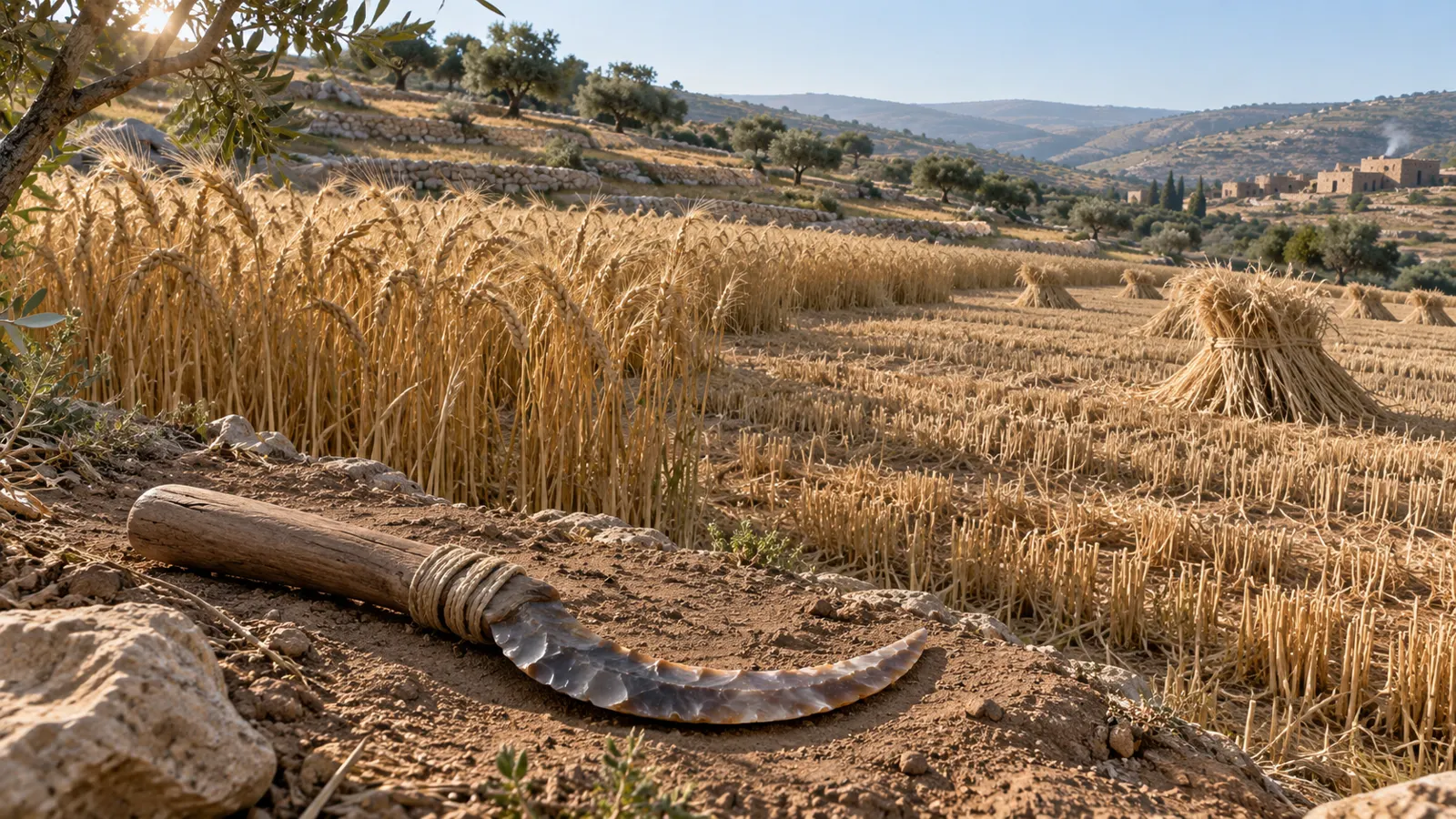
Source: AI-generated editorial illustration for Beyond The Known.
At the opening of Israel’s festival calendar, no month has yet been named and no crop needs to be ripe. A household can already tell when to stop working. Leviticus 23 begins with the Sabbath because the seventh day establishes what it means for time to belong to the Lord wherever Israel lives. The annual festivals take up that principle under different conditions. A new heading in verse 4 introduces their dates, and verse 38 counts their obligations in addition to the Sabbaths. The Sabbath belongs at the head of the calendar while keeping its own schedule.
In the preceding study of Leviticus 22, a thanksgiving sacrifice had to be eaten within the time appointed for it. Even a suitable gift could be handled wrongly by keeping it overnight. Chapter 23 turns from a particular meal to the people who must arrange their working lives around such appointments. The easiest place to see the difference is a field where grain is ready to cut. A farmer can recognize ripe grain by looking at it. Nothing in the color of the stalks will tell him whether today is the Sabbath.
Two announcements at the top of one calendar
Read Leviticus 23:1–8 in the New American Bible, Revised Edition, paying particular attention to who speaks. The Lord tells Moses to address the Israelites. They are to declare the Lord’s festivals as holy days. There are two acts here, easily confused in English. The occasions belong to the Lord, who sets their terms, and the people must announce and keep them. A proclamation lets other people know when they are to act together. It does not give the person making it discretion to postpone the seventh day until the harvest is finished.
Verse 3 gives the whole rule for identifying the Sabbath within a single sentence about labor. Six days are available for work. The seventh is reserved for complete rest. A listener needs to know where the community stands in that sequence, but has no need to consult a priest about the maturity of a crop or ask which day of the month it is. The verse expressly extends the obligation to the places where the people live. A farmer far from the sanctuary has as definite an appointment to keep as someone who lives within sight of it.
Then the wording of the introduction returns. Verse 4 announces the Lord’s festivals again, this time with a direction to proclaim them at the proper time. The very next verse gives a month, a day of that month, and a time of day. That change explains why attempts to settle the issue by counting how many festivals are in the chapter can miss the author’s arrangement. Include verse 3 under verse 2 and the Sabbath clearly belongs among Israel’s sacred occasions. Follow the dates from verse 4 onward and the first named annual occasion is Passover. The headings allow both observations.
What a Sabbath costs at harvesttime
An idle sickle has very different meanings in an empty field and in a field still standing ripe. In the first case there may be no work to do. In the second, the person who sets it down leaves something valuable unfinished. Exodus 34:21–23 puts the seventh-day rule directly beside the harvest festivals and expressly includes plowing and harvesting among the seasons when rest must be kept. It anticipates a practical objection that the terse calendar in Leviticus leaves unstated. Agricultural urgency makes the rule consequential at precisely the point when an exception would be most convenient.
That comparison also helps us read the illustration. Leviticus describes neither a particular farm nor a particular Sabbath morning. Its law can be carried out on many different landscapes. The half-cut field represents the decision that Exodus makes explicit. Setting down a tool on the seventh day acknowledges a limit on the farmer’s use of time, even while the field and the remaining crop are still the farmer’s responsibility. On the next working day the grain will need attention again.
There is a corresponding danger in taking the cessation of labor to mean that every activity at the sanctuary ceased. Numbers 28:3–10 gives a different view of the same week. One lamb is offered in the morning and another at twilight. On the Sabbath two additional lambs are offered with grain and a libation. The passage actually adds obligations for the appointed day. The person reading the calendar from a field and the priest reading a list of sacrifices thus need different instructions about the same date. Leviticus 23:3 addresses Israel’s work. Its silence about the altar cannot serve as evidence for an empty sanctuary.
Twilight, seven days, and the first taste of grain
The annual sequence opens on the fourteenth day of the first month at twilight. Passover occupies that entry. Unleavened Bread begins on the fifteenth and runs for seven days. The distinction matters even to someone who thinks of the two as a single festival season. The instruction about eating unleavened bread has a duration. The instruction about Passover in verse 5 has a specified time. Collapsing both into a generic week makes it difficult to see why the beginning and end of the seven days have special directions concerning work, while an offering is required on every one of the days.
The wording about work also changes. The NABRE uses a narrower prohibition concerning heavy work for the opening and closing days of Unleavened Bread. Verse 3 speaks more comprehensively about the Sabbath. The distinction belongs to the wording of the instructions themselves. It would be risky to use an English adjective as a complete manual for deciding which tasks an ancient household could perform, but equally risky to paraphrase every festival entry as seven consecutive Sabbaths. Verses 7–8 distinguish particular days inside the observance even as the repeated offerings hold the week together.
A fresh divine speech in verse 9 shifts the reader’s eye from the month to the field. Its first condition is entry into the land and reaping its harvest. Someone must cut the sheaf before it can be carried to the priest. Meanwhile, verse 14 restricts eating the new grain, listing bread, roasted grain and fresh kernels. The difference between harvesting and eating is easy to miss. Substituting “no one may touch the crop” would make the first part of the instruction hard to perform. What waits is the community’s enjoyment of the new produce until the offering has been brought.
The list includes grain one could eat with very little preparation as well as a finished loaf. A household could not get around the sequence by tasting fresh kernels on the way home and saving the baking for later. The priest’s action with part of the harvest marks a transition for people eating elsewhere. This is a more exact sense in which a sanctuary calendar matters in a kitchen. The family does not have to eat the actual sheaf presented by the priest for that presentation to change what may be set on its table.
Counting fifty days requires a starting point
The sheaf is presented on the day following the Sabbath (v. 11). From that day Israel is to count seven complete weeks and reach the fiftieth day (vv. 15–16). Seven times seven gives forty-nine. Counting to the day following the completed weeks explains the fifty without adding another festival week. The real interpretive problem is earlier in the calculation. Two readers who agree about the arithmetic can still arrive on different dates if they identify the initial Sabbath differently.
The NABRE note on verse 11 records readings that relate the expression to the festival period, including its first day, its last day, or the week as a whole. A reader coming directly from verse 3 can readily understand why a weekly Sabbath might come to mind. Verse 11 itself supplies neither a numbered date nor a fresh definition. The weekly Sabbath’s prominent opening position deserves attention, but it cannot by itself settle the referent of every later occurrence. Verse 32 will apply Sabbath language to an occasion fixed by the day of a month.
One ancient interpreter lets us see what choosing a starting point actually does. In Jewish Antiquities 3.10.5–6, Josephus places the offering of the first barley on the sixteenth of the month, the second day of Unleavened Bread. He then describes the count leading to the fiftieth day. In his account a reader who knows the festival date can start counting without first finding the next weekly Sabbath. Josephus also places the general reaping of the crop after the barley presentation. Leviticus 23:14 expressly restricts eating the new grain. Josephus thus tells us both when he understood the count to begin and how he understood the harvest to proceed. His account gives us one ancient interpretation.
Follow the material being presented across those weeks. First there is a sheaf. At the later offering, grain has been ground into flour, made into dough and baked with leaven as two loaves (v. 17). Someone has done considerable work between the two presentations. The calendar gives that work a place within worship, just as the seventh day limits when the work may proceed. The leaven in these loaves belongs to their own prescribed use. Carrying the rule for Unleavened Bread forward to ban leaven from every festival loaf would produce the wrong offering at the end of the count.
Why leave part of the crop standing?
The field-edge rule already appears in 19:9–10, among the laws examined in our study of holiness and love of neighbor. Here its neighbors on the page are different. Verse 21 calls for a proclamation. Verse 22 turns without ceremony to the edges of a field. Read only for dates and this direction about gleaning looks misplaced. Read from the perspective of someone who must bring the loaves, and its location is arresting. After specifying what to bring toward the sanctuary, the law specifies what must stay where it grows. The poor and the resident alien are to have access to the edges and gleanings. There is no instruction to harvest the entire field, deduct the required religious portion, and then decide whether anything remains for them.
This produces a useful distinction between two ways in which a crop passes beyond the grower’s control. The first sheaf is carried away and presented. The uncut edge is made available by the grower’s restraint. Substituting one action for the other would alter who can receive what the law assigns. A generous offering at the sanctuary would still leave a gleaner with nothing to gather if the owner had cut all the way to the boundary. The passage does not specify the width of that boundary or quantify a family’s yield. Its precision lies in the action required and in naming the people who stand to benefit.
Consider the rule from the other side of the boundary. A gleaner does not need to know how many loaves were presented to know whether there is grain left to gather. The evidence is there at the edge. Conversely, the appearance of a field after harvest would tell a passerby very little about whether the appointed offering had been brought on time. Leviticus preserves both obligations by giving each its own verbs and its own recipients. It does not make the recipient of the grain dependent on visiting the sanctuary to claim a share.
Three different occasions in the seventh month
The first day of the seventh month is marked by blasts, a declared holy day and a restriction on heavy work. The tenth day brings the Day of Atonement. This time the people must humble themselves, and the comprehensive work prohibition recalls verse 3. Even its beginning receives special care. Observance runs from the evening of the ninth to the following evening. A reader who entered the tenth as a date in a list could miss part of the observance by waiting for daylight. The text gives enough information to correct that mistake without requiring a general theory about how every ancient people reckoned every kind of day.
On the fifteenth the Feast of Booths begins. The first day and the eighth-day closing assembly receive particular directions. Seven days of dwelling in booths are specified later in the chapter. Someone who stayed in a booth for seven days and then ignored the eighth-day assembly would have counted the first instruction correctly while overlooking the second. Conversely, describing Booths as eight days of residence would extend the lodging requirement past the wording of verse 42. Calendar entries can overlap without having identical endpoints.
After the produce has been gathered in, the scene changes from harvest to temporary dwellings. Verses 42–43 give a reason a descendant can learn from that change of lodging. God made the Israelites live in booths when he brought them out of Egypt. The present harvest and the remembered departure have different places in the explanation. Gathering the produce locates the occasion in Israel’s year. Dwelling in booths gives later generations a way to ask how their people once lived. The passage even distinguishes the command to rejoice with gathered branches from the command to reside in booths. As the NABRE note observes, it leaves the precise use of the foliage unstated.
The Deeper Discovery
Near the apparent close of the calendar, verse 38 supplies a test of how well we understood the first Sabbath. Imagine a keeper of the sanctuary accounts reading the list of festival offerings in verse 37. Could the regular Sabbath obligations be credited toward the total, as though observing one occasion settled the account for another? Verse 38 expressly counts the festivals in addition to the Sabbaths, gifts and offerings made voluntarily or under a vow. Numbers 28 gives a concrete parallel in its treatment of the daily offering and the additional Sabbath offering. A more conspicuous occasion need not displace a quieter recurrent one.
There is a historical question here too. The NABRE note on verses 37–38 suggests that these lines once closed the calendar. That proposal concerns the formation of the chapter. In the text that readers now have, a second account of Booths follows, giving household observances considerably more space than the first account did. A reader can recognize the change in emphasis without having to decide when the two descriptions came together. The closing summary settles the status of the Sabbath even as the following verses give the annual feast another dimension.
That small piece of accounting changes what the reader sees at the beginning. Verse 3 first put the ordinary seventh day in plain sight. Verse 38 protects it from disappearing into the grander occasions described since then. Between the two are the household that has waited to taste the grain, the priest who has received the loaves, and the gleaner who can enter the field. Israel’s year can accommodate these different claims because its calendar specifies whose action is due, where it happens, and when another obligation still stands.
FAQ
Does the calendar give the Sabbath a date in the first month?
Verse 3 identifies the day by its place after six working days. Month-and-day dates begin in verse 5 with Passover.
Which crop does Josephus identify with the first sheaf?
Josephus identifies barley. Leviticus 23:10 calls for the first sheaf of the harvest without naming the grain there. The NABRE note identifies barley as the crop ripening at that season.
Does the chapter require a pilgrimage every seventh day?
Verse 3 extends Sabbath observance to the places where Israel lives and gives no weekly travel instruction. Exodus 34:23 treats appearances before the Lord on three annual occasions separately.
Does Leviticus say who must live in booths?
Verse 42 specifies native-born Israelites for the seven-day residence. Other instructions in the chapter name different participants, including the resident alien who may glean in verse 22.
What Comes Next?
In chapter 24 the weekly cycle reaches a table inside the sanctuary. What happens to bread set out before the Lord when another Sabbath comes around? Continue through the Leviticus Studies reading map. Next study: Why Is Fresh Bread Set Before the Lord Every Sabbath in Leviticus 24?
Selected Sources
Leviticus 23, New American Bible, Revised Edition, especially verses 2–4, 9–22 and 37–43, with the translation notes on verses 3, 11 and 40–43.
Exodus 34:18–26, NABRE. Seventh-day rest during plowing and harvest and the annual appearances before the Lord.
Numbers 28:3–10, NABRE. The relationship between daily and Sabbath offerings.
Flavius Josephus, Antiquities of the Jews, book 3, chapter 10, sections 5–6, translated by William Whiston. The sixteenth-day barley presentation and the subsequent count.