Why Do the Watchers Swear an Oath on Mount Hermon in 1 Enoch 6?
A chief fears being left alone. His companions answer with a curse that makes retreat from their plan a breach of faith.
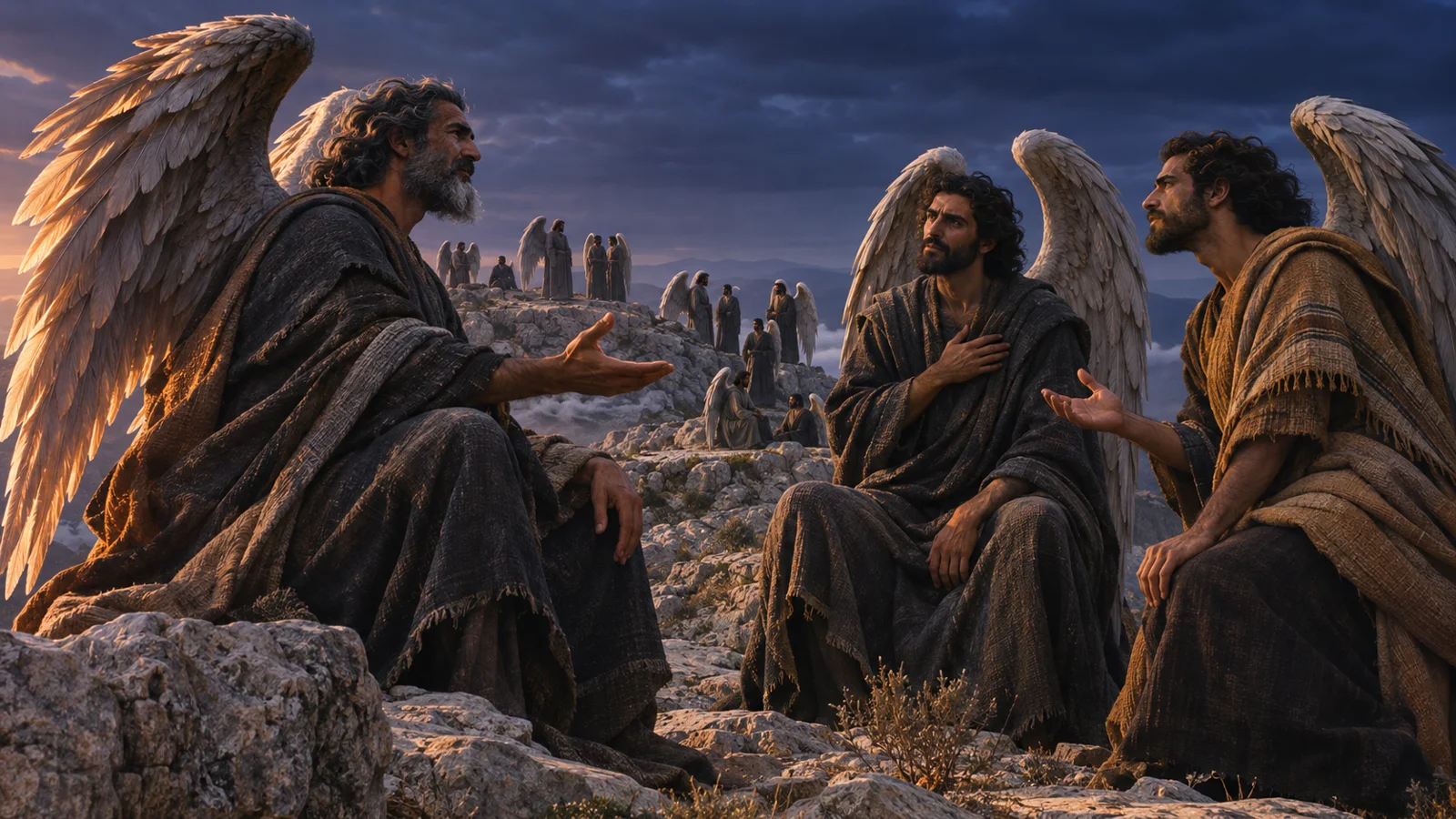
Source: AI-generated editorial illustration for Beyond The Known.
When the Watchers discuss taking human wives, their chief voices one fear: if the others withdraw, he will answer for the deed alone. Shemihazah calls the deed a grave sin (1 Enoch 6:3). His companions answer by swearing together and placing themselves under a curse if they turn back. The oath solves a problem of trust among the conspirators. It gives none of them authority to do what they have agreed to do. The narrator connects the name of Mount Hermon to the curse the Watchers swear there (6:6).
The previous study of the seasons in 1 Enoch 2–5 ended with a speaker holding his hearers responsible for the way they use their mouths. Chapter 6 opens with a particularly consequential use of speech. Before any giant has been born, and before the text describes the taking of wives, a group makes a promise. A reading that jumps from heavenly desire straight to the giants loses the moment at which the participants themselves put a name to the gravity of their choice. References here follow George W. E. Nickelsburg and James C. VanderKam’s Hermeneia translation.
Where Enoch slows down the story in Genesis
Place Genesis 6:1–4 in the New American Bible, Revised Edition beside 1 Enoch 6:1–3. The two openings invite comparison even before a reader gets to the identity of the heavenly beings. Human beings multiply. Daughters are born. Their beauty comes to the attention of figures associated with heaven. In Genesis, seeing the women and taking wives occupy a single verse. The next voice heard belongs to the Lord. Genesis gives no transcript of deliberations among the sons of God and names no mountain as the site of an agreement.
In Enoch, the interval between seeing and taking expands until it can accommodate almost a whole chapter. The sons of heaven speak to one another, suggesting that they choose women and have children. A named leader speaks in reply. His companions have an answer for him. Only in 7:1 does the narrator report the taking of wives. That placement matters for the question of responsibility. The oath cannot be a belated attempt to cover up a deed already carried out. It comes at a point when the participants could still abandon their proposal, and their words address that very possibility.
The translators’ note to 6:1 explains why they preserve the repeated language of sons and daughters. Smoothing the whole passage into a reference to angels and people would obscure the relationship between the two openings. Yet the resemblance also has a limit. Someone looking up the Mount Hermon episode in Genesis will search in vain. The Enochic writer develops the biblical episode in a distinctive direction. The Genesis study of the Nephilim examines the biblical wording on its own terms. The oath is evidence for how the Book of the Watchers tells the story. Importing it into a paraphrase of Genesis would silently give the biblical narrator an explanation he does not supply.
What the chief actually fears
The first proposal is plural. The Watchers speak to one another about something they want to undertake together. Shemihazah does not introduce the idea in a speech to reluctant followers. He first appears by name as the chief who replies to an initiative already voiced among them. This is a small grammatical detail with a considerable effect on a familiar picture of the rebellion. A named chief is easier to remember than an unnamed assembly. It is also easier, and misleading, to let that one memorable character become the author of every decision in the scene.
His words in verse 3 give a precise object for his fear. He anticipates a future in which the others decide against the deed and he alone bears guilt for a grave sin. He does not ask how human beings will react or whether he and the others have the power to descend. Neither does he ask whether the proposed conduct is permissible. He has already described it in moral terms. His objection concerns what the others will do after he has counted on them. The scene leaves open what any individual Watcher had privately intended before he spoke.
Two translations bring out different aspects of the objection. In R. H. Charles’s rendering of 6:3, the chief anticipates paying the penalty alone. Nickelsburg and VanderKam express his fear in terms of being guilty alone. The first wording directs attention toward what might happen to him. The second draws attention to what could be laid to his charge. In both, the decisive qualification is his isolation. Changing editions does not turn the scene into a confession of remorse. Nor does a difference between two English sentences, by itself, identify a difference between ancient manuscripts.
Try asking what reply would have addressed a genuinely different concern. If the chief had asked for proof that the marriage was lawful, his companions might have offered a precedent or claimed permission. They offer neither. If he had doubted their ability to reach the earth, an oath about their willingness to follow through would have left the practical obstacle intact. The fact that he accepts this particular reply helps identify the problem it answers. The others provide him with a reason to expect continued participation. They leave his judgment about the deed itself untouched.
A condition for turning back
The group’s answer has more content than an ordinary expression of agreement. It sets a condition for each participant’s future conduct. Under the proposed curse, a participant is to remain committed until the undertaking has been carried out. This tells us what action the oath is designed to prevent. It would make retreat, which might otherwise stop a wrong, into an act of bad faith toward the other conspirators. The narrative allows a disturbing possibility. A person may keep a promise with complete fidelity and in doing so carry a wrongful act through to completion.
Verse 5 deserves to be read as its own sentence. In verse 4 the Watchers propose swearing. In verse 5 the narrator reports that they actually swear. One could delete the second statement and still know what arrangement they had considered. One could no longer say with the same certainty that the whole assembly had entered it. Repetition does work here that an illustration cannot. No gesture, expression or arrangement of figures on a mountainside could establish that everyone spoke. The narrator expressly affirms their participation before giving their number.
The curse is attached to a possible withdrawal. The divine judgment described later addresses the Watchers’ transgression. Those are two distinct grounds for a consequence. The text gives no formula specifying who would enforce the mutual curse, what particular harm it would bring, or whether anyone ever tried to withdraw and suffered it. A reader who describes the later punishment as the fulfillment of this curse has reversed its condition. The later story treats the Watchers as culpable for going ahead with the deed to which they pledged themselves.
Why the mountain receives a name
Only after reporting the agreement does verse 6 give a number, a time and a place. Two hundred descend in the days of Jared onto Mount Hermon. The narrative then connects the mountain’s name with the oath and curse sworn there. That last detail matters when imagining a timetable. Because the oath is reported before the descent, a summary can easily put the swearing in heaven and the arrival on Hermon afterward. Yet the same verse explicitly locates the swearing on the mountain. The order in which the narrator discloses details does not provide a travel itinerary precise enough to separate those events into two locations.
The name gives the audience something to carry away from a conversation it could never have witnessed. A mountain can be pointed to or named again long after speakers have fallen silent. Within the story, its name recalls what was agreed there. That is a literary explanation of a place-name. Establishing the historical origin of the name would be a different inquiry requiring evidence about usage outside this passage. Nor does the verse identify the exact spot where someone standing on the massif today would find traces of an assembly.
The image above chooses a broad ridge and a handful of figures so that a reader can see an exchange taking place. The source gives two hundred as the number who descended. It supplies no costume, gesture or description of Shemihazah’s face. There is a more consequential omission in the text itself. Although the Watchers imagine wives and offspring, none of the women is a party to the promise. Those making commitments to one another here are the visitors. Their assurance that everyone agrees extends only to their own group. It tells us nothing about the wishes of the people their decision will affect.
What can a list of names establish?
After the number comes a list that can look dispensable to anyone reading for plot. The narrator has already told us that all swore. Why linger over a roster? Notice its heading in verse 7. These are the chiefs. A list of the names of all two hundred would do a different job. Read as a list of leaders, it preserves distinctions inside the group even after the repeated insistence that all participated. Shemihazah appears first. Other named figures have a place beside him. The reader can recognize some of them when particular kinds of instruction are attributed to particular teachers later on.
For example, the Hermeneia rendering includes Asael in the list in 6:7. In 8:1 the account singles him out as a teacher, and in 10:4–8 Raphael receives instructions concerning him. Michael receives a separate commission concerning Shemihazah and his associates in 10:11–12. The roster thus lets a reader follow an individual through more than one scene. Shared participation at Hermon never obliges the narrator to distribute identical deeds or identical narrative attention to each chief. The text can speak about all the Watchers in one breath and single one of them out in the next.
Another note in the same edition illustrates how small the difference between witnesses can be. At 6:2 the editors report additional wording in a Greek witness and in Syriac that explicitly describes a going astray. Read the main text without that addition and the moral assessment emerges sharply in the chief’s reply in verse 3. With the addition, the reader encounters an adverse judgment already in the description of desire. In either reading the assembly still deliberates. The variant affects when the judgment is heard, without changing who proposes the oath. That is a more limited claim, and a more interesting one, than saying that different witnesses tell entirely different stories.
The list also tests the reliability of modern reconstructions. The Hermeneia translators note that many names have suffered in transmission in Greek and Ethiopic and that Aramaic evidence helps them establish the list. On the same page they flag uncertainty about the wording of 6:8, which concerns leadership in tens. A printout that arranges the names in an immaculate chart of units may suggest a precision its source does not possess. Two hundred is the number in verse 6. The chiefs are a named subset in verse 7. Those two observations are considerably firmer than a complete command chart inferred from them.
A manuscript check at the point where the plan becomes a deed
A reader can test the transition into chapter 7 against a specific ancient witness. Open the Dead Sea Scrolls exhibition entry for 4Q201, an Aramaic parchment copy dated there to approximately 200–150 BCE. Its English excerpts come from J. C. Greenfield, working from J. T. Milik’s transcription with amendments. Choose the second excerpt, column iii, lines 13–16. The preceding excerpt on the same page concerns the accusation of chapter 5. Neither excerpt as printed there presents the wording of the Hermon oath.
Line 13 places the words identifying the leaders and others as subjects inside square brackets. In line 14, the words about wives chosen by the participants stand outside the brackets. The subsequent wording about cohabitation and defilement is supplied within brackets. The difference can be checked without accepting a claim about the shape of an Aramaic letter. Look first at where the closing bracket falls at the end of line 13, then at where the next one opens in line 14. Greenfield is presenting a readable sequence while allowing the reader to distinguish restoration from surviving evidence.
Now set that line beside 7:1 in the Hermeneia translation. The wives have ceased to be the object of a proposal and have become part of a reported deed. The exhibition’s surviving phrase bears on precisely that transition. It gives an early witness to language about chosen wives at the point where the continuous text reports the taking. It cannot independently confirm each reconstructed word about the leadership, much less supply the wording of the promise in the preceding chapter. The comparison is valuable partly because the exact point at which its evidence runs out can be seen on the page.
Line 15 goes on to teaching, and line 16 to pregnancy. The display places portions of each line within brackets. Even so, the movement from choosing wives toward consequences for the next generation is visible in more than a modern chapter heading. That is the broader interest of this small document for the oath scene. The reader who turns the printed page from chapter 6 into chapter 7 has moved from what the Watchers say they will accomplish into events that involve other lives. The physical witness helps locate that movement without certifying every detail of a continuous modern translation.
The Deeper Discovery
Much later the reader discovers whether Shemihazah will have to face judgment alone. In 10:11 Michael is instructed to bind him together with the others who took human wives. Read those directions after 6:4–5 and the reversal is hard to miss. On Hermon the Watchers undertake to bind one another so that no one will leave. In the judgment scene, the authority to bind them belongs to someone outside their agreement. This observation concerns the repeated action in the English reading text. It does not require reconstructing an identical Aramaic verb behind every occurrence.
In one limited respect, the arrangement has worked exactly as the chief hoped. He has company when the consequences arrive. Having company provides no defense. The next episode involving their appeal sharpens the irony further. In 13:3–4 the group asks Enoch to put a petition in writing for them. The beings who once considered their own spoken undertaking sufficient to settle their course now depend on another voice to present their request. Read from Hermon to that petition, the oath is a striking measure of what the rebels can and cannot accomplish by speaking together. They can secure one another’s cooperation. They cannot determine how their deed will be judged.
FAQ
Does Enoch witness the oath in chapter 6?
Chapter 6 gives Enoch no part in the conversation on Hermon. He enters the dispute later as an intermediary when the Watchers ask him to write and present their petition (13:3–4).
Are Semjâzâ and Shemihazah different leaders?
These are forms used for the chief in the English editions compared here. A difference in the spelling of his name is insufficient evidence for a second character.
Are the giants present at the swearing?
The children are still prospective in 6:2. Their birth belongs to the account that follows the taking of wives in chapter 7.
Does the passage say the oath was made to God?
The speakers undertake the obligation among themselves and bind one another. The chapter records no divine acceptance or authorization of it.
What Comes Next?
The two hundred can promise to see their undertaking through. They cannot promise that the earth will be able to feed their children. Chapter 7 follows the consequences from human labor to an accusation brought by the earth itself. Explore the Ancient Texts collection. Next study: Why Does the Earth Bring an Accusation in 1 Enoch 7?
Selected Sources
George W. E. Nickelsburg and James C. VanderKam, 1 Enoch: The Hermeneia Translation, pp. 23–25, 28–29, 32. Reading text and notes on the chiefs’ names and the wording of 6:8.
Genesis 6:1–4, New American Bible, Revised Edition. The biblical sequence of seeing and taking against which the Enochic dialogue is read.
R. H. Charles, The Book of Enoch, chapter VI. Comparison of the chief’s speech and the terms of the oath.
J. C. Greenfield, exhibition translation of 4Q201, column iii, lines 13–16, following Milik’s transcription as amended by Greenfield. Distinction between preserved and restored language about the taking of wives.