Why Did God Ask Israel to Build Him a Sanctuary?
Exodus 25 Explained: Voluntary Offerings, the Ark, Cherubim, Bread of the Presence, the Menorah, and God’s Dwelling Among Israel
Source: AI-generated image created for Beyond The Known.
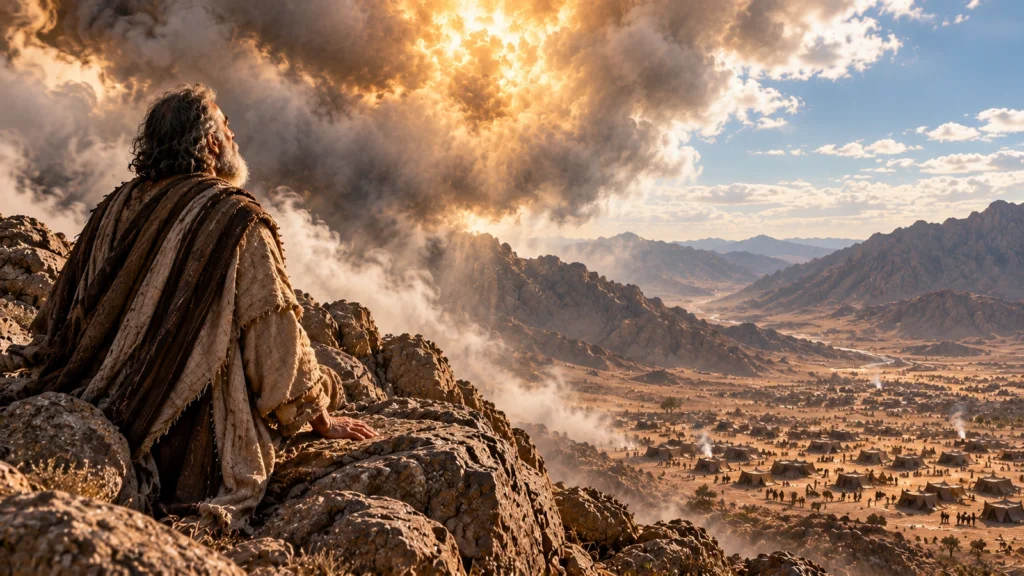
Moses has disappeared into the cloud on Mount Sinai.
Below him stands a nation that has just entered a covenant through spoken words, written commands, sacrifice, blood, and a meal before God.
The question behind Exodus 25 is straightforward: why did God ask Israel to build him a sanctuary?
The previous study, Why Was Israel’s Covenant Sealed with Blood?, ended with Moses moving farther into a place the rest of Israel could not enter.
Then Exodus 25 changes direction.
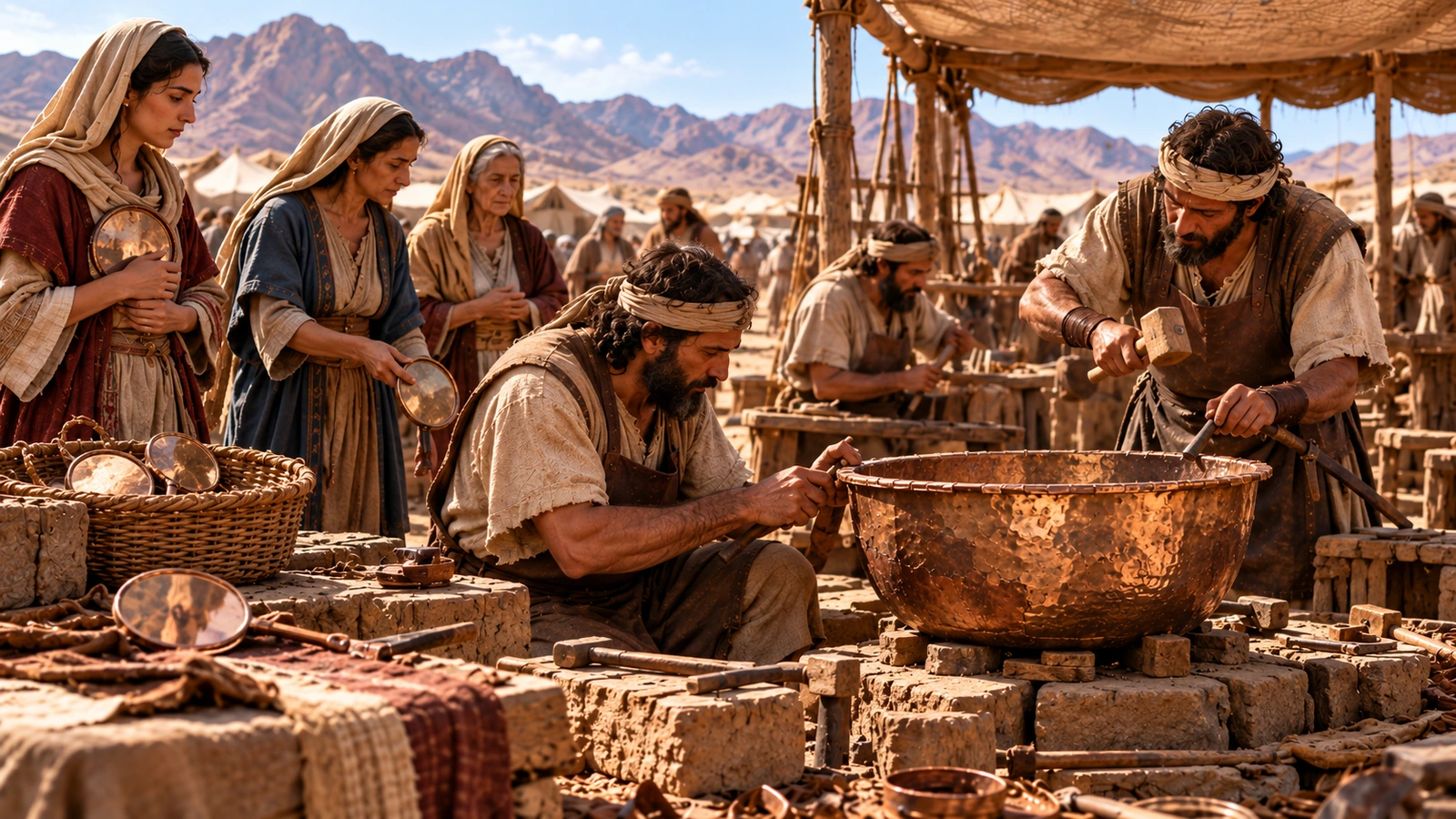
YHWH asks for gold.
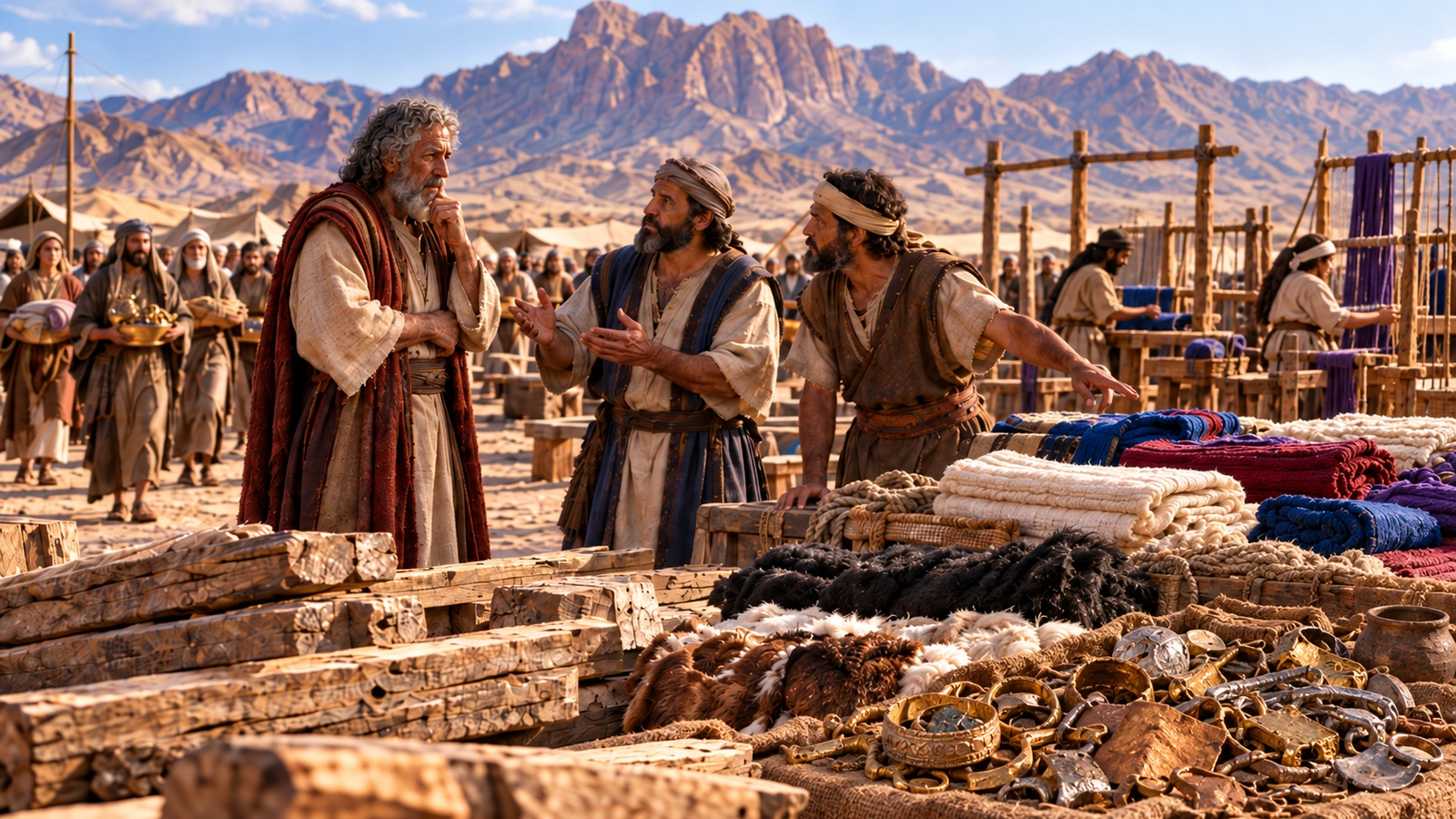
Silver. Bronze. Fine fabrics. Animal skins. Acacia wood. Oil. Spices. Precious stones.
The list sounds almost like an inventory until verse 8 reveals why these materials matter:
“Let them make me a sanctuary, that I may dwell among them.”
That sentence changes the story of Sinai.
Israel cannot remain beside the mountain forever. Yet the God encountered there intends to remain in their midst.
The question is not simply why Israel needed a sacred tent.
It is how the presence that made Sinai dangerous, holy, and inaccessible could accompany a people moving through the wilderness.
The Sanctuary Begins with a Gift
Before Moses receives a measurement or construction detail, YHWH tells him to collect a contribution.
The Hebrew noun is:
תְּרוּמָה — tərûmâ — contribution / offering
The term refers to something set apart and presented for sacred use.
But Exodus adds a qualification.
Moses is to receive it from each person whose heart moves that person to give.
The project itself is commanded.
The individual contribution is described as willing.
That combination deserves attention.
YHWH does not begin the tabernacle instructions by imposing a tax schedule. The materials for the sacred dwelling are drawn from possessions Israelites choose to set apart.
Gold matters.
So does the disposition of the giver.
Later, when the materials are actually collected in Exodus 35, this language of willing hearts will return.
The sanctuary begins before the first object is built.
It begins with relinquishment.
Why Does Exodus List So Many Valuable Materials?
The inventory in Exodus 25:3–7 is unusually rich.
Gold, silver, and bronze appear beside blue, purple, and scarlet yarns, fine linen, goat hair, skins, wood, oil, aromatic substances, onyx, and other stones.
This is not the description of an ordinary desert shelter.
The dwelling will be portable, but portability does not make it crude.
Its materials distinguish sacred space from the common tents surrounding it.
Earlier in Exodus, the Israelites are said to have departed Egypt with articles of silver, gold, and clothing. That provides a narrative background for at least some of the wealth now available.
Exodus 25, however, does not explain the origin of every material.
Its interest lies elsewhere.
Objects once held as personal property are being redirected toward a communal sacred purpose.
“That I May Dwell Among Them”
Verse 8 supplies the purpose before the architecture begins:
וְעָשׂוּ לִי מִקְדָּשׁ וְשָׁכַנְתִּי בְּתוֹכָם
wəʿāśû lî miqdāš wəšākantî bətôkām
“Let them make me a sanctuary, and I will dwell among them.”
The word:
מִקְדָּשׁ — miqdāš — sanctuary / holy place
belongs to the language of holiness.
The verb:
שָׁכַן — šākan — dwell / settle / reside
is closely related to:
מִשְׁכָּן — miškan — dwelling / tabernacle
The verbal relationship is fitting.
Israel will construct a miškan because YHWH intends to šākan among them.
Yet the preposition is just as significant as the noun.
The verse does not simply say that God will dwell inside the structure.
It says he will dwell among them.
The building is important because of what it makes possible within the life of the community.
Did God Need a House?
Nothing in the narrative suggests that YHWH requires protection from heat, wind, or rain.
The God speaking from the summit of Sinai is not portrayed as lacking shelter.
Exodus has created a different problem.
At the mountain, divine nearness is concentrated in one dangerous location.
Boundaries are imposed.
The people cannot ascend.
Even the elders approach only under specific conditions.
Moses alone enters the cloud.
But Israel is a traveling people.
When the camp eventually moves away, the relationship established at Sinai must not be reduced to a memory of a mountain left behind.
The tabernacle addresses that narrative tension.
Sacred nearness will no longer be associated only with a fixed summit.
A mobile dwelling will stand within the camp.
Sinai cannot travel.
The tabernacle can.
Moses Must Follow a Pattern
Before describing the ark, YHWH tells Moses to construct the dwelling and its furnishings according to what he is being shown.
The key word is:
תַּבְנִית — tabnît — pattern / form / model
Exodus 25:9 uses the term, and verse 40 returns to it.
What exactly did Moses see?
The chapter does not tell us.
Tabnît can refer to a form, likeness, design, or model. Some interpreters have understood the passage as describing a heavenly sanctuary that serves as the archetype for the earthly one.
That reading becomes explicit in later Christian interpretation, especially Hebrews 8:5.
Exodus itself is more restrained.
It says that Moses is shown a tabnît on the mountain and must reproduce the revealed design faithfully.
The secure point is not that the reader can reconstruct what Moses saw.
It is that Moses is not presented as the architect inventing the sanctuary from personal preference.
The design carries divine authorization.
Later interpretation developed the heavenly-sanctuary reading of Exodus 25:40 considerably, but that development should remain distinct from what the chapter states directly.
Why Does God Begin with the Ark?
The first object described is not a curtain, wall, entrance, or frame.
It is the ark.
That order is revealing.
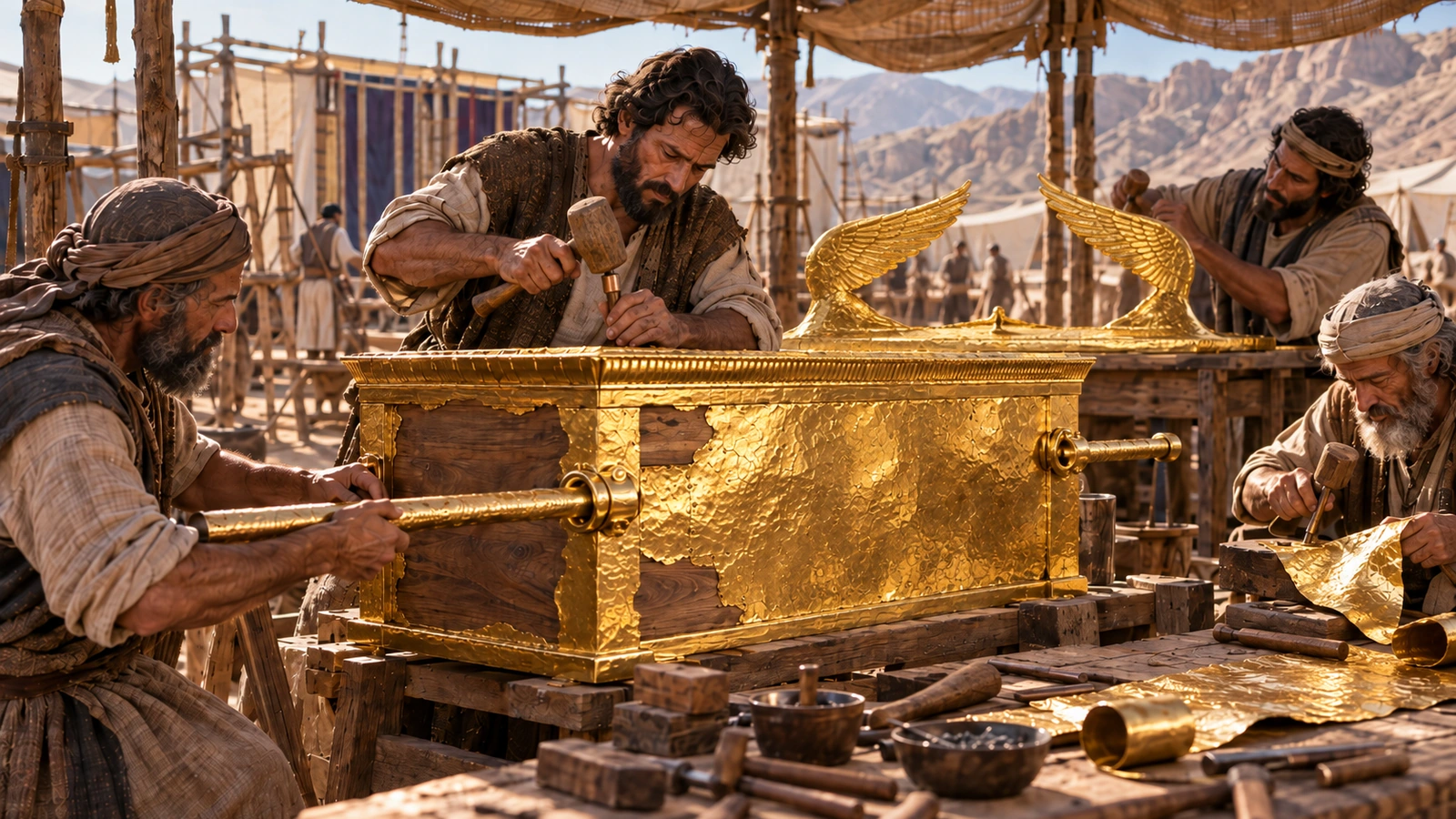
The Hebrew word:
אָרוֹן — ʾārôn — ark / chest
refers to a wooden container made from acacia wood and covered with gold inside and outside.
Rings are attached to it.
Gold-covered poles pass through those rings.
The poles are to remain in place.
Mobility has been designed into the object from the beginning.
The ark is not made for a permanent stone chamber.
It belongs to a sanctuary that must travel.
Inside it Moses is instructed to place:
עֵדֻת — ʿēdût — testimony
which YHWH promises to give him.
Later in Exodus, the testimony is identified with the stone tablets.
The sacred chest therefore contains covenantal witness.
It does not contain an image of Israel’s God.
That absence becomes even more striking once the cherubim are introduced.
The Ark Does Not Contain God
It is easy for later imagination to turn the ark into a magical container of divine power.
Exodus 25 does not describe it that way.
The testimony is placed inside.
YHWH speaks from above.
Verse 22 locates the encounter over the gold kappōret, between the cherubim.
That distinction matters.
The divine presence is not represented by a statue enclosed in the chest.
No face is carved for YHWH.
No body is placed upon the ark.
The object preserves the testimony of the covenant while marking a place from which divine speech will be heard.
What Is the Kappōret?
A piece of pure gold is placed above the ark.
Its Hebrew name is:
כַּפֹּרֶת — kappōret
Translating this term is difficult.
Traditional English Bibles often use “mercy seat.”
Other translations prefer “atonement cover” or simply “cover.”
Each rendering carries interpretive assumptions.
Later priestly ritual, especially Leviticus 16, gives the kappōret a major role in purification and atonement ceremonies. That later material influences how translators understand the word.
In Exodus 25, the safest description begins with what can actually be observed from the instructions.
The kappōret is made of pure gold, rests above the ark, supports the two cherubim as part of the same crafted unit, and marks the place from which YHWH promises to meet Moses.
Its importance is not merely physical.
The narrative turns this object into a point of encounter.
What Were the Cherubim?
Two cherubim stand at opposite ends of the kappōret.
The Hebrew plural is:
כְּרֻבִים — kərubîm — cherubim
Their wings extend upward and overshadow the gold surface.
They face one another.
Their faces are directed toward the kappōret.
That is almost everything Exodus tells us about their appearance.
The familiar Western image of a “cherub” as a small winged child comes from much later artistic tradition.
It should not be projected into this passage.
Ancient Near Eastern art contains numerous winged composite beings associated with sacred spaces, royal symbolism, and protection. Those comparisons help establish a visual world in which such figures were intelligible.
They do not tell us exactly what Israel’s cherubim looked like.
Scholars have also debated whether the ark-and-cherubim arrangement evokes a throne, a footstool, or another form of divine royal symbolism. Menahem Haran’s classic study is an important example of that discussion.
Exodus itself keeps the focus on a more immediate claim.
YHWH will speak from between them.
The Most Important Part of the Ark Is a Voice
Gold dominates the description.
Yet the ark section reaches its climax with speech.
YHWH says that he will meet Moses there and communicate everything that must be commanded to the Israelites.
The sanctuary is not merely a place where offerings are deposited.
It becomes a site of revelation.
That connection reaches backward to Exodus 24.
Moses is currently on the mountain because YHWH called him upward.
He entered the cloud to receive instruction.
Exodus 25 now establishes a place within the future camp where that communicative relationship can continue.
The location changes.
The divine voice does not.
Why Is There a Table Before God?
The next furnishing is a gold-covered table made from acacia wood.
Like the ark, it has rings and poles.
It also travels.
Its vessels are fashioned from gold, and bread must remain upon it continually.
The Hebrew expression is:
לֶחֶם פָּנִים — leḥem pānîm — bread of the Presence / bread of the face
The phrase refers to bread kept before YHWH.
Exodus 25 gives only a brief instruction.
Later legislation in Leviticus 24 explains that twelve loaves are involved and provides further ritual details.
Those later specifications should not be read backward as though Exodus 25 has already stated them.
Here the emphasis is continuous placement.
Bread remains before YHWH within the ordered service of the dwelling.
Does the Bread Mean God Needed Food?
Ancient temples throughout the Near East commonly included food offerings for deities.
That historical background can illuminate the environment in which temple meals and offerings were understood.
Similarity, however, does not erase difference.
Exodus 25 never says that YHWH requires bread for nourishment.
It does not depict a deity dependent on human feeding.
The food is placed before him.
Its function belongs to worship and sacred service, not divine survival.
That restraint matters when ancient parallels are used.
Context can clarify a practice without forcing Israel’s theology into the assumptions of every neighboring cult.
The Menorah Is Designed Like a Living Plant
The final major furnishing in the chapter is the lampstand:
מְנוֹרָה — mənôrâ — lampstand
It is made from pure hammered gold.
A central shaft supports six branches, three on each side.
Then the vocabulary changes.
The description begins to sound botanical.
There are cups shaped like almond blossoms.
There are buds.
There are flowers.
The branches grow outward from a central stem.
Seven lamps provide light.
The result is more than a practical stand for flames.
Its form deliberately evokes a flowering plant.
Was the Menorah the Tree of Life?
The connection is tempting.
A golden, branching, flowering object stands inside sacred space and produces light.
Scholars have long compared the menorah with sacred-tree imagery, and Carol Meyers devoted a major study to its symbolism and ancient context. Her work also places the lampstand within wider discussions of trees in biblical and Near Eastern art.
Still, Exodus never calls the menorah the Tree of Life.
That limit should remain intact.
Its floral design is explicit.
An identification with Eden’s tree is interpretive.
The distinction does not weaken the imagery.
It makes the observation more defensible.
The text gives us a golden object shaped by the language of growth, blossoms, branches, and light.
That is already enough to make the menorah unlike an ordinary lamp.
Why Are the Instructions So Detailed?
Modern readers often reach the tabernacle material and feel the story has stopped.
Measurements replace conflict.
Craftsmanship replaces dialogue.
Rings, poles, borders, bowls, flowers, and construction techniques fill the page.
But technical detail is part of the literary form.
Brian Donnelly-Lewis has compared Exodus 25–31 with Akkadian procedural texts used to transmit specialized manufacturing instructions. He points to features such as second-person directives, technical vocabulary, and descriptive clauses, arguing that the tabernacle commands share important characteristics with an ancient instructional genre.
That comparison does not prove that Exodus copied one Mesopotamian manual.
It does something more modest and useful.
It helps explain why the passage sounds like a manual.
The density is intentional.
Israel is not told to construct “something sacred” according to artistic instinct.
The craftsmen will work from specifications.
Can Archaeology Reconstruct the Tabernacle?
Not with certainty.
Portable textile structures leave a different archaeological record from monumental stone buildings.
The historical setting and literary development of Exodus 25–40 are also heavily debated.
Historical-critical scholarship has often connected these chapters with priestly tradition. Some reconstructions argue that features of the wilderness sanctuary reflect later temple institutions projected back into Israel’s foundational story.
Other scholars give greater weight to older traditions of mobile sanctuaries and to ancient parallels for portable sacred structures.
Neither archaeology nor literary criticism provides a photograph of the tabernacle.
Material culture can illuminate metals, textiles, woodworking, sacred furniture, winged creatures, incense, lampstands, and temple environments.
That evidence supplies context.
It does not verify every element of the biblical account.
The distinction protects both archaeology and the text from claims neither can sustain.
The Deeper Discovery
Exodus 25 contains a structural detail that is easy to miss.
The first group of furnishing instructions is enclosed by the same idea.
Before the ark is described, verse 9 tells Moses to make everything according to the tabnît shown to him.
After the ark, table, and menorah have been described, verse 40 returns to the command:
Moses must make them according to the pattern shown on the mountain.
The repeated word creates a frame.
Inside that frame stand the three objects that define the chapter’s sacred interior.
The ark contains covenant testimony and becomes the place associated with divine speech.
The table holds bread continually before YHWH.
The menorah supplies light through a design shaped like a flowering plant.
But the frame around all three says something just as significant:
none of them originates in Israelite improvisation.
The chapter begins with willing human gifts, yet it does not end in human religious invention.
Israel supplies the materials.
The design is given.
That tension runs through the entire chapter.
Human beings contribute gold, wood, fabric, oil, and skill.
They do not decide what divine presence should look like on their own terms.
Exodus 25 therefore holds two forms of participation together.
The people give willingly.
They build obediently.
And the purpose announced before any object is made remains the controlling one:
YHWH intends to dwell among them.
FAQ
Why did God ask Israel to build a sanctuary?
Exodus 25:8 gives the stated purpose: YHWH intends to dwell among Israel. The sanctuary provides an ordered sacred space for divine presence, worship, and revelation as the people move beyond Sinai.
Were the tabernacle offerings voluntary?
The project itself is commanded, but the contributions are to come from people whose hearts move them to give. Exodus presents the materials as willing offerings set apart for sacred use.
What was kept inside the Ark of the Covenant?
Exodus 25 calls it the ʿēdût, or “testimony,” that YHWH will give Moses. Later in Exodus, this testimony is identified with the stone tablets.
What was the kappōret?
The kappōret was the pure-gold element positioned above the ark beneath the cherubim. Its translation is disputed; “mercy seat,” “atonement cover,” and “cover” are common renderings. Exodus 25 emphasizes it as the location above which YHWH will meet and speak with Moses.
What did the cherubim look like?
The passage describes their wings, faces, position, and orientation but does not provide a complete anatomy. They should not be imagined as the small winged children of later European art.
Was the menorah a representation of the Tree of Life?
Exodus never identifies it as the Tree of Life. Its branches, almond blossoms, buds, and flowers create unmistakable plant imagery, making comparisons with sacred-tree symbolism reasonable but inferential.
What was the pattern shown to Moses on Sinai?
The Hebrew tabnît can mean pattern, form, or model. Exodus says Moses was shown it on the mountain and had to reproduce the design faithfully. The chapter does not describe exactly what he saw.
Exodus 25 has established the purpose of the sanctuary and described its sacred furnishings.
Yet there is still no room around them.
No curtains surround the ark.
No veil separates the innermost space.
No entrance marks where one zone ends and another begins.
Exodus 26 will construct those boundaries.
And once the walls of fabric go up, a new question emerges.
If YHWH wants to dwell among Israel, why must his nearness still be concealed behind layers, divisions, and a veil?
Why Did the Tabernacle Need Curtains, Veils, and Sacred Boundaries?
Selected Sources
- Brevard S. Childs, The Book of Exodus: A Critical, Theological Commentary. Old Testament Library. Westminster Press, 1974.
- John I. Durham, Exodus. Word Biblical Commentary 3. Word Books, 1987.
- Menahem Haran, “The Ark and the Cherubim: Their Symbolic Significance in Biblical Ritual.” Israel Exploration Journal 9 (1959): 30–38, 89–94.
- Carol L. Meyers, The Tabernacle Menorah: A Synthetic Study of a Symbol from the Biblical Cult. American Schools of Oriental Research Dissertation Series 2. Scholars Press, 1976.
- Brian Donnelly-Lewis, “The Tabernacle Manual: Exodus 25:1–31:18 in Light of the Cuneiform Procedural Genre.” Journal of Biblical Literature 141.4 (2022): 617–634.
- William H. C. Propp, Exodus 19–40: A New Translation with Introduction and Commentary. Anchor Bible 2A. Doubleday, 2006.
- Nahum M. Sarna, Exodus: The Traditional Hebrew Text with the New JPS Translation. JPS Torah Commentary. Jewish Publication Society, 1991.