Why Did God Refuse to Go with Israel After the Golden Calf?
Exodus 33 Explained: The Tent Outside the Camp, Moses’ Intercession, God’s Presence, and the Glory Moses Could Not Fully See
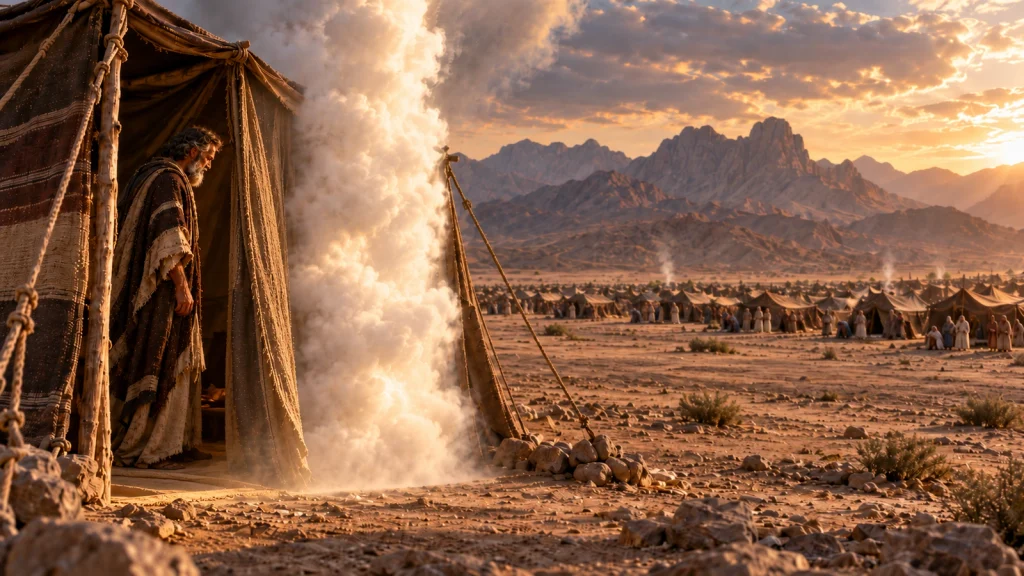
Source: AI-generated image created for Beyond The Known.
Exodus 32 ended with Israel still alive, but the covenant crisis unresolved. The calf had been destroyed, the tablets shattered, judgment had fallen, and Moses had interceded successfully against the destruction of the nation.
The previous study, Exodus 32: Why Israel Made the Golden Calf at Sinai, ended with a question more serious than whether Israel would reach Canaan: would YHWH himself still go with them?
Exodus 33 opens with a disturbing answer. The journey may continue. The land is still promised. An angel will still go ahead. But YHWH says:
“I will not go up among you.”
Israel may still receive the destination while losing the presence that made the journey meaningful.
Why?
The Promised Land Is Still Promised
YHWH tells Moses to leave Sinai and continue toward the land sworn to Abraham, Isaac, and Jacob. The patriarchal promise has not been erased. An angel will go before Israel, and the peoples of Canaan will be driven out.
Then comes the qualification: YHWH will not go in Israel’s midst.
The reason is explicit. Israel is a “stiff-necked people,” and YHWH warns that his immediate presence among them could consume them on the way.
That makes the threatened withdrawal both judgment and protection. The golden calf has not made YHWH unable to fulfill the land promise. It has made his nearness dangerous to a people who have already violated the covenant.
This is especially severe in the literary context of Exodus. The tabernacle instructions had repeatedly anticipated God dwelling among Israel. After the calf, that promise is now in jeopardy.
Israel Mourns the News
The people do not respond with relief that Canaan is still available.
They mourn.
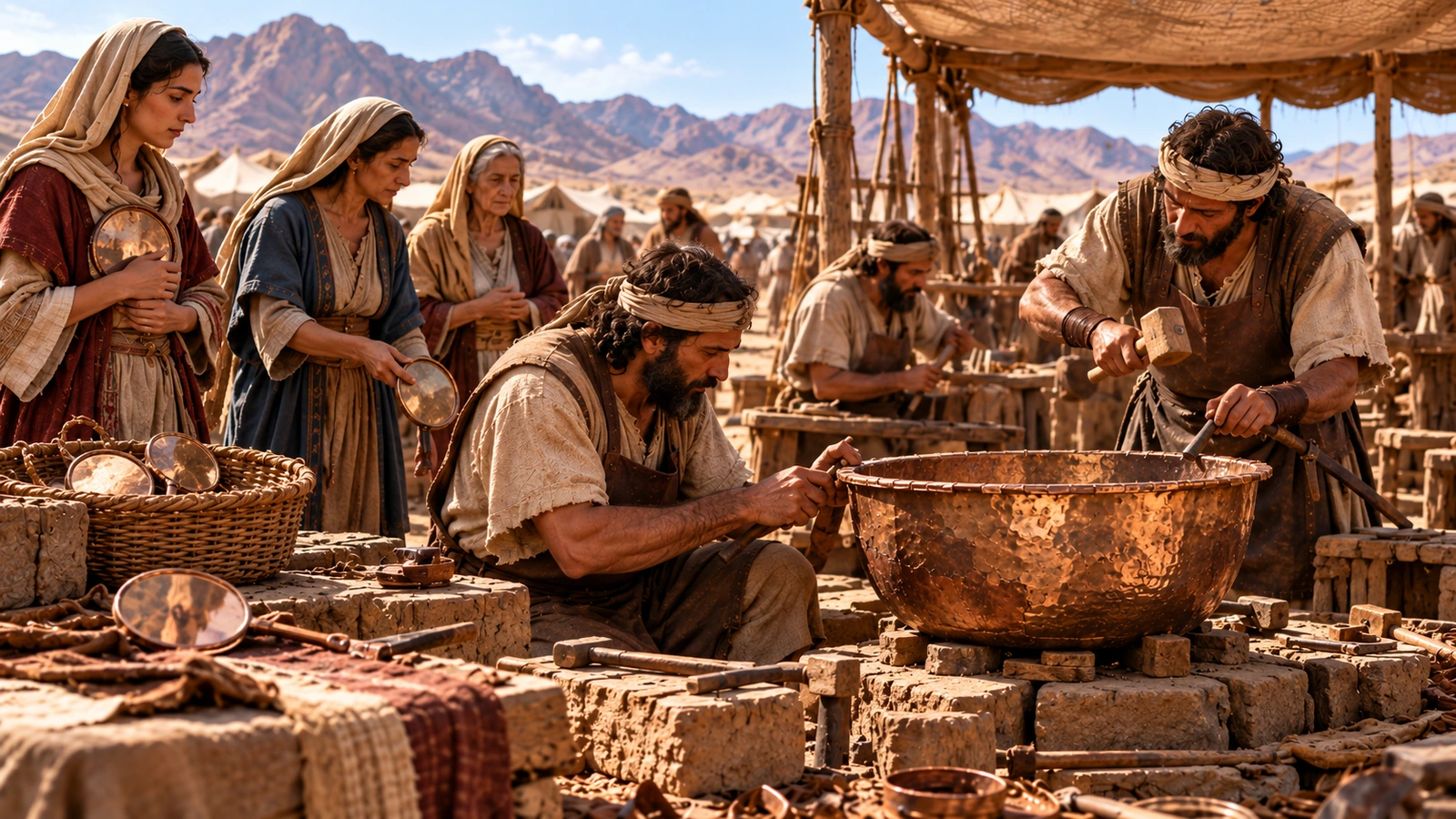
No one puts on ornaments, and YHWH tells them to remove their adornments while he determines what will happen next.
The Hebrew word is:
עֲדִי — ʿădî — ornament / adornment
The text does not condemn jewelry as such. In this scene, removing ornaments functions as an outward expression of grief and lowered status before God.
The contrast with Exodus 32 is hard to miss. Gold had recently been gathered for the calf. Now Israel strips off adornment as the seriousness of the rupture becomes clear.
The journey can still continue, but the relationship cannot simply return to normal.
Why Is the Tent of Meeting Outside the Camp?
Verses 7–11 introduce one of the chapter’s most discussed features.
Moses takes a tent and places it:
מִחוּץ לַמַּחֲנֶה — miḥûṣ lammaḥăneh — outside the camp
at some distance from Israel.
It is called the Tent of Meeting.
That raises an obvious question. How can there already be a “Tent of Meeting” when the elaborate tabernacle described in Exodus 25–31 has not yet been constructed?
Several explanations have been proposed. Many interpreters understand this as a provisional meeting place used before the tabernacle was completed. Historical-critical scholarship has often argued that Exodus 33:7–11 preserves a distinct or earlier Tent of Meeting tradition. Max Rogland has also challenged the common assumption that the verbs merely describe Moses’ habitual practice, arguing that their force may be more closely tied to the present crisis.
Those questions matter for the compositional history of Exodus, but the final narrative makes one point unmistakable:
the tent is outside the camp.
Presence Has Moved Away from the Center
The sanctuary project had anticipated divine dwelling in Israel’s midst.
Now the place where Moses meets YHWH stands at a distance.
Anyone seeking YHWH must go outside the camp. When Moses approaches the tent, the people stand at the entrances of their own tents and watch. The pillar of cloud descends, YHWH speaks with Moses, and the people worship.
So the scene is not one of total abandonment.
Communication remains possible.
But access now bears the mark of distance.
That makes the tent both a sign of rupture and an act of mercy. Israel’s rebellion has damaged nearness, yet YHWH still permits encounter.
What Does “Face to Face” Mean?
Verse 11 says:
פָּנִים אֶל־פָּנִים — pānîm ʾel-pānîm — face to face
YHWH speaks with Moses “as a man speaks with his friend.”
Later in the same chapter, however, YHWH says:
“You cannot see my face, for no one may see me and live.”
The tension is real and should not be explained away too quickly.
Within the final form of the chapter, the two expressions can function differently. “Face to face” in verse 11 emphasizes the unusual directness of Moses’ communication with YHWH. Verses 20–23 concern visual access in the context of Moses’ request to behold divine glory.
The first stresses immediacy of communication.
The second establishes a limit on sight.
Some scholars regard the chapter as preserving different traditions about how God may be encountered. A synchronic reading, however, can still recognize that “face” is doing more than one kind of work in the narrative.
Moses Wants More Than Personal Favor
When the dialogue resumes in verse 12, Moses returns to Israel’s future.
YHWH has told him to lead the people, but Moses wants assurance. He appeals to the fact that YHWH knows him by name and that he has found favor.
Then he adds:
“Consider too that this nation is your people.”
The wording continues the struggle already visible in Exodus 32. Moses will not accept a private relationship with God while Israel remains at a distance.
His concern is not merely whether he personally can complete the journey.
It is whether the people can continue as YHWH’s people.
“My Presence Will Go”
YHWH answers:
“My presence will go, and I will give you rest.”
The key expression is:
פָּנַי — pānay — my face / my presence
Literally, YHWH says that his “face” will go.
English translations usually render this idiomatically as “presence.”
There is also a grammatical detail worth noticing. The second-person form in “I will give you rest” is singular, addressed to Moses. That helps explain why Moses immediately presses the matter further.
He does not respond as though a private assurance is enough.
Instead he says:
“If your presence does not go with us, do not bring us up from here.”
Moses takes the assurance given to him and turns it into intercession for the whole nation.
What Makes Israel Different?
Moses then asks how anyone will know that he and Israel have found favor unless YHWH goes with them.
Without that presence, what distinguishes Israel from the other peoples of the earth?
His argument is striking because possession of Canaan is not enough.
Israel could have the land, angelic guidance, military success, and fulfillment of ancestral promises—and still lack what Moses considers essential.
YHWH’s presence is what marks Israel as a people in covenant relationship with him.
The promise cannot be separated from the Promiser.
YHWH Grants the Request
Verse 17 resolves the immediate negotiation.
YHWH tells Moses:
“This very thing that you have spoken I will do.”
Moses has found favor, and YHWH knows him by name.
The movement from verses 14 to 17 matters. The first assurance is expressed personally to Moses. Moses then speaks in the plural, and YHWH agrees to what he has asked.
The intercession has moved from Moses’ own standing before God to Israel’s future.
Then Moses asks for something even greater.
“Show Me Your Glory”
Moses says:
“Please show me your glory.”
The Hebrew noun is:
כָּבוֹד — kāḇôḏ — glory
The request follows naturally from the conversation. Moses has asked to know YHWH’s ways and has sought assurance that divine presence will remain with Israel. Now he asks for a deeper disclosure.
YHWH’s answer does not focus first on visual splendor.
He says:
“I will make all my goodness pass before you, and I will proclaim before you my name, YHWH.”
The word translated “goodness” is:
טוּב — ṭûḇ — goodness / good
YHWH then speaks of grace and compassion.
Moses asks for glory; the answer connects that glory with goodness, name, mercy, and divine freedom.
Exodus 34 will develop the connection further when YHWH proclaims his name before Moses.
The glory of God in this passage is therefore not reduced to appearance. It is bound to the disclosure of who YHWH is.
“I Will Be Gracious to Whom I Will Be Gracious”
The end of verse 19 has generated extensive theological discussion:
“I will be gracious to whom I will be gracious, and I will show mercy on whom I will show mercy.”
Later Jewish and Christian traditions have drawn this statement into debates over election, sovereignty, and grace.
Those discussions should not obscure the immediate context.
Moses is asking for extraordinary favor in the aftermath of Israel’s rebellion. YHWH’s response insists that grace and compassion remain his to give. They cannot be demanded, controlled, or turned into an entitlement—even by the mediator who has found favor.
Why Can Moses Not See God’s Face?
YHWH then tells Moses:
“You cannot see my face, for no one may see me and live.”
A place is prepared beside God.
Moses stands on a rock.
He is placed in a cleft.
YHWH covers him with a “hand” while passing by, then allows him to see what the text calls his “back,” but not his “face.”
The language is deliberately bodily:
face, hand, back.
Jewish and Christian theology has often read such descriptions anthropomorphically—that is, as human language used to speak about divine action without requiring a human-shaped divine body.
Some modern scholars, however, argue that texts like Exodus 33 preserve ancient Israelite ideas of divine embodiment more directly than later theology has sometimes allowed.
The article does not need to settle that wider debate.
The narrative point is clear enough: Moses receives a real encounter, but not unrestricted visual access.
Revelation Has a Boundary
Moses enjoys a degree of intimacy with YHWH unmatched by the rest of Israel.
He speaks “face to face.”
He is known by name.
His intercession changes Israel’s immediate future.
Still, a boundary remains.
Even Moses does not control the revelation he receives.
YHWH determines what passes before him, protects him, and decides what may and may not be seen.
The divine presence Israel desperately needs is therefore not something Israel can domesticate.
That is precisely what makes the golden calf such a profound failure.
The calf offered visibility on human terms.
Exodus 33 restores presence without surrendering divine freedom.
The Deeper Discovery
One Hebrew word quietly ties the whole chapter together:
פָּנִים — pānîm — face / presence
In verse 11, YHWH speaks with Moses:
“face to face.”
In verse 14, YHWH says:
“My face will go”—
the expression usually translated:
“My presence will go.”
Moses then responds:
“If your presence does not go with us…”
Finally, in verse 20, YHWH says:
“You cannot see my face.”
The repetition links the chapter’s two major questions.
First:
Will God’s face—his presence—go with Israel?
Then:
Can Moses see God’s face?
The first question receives a yes.
The second still receives a no.
Israel may receive divine presence without possessing divine visibility. Moses may know YHWH with extraordinary intimacy without mastering the mystery of YHWH.
That distinction is one of the chapter’s deepest achievements.
Exodus 32 showed Israel attempting to make divine presence visible through an object it could control.
Exodus 33 restores presence while preserving mystery.
YHWH will go with Israel.
But Israel will not reduce YHWH to something it can manufacture, contain, or fully see.
That is a more profound answer to the golden calf than simply destroying the idol.
FAQ
Why did God initially refuse to go with Israel?
Exodus 33:3 gives the reason directly: Israel was stiff-necked, and YHWH warned that his presence among them could result in their destruction. The threatened withdrawal therefore functions both as judgment after the golden calf and as protection from further judgment.
Did God completely abandon Israel in Exodus 33?
No. He promises an angel to lead them, continues speaking with Moses, and permits encounter at the tent outside the camp. The crisis concerns the nearness and form of his presence among Israel, not complete abandonment.
Was the Tent of Meeting in Exodus 33 the completed tabernacle?
That is debated. In the final narrative sequence, the tabernacle has not yet been constructed, so many interpreters understand Exodus 33:7–11 as a provisional meeting place. Historical-critical scholarship has often treated it as a distinct Tent of Meeting tradition. Its location outside the camp is explicit regardless of which reconstruction one adopts.
How could Moses speak with God “face to face” if he could not see God’s face?
The expressions occur in different contexts. Verse 11 emphasizes the directness of Moses’ communication with YHWH, while verses 20–23 limit visual access to the divine presence. Scholars differ over whether this resolves the tension completely or whether the chapter preserves different traditions about encountering God.
What does “My presence will go with you” mean?
The Hebrew literally says “My face will go.” “Presence” is an idiomatic English rendering. Verse 14 initially addresses Moses personally, while Moses then presses the promise in verses 15–16 so that it explicitly includes Israel.
What did Moses mean by “Show me your glory”?
Moses asks for a deeper disclosure of YHWH after receiving assurance concerning divine presence. YHWH answers by making his goodness pass before Moses and proclaiming his name. Exodus therefore links the revelation of glory with divine goodness, identity, grace, and mercy.
Did Moses literally see God’s back?
Exodus uses bodily language of face, hand, and back. The precise implications of that language are debated. What the narrative explicitly communicates is that Moses receives a protected and limited encounter: something is revealed, but the divine face remains withheld.
Exodus 33 ends with Moses waiting in the cleft of the rock.
He has asked to see YHWH’s glory.
But the fullest answer to that request has not yet been spoken.
In the next chapter, YHWH passes before Moses and proclaims his own name.
What follows becomes one of the most important descriptions of God’s character anywhere in the Hebrew Bible:
merciful,
gracious,
slow to anger,
abounding in covenant loyalty—
yet not simply ignoring guilt.
How can those things belong together?
Why Does God Call Himself Merciful Yet Refuse to Leave the Guilty Unpunished?
Selected Sources
- Brevard S. Childs, The Book of Exodus: A Critical, Theological Commentary. Old Testament Library. Westminster Press, 1974.
- Thomas B. Dozeman, Exodus. Eerdmans Critical Commentary. Eerdmans, 2009.
- Terence E. Fretheim, Exodus. Interpretation. John Knox Press, 1991.
- Francis Landy, “The Face of God: Dialogue and Distance in Exodus 33,12–34,8.” Scandinavian Journal of the Old Testament 37.1 (2023): 102–115.
- Carol L. Meyers, Exodus. New Cambridge Bible Commentary. Cambridge University Press, 2005.
- William H. C. Propp, Exodus 19–40. Anchor Bible 2A. Doubleday, 2006.
- Max Rogland, “‘Moses Used to Take a Tent’? Reconsidering the Function and Significance of the Verb Forms in Exodus 33:7–11.” Journal of Theological Studies 63.2 (2012): 449–466.
- Nahum M. Sarna, Exodus. JPS Torah Commentary. Jewish Publication Society, 1991.