Why Was Blood Placed on Aaron’s Ear, Thumb, and Toe?
Leviticus 8 describes the ordination of Aaron and his sons, revealing how priestly garments, anointing, and sacrifice prepared them for service at Israel’s sanctuary.
Source: AI-generated image created for Beyond The Known.
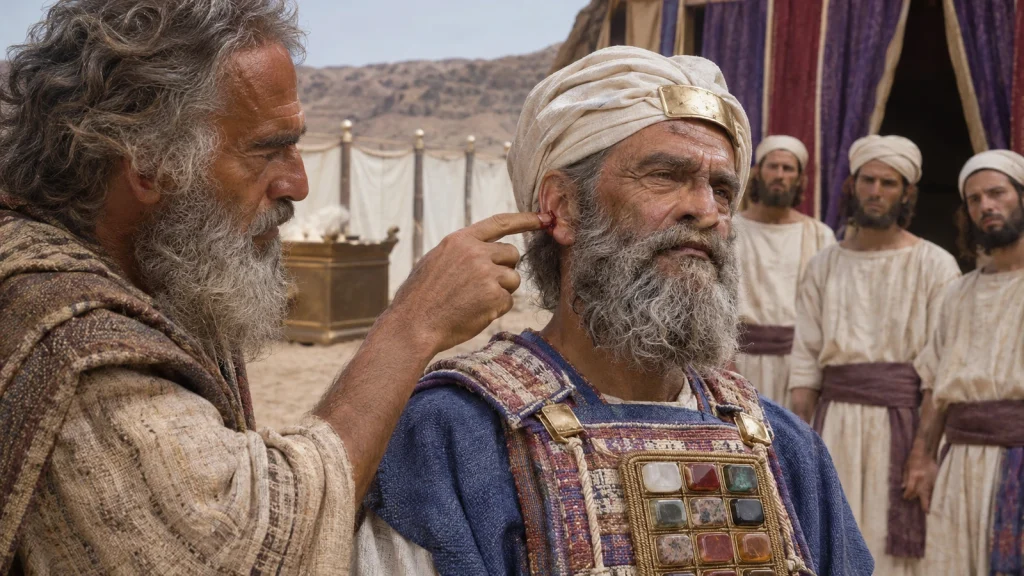
Moses placed blood on Aaron’s right earlobe, right thumb, and right big toe as part of the ritual that consecrated him for priestly service. The same action was performed for Aaron’s sons. Leviticus 8:23–24 identifies the blood as coming from the ram of ordination but does not explain why these three parts of the body were selected. Their placement may symbolize the consecration of the whole person, an interpretation supported by a similar ritual elsewhere in Leviticus.
The familiar explanation that the ear represents hearing God’s instructions, the hand performing sacred duties, and the foot walking in obedience offers a possible theological reading. Yet the ceremony itself is more complex than that symbolism suggests. Before the blood is applied, Aaron and his sons are washed and clothed, the sanctuary is anointed, and two other sacrifices are presented. Afterward, the candidates participate in the offering of the ordination ram, eat a prescribed meal, and remain at the entrance of the Tent of Meeting for seven days.
Our previous study, Why Does Leviticus 7 Set Rules for Eating Sacrificial Meat?, examined the distribution of offerings among the altar, the priests, and eligible worshipers. That chapter ended by naming the ordination offering among Israel’s sacrifices. Leviticus 8 now describes how Aaron and his sons were installed into the office responsible for administering those regulations. The narrative moves from instructions about priestly service to the men who must carry them out.
Why Was the Community Gathered for Aaron’s Ordination? (8:1–5)
The LORD instructs Moses to bring Aaron and his sons, their garments, the anointing oil, a bull, two rams, and a basket of unleavened bread. He must also assemble the congregation at the entrance of the Tent of Meeting. Aaron’s appointment is therefore presented as a public event. The priesthood will serve Israel’s sanctuary, and the people are called to witness its inauguration. Before beginning, Moses announces that the ceremony has been commanded by the LORD. The statement establishes the authority under which he acts. He is not devising a ritual for his brother or granting him an office through personal preference.
There is also a close relationship between this chapter and Exodus 29. That earlier passage contains instructions concerning priestly garments, consecration sacrifices, blood applications, and a seven-day installation. Leviticus 8 recounts their implementation.
Why Did Moses Officiate Instead of Aaron?
Aaron is the person being installed. Although he will later perform sacrifices on behalf of Israel, he has not yet completed the rites preparing him for that responsibility. Moses conducts the ceremony because he has been instructed to do so. He washes and clothes the candidates, handles the offerings, and applies the blood and oil. The distinction becomes important in Leviticus 9. There, after the ordination period, Aaron begins performing the priestly duties for which he has been prepared.
Why Were Aaron and His Sons Washed and Clothed? (8:6–9, 13)
Moses begins by washing Aaron and his sons with water. He then dresses Aaron in the prescribed priestly garments: a tunic, sash, robe, ephod, breastpiece, and turban bearing a sacred gold plate. Aaron’s sons receive tunics, sashes, and head coverings, but the text does not describe them wearing the complete set of distinctive garments assigned to their father. These differences reflect their respective offices. The priesthood is not presented as an undifferentiated group in which every member has precisely the same responsibilities.
The garments also connect the narrative with Exodus 28, where their construction and use had already been specified. Leviticus 8 does not introduce a new priestly wardrobe; it shows the prescribed clothing being placed on the men who will wear it.
What Were the Urim and Thummim?
Verse 8 includes the Urim and Thummim among the objects placed in Aaron’s breastpiece. Their precise appearance remains uncertain. Elsewhere in Scripture, they are associated with seeking divine decisions, but the surviving descriptions do not establish their physical form or the full procedure by which they were used. Their presence in the ordination ceremony nevertheless identifies an additional dimension of Aaron’s office. His duties extend beyond handling sacrifices to responsibilities associated with priestly inquiry. The garments mark the office into which he is entering and distinguish his position from that of his sons.
Why Was the Tabernacle Anointed Before Aaron? (8:10–13)
Before applying oil to Aaron, Moses anoints the Tabernacle and its furnishings. He sprinkles oil on the altar seven times and consecrates its utensils, along with the basin and its stand. He then pours anointing oil on Aaron’s head. This sequence brings the sanctuary itself into the ordination ceremony. The men appointed to serve there are being prepared alongside the place and objects associated with their duties. The Hebrew vocabulary of consecration comes from the word family associated with holiness. Here it concerns setting persons and objects apart for a designated sacred function.
Aaron receives a particular form of anointing: oil is poured directly onto his head. His sons are clothed afterward, but no corresponding individual application to their heads is described at this stage. Later, in verse 30, oil and blood are sprinkled on Aaron, his sons, and their garments. That subsequent action encompasses the priestly group rather than Aaron alone. The distinction helps explain why the chapter describes several stages of consecration instead of treating anointing as a single, undifferentiated act.
Why Were Three Sacrifices Required for Ordination? (8:14–24)
The installation involves three animals presented in sequence: a bull for purification, a ram for a burnt offering, and a second ram specifically designated for ordination. Aaron and his sons place their hands on each animal before it is slaughtered. The procedure that follows, however, differs according to the sacrifice.
The Bull: Purifying the Altar (8:14–17)
Moses takes blood from the bull and applies it to the horns of the altar. He pours the remainder at its base. Verse 15 explains that the action purifies and consecrates the altar so that atonement may be made upon it. The blood is directed toward the sanctuary’s sacrificial equipment, not the bodies of the priestly candidates. The prescribed fat is burned on the altar, while the bull’s flesh, hide, and refuse are taken outside the camp and burned.
This treatment recalls the purification offerings examined in Why Does Leviticus 4 Require Different Sacrifices for Unintentional Sin?. In those laws, the location of the blood application and the disposal of the remains distinguish particular forms of the rite. Here the purification offering serves the special circumstances of priestly installation, including the consecration of the altar.
The First Ram: A Burnt Offering (8:18–21)
The first ram is presented as a burnt offering. After slaughter, its blood is splashed against the sides of the altar. Moses divides the animal, washes the prescribed parts, and burns it according to the established procedure. The offering resembles the instructions given in Leviticus 1, but its position within the ordination sequence gives it a particular setting. No blood is applied to Aaron’s body during this sacrifice.
The Second Ram: The Ordination Offering (8:22–24)
The final animal receives a different treatment. After slaughtering the ram of ordination, Moses places some of its blood on Aaron’s right earlobe, the thumb of his right hand, and the big toe of his right foot. He repeats the procedure for Aaron’s sons and splashes the remaining blood against the altar. The change in blood application is striking. The previous offerings involved the altar; this one also marks the men being appointed to serve there. It is this unusual combination of locations that raises the chapter’s central interpretive question.
Why the Right Ear, Thumb, and Big Toe? (8:23–24)
The text is precise about where the blood was placed. It is less explicit about what the selected body parts signify. Two interpretations deserve consideration.
Hearing, Working, and Walking
One traditional explanation associates the ear with hearing divine instruction, the hand with performing priestly duties, and the foot with walking according to God’s commands. The associations are understandable. Listening, acting, and walking can represent different dimensions of a person’s conduct, and all three are relevant to a priest’s responsibilities. The difficulty is that Leviticus never assigns these meanings individually. Neither does the parallel command in Exodus 29:20. The interpretation may be used as a theological application, but it should not be presented as the explicit explanation for the ritual.
The Consecration of the Whole Person
A second interpretation regards the three extremities as representative of the body as a whole. The ear belongs to the head, the thumb to the hand, and the big toe to the foot. Marking these locations may indicate that the entire person is being set apart for sacred service. The explanatory notes to the New American Bible, Revised Edition favor this reading. They understand the applications as symbolizing the priests’ transition from ordinary status to a consecrated condition.
This interpretation fits the purpose of the ceremony without requiring a separate symbolic meaning for each body part. The consistent use of the right side is also deliberate, though the passage offers no direct explanation for that preference. The Hebrew word bōhen (בֹּהֶן) can designate either the thumb or big toe, depending on whether the hand or foot is in view. The language establishes the required anatomical locations. Their broader significance must be considered through the ritual’s setting and its parallels elsewhere in Leviticus.
Why Does Leviticus 14 Repeat the Same Pattern?
Leviticus 14:14 describes a remarkably similar action. During the purification of someone recovering from a serious skin condition, blood from a reparation offering is placed on the right earlobe, right thumb, and right big toe. The sequence matches the ordination ritual, although the circumstances differ. In Leviticus 8, Aaron and his sons are being installed into priestly office. In Leviticus 14, the rite concerns a person’s purification and restoration following a condition associated with ritual impurity.
The later ceremony also includes the application of oil, including oil placed on the locations previously marked with blood. This shared pattern strengthens the possibility that the three extremities represent a person undergoing a significant change in ritual status. It does not make the ceremonies identical. Their purposes and surrounding procedures remain distinct. The comparison is valuable precisely because it places the blood applications within a broader ritual vocabulary rather than treating them as a gesture invented solely for Aaron.
What Happened to the Ram of Ordination? (8:25–29)
After applying the blood, Moses gathers the prescribed fat, the fatty tail, the portions associated with the internal organs, and the right thigh of the ram. He adds three pieces of unleavened bread from the basket prepared for the ceremony. These materials are placed on the palms of Aaron and his sons for presentation before the LORD. Moses then takes them back and burns them on the altar. The candidates participate directly in the presentation, but Moses remains the officiant responsible for completing the sacrifice.
What Does It Mean to Fill the Priests’ Hands?
The action has a possible connection with the Hebrew vocabulary of ordination. The noun milluʾîm (מִלֻּאִים), used for the ordination offering, belongs to the word family associated with filling. Related biblical expressions describe priestly installation through the filling of hands. That language has been interpreted as the conferral of an office or responsibility. Some scholars have also connected it with the physical placement of sacrificial portions in the candidates’ hands.
The NET Bible’s note on Leviticus 8:33 offers an important qualification. It observes that the term translated “palms” in verse 27 differs from the ordinary word for “hands” used in the wider ordination expression. The visible action may illustrate the appointment, but it does not establish the exact origin of the terminology. The relationship remains suggestive: the candidates handle materials associated with the office they are being prepared to enter.
Why Did Moses Receive the Breast?
Verse 29 describes Moses presenting the breast of the ordination ram and receiving it as his allotted portion. This detail becomes especially interesting when compared with the ordinary well-being offering in Leviticus 7. The ordination ram shares several features with that sacrifice, including a presentation of portions and a meal. Its distribution, however, is different. The significance of that variation deserves closer examination because it reveals something about the nature of priestly installation.
Why Were Blood and Oil Sprinkled on the Priests’ Garments? (8:30)
Moses next combines some anointing oil with blood taken from the altar and sprinkles them on Aaron, his sons, and their garments. Verse 30 identifies the result as consecration. Both substances have already appeared in the ceremony. Oil was used for the sanctuary and Aaron, while sacrificial blood had been applied to the altar and the candidates’ bodies. Their combined application now includes the priestly clothing. The garments are integral to the office being established. Consecrating the men and their vestments together brings this part of the installation to a close before the prescribed meal and seven-day observance.
Why Did the Priests Eat the Ordination Sacrifice? (8:31–32)
Moses instructs Aaron and his sons to cook and eat the designated meat with bread at the entrance of the Tent of Meeting. Whatever remains must be burned. The meal has a specified location, participants, and treatment of leftovers. It belongs to the ordination rather than being a separate celebration after the religious proceedings. Jonathan Grossman and Eliezer Hadad offer a relevant interpretation in their study The Ram of Ordination and Qualifying the Priests to Eat Sacrifices.
They argue that the different elements of priestly installation have distinct functions. In their analysis, the garments qualify priests to minister in the sanctuary, anointing establishes their sacred status, and the ordination ram qualifies them to eat portions of sacrifices offered on the altar.
Their proposal comes from a semantic and literary study of the regulations. Leviticus itself does not formulate the ceremony in precisely those three categories, but the interpretation draws attention to the importance of sacrificial food in establishing the priestly office.
The men who will later receive and handle holy portions are now participating in a meal prescribed for their own consecration.
Why Did Ordination Last Seven Days? (8:33–36)
The ceremony does not end with the meal. Aaron and his sons must remain at the entrance of the Tent of Meeting for seven days, observing the LORD’s instructions throughout that period. Moses warns them that failure to keep these requirements could result in death. The language emphasizes the seriousness of the appointment and the obligations it entails. Exodus 29:35–37 gives additional directions for the seven-day consecration, including repeated sacrificial procedures. Leviticus 8 records the principal sequence without narrating each day separately.
The number seven may invite comparison with creation and other biblical periods of sacred preparation. Such associations are possible, but the immediate concern is the completion of the prescribed installation. The chapter closes by reporting that Aaron and his sons obeyed everything the LORD had commanded through Moses. The next stage of the narrative can now begin.
The Deeper Discovery
Why Was the Right Thigh Burned Instead of Given to the Priest?
One of the most revealing details in Leviticus 8 becomes apparent only when the ordination ram is compared with the well-being sacrifice in the preceding chapter. Leviticus 7:32–33 assigns the right thigh of a well-being offering to the priest who performs the prescribed blood and fat procedures. The breast is likewise allocated to the priesthood under the regulations given there. These portions provide for those administering Israel’s sacrifices. The ordination ram is treated differently.
In Leviticus 8:25–28, Moses places the right thigh together with the fat and three pieces of unleavened bread on the palms of Aaron and his sons. The portions are presented before the LORD, but instead of becoming food for the officiant, they are taken back and burned on the altar. Moses receives the breast separately. The contrast is significant because the two offerings resemble one another in several respects. Both involve a slaughtered animal, blood applied to the altar, prescribed fatty portions, a ritual presentation, and food associated with the ceremony.
Yet the right thigh has a different destination. The text gives no explicit reason for this variation. What it establishes is that the ram of ordination has its own instructions, even where its procedure resembles the ordinary well-being sacrifice. This difference brings the roles of Moses and Aaron into sharper focus. Moses is conducting the installation, while Aaron and his sons are being prepared to receive priestly responsibilities. They hold the appointed materials, but Moses removes them and completes the prescribed burning. Later, the candidates eat the meat and bread allocated to them.
Holding an offering, presenting it, burning it, and eating it are separate actions governed by the requirements of the ceremony. That sequence connects directly with the regulations explored in Leviticus 7. There, the destination of each portion was central to understanding the sacrificial meal. The same issue now appears within a rite that prepares the priesthood to administer those rules. Grossman and Hadad’s interpretation of the ordination ram adds a possible explanation for why these food-related actions matter. If the ram ceremony helps establish the priests’ entitlement to eat portions of offerings, its unusual handling of the sacrificial materials becomes especially relevant.
Their proposal should be distinguished from the narrative’s explicit statements. Nevertheless, the comparison between chapters 7 and 8 provides a firm textual basis for recognizing the ordination ram as a distinct sacrificial procedure. It also changes the way we approach the blood placed on Aaron’s body. The marked ear, thumb, and toe belong to a larger series of actions involving the candidates’ bodies, garments, hands, and access to sacred food. The ceremony does not depend on a single gesture to communicate the significance of priestly installation. Each stage contributes to the transition from men awaiting appointment to priests entrusted with the sanctuary’s responsibilities.
What Did the Blood Ritual Accomplish?
Leviticus 8 presents the blood applications as part of the consecration of Aaron and his sons. The three right-side extremities are carefully specified, and the procedure is repeated for each candidate. The interpretation that these locations represent the whole person is supported by the chapter’s purpose and the parallel ritual in Leviticus 14. It remains an interpretation rather than a direct explanation supplied in the narrative. More important than assigning independent symbolism to every body part is recognizing the setting in which the action occurs.
Aaron and his sons are washed, clothed, anointed, and associated with sacrifices that prepare the altar and establish their place within its service. Their installation also involves the handling of holy food and seven days of required observance. The blood ritual forms part of that transition. At the end of the chapter, the candidates have obeyed the prescribed instructions and are prepared for the inauguration of their duties.
FAQ
Why did Moses place blood on Aaron’s ear, thumb, and toe?
The blood applications belonged to the ordination ceremony in Leviticus 8:23–24. One interpretation understands the three locations as representing the consecration of the whole person.
Why were the right ear, right thumb, and right big toe selected?
The text consistently specifies the right side but does not explain why these particular locations were chosen.
Does the ear symbolize hearing God’s word?
That is a traditional theological application. Leviticus 8 does not explicitly assign a separate symbolic meaning to the ear.
Why did Moses officiate during Aaron’s ordination?
Moses had been commanded to install Aaron and his sons. He performed the prescribed rituals before they assumed their priestly duties.
Where else does the Bible describe this blood ritual?
Leviticus 14:14 uses the same three locations during a purification ceremony. Its purpose differs from priestly ordination.
Why were a bull and two rams required?
The bull served as a purification offering, the first ram as a burnt offering, and the second as the ordination offering. Each had its own prescribed treatment.
Why did Aaron and his sons remain for seven days?
The installation required a seven-day period of consecration and observance at the Tent of Meeting. Exodus 29 provides further instructions for that period.
What Comes Next?
Leviticus 8 ends with Aaron and his sons observing the requirements of their ordination. The following chapter begins on the eighth day, when Aaron steps forward to perform the sacrificial duties for which he has been prepared. After the appointed offerings are presented, Aaron blesses the people. Moses and Aaron then enter the Tent of Meeting, and when they emerge, they bless the congregation again. The glory of the LORD appears to the people. Fire comes out from before the LORD and consumes the offering on the altar.
This event marks a dramatic development in the inauguration of Israel’s sanctuary service. Why does the fire appear at this moment, and what does it reveal about the divine presence and the sacrifices Aaron has just offered? Next Study: Why Did Fire Come Out from Before the LORD in Leviticus 9? Series navigation Previous study: Why Does Leviticus 7 Set Rules for Eating Sacrificial Meat? Explore the series: Leviticus Studies
Selected Sources
- NET Bible. Leviticus 8, with Translators’ Notes. New English Translation. Bible.org. Especially the notes on the ordination offering and the terminology of filling the hands.
- United States Conference of Catholic Bishops. Leviticus 8, with Explanatory Notes. New American Bible, Revised Edition. Particularly the notes on verses 10–12, 22–24, and 33–35.
- United States Conference of Catholic Bishops. Exodus 29, with Explanatory Notes. New American Bible, Revised Edition. The instructions concerning Aaron’s consecration and the seven-day ordination.
- Jonathan Grossman and Eliezer Hadad. “The Ram of Ordination and Qualifying the Priests to Eat Sacrifices.” Journal for the Study of the Old Testament 45, no. 4 (2021): 476–492. The interpretation discussed in this study is based on the authors’ published abstract.
- Roy E. Gane. “Sacrifice and the Old Testament.” St Andrews Encyclopaedia of Theology. University of St Andrews, August 17, 2022.
- United States Conference of Catholic Bishops. Leviticus 14, with Explanatory Notes. New American Bible, Revised Edition. Particularly verses 14–18 concerning the application of blood and oil.
- United States Conference of Catholic Bishops. Leviticus 9, with Explanatory Notes. New American Bible, Revised Edition. Particularly verses 22–24 concerning the appearance of divine glory and fire.