Why Does Leviticus 19 Link Holiness with Loving Your Neighbor?
Leviticus 19 brings together laws concerning worship, agriculture, justice, work, and human relationships. Two commands to love—one addressed to the neighbor and another to the resident foreigner—reveal how holiness extends into everyday life.
Source: AI-generated image created for Beyond The Known.
A farmer leaves grain standing at the edge of his field. An employer pays a laborer before nightfall. A merchant uses accurate weights, even when a dishonest measure might go unnoticed. What do these ordinary actions have to do with holiness?
Leviticus 19 connects holiness with loving one’s neighbor because obedience to the LORD is expressed not only through worship but also through the treatment of other people. The chapter requires honesty, justice, restraint, and practical concern for those who may be vulnerable to exploitation. Its command to love one’s neighbor in verse 18 belongs to that wider collection of responsibilities. The connection becomes more striking in verse 34, where similar language is applied to the resident foreigner.
Between these two commands, Leviticus addresses subjects as different as mixed fabrics, an enslaved woman’s legal status, fruit trees, divination, and bodily markings. The variety can make the chapter seem like an assortment of unrelated regulations. Yet the repeated declaration “I am the LORD” gives them a common authority, while several instructions echo one another across the chapter. Our previous study, Why Does Leviticus 18 Link Sexual Prohibitions to the Land?, examined how prohibited conduct was associated with the defilement of Canaan and the possibility of expulsion.
Leviticus 19 now develops the positive responsibilities of a people called to live under the LORD’s commandments. The question is no longer only which practices Israel must avoid. It is also how a holy community should conduct its ordinary affairs. To understand the answer, we need to examine the laws in their own contexts rather than force every command into one explanation.
Why Is the Entire Community Commanded to Be Holy? (19:1–4)
The chapter begins with an instruction addressed to the whole congregation of Israel: “Be holy, for I, the LORD your God, am holy.” The Hebrew adjective qādôš (קָדוֹשׁ) describes what is holy or sacred. In Leviticus, holiness is closely associated with the LORD and with the people, places, and practices set apart in relation to him. Here, however, the command reaches beyond the priests. Everyone is addressed. The instructions that follow will regulate not only sacrifices but also family relationships, economic dealings, and the treatment of vulnerable people. Holiness therefore cannot be understood here as a condition relevant only when someone approaches the sanctuary.
Why Are Parents, the Sabbath, and Idols Mentioned First?
Verse 3 requires reverence for one’s mother and father and observance of the Sabbath. Verse 4 prohibits turning to idols or making molten gods. These commands recall important elements of the Decalogue in Exodus 20 and Deuteronomy 5. Their arrangement is not identical. Leviticus names the mother before the father, although both are included within the obligation of reverence. No explanation is given for that order, so it should not be used to construct a theory of household authority.
The three instructions establish a recognizable foundation. Family obligations, sacred time, and allegiance to the LORD all belong to the life of the community. The recurring declaration “I am the LORD your God” reinforces the point. The authority behind these requirements will also appear in laws concerning harvests, wages, justice, and commercial measurements. The same God who regulates worship also governs conduct beyond the sanctuary.
Why Does Leviticus 19 Return to Sacrifices and Harvests? (19:5–10)
Verses 5–8 concern the well-being offering, also called the peace or fellowship offering. Its meat may be eaten on the day of sacrifice or the following day. Whatever remains must be burned rather than consumed on the third day. Eating it after the permitted period profanes what is holy and brings severe consequences.
How Does This Relate to Leviticus 7?
The earlier sacrificial instructions provide additional distinctions. As explained in our study of Leviticus 7, a thanksgiving offering had to be consumed on the day it was presented. Other forms of well-being offering permitted consumption on the following day. Leviticus 19 does not repeat every qualification. Its immediate concern is the unacceptable consumption of sacrificial meat beyond the prescribed period. The worshiper could receive food from the offering, but that privilege remained subject to sacred restrictions. The reference to sacrifice therefore establishes continuity with the earlier chapters before the discussion turns to agriculture.
Why Must Farmers Leave Part of Their Harvest Behind?
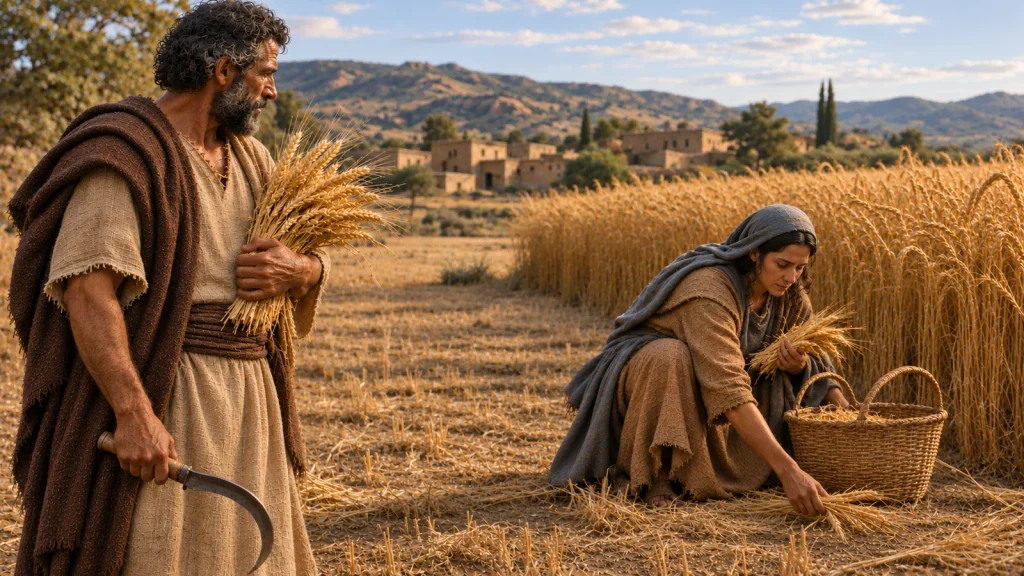
Verses 9–10 forbid landowners from harvesting their fields completely. They must leave the edges and the fallen grain rather than collect everything available. Vineyards are subject to a comparable requirement: fallen grapes and remaining produce are to be left for the poor and resident foreigners. The instruction does not merely encourage kindness. It places a practical restriction upon the owner’s use of agricultural resources. Someone who controls a field may gather its harvest, but not without regard for people who lack sufficient means of obtaining food.
The legislation identifies those beneficiaries directly. A landowner’s right to collect produce is limited by an obligation toward others. Ruth 2 provides a useful narrative comparison. Ruth, a Moabite widow, gleans in the field of Boaz, obtaining food through an agricultural practice resembling the provision described here. Boaz also grants her additional protection and assistance. The narrative therefore illustrates how gleaning could function while distinguishing ordinary access to leftover produce from further generosity.
The command in Leviticus 19 ends with the declaration that the LORD is Israel’s God. Its placement matters. Leaving food for those in need is treated as an obligation arising from the same divine authority that governs sacrifice and Sabbath observance.
How Does Holiness Govern Work, Justice, and Human Vulnerability? (19:11–16)
The next instructions prohibit theft, lying, deception, false oaths, oppression, robbery, and the withholding of wages. The list then turns to disabled people, impartial judgment, slander, and a difficult expression concerning a neighbor’s blood. These commands regulate situations in which one person’s actions can cause serious harm to another.
Why Must a Laborer Be Paid Promptly?
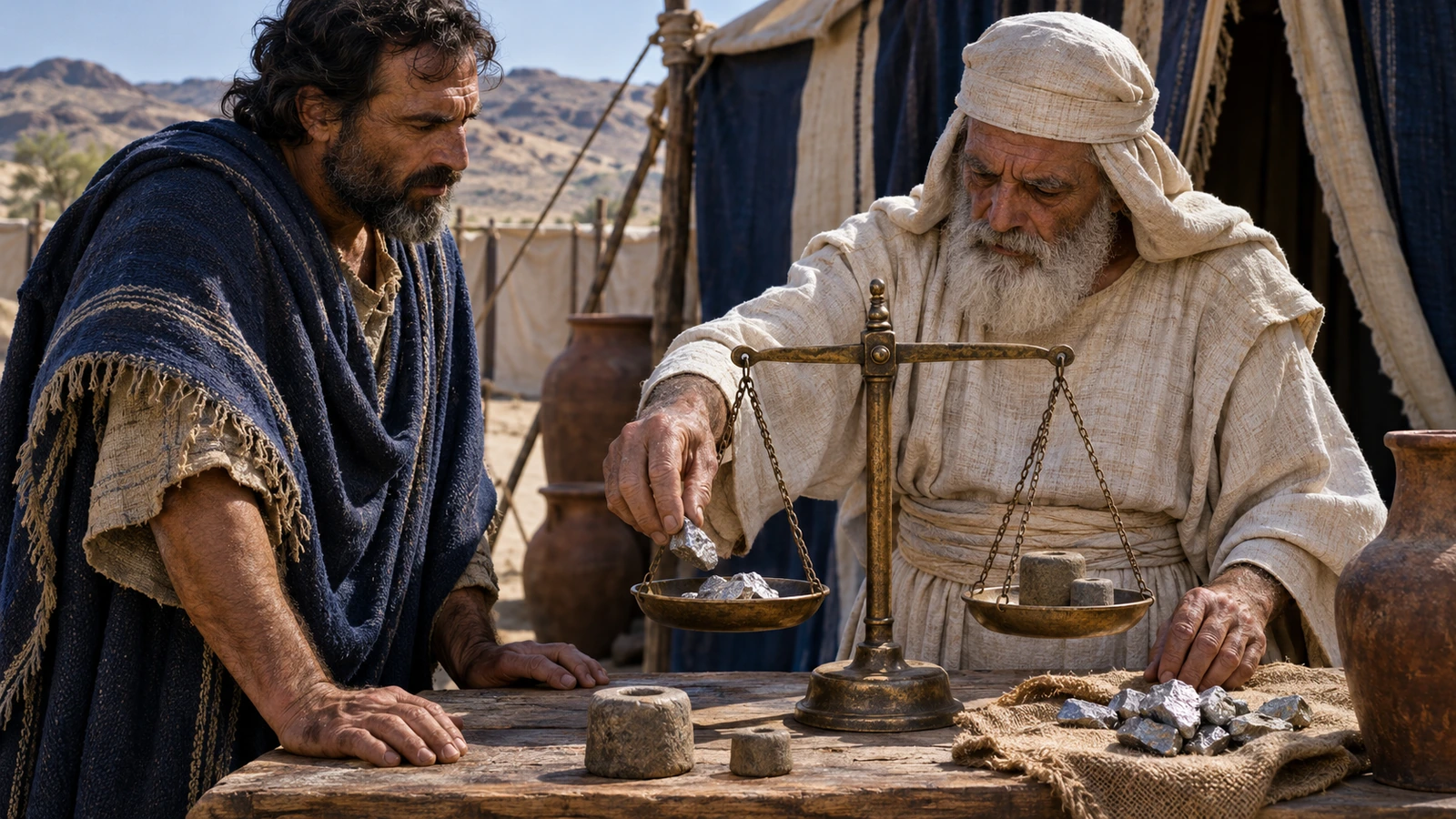
Verse 13 forbids keeping a hired worker’s wages until morning. The instruction protects someone whose livelihood may depend upon receiving payment without unnecessary delay. In an agricultural economy, hired workers did not necessarily possess the same resources as those employing them. Withholding wages could therefore place the laborer at a considerable disadvantage. The law does not allow an employer to use control over payment as an opportunity for exploitation. This concern resembles the harvesting regulations.
A landowner must leave some produce for those in need. An employer must pay what is owed to someone who has worked. Both commands limit the exercise of economic power.
Why Are the Deaf and Blind Mentioned?
Verse 14 prohibits cursing a deaf person or placing an obstacle before someone who is blind. The examples are concrete. A deaf person may not hear an insult. Someone who cannot see may be unable to detect a deliberately placed obstacle. The offender could exploit the other person’s condition and perhaps escape immediate confrontation. The command therefore ends with an instruction to fear God. That addition identifies an authority beyond the ability of the injured person to observe or challenge the wrongdoing. The prohibition does not depend upon whether a victim can defend themselves.
Why Must Judges Avoid Favoritism?
Verse 15 requires impartial judgment. Neither poverty nor high social standing should determine the outcome of a legal dispute. This does not contradict the earlier instruction to provide food for the poor. The situations differ. Leaving part of a harvest concerns economic provision. A judicial decision requires fair consideration of the matter being judged. The legislation rejects decisions distorted by favoritism, whether directed toward someone influential or someone disadvantaged.
What Does It Mean Not to Stand Against a Neighbor’s Blood?
Verse 16 prohibits spreading harmful reports and then uses a difficult expression involving a neighbor’s blood. The Hebrew wording is often translated as a warning against standing idly by when another person’s life is endangered. Other interpretations emphasize participation in conduct that threatens a neighbor or exposes that person to serious harm. The NET Bible notes that the expression is difficult to interpret with complete certainty. The surrounding commands provide useful context. The passage has just addressed justice and is about to discuss hatred, correction, revenge, and love.
At minimum, the instruction belongs to a collection concerned with protecting others from harmful conduct. Its exact legal scope remains a matter of interpretation.
What Does “Love Your Neighbor as Yourself” Mean? (19:17–18)
The familiar command appears after instructions concerning the ways people can injure one another. That placement is essential. Leviticus does not introduce love as a detached sentiment. It follows prohibitions against deception, exploitation, injustice, and harmful behavior. Verses 17–18 then address the attitudes and responses that can emerge during conflict.
Why Does the Law Address Hatred Before Love?
Verse 17 prohibits harboring hatred toward another member of the community. Rather than allowing hostility to remain concealed, the person is instructed to confront wrongdoing. The Hebrew wording concerning the consequences of sin has generated different interpretations. Some understand the warning as addressing guilt incurred by failing to correct another person. Others emphasize the danger of sharing responsibility for wrongdoing. Whatever its precise legal implication, the passage contrasts concealed hatred with direct engagement.
The instruction does not make every accusation legitimate or authorize humiliating someone under the pretext of correction. It requires the issue to be addressed without allowing hostility to govern the relationship.
Why Are Revenge and Resentment Forbidden?
Verse 18 prohibits taking vengeance and keeping a grudge. The two responses are related but not identical. Revenge involves retaliation. A grudge preserves resentment, even when no immediate action follows. The command to love stands in contrast to both. This does not mean that wrongdoing must be ignored. The preceding verse has already provided a place for correction. The concern is that the response to an offense should not become an enduring pursuit of retaliation or hostility.
What Does the Hebrew Word for Love Mean?
The command uses a form of the Hebrew verb ʾāhav (אהב), meaning “to love.” The person to be loved is described by rēaʿ (רֵעַ), a term that can refer to a neighbor, companion, or fellow member of a community, depending upon context. The expression kāmôkā (כָּמוֹךָ) is traditionally translated “as yourself.” Kengo Akiyama, in The Love of Neighbour in Ancient Judaism, examines whether the phrase is better understood as describing someone “who is like you.”
The distinction affects the way the relationship between the speaker and the neighbor is expressed. The traditional translation emphasizes concern for another comparable to one’s concern for oneself. The alternative gives greater weight to the neighbor’s similarity or shared standing. Neither reading removes the command from its immediate context. The preceding laws already identify practical responsibilities toward other people. Love is presented within that network of obligations.
Is Love Here More Than an Emotion?
Richard A. Allbee argues that Leviticus 19:11–18 places the love command within the kinds of social relationships ordinarily regulated by law. The prohibition of theft, oppression, injustice, and hatred gives the instruction practical significance. The passage does not require a particular emotional experience before someone can obey. Its emphasis lies in conduct. A person cannot mistreat a neighbor and then appeal to love as though it were unrelated to those actions.
The command supplies a positive obligation within a series of restrictions against harm. But the question of whom it includes remains important. The immediate wording refers to members of Israel’s community. Later in the chapter, the obligation is explicitly extended to the resident foreigner. That second occurrence prevents the discussion from ending at verse 18.
Why Are Mixtures Prohibited Immediately After the Love Command? (19:19)
Verse 19 moves abruptly to three regulations. Different kinds of animals must not be bred together. A field must not be planted with two kinds of seed. Certain garments made from mixed materials are prohibited. The transition is one reason scholars have debated the chapter’s organization.
What Was Forbidden?
The instructions address particular combinations rather than every possible mixture in the natural world. The garment regulation uses the Hebrew term šaʿaṭnēz (שַׁעַטְנֵז), commonly rendered shatnez. Deuteronomy 22:11 identifies a prohibited combination of wool and linen. That parallel helps clarify the clothing restriction, although questions remain about the broader relationship between the two legal formulations.
Why Did These Distinctions Matter?
Several explanations have been proposed. Some interpreters associate the prohibitions with preserving distinctions between different kinds of things. Others examine their relationship to sacred practices or particular forms of material combination. Jacob Milgrom discusses these possibilities within the wider Holiness legislation. Leviticus 19:19 itself does not explain the rationale behind each restriction. An interpretation involving sacred distinctions may be coherent, but it should not be presented as the verse’s explicit explanation.
The change of subject also demonstrates that the command to love one’s neighbor does not replace every other category of obligation in the chapter. Holiness continues to involve practices whose purposes may differ from the preceding social regulations.
Why Does the Law Address an Enslaved Woman? (19:20–22)
The next case concerns a man who has intercourse with an enslaved woman designated for another man, although she has not been redeemed or given her freedom. The parties are not to be executed because the woman remains enslaved. A legal consequence is required, and the man must bring a ram as a reparation offering. The priest then makes atonement for the offense.
Why Is Her Status Central to the Case?
The legislation reflects a society in which enslavement affected legal standing, including the treatment of sexual and marital relationships. The woman’s lack of freedom is central to the law’s distinction between this situation and other prohibited relations. The text does not describe the circumstances of the sexual encounter sufficiently to establish whether it was consensual. That absence should not be filled with assumptions. The power imbalance inherent in enslavement is nevertheless relevant to understanding the social world of the passage.
The law’s treatment of her status should be described accurately without presenting ancient legal inequality as though it corresponded to modern principles of personal freedom.
What Does the Hebrew Say About Punishment?
The term biqqōret (בִּקֹּרֶת) in verse 20 is difficult. Translations have rendered it through language associated with investigation, punishment, or another form of legal consequence. René Péter-Contesse and John Ellington discuss the uncertainty in A Handbook on Leviticus. Because the precise meaning is disputed, identifying a particular corporal punishment as certain would go beyond the available evidence. The passage is clearer about the man’s sacrificial obligation. He must present a ram as an ʾāšām (אָשָׁם), usually translated “guilt offering” or “reparation offering.”
The priest performs atonement, and forgiveness is described. This connects the case with the sacrificial procedures examined in our study of Leviticus 5. The offenses are different, but both belong to the broader system of addressing wrongdoing through prescribed offerings. Baruch J. Schwartz has examined Leviticus 19:20–22 as a distinct literary and legal unit. Its unusual features caution against treating it as an ordinary adultery law without qualification.
Why Were the First Three Years of Fruit Restricted? (19:23–25)
The next regulation looks ahead to Israel’s settlement in the land. When fruit trees are planted, their produce must not be eaten during the first three years. The fourth year’s fruit is dedicated to the LORD in a setting associated with praise. Ordinary consumption begins in the fifth year. The Hebrew text uses the language of ʿorlâ (עָרְלָה), commonly translated “uncircumcised,” to describe the fruit during the restricted period. The expression marks it as unavailable for consumption. It does not refer to a literal procedure performed upon the tree.
The instructions establish a sequence: The first three years are restricted. The fourth is specially dedicated. The fifth permits the owner to eat the fruit. Verse 25 associates obedience with the yield of the trees, although translations differ in how they express the relationship between the fifth-year harvest and its increase. The passage is not a scientific claim that delaying consumption guarantees a particular agricultural result. Its primary concern is the regulation of produce during the early years of a tree’s growth.
Later Jewish traditions developed more detailed rules concerning these requirements. Those interpretations belong to the history of the law’s reception and should be distinguished from what Leviticus 19 explicitly states.
What Do Blood, Divination, Hair, and Tattoos Have in Common? (19:26–31)
The next instructions address practices involving blood, divination, bodily appearance, mourning, and consultation with spirits. Verse 29 also prohibits degrading one’s daughter by making her a prostitute. Sabbath observance and reverence for the sanctuary reappear in verse 30. The subjects differ, and the text does not supply one explanation covering them all.
Does Verse 26 Repeat the Blood Prohibition of Leviticus 17?
The Hebrew expression in verse 26 is literally something like “You shall not eat upon the blood.” Many translations understand it as prohibiting the consumption of meat with blood still present, connecting it with Leviticus 17. That interpretation fits the larger legal context, but the Hebrew wording has also generated alternative explanations. The Septuagint preserves a different rendering, “upon the mountains,” which has been associated with unauthorized forms of worship.
The NET Bible discusses these issues in its translators’ notes. It is therefore reasonable to connect the verse with the preceding restrictions concerning blood, while acknowledging that its exact formulation is debated. The same verse prohibits divination and related practices. These instructions express restrictions upon forms of religious conduct regarded as incompatible with the LORD’s commands.
Why Were Certain Haircuts and Bodily Marks Prohibited?
Verses 27–28 regulate cutting the hair around the temples, damaging the edges of the beard, making cuts for the dead, and placing prohibited markings upon the body. The reference to the dead explicitly identifies mourning as the setting for the cutting prohibition. Whether that qualification also governs the following instruction concerning tattoos is disputed. David Bernat examines the question in “Tattoos—What Exactly Is Prohibited?” He discusses the rare Hebrew terminology, ancient translation traditions, and interpretations that either restrict the tattoo prohibition to mourning-related practices or understand it more broadly.
The expression concerning tattoos is difficult because its distinctive vocabulary occurs only here in the Hebrew Bible. The existence of that uncertainty does not make the prohibition meaningless. It does, however, caution against assuming that every modern form of tattooing corresponds directly to the same ancient practice. The restrictions on hair and beard trimming have likewise been connected by scholars with possible mourning or ritual customs. Those explanations are plausible historical proposals, not descriptions supplied explicitly by Leviticus 19.
Why Does Verse 29 Mention a Daughter and the Land?
Verse 29 prohibits making one’s daughter a prostitute. The consequence is described through language involving the land becoming filled with sexual misconduct. This recalls the preceding chapter, where prohibited behavior is associated with the defilement of Canaan. The connection is worth noticing. Leviticus 18 describes the land as capable of becoming defiled through human conduct. Leviticus 19:29 again uses the land to express the wider consequences of wrongdoing. The two passages are not identical. Verse 29 does not repeat the image of the land vomiting out its inhabitants. Still, the broader concern is recognizable: conduct within households may have consequences extending to the community.
Why Does the Section Return to the Sabbath and Sanctuary?
Verse 30 repeats the requirement to observe the Sabbath and adds reverence for the sanctuary. Both subjects appeared earlier in the book, and Sabbath observance was already mentioned in Leviticus 19:3. The recurrence creates continuity across a collection of diverse laws. Verse 31 then forbids consultation with mediums and spirits, identifying such practices as defiling. The contrast between reverence for the LORD and prohibited spiritual consultation is clear, even though the chapter does not describe every form of ancient divination or necromancy. The repeated religious commands prevent the social laws from being detached from the worship of Israel’s God.
Why Must Israel Love the Resident Foreigner? (19:32–34)
Verse 32 requires respect for older people. The Israelites must rise in the presence of the aged, honor them, and fear God. This resembles the earlier command concerning deaf and blind people. In both passages, fear of God is connected with the treatment of another person. Verses 33–34 then turn to those living among Israel without belonging to the native-born population. The Hebrew term gēr (גֵּר) describes a resident foreigner.
Its ancient legal meaning should not be equated mechanically with modern citizenship or immigration categories. Nevertheless, the instruction is explicit: the resident foreigner must not be mistreated. The law goes further. Such a person is to be treated like the native-born in the respect commanded here and loved as oneself.
Why Is the Love Command Repeated?
Verse 18 commands love for one’s neighbor. Verse 34 applies corresponding language to the resident foreigner. Hendrik L. Bosman examines this relationship in “Loving the Neighbour and the Resident Alien in Leviticus 19 as Ethical Redefinition of Holiness.” He argues that the second command broadens the ethical expression of holiness beyond the immediate community. The repetition is important because verse 18 appears in a context concerning fellow Israelites. Verse 34 explicitly names someone whose ancestry and social standing may differ.
This does not establish that resident foreigners possessed every legal privilege of native Israelites. It does establish an obligation of treatment that the chapter does not leave implicit. The foreigner’s status cannot be used as an excuse for mistreatment.
Why Does the Command Refer to Egypt?
The explanation is grounded in Israel’s own history. The people are reminded that they were foreigners in Egypt. That memory becomes a reason for treating resident outsiders with concern. Their earlier experience does not mean that every foreigner’s circumstances are identical to those of Israel in Egypt. It creates a moral comparison between a people who once lived outside their homeland and others who now live among them. This is an important development of the chapter’s opening command.
Israel’s relationship with the LORD and its remembered experience of deliverance become reasons for how it should treat people in the present.
Why Does Leviticus 19 End with Honest Weights and Measures? (19:35–37)
The final practical instruction concerns commercial measurement. Israel must use accurate standards for length, weight, and capacity. The law refers to honest scales and weights, together with the ephah, a dry-capacity measure, and the hin, a measure used for liquids. The requirement addresses transactions in which someone could manipulate the amount of goods exchanged. A dishonest merchant might profit from inaccurate weights while the other party remained unaware. The command therefore connects commercial practice with the prohibition against deception.
Its placement near the chapter’s conclusion is significant. After regulating sacrifices, harvests, wages, family obligations, and treatment of foreigners, Leviticus addresses the measurement of ordinary goods. The instruction shows how far the obligations of holiness extend into daily activities. Verse 36 also recalls the Exodus. The LORD identifies himself as the God who brought Israel out of Egypt. Earlier, Israel’s experience there was invoked as a reason for loving the foreigner. Here, deliverance reinforces the authority behind commercial honesty.
The relationship is not merely verbal. Both passages connect Israel’s historical identity with responsibilities toward others. The chapter closes by commanding the people to observe all the statutes and ordinances. The diverse laws are gathered under the same authority established in verse 2.
How Did Later Jewish and Christian Interpreters Understand the Love Command?
Leviticus 19:18 became an influential text in Jewish and Christian tradition. Its reception developed through different historical settings rather than one uniform interpretation. Kengo Akiyama traces the command’s use in the Septuagint, the Book of Jubilees, the Dead Sea Scrolls, and New Testament literature. His research demonstrates how early interpreters examined both the meaning of love and the identity of those to whom it should be directed. In Mark 12:28–34, Jesus joins the command to love God from Deuteronomy 6:5 with the instruction to love one’s neighbor.
Matthew 22:34–40 presents a related discussion. Luke 10:25–37 explores the question of who qualifies as a neighbor through the parable of the Good Samaritan. Paul appeals to the command in Romans 13:8–10 and Galatians 5:14. These later interpretations are important, but they should not replace the immediate meaning of Leviticus 19. Within the Hebrew legislation, the command belongs to a collection of obligations involving justice, honesty, social responsibility, and the treatment of other people. Later readers developed its significance while engaging with that inherited text.
The Deeper Discovery
The People Least Able to Protect Themselves Are Placed Under God’s Authority
The chapter’s most revealing pattern becomes clearer when the social laws are considered through a different question: Who can enforce these commands when someone more powerful chooses to disregard them? Consider the people named throughout the chapter. A poor person may depend upon the grain a landowner leaves behind. A hired worker may lack the means to compel immediate payment. A deaf person might never hear an insult. Someone who is blind cannot always detect a deliberately placed obstacle.
An elderly person may depend upon the respect shown by others. A foreign resident might have less influence than native-born members of the community. A customer may be unable to verify whether a merchant’s weights are accurate. These situations are not identical. Some concern economic vulnerability, others physical conditions, social standing, or unequal access to power. Yet they share an important feature. The person affected may have limited ability to prevent the wrongdoing or obtain immediate justice.
Leviticus 19 repeatedly places such conduct under the authority of the LORD. This is especially visible in verses 14 and 32. Both connect the treatment of other people with the command to fear God. The first concerns deaf and blind persons. The second concerns respect for the aged. The repetition gives the instructions a theological dimension that extends beyond public reputation. Human conduct remains subject to divine authority even where those affected cannot easily defend themselves.
The Love Commands Create a Wider Circle of Responsibility
The relationship between verses 18 and 34 adds another dimension. In verse 18, the command to love follows prohibitions against hatred, vengeance, and resentment toward members of the community. Verse 34 explicitly directs comparable love toward resident foreigners. The second instruction broadens the named recipients. The chapter therefore does not allow the immediate social boundaries of verse 18 to exhaust its treatment of love. At the same time, these statements should not be flattened into a claim that ancient Israelite law recognized no distinctions of status.
Those distinctions existed. The significance of verse 34 is that the law imposes a serious obligation toward someone outside the native-born community despite such differences. This is where the text moves beyond a purely internal ethic. The command to love is applied to a person whose presence might otherwise be regarded through the lens of foreignness.
A Repeated Pattern Connects the Chapter’s Beginning and End
Several instructions appear in related forms across the chapter.
| Earlier passage | Later passage | Connection |
|---|---|---|
| Sabbath observance (19:3) | Sabbath and sanctuary reverence (19:30) | Worship remains central throughout the collection |
| Protection of deaf and blind people (19:14) | Respect for the elderly (19:32) | Fear of God governs treatment of others |
| Love your neighbor (19:18) | Love the resident foreigner (19:34) | Love extends beyond the immediate community |
| Harvest provisions for the poor and foreigner (19:9–10) | Protection of the resident foreigner (19:33–34) | Responsibility toward those with limited resources or standing |
| Prohibitions against deception and exploitation (19:11–13) | Honest weights and measures (19:35–36) | Integrity in economic relationships |
These correspondences do not prove that the chapter was composed as a perfectly symmetrical literary structure. Calum Carmichael and other scholars have examined its arrangement, while historical-critical approaches have explored how diverse legal materials may have been brought together. The repetitions nevertheless have a clear effect in the received text. The reader encounters similar obligations in different areas of life. What begins in the field returns in the treatment of foreigners.
Concerns about dishonesty reappear at the marketplace. Respect for those who might be mistreated is reinforced through the command to fear God. The connections make the chapter more coherent than its variety initially suggests.
Holiness Is Not Limited to Actions Performed at the Sanctuary
The opening command might lead a reader to expect a chapter concerned primarily with sacrifices, purity, and sacred ceremonies. Those subjects are present. But holiness is also expressed through the conduct of farmers, employers, judges, family members, and merchants. A landowner must refrain from collecting every part of the harvest. An employer must pay a worker promptly. A judge must resist favoritism. Someone who could exploit another person’s disability is forbidden to do so.
A foreign resident must not be mistreated. A merchant must use accurate measurements. The instructions do not all have identical rationales, and the chapter also contains regulations concerning material mixtures, fruit trees, and bodily practices. Still, its social laws repeatedly establish limits on what people may do simply because they possess the means or opportunity. Richard Allbee’s analysis of Leviticus 19:11–18 helps explain how the love command functions within those concrete obligations.
Bosman’s study extends that discussion to the connection between holiness and the treatment of resident foreigners. Together, these approaches draw attention to an essential feature of the chapter. Holiness is not presented only through avoidance of prohibited worship or the correct performance of sacred rites. It also becomes visible in the way people exercise responsibility toward one another.
The Command to Love Is Surrounded by Actions That Make Love Visible
The placement of verse 18 is particularly revealing. Before the command appears, the reader has encountered theft, deception, oppression, delayed payment, injustice, slander, concealed hatred, and revenge. Afterward, the chapter eventually returns to the foreigner and to honesty in trade. The law does not provide a philosophical definition of love. Instead, it surrounds the command with situations in which the treatment of another person can be evaluated. Love becomes inseparable from conduct.
It restrains retaliation, limits exploitation, and establishes obligations toward people whose interests may conflict with one’s own immediate advantage. The later instruction concerning resident foreigners makes this responsibility still more explicit. The command extends beyond those who share the same ancestry or immediate social position. Leviticus 19 presents holiness as something tested not only at the altar, but also wherever one person has the opportunity to benefit at another’s expense. Loving one’s neighbor—and the resident foreigner—belongs to the practical expression of that holiness.
The chapter’s diverse regulations are therefore more than a collection of unrelated commands. They show how allegiance to the LORD reaches into ordinary relationships, including circumstances where obedience may be costly and wrongdoing difficult to detect.
Frequently Asked Questions
Why does Leviticus 19 command Israel to be holy?
The opening command is grounded in the holiness of the LORD. The following instructions show that Israel’s obligations extend to worship, family relationships, justice, economic conduct, and the treatment of others.
What does “love your neighbor as yourself” mean?
The traditional translation emphasizes concern for another comparable to one’s concern for oneself. Scholars also debate whether the Hebrew expression kāmôkā describes a neighbor “who is like you.” The surrounding laws give the command practical meaning.
Does Leviticus 19 command love for foreigners?
Yes. Verse 34 expressly commands love for the resident foreigner and connects the obligation with Israel’s earlier experience in Egypt.
Why were farmers required to leave grain behind?
Verses 9–10 reserve part of the harvest for the poor and resident foreigners. The requirement limits the owner’s collection of produce so that vulnerable people may gather food.
Why does Leviticus 19 prohibit mixed seeds and fabrics?
Verse 19 names particular prohibited combinations. Scholars have proposed explanations involving distinctions and sacred practices, but the passage does not explicitly provide a complete rationale.
Does Leviticus 19:28 prohibit modern tattoos?
The verse prohibits particular bodily markings. Its precise relationship to mourning practices is debated, so applying it to every modern form of tattooing requires further interpretation.
Why does Leviticus 19 end with honest weights and measures?
The final laws forbid inaccurate commercial measurements. They place honesty in ordinary transactions under the same divine authority that governs the chapter’s religious and social obligations.
What Comes Next?
Leviticus 19 develops the responsibilities of a community called to reflect the holiness of the LORD. Its laws move from sacrifices and agricultural practices to justice, wages, family obligations, and the treatment of neighbors and resident foreigners. Love is not detached from those responsibilities. It appears within the conduct expected of the people. The next chapter returns to several practices already prohibited in Leviticus 18, but its emphasis changes. Leviticus 20 describes penalties associated with offenses involving Molech, mediums, prohibited sexual relationships, and violations of family boundaries.
Why does the legislation revisit earlier prohibitions rather than simply introduce new ones? And what do those penalties reveal about the relationship between holiness, communal responsibility, and divine judgment? Next Study: Why Does Leviticus 20 Prescribe Penalties for Forbidden Practices?
Series Navigation
Previous Study: Why Does Leviticus 18 Link Sexual Prohibitions to the Land? Related Study: Why Does Leviticus 5 Require Confession and Restitution? Next Study: Why Does Leviticus 20 Prescribe Penalties for Forbidden Practices? Explore the Series: Leviticus Studies
Selected Sources
- Hebrew Bible. Leviticus 19. Primary text for the legislation concerning holiness, worship, agriculture, justice, love of neighbor, resident foreigners, and commercial honesty.
- New American Bible, Revised Edition. Leviticus 19 and Explanatory Notes. United States Conference of Catholic Bishops. Provides commentary on the chapter’s legal framework, social obligations, sacrifices, mixtures, bodily markings, and resident foreigners.
- Milgrom, Jacob. Leviticus 17–22: A New Translation with Introduction and Commentary. Anchor Bible, volume 3A. Doubleday, 2000. A major scholarly commentary on the Holiness legislation. Publication details were verified through the publisher.
- Bosman, Hendrik L. “Loving the Neighbour and the Resident Alien in Leviticus 19 as Ethical Redefinition of Holiness.” Old Testament Essays 31, no. 3 (2018). Examines the relationship between the commands to love the neighbor and resident foreigner and their implications for holiness. The open-access study was consulted.
- Akiyama, Kengo. The Love of Neighbour in Ancient Judaism: The Reception of Leviticus 19:18 in the Hebrew Bible, the Septuagint, the Book of Jubilees, the Dead Sea Scrolls, and the New Testament. Brill, 2018. Investigates the Hebrew command and its diverse interpretations in ancient Judaism and early Christianity. Publisher information and an academic review were consulted.
- Kaminsky, Joel S. “Loving One’s (Israelite) Neighbor: Election and Commandment in Leviticus 19.” Interpretation 62, no. 2 (2008): 123–132. Examines the command to love within Israel’s election theology and the wider Priestly framework. The published abstract was consulted.
- Allbee, Richard A. “Asymmetrical Continuity of Love and Law between the Old and New Testaments: Explicating the Implicit Side of a Hermeneutical Bridge, Leviticus 19.11–18.” Journal for the Study of the Old Testament 31, no. 2 (2006). Studies the relationship between the love command and the surrounding laws governing social conduct. The published abstract was consulted.
- Schwartz, Baruch J. “A Literary Study of the Slave-Girl Pericope: Leviticus 19:20–22.” Scripta Hierosolymitana 31 (1986): 240–255. A specialized study of the chapter’s difficult legal case involving an enslaved woman. The Hebrew University bibliographic record was verified.
- Péter-Contesse, René, and John Ellington. A Handbook on Leviticus — Commentary on 19:20. United Bible Societies, 1990. Discusses translation difficulties involving the legal consequences described in verse 20.
- Bernat, David. “Tattoos—What Exactly Is Prohibited?” TheTorah.com, 2021. Examines the wording of Leviticus 19:28 and competing interpretations concerning mourning and bodily markings.
- Carmichael, Calum M. “The Laws of Leviticus 19.” Harvard Theological Review 87, no. 3 (1994). Discusses the chapter’s arrangement and challenges explanations based solely upon the presumed miscellaneous origins of its laws. The published abstract was consulted.