Why Does Exodus 39 Keep Repeating “As the LORD Commanded Moses”?
Exodus 39 Explained: The Priestly Garments, Israel’s Names, Seven Repetitions of Obedience, and Moses’ Final Inspection
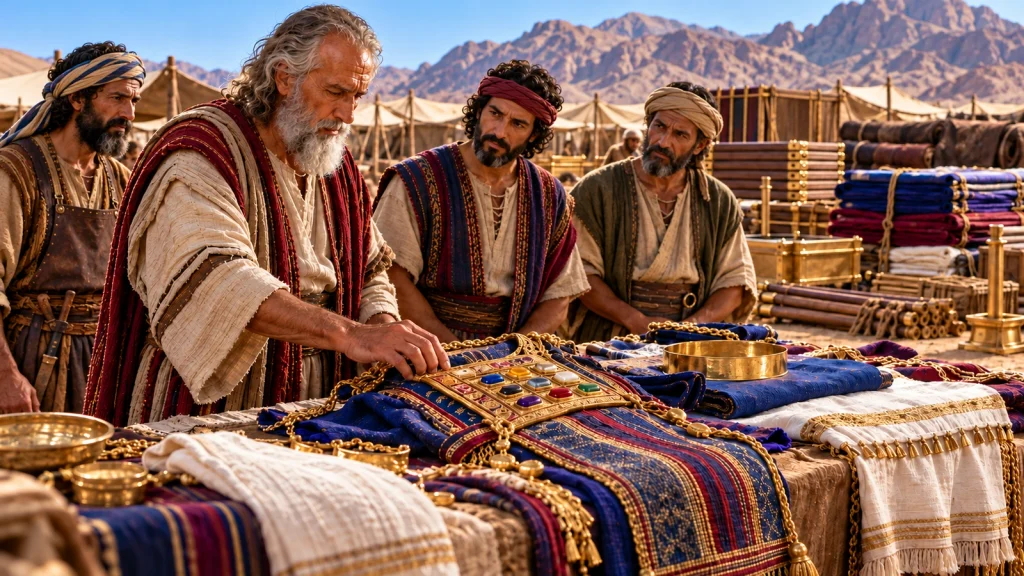
Source: AI-generated image created for Beyond The Known.
Exodus 39 can sound repetitive on a first reading.
The artisans make the ephod, and the text says they did it “as the LORD commanded Moses.” They set the engraved stones on its shoulders, and the same formula returns. It appears again after the breastpiece, the robe, the woven garments, the sash, and the gold plate on Aaron’s forehead.
By the time the priestly garments are complete, the exact refrain has appeared seven times.
Then the scale widens. The entire tabernacle project is brought to Moses. He examines it, sees that Israel has done the work according to YHWH’s command, and blesses the people.
Why does Exodus insist on repeating the same judgment?
The repetition is not filler. It tells the reader how the work is to be evaluated.
Israel has already shown that it can produce impressive religious objects with precious materials and skilled labor. The golden calf proved that craftsmanship, enthusiasm, and religious intention are not enough to make worship faithful.
Exodus 39 measures the completed sanctuary by a different standard.
The question is not merely whether the work is beautiful, costly, or technically impressive.
It is whether Israel made what YHWH commanded.
That is why the refrain matters.
The previous study, Why Was the Bronze Basin Made from the Women’s Mirrors?, followed the construction outward through the altar, basin, courtyard, and final accounting of the sanctuary’s metals. Exodus 39 returns to the priests, completes their garments, and then brings the whole project before Moses for inspection.
Exodus 39 Is an Execution Report
Most of the first thirty-one verses are familiar because the priestly garments were already described in Exodus 28.
There, Moses receives instructions for the ephod, breastpiece, robe, tunics, headgear, sash, and gold plate. Exodus 39 reports their manufacture.
That shift from instruction to execution is fundamental to Exodus 35–40.
Earlier, the grammar is largely prospective:
you shall make.
Now it is retrospective:
they made.
The construction account is therefore not simply retelling the same material. It is asking whether the instructions given earlier were actually carried out.
The correspondence is close, but not mechanically identical. Some details are abbreviated. Others appear in a different place. Exodus 39:3 even adds a technical explanation not supplied in the same way in Exodus 28: the artisans hammered gold into thin sheets, cut it into threads, and worked those threads into the colored textiles.
So the chapter does two things at once.
It confirms obedience to an earlier pattern while still showing the intelligence required to turn instructions into finished objects.
The Exact Formula Appears Seven Times
The recurring Hebrew phrase is:
כַּאֲשֶׁר צִוָּה יְהוָה אֶת־מֹשֶׁה — kaʾăšer ṣiwwâ YHWH ʾet-Mōšeh
“as YHWH commanded Moses.”
In Exodus 39:1–31, that exact wording occurs seven times:
- verse 1
- verse 5
- verse 7
- verse 21
- verse 26
- verse 29
- verse 31
The seven occurrences mark successive stages in the making of the priestly garments.
We should not overstate the number. Exodus itself never pauses to explain, “There are seven repetitions because seven symbolizes completion.”
But the pattern is real, and it becomes more difficult to dismiss when Exodus 40 uses the same formula seven more times as Moses erects and arranges the tabernacle.
At minimum, the repetition gives the construction narrative a deliberate rhythm.
One piece is completed.
The text checks it against the command.
Then another.
And another.
The repeated verdict keeps the standard in front of the reader.
The Golden Calf Changes How the Refrain Sounds
The phrase becomes more significant because of what has happened since the instructions were first given.
In Exodus 32, Israel also participated in a religious construction project.
Gold was collected.
Aaron fashioned an object.
An altar was built.
A festival followed.
The episode included craftsmanship, precious material, communal participation, and worship.
What it lacked was authorization.
That contrast matters when Exodus later says again and again that the tabernacle work was done “as YHWH commanded Moses.”
The point is not that creativity has disappeared.
Bezalel and the other artisans remain highly skilled. They must weave, engrave, cut gold, set stones, attach rings, form bells, strengthen openings, and solve difficult practical problems.
Their intelligence is indispensable.
What changes is the source of authority.
The golden calf shows Israel determining sacred form for itself.
The tabernacle narrative presents skilled work answering to a received command.
The Priestly Garments Belong to the World of the Tabernacle
The chapter begins with clothing, but these garments should not be imagined as an ordinary wardrobe made more luxurious for a religious leader.
Their materials tie Aaron visually to the sanctuary.
Gold.
Blue-purple.
Purple.
Crimson.
Fine linen.
These same materials appear throughout the tabernacle and reappear in the high priest’s clothing.
The effect is more than decorative coordination. Aaron is dressed for service within a sacred environment whose colors and materials are echoed on his own body.
This helps explain why Exodus spends so much time on garments.
The priest does not simply enter the sanctuary wearing expensive clothing. His vestments identify him with a particular office, place him within the ordered world of the tabernacle, and carry visible signs of Israel and holiness into that space.
Gold Becomes Thread
Exodus 39:3 provides one of the most concrete glimpses of the artisans at work.
The gold is beaten into thin sheets.
Those sheets are cut into narrow strands.
The gold is then worked into the blue-purple, purple, crimson, and fine linen of the ephod.
This detail is easy to pass over, but it tells us something important about the craftsmanship.
Gold is not merely attached afterward as a plate or ornament.
Metal is turned into a material that can participate in textile work.
The instruction in Exodus 28 named gold among the components of the ephod. Exodus 39 shows how the artisans solved the problem of putting gold into fabric.
That is exactly the kind of detail that keeps the construction account from becoming a sterile checklist.
The sanctuary depends on technical knowledge.
Aaron Carries Israel on His Shoulders
Two stones are prepared for the ephod and engraved with the names of the sons of Israel.
The text calls them:
אַבְנֵי זִכָּרוֹן — ʾaḇnê zikkārôn — stones of remembrance
They are placed on Aaron’s shoulders.
The earlier instructions in Exodus 28 explain the function more fully: Aaron is to bear the names before YHWH as a memorial.
The image is physical.
Israel’s names are cut into stone and carried on the priest’s body as he enters sacred service.
The high priest does not approach YHWH merely as Aaron the individual.
He bears Israel with him.
The Breastpiece Brings the Names Closer
The breastpiece develops the same idea.
Twelve stones are arranged in four rows, one for each tribe. Each stone is engraved like a seal with a tribal name.
Exodus 28 explains that Aaron carries those names over his heart when he enters before YHWH.
The shoulder stones and breastpiece therefore place Israel’s names in two locations on the high priest:
on his shoulders,
and over his heart.
There is no need to invent hidden meanings for each gemstone to see the significance.
The names are explicit.
The priest’s clothing turns representation into something visible and bodily.
We Cannot Identify Every Gemstone with Certainty
Modern translations often give familiar mineral names:
ruby,
topaz,
beryl,
sapphire,
diamond,
agate,
amethyst,
onyx,
jasper.
But the Hebrew terminology does not map neatly onto modern mineralogy.
The identification of several stones remains uncertain, and ancient color categories, trade names, and mineral classifications do not correspond exactly to contemporary scientific labels.
Even שֹׁהַם — šōham, often translated “onyx,” has been identified in different ways.
That uncertainty should affect both interpretation and biblical imagery.
We can say confidently that the breastpiece contained twelve valuable stones in gold settings, each engraved with a tribal name.
We should be more cautious about claiming that every modern English gemstone label identifies the ancient stone with precision.
The theological point does not depend on solving the mineralogy.
Israel’s names are what the text emphasizes.
The Breastpiece Has to Stay in Place
Exodus devotes a surprising amount of space to chains, rings, cords, settings, and attachment points.
Those details can feel repetitive until we remember that the breastpiece must function as clothing.
It cannot swing loose or detach from the ephod during priestly movement.
Gold chains secure the upper portion.
Additional rings and a blue cord fasten the lower part so that the breastpiece remains attached.
This is the same practical intelligence we have seen throughout the tabernacle construction.
Curtains must join correctly.
Frames must stand.
Furniture must be carried.
A garment must stay where it belongs.
Sacred beauty does not remove the need for engineering.
The Urim and Thummim Are Missing from the Construction Report
Exodus 28:30 instructed Moses to place the Urim and Thummim in the breastpiece of judgment.
Exodus 39 describes the manufacture of the breastpiece in considerable detail but never mentions them.
That omission is real.
Its explanation is not given.
The Bible never provides a clear physical description of the Urim and Thummim, and later interpretations differ over what they were and how they functioned.
We should therefore avoid filling the silence with certainty.
The safest conclusion is simple:
they appear in the instructions of Exodus 28 but are not mentioned in the execution report of Exodus 39.
Anything beyond that requires interpretation.
The Blue Robe Is Built for Priestly Service
After the breastpiece, the artisans make the robe of the ephod entirely from תְּכֵלֶת — təḵēleṯ, a blue or blue-purple textile color.
The neck opening is reinforced so that it will not tear.
Around the hem are textile pomegranates alternating with bells of pure gold.
Here again, the clothing combines visual effect with practical construction.
The opening must hold.
The hem carries repeated textile and metal elements.
The bells will sound as Aaron moves in priestly service, a function explained more fully in Exodus 28.
The garment belongs to ritual action, not simply display.
“Holy to YHWH”
The final distinctive piece is the gold plate attached to Aaron’s headdress.
Its inscription reads:
קֹדֶשׁ לַיהוָה — qōdeš laYHWH
“Holy to YHWH.”
Many English Bibles render it:
“Holy to the LORD.”
The words identify consecration.
Placed on Aaron’s forehead, the inscription makes his set-apart status visible as he serves before YHWH.
Then verse 31 closes the garment-making section with the refrain one final time:
“as YHWH commanded Moses.”
That is the seventh exact occurrence in the chapter’s first major section.
The last item is complete, and the repeated judgment has reached its full sequence.
Then the Camera Pulls Back
Verse 32 abruptly changes scale.
The text is no longer concerned with one stone, one cord, one robe, or one plate.
It announces that the entire work of the tabernacle of the Tent of Meeting has been completed.
Then comes a broader statement:
Israel had done everything according to all that YHWH commanded Moses.
The wording is related to the earlier refrain, but its function has changed.
The seven earlier occurrences evaluated individual portions of the garment work.
Now the verdict covers the whole project.
The narrative has moved from itemized compliance to comprehensive completion.
Everything Is Brought to Moses
The finished components are presented to Moses:
the tent,
its coverings,
frames,
bars,
columns,
bases,
the ark,
the table,
the lampstand,
the altars,
the basin,
the courtyard materials,
and the priestly garments.
The sanctuary has not yet been erected. That will happen in Exodus 40.
For now, the completed work is assembled before the man who received the instructions.
That arrangement makes sense within the story.
Moses received the command.
The artisans executed it.
Now he examines the result.
Moses Inspects Before He Blesses
Exodus 39:43 gives the climax:
וַיַּרְא מֹשֶׁה אֶת־כָּל־הַמְּלָאכָה — wayyarʾ Mōšeh ʾeṯ-kol-hamməlāʾḵâ
“Moses saw all the work.”
Then:
וְהִנֵּה עָשׂוּ אֹתָהּ — wəhinnēh ʿāśû ʾōṯāh
“and behold, they had done it.”
The verse continues:
כַּאֲשֶׁר צִוָּה יְהוָה כֵּן עָשׂוּ — kaʾăšer ṣiwwâ YHWH kēn ʿāśû
“as YHWH commanded, so they had done.”
Only after that inspection does Moses bless them.
The sequence deserves attention.
The blessing does not come merely because Israel worked hard or because the project was religious.
Moses sees the finished work, recognizes its correspondence to the command, and then blesses the people.
The chapter’s repeated refrain has become a final verdict.
Exodus 39 Echoes the Language of Creation
The wording of verse 43 has long attracted attention because it resembles the creation account in Genesis 1.
Genesis 1:31 says that God saw all that he had made, and behold, it was very good. Genesis also repeatedly uses the language of completed work and blessing.
Exodus 39 says that Moses saw all the work, behold, they had made it according to YHWH’s command, and Moses blessed them.
The verbal overlap is substantial enough that many scholars see a literary echo between the completion of creation and the completion of the tabernacle.
That observation should be stated carefully.
Exodus 39 does not say that Moses becomes a divine creator.
It does not explicitly call the tabernacle “a new creation.”
The stronger claim is literary: the completion of the sanctuary is narrated with vocabulary that recalls the completion of Genesis 1.
The echo places the tabernacle within a broader biblical language of ordered work reaching its intended completion.
The Deeper Discovery: The Refrain Changes as the Chapter Progresses
The most interesting feature of Exodus 39 is not simply that one sentence appears several times.
It is that the language of obedience expands.
First, the exact formula appears seven times while individual parts of the priestly garments are being made:
“as YHWH commanded Moses.”
Then verses 32 and 42 widen the scope:
Israel did all that YHWH commanded Moses.
Finally, verse 43 changes perspective.
Moses sees the completed work and confirms:
“as YHWH commanded, so they had done.”
The refrain has moved from local to comprehensive.
Piece by piece.
Then the whole project.
Then inspection.
That progression gives the repetition its force.
The text is not merely repeating a slogan.
It is building toward certification of the entire work.
Seven Here, Seven Again in Exodus 40
The pattern does not end with the priestly garments.
When Moses erects the tabernacle in Exodus 40, the formula “as YHWH commanded Moses” appears seven more times.
That creates a striking literary balance.
Exodus 39 repeatedly confirms the making of the garments.
Exodus 40 repeatedly confirms the erection and arrangement of the sanctuary.
We should still resist turning the number seven into a mathematical code the text itself never explains.
But the repeated sevenfold structure fits naturally with a narrative already echoing creation language at the point of completion.
The literary design is difficult to regard as careless redundancy.
The Repetition Is Also the Answer to the Golden Calf
Read against Exodus 32, the refrain becomes sharper.
The golden calf and the tabernacle both involve skilled making.
Both use valuable materials.
Both concern Israel’s worship.
Yet their narratives move in opposite directions.
The calf episode shows religious creativity severed from the command Moses received on the mountain.
The tabernacle construction repeatedly shows action corresponding to that command.
That does not reduce faithfulness to mindless copying.
The artisans still exercise wisdom, judgment, and technical expertise.
But they do not claim the authority to redefine the sanctuary.
The distinction is not between creativity and obedience.
It is between creativity that serves a received commission and creativity that replaces it.
Why the Repetition Would Be a Mistake to Edit Out
Modern prose normally avoids repeating the same sentence seven times in thirty-one verses.
A contemporary editor might instinctively vary the wording.
Exodus does not.
That difference is part of how the text communicates.
The recurrence creates cumulative verification.
The reader hears, in effect:
this was made according to the command.
This too.
And this.
And this.
By the time Moses sees the completed work, the final judgment no longer comes as a surprise.
The chapter has prepared it line by line.
What sounds repetitive in modern stylistic terms is structurally purposeful in the narrative.
Why Does Exodus 39 Keep Repeating “As the LORD Commanded Moses”?
Because Exodus 39 is not merely interested in whether the sanctuary objects were finished.
It is interested in correspondence between command and execution.
After the golden calf, that distinction is decisive.
Israel can be generous and still be wrong.
It can be artistic and still be wrong.
It can produce an impressive religious object and still be wrong.
Exodus 39 therefore judges the completed work by a narrower and more demanding criterion:
Did Israel make what YHWH commanded?
Seven times during the garment section, the answer is given.
Then the chapter widens the verdict to the entire tabernacle.
Moses examines the work.
He sees that they have done it as commanded.
And he blesses them.
The repetition is not an editorial weakness.
It is the chapter’s standard of faithfulness.
FAQ
How many times does Exodus 39 say “as the LORD commanded Moses”?
The exact Hebrew formula kaʾăšer ṣiwwâ YHWH ʾet-Mōšeh appears seven times in Exodus 39:1–31: verses 1, 5, 7, 21, 26, 29, and 31. Verses 32, 42, and 43 then use broader statements affirming that the entire work was completed according to YHWH’s command.
Why is the phrase repeated?
Exodus does not provide a separate explanation of the repetition, but its literary function is clear: the phrase repeatedly verifies that the construction corresponds to the earlier instructions. In the aftermath of the golden calf, the contrast between commanded worship and self-directed worship is especially important.
Why are the priestly garments described twice?
Exodus 28 gives the instructions. Exodus 39 reports their manufacture. The execution account sometimes abbreviates earlier material and sometimes adds practical details, such as the explanation in 39:3 of how gold was turned into thread.
What was the ephod?
The ephod was a specialized high-priestly garment associated with the shoulder stones and breastpiece. Its exact shape cannot be reconstructed with complete certainty because the biblical descriptions leave some structural questions unanswered.
Were the twelve stones the same gemstones named in modern translations?
Not with complete certainty. The Hebrew preserves twelve gemstone terms, but several cannot be securely matched with modern mineral classifications. The clear point in Exodus 39 is that each valuable stone carried the engraved name of one of Israel’s tribes.
Why were Israel’s names engraved on Aaron’s garments?
The shoulder stones and breastpiece carried the names of the tribes. Exodus 28 explains that Aaron would bear those names before YHWH as a memorial, representing Israel during his priestly service.
Why are the Urim and Thummim not mentioned in Exodus 39?
Exodus 28:30 mentions them in connection with the breastpiece, but Exodus 39 does not include them in its construction report. The text gives no explanation for the omission, and their precise physical nature remains uncertain.
What did the gold plate on Aaron’s forehead say?
It bore the inscription qōdeš laYHWH, traditionally translated “Holy to the LORD.” The phrase marked Aaron’s consecration for priestly service.
Why does Moses inspect the completed work?
Moses is the mediator who received the sanctuary instructions. Exodus 39:43 presents him examining the completed work, recognizing that Israel made it according to YHWH’s command, and then blessing the people.
Does Exodus 39 intentionally echo Genesis 1?
The wording of Exodus 39:43 shares several notable terms and movements with the creation account, including seeing, making, “behold,” completed work, and blessing. Many scholars therefore identify a literary echo. Exodus does not explicitly call the tabernacle a new creation, so the connection should be described as a literary parallel rather than a direct statement.
What Comes Next?
By the end of Exodus 39, the work has been completed and inspected.
The pieces are ready.
The priestly garments are finished.
Moses has confirmed that Israel followed the instructions.
But the sanctuary is still not functioning.
In Exodus 40, Moses erects the tabernacle and places each object in its appointed position.
Then something happens that no artisan can manufacture.
The glory of YHWH fills the tabernacle.
And Moses cannot enter.
Why Couldn’t Moses Enter the Tabernacle After God’s Glory Filled It?
Selected Sources
- Brevard S. Childs, The Book of Exodus: A Critical, Theological Commentary. Old Testament Library. Westminster Press, 1974.
- Thomas B. Dozeman, Exodus. Eerdmans Critical Commentary. Eerdmans, 2009.
- Carol Meyers, Exodus. New Cambridge Bible Commentary. Cambridge University Press, 2005.
- Nahum M. Sarna, The JPS Torah Commentary: Exodus. Jewish Publication Society, 1991.
- William H. C. Propp, Exodus 19–40: A New Translation with Introduction and Commentary. Anchor Bible 2A. Doubleday, 2006.
- Nathan MacDonald, The Making of the Tabernacle and the Construction of Priestly Hegemony. Oxford University Press, 2023.
- The Cambridge Bible for Schools and Colleges, commentary on Exodus 39, especially the instruction/execution structure, the seven occurrences of the compliance formula, the gold-thread detail in verse 3, and the omission of the Urim and Thummim from the construction report.
- Jonathan Grossman, “The Tabernacle, the Creation, and the Ideal of an Orderly World,” for the literary parallels between Exodus 39:43 and Genesis 1.