Why Couldn’t Moses Enter the Tabernacle After God’s Glory Filled It?
Exodus 40 Explained: The Tabernacle Is Raised, YHWH’s Glory Descends, and Israel Learns That Obedience Does Not Control Divine Presence
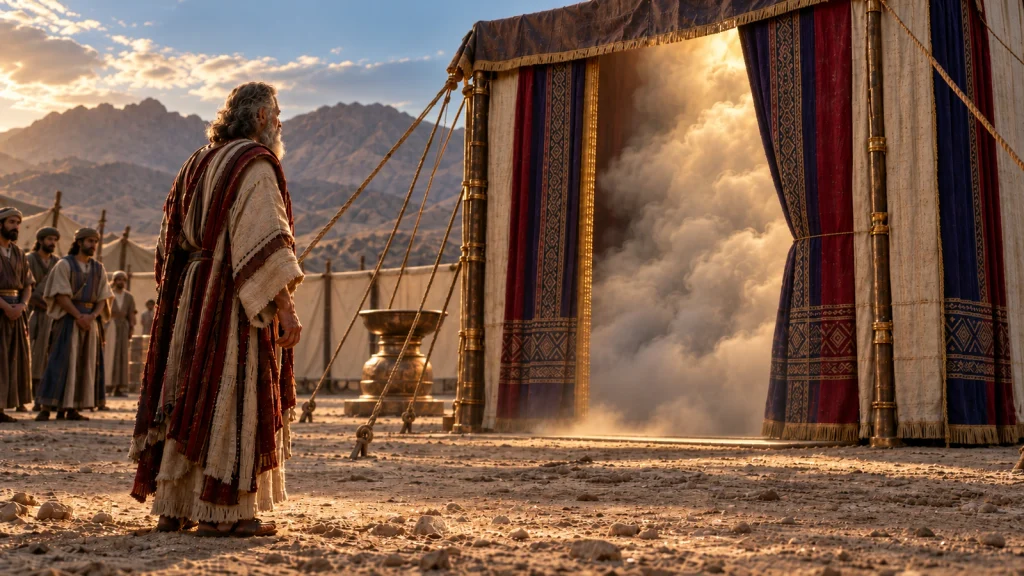
Source: AI-generated image created for Beyond The Known.
Exodus ends with one of the most striking reversals in the book.
In the previous study, “Why Does Exodus 39 Keep Repeating ‘As the LORD Commanded Moses’?”, we saw the tabernacle project reach completion under a repeated standard of obedience. The garments were finished, the components were brought to Moses, and he inspected the work before blessing the people.
Exodus 40 begins where that inspection ended.
Moses now erects the tabernacle. The sacred furnishings are placed in their appointed locations. The altar stands before the entrance. The basin is filled. The courtyard is completed.
Then YHWH comes.
The cloud covers the Tent of Meeting, the glory of YHWH fills the tabernacle, and suddenly the man who led Israel out of Egypt, climbed Sinai, received the covenant, and supervised the sanctuary project cannot enter the tent.
That reversal is not a minor detail. It is the theological climax of Exodus.
The book does not end by suggesting that Israel has built a structure that makes divine access simple or controllable. Instead, it closes by showing that the God who chooses to dwell among Israel remains overwhelmingly holy.
Israel can prepare the dwelling.
It cannot control the presence that fills it.
That is what makes Exodus 40 such a powerful ending.
The Tabernacle Is Erected at the Beginning of a New Year
Exodus 40 opens with a precise command. Moses is told to set up the tabernacle on the first day of the first month. Verse 17 then makes the chronology explicit: this happens in the second year.
That timing is meaningful.
Israel left Egypt in the first month of the previous year. Now, at the beginning of a new year, the people stand not at the edge of slavery but at the threshold of divine dwelling. The nation that once labored under Pharaoh has completed a sanctuary for YHWH.
The transformation is profound.
Earlier in Exodus, Israel’s work was coerced and degrading. In the tabernacle narratives, labor is redirected toward worship, order, and covenant fidelity. The same people once forced to build store cities have now fashioned a dwelling associated with the presence of the God who redeemed them.
Exodus 40 marks the culmination of that movement.
The Arrangement of the Sanctuary Is Not Arbitrary
The first section of the chapter lays out the order in which the sanctuary is to be assembled.
The ark is placed inside and screened by the veil. The table is brought in and arranged. The lampstand is positioned opposite the table. The incense altar stands before the veil. The bronze altar is set at the entrance. The basin is placed between the altar and the Tent. Then the courtyard is erected around the whole.
This sequence matters because sacred space in Exodus is structured, not improvised.
The sanctuary is not merely a holy container filled with objects. It is an ordered environment in which placement reflects meaning. The further inward one moves, the more restricted the space becomes. The outer court is not the Holy Place, and the Holy Place is not the Most Holy Place. Each object belongs in its proper location because holiness is being arranged spatially.
Exodus 25–31 gave the instructions. Exodus 40 turns those instructions into reality.
The Refrain from Exodus 39 Returns
In Exodus 39, the repeated formula “as YHWH commanded Moses” served as a running evaluation of the work. The same emphasis reappears in Exodus 40, but now the focus shifts from manufacture to installation.
Verse 16 introduces the pattern broadly:
“Moses did everything just as the LORD commanded him.”
Then the execution account repeatedly returns to the same verdict as Moses erects, arranges, and completes the sanctuary.
The effect is deliberate.
Israel’s artisans had already shown obedience in producing the tabernacle components. Now Moses shows obedience in placing those components exactly where they belong. The sanctuary is not activated by religious enthusiasm or by the sheer beauty of its materials. Its assembly must correspond to divine instruction.
That continuity is important for the larger theology of Exodus.
After the golden calf, the question is no longer whether Israel is capable of religious expression. The question is whether Israel will worship according to the command of YHWH rather than according to its own instincts. Exodus 39 and 40 answer that question by insisting on correspondence between command and execution.
Moses Finishes the Work
Verse 33 concludes the human side of the story in a single line:
“So Moses finished the work.”
That sentence is short, but it carries enormous literary weight.
The wording recalls Genesis 2, where God finishes the work of creation. The parallel should not be exaggerated into something the text itself does not say. Exodus does not identify Moses as a creator in the divine sense, nor does it explicitly label the tabernacle a new cosmos.
Even so, the echo is hard to miss.
Creation reaches completion. Now the sanctuary reaches completion.
In both cases, ordered work comes to its intended end. And in both cases, what follows belongs to God.
That transition matters. Human beings can build, arrange, and obey. Yet the decisive act at the end of Exodus is not performed by Moses, Aaron, Bezalel, or the people. It is performed by YHWH.
Then the Glory Descends
Once the work is finished, the narrative moves immediately from human action to divine occupation:
“Then the cloud covered the Tent of Meeting, and the glory of the LORD filled the tabernacle.” — Exodus 40:34
That is the true climax of the chapter.
The sanctuary is no longer merely a completed project. It is now the place filled by the manifest presence of YHWH.
This is the crucial distinction.
Israel can build the tabernacle. Israel cannot make YHWH dwell there.
The people can obey the pattern. They can contribute materials, weave fabrics, construct furniture, and erect the structure. But the indwelling presence of God is not the automatic result of human craftsmanship. The glory of YHWH arrives as divine action, not as the predictable outcome of ritual technique.
Exodus ends by drawing a line between faithful preparation and divine self-disclosure.
What Does “The Glory of YHWH” Mean?
The Hebrew phrase kəḇôḏ YHWH, often translated “the glory of the LORD,” carries more weight than mere brightness. In Exodus, it refers to the manifested majesty and presence of YHWH, often associated with the cloud.
This is not the first time the glory appears.
In Exodus 16, Israel sees the glory of YHWH in connection with the wilderness provision. At Sinai, divine presence is associated with cloud, fire, and overwhelming holiness. In Exodus 40, that same divine reality comes to rest in relation to the tabernacle.
The God of Sinai is now present in the midst of Israel’s camp.
Yet the chapter makes equally clear that this presence is not something Israel possesses in a controlling way. The sanctuary may be filled by YHWH’s glory, but YHWH remains free, holy, and sovereign.
That becomes obvious in the next verse.
Why Couldn’t Moses Enter?
Exodus 40:35 gives the answer with striking directness:
“Moses was not able to enter the Tent of Meeting because the cloud had settled on it, and the glory of the LORD filled the tabernacle.”
The immediate reason is not hidden.
Moses cannot enter because the divine presence has so fully occupied the sanctuary that entry is not possible at that moment.
Just as important is what the verse does not say.
It does not say Moses was rejected because of personal sin. It does not say God was punishing him. It does not say Moses had permanently lost access. It does not say Aaron had displaced him.
Those ideas may tempt interpreters, but they go beyond the text.
The verse highlights the intensity of divine holiness. The sanctuary has become what it was built to become—the dwelling place of YHWH among Israel—and the moment of occupation is so overwhelming that even Moses remains outside.
This is not a statement about Moses’ inferiority. It is a statement about God’s unapproachable majesty.
But Hadn’t Moses Already Entered the Cloud?
That question naturally arises because Exodus has already shown Moses entering the cloud on Sinai.
If he could enter there, why not here?
The text does not pause to explain the difference, so any confident theory must be held carefully. Still, one point is clear: access to divine space is governed by YHWH, not by Moses’ past experience.
Moses does not carry permanent entitlement into every manifestation of God’s presence. He enters when summoned. He remains outside when the cloud settles in a way that bars entry.
That detail reinforces a key theme.
Proximity to God is always granted, never seized.
Even the mediator of the covenant does not command divine access on his own terms.
Exodus Is Not Saying Moses Was Permanently Excluded
This needs to be stated clearly because readers sometimes overread the moment.
Exodus 40:35 does not mean that Moses will never enter the Tent of Meeting again. The opening of Leviticus immediately shows the story continuing, with YHWH speaking to Moses from the Tent of Meeting. Later texts also presuppose Moses’ access in ways that make permanent exclusion impossible.
So what happens in Exodus 40?
The chapter presents the inaugural filling of the sanctuary. The dwelling has just been completed, and YHWH’s glory has now occupied it. The scene emphasizes the overwhelming reality of that event, not the final termination of Moses’ relationship to God.
The point is momentary but theologically charged.
The builder does not become the owner.
The Sanctuary Belongs to YHWH Before It Belongs to Israel
This may be the most important theological observation in the chapter.
Moses received the instructions. Moses oversaw the work. Moses erected the structure. Moses arranged the furnishings. Moses completed the task. Then Moses cannot enter.
That sequence is not accidental.
It teaches that obedience, even perfect obedience, does not place God under human control. The sanctuary was built according to divine command, but it is still God’s dwelling, not Moses’ achievement. Once YHWH fills it, the structure is revealed to be more than a religious construction project. It has become sacred space in the fullest sense.
Israel may dwell around it. Priests may serve in relation to it. But the presence at its center remains sovereign.
The “Dwelling” Finally Becomes a Dwelling
The Hebrew word commonly translated tabernacle is miškān, a term related to the root meaning “to dwell” or “to settle.”
That connection becomes especially meaningful in this chapter. The cloud “settles” upon the sanctuary, and the sanctuary is the “dwelling.”
In other words, Exodus 40 brings the name of the tabernacle to fulfillment. It is not merely called a dwelling in anticipation. It becomes one in actuality when YHWH’s presence comes to rest upon it.
This is why later theological language must be handled with care. The later Jewish term Shekhinah is related to the same root, but the word itself does not appear in Exodus 40. We do not need later terminology to appreciate what the text is doing. The Hebrew already expresses the point powerfully enough: the dwelling is now the place of divine indwelling.
The Cloud Connects the End of Exodus to the Beginning of Israel’s Journey
The closing verses widen the lens.
Whenever the cloud lifts, Israel sets out. Whenever it remains, the people stay in place.
The cloud is no longer simply a dramatic sign over the sanctuary. It becomes the principle of Israel’s movement.
That ending deliberately reaches back to earlier Exodus scenes. When Israel first left Egypt, YHWH went before the people in a pillar of cloud by day and fire by night. The journey out of bondage was marked from the beginning by divine guidance.
Exodus now ends with the same imagery.
The people have changed locations. The covenant has been given. The tabernacle has been built. The golden calf crisis has come and gone. Yet Israel still lives by the same fundamental reality: it is led by the presence of YHWH.
The cloud that guided refugees now hovers above the sanctuary.
The story has advanced, but the dependence remains.
Israel’s Freedom Is Not Autonomy
That detail matters more than it may seem at first glance.
Exodus is often read as a story of liberation, and rightly so. God delivers Israel from Pharaoh’s tyranny, shatters imperial power, and brings the people out of slavery.
But the end of the book makes clear that biblical freedom is not autonomy.
Israel is no longer ruled by Pharaoh, but neither does it become a people answerable to no one. The cloud determines when the camp moves. The presence of YHWH governs the rhythm of the nation’s life. Freedom from oppressive rule is not the same thing as radical independence. Israel is redeemed into covenantal life under the God who saved them.
Exodus therefore does not end with self-direction.
It ends with holy dependence.
The Book Does Not End in the Promised Land
That may be one of the most surprising facts about the entire narrative.
Exodus does not close with Israel entering Canaan. It does not close with a city, a settled kingdom, or a permanent temple. It closes in the wilderness.
Why?
Because the theological goal of Exodus is not merely relocation. The book is not simply about getting Israel from one piece of land to another. It is about bringing a redeemed people into ordered relationship with the presence of YHWH.
The journey remains unfinished geographically. But the covenantal center has now been established.
Israel has not yet arrived in the land, but YHWH dwells in the midst of the camp. That reality redefines the wilderness itself.
A Tension Remains at the End
Exodus ends triumphantly, but not neatly.
YHWH now dwells among Israel.
Yet the final scene also raises an unresolved problem: if divine presence is so holy that even Moses cannot enter at that moment, how can ordinary human beings approach God at all?
That tension is not a flaw in the narrative.
It is the bridge into Leviticus.
Exodus builds the dwelling and shows it filled. Leviticus begins to explain how life near that dwelling is possible—through priesthood, sacrifice, purity, atonement, and carefully regulated approach.
The ending of Exodus therefore creates theological pressure rather than dissolving it.
The God who dwells among his people is not therefore casual, manageable, or safe.
The Deeper Discovery: Exodus Ends Where Israel’s Journey Began
The deepest literary insight in Exodus 40 may be this: the book closes by returning to one of its earliest images.
At the beginning of Israel’s journey, the cloud led them out of Egypt.
At the end of the book, the cloud rests over the tabernacle and directs every future stage of the journey.
This is more than narrative symmetry.
It reveals what Exodus has been trying to show all along. The central issue was never merely escaping Pharaoh. It was learning to live under the presence of YHWH. Israel is not simply delivered from something. It is brought to someone.
The cloud at the end of the book confirms that the story remains unfinished in one sense and complete in another.
The journey continues. But the presence that defines the journey is now in the midst of the camp.
That is why Exodus does not end with arrival in Canaan. It ends with God dwelling among his people.
Why Couldn’t Moses Enter the Tabernacle After God’s Glory Filled It?
Because the cloud had settled upon the Tent of Meeting and the glory of YHWH filled the sanctuary.
That is the immediate answer given by the text.
But the larger significance lies in what the moment reveals.
Moses has done everything he was commanded to do. The sanctuary stands complete. The sacred furnishings are in place. The human task has reached its end. Then the divine presence arrives in such fullness that even Moses cannot enter.
The scene teaches a crucial distinction.
Obedience does not produce control.
Human beings may prepare the dwelling, but only YHWH can occupy it. And when he does, access remains his to grant.
That is not rejection.
It is revelation.
Exodus ends by showing that the God who redeems Israel also remains holy beyond human management. The tabernacle is complete, but it is no mere artifact. It has become the dwelling place of the living God.
FAQ
Why couldn’t Moses enter the Tent of Meeting in Exodus 40:35?
Because the cloud had settled upon it and the glory of YHWH filled the tabernacle. The verse gives that as the direct reason and does not say Moses was being punished.
Was Moses permanently excluded?
No. Exodus 40 describes a specific moment when the newly completed sanctuary was filled by divine glory. The larger Pentateuch makes clear that this was not a permanent exclusion.
What does “the glory of the LORD” mean?
In Exodus, the phrase refers to the manifest majesty and presence of YHWH, often associated with cloud and overwhelming holiness. It is more than ordinary brightness.
Why is the cloud so important at the end of Exodus?
Because it links the end of the book to Israel’s earlier deliverance from Egypt. The same divine presence that guided Israel at the beginning now rests over the tabernacle and governs the nation’s movement.
Does Exodus 40 echo creation?
Yes, especially in the language of Moses finishing the work. The parallel should be described as a literary echo rather than as a direct claim that the tabernacle is explicitly called a new creation.
Does Exodus 40 use the word “Shekinah”?
No. That later term is related to the same Hebrew root associated with dwelling, but the word itself does not appear in Exodus 40.
Why doesn’t Exodus end in the Promised Land?
Because the theological climax of the book is not Israel’s arrival in Canaan but YHWH’s dwelling among his redeemed people.
What Comes Next?
Exodus closes with the tabernacle filled by glory and the people ordered around the divine presence.
But that ending creates a pressing question.
If YHWH now dwells in the midst of Israel, how can sinful human beings approach him?
The next book opens with an answer.
Leviticus begins not with travel, conquest, or kingship, but with sacrifice.
Animals are brought near. Hands are laid upon them. Blood is handled. Offerings ascend in smoke.
The dwelling has been established. Now the terms of approach must be explained.
Why Did Leviticus Begin with Sacrifice?
Selected Sources
- Brevard S. Childs, The Book of Exodus: A Critical, Theological Commentary. Old Testament Library. Westminster Press, 1974.
- Thomas B. Dozeman, Exodus. Eerdmans Critical Commentary. Eerdmans, 2009.
- Carol Meyers, Exodus. New Cambridge Bible Commentary. Cambridge University Press, 2005.
- William H. C. Propp, Exodus 19–40: A New Translation with Introduction and Commentary. Anchor Bible 2A. Doubleday, 2006.
- Nahum M. Sarna, The JPS Torah Commentary: Exodus. Jewish Publication Society, 1991.
- John I. Durham, Exodus. Word Biblical Commentary 3. Word Books, 1987.
- Jonathan Grossman, studies on the literary relationship between creation and tabernacle.
- Gary A. Anderson, studies on the chronology and consecration of the tabernacle.