Why Does Leviticus 6 Move from Restitution to an Unending Fire?
From dishonest dealings between neighbors to the daily work of Israel’s priests, Leviticus 6 examines the obligations surrounding sacrifice and the handling of sacred offerings.
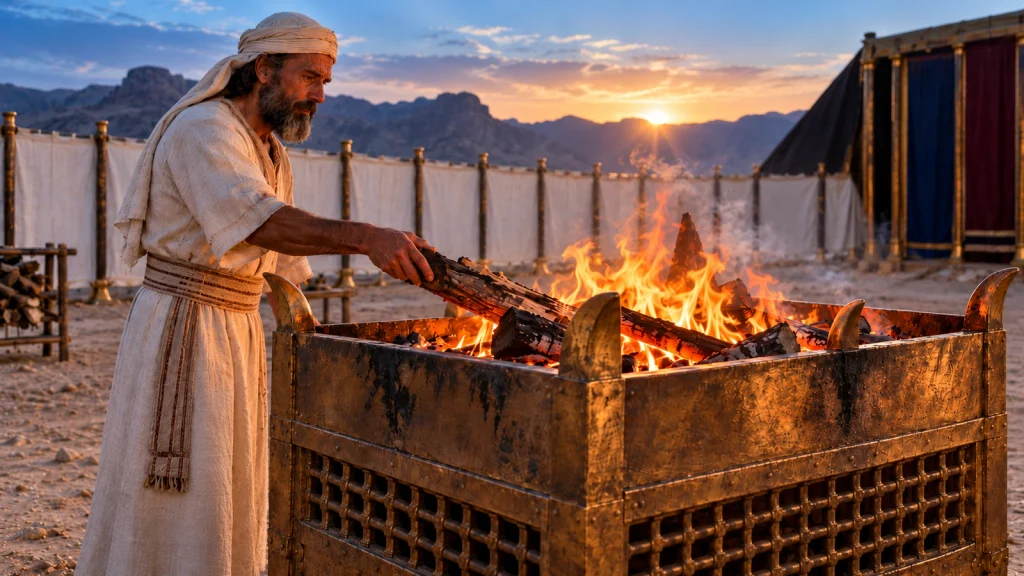
Source: AI-generated image created for Beyond The Known.
Leviticus 6 moves from restitution to the altar’s perpetual fire because it brings together the conclusion of the reparation laws and the beginning of a new set of instructions for priests. Verses 1–7 address people who have wrongfully taken or withheld another person’s property. Beginning in verse 8, Aaron and his sons receive directions for maintaining the altar and handling sacrifices. The change marks a shift in audience and responsibility, not a single ritual connecting repayment with the burning fire.
At first, the transition seems abrupt. Someone who has deceived a neighbor must return the property, add one-fifth of its value, and bring a ram for atonement. The next instructions describe a fire that must burn through the night, a priest changing garments to remove ashes, and restrictions on eating sacrificial food. The connection becomes clearer when the two collections are read in their proper settings. Our previous study, Why Does Leviticus 5 Require Confession and Restitution?, examined the different obligations arising from offenses involving ritual impurity, careless oaths, and sacred property. The opening verses of chapter 6 extend the law of restitution to wrongdoing committed against another person.
The remainder turns to the priests who administer Israel’s sacrifices. Here the concerns become more specific: how the altar is maintained, which portions may be eaten, where sacred materials belong, and what must be done with their remains.
Why Is Deceiving a Neighbor Called a Breach of Faith Against God? (6:1–3)
The chapter opens with offenses involving property entrusted to another person, goods obtained through theft or extortion, and lost possessions dishonestly retained by someone who finds them. False swearing also appears among the prohibited actions. These situations share an underlying problem. A person has taken, withheld, or misrepresented something that rightfully belongs to someone else. Yet the law describes the misconduct as a breach of faith against the LORD. The immediate victim is human, and the property need not have any connection with the sanctuary.
The Hebrew verb māʿal (מָעַל) is associated with unfaithfulness or trespass. Its appearance here is especially significant because Leviticus 5:15 uses the same vocabulary for an offense involving the LORD’s sacred things. The earlier regulation concerns property consecrated to God. The present cases involve possessions belonging to a neighbor. By employing related language, Leviticus places both forms of wrongdoing within its treatment of liability before the LORD. That connection does not make the offenses identical. Their circumstances and the recipients of restitution differ.
The Role of Deception and False Oaths
The law gives considerable attention to dishonest claims. Someone may deny receiving entrusted property, conceal the discovery of a lost possession, or swear falsely about a disputed matter. A false oath adds particular seriousness because divine authority may be invoked to support a dishonest statement. The passage, however, does not provide enough detail to reconstruct the exact legal circumstances behind every example. Kyle Dunham, in his study of the purification and reparation offerings, examines the relationship between breaches of trust, property rights, and the Hebrew category of the ʾāšām. His analysis treats violations against other people as an important part of the legislation governing reparation.
Scholars have proposed different explanations for why these offenses are also characterized as breaches against God. The biblical wording establishes that relationship without offering an extended theoretical account of it. The immediate duty of the offender is less ambiguous. Property wrongfully obtained or retained must be returned to its rightful owner.
Why Must Restitution Exceed the Original Loss? (6:4–7)
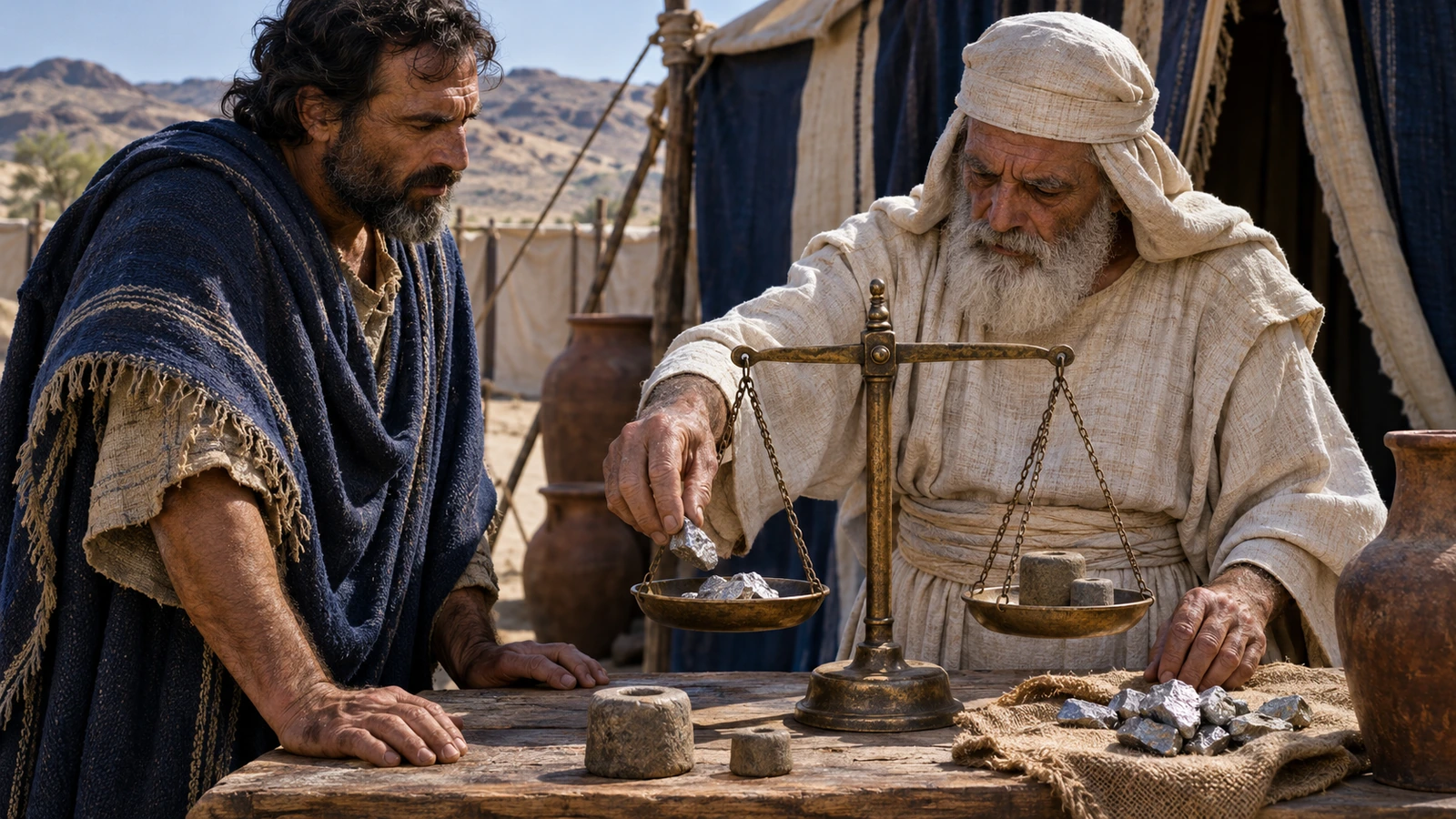
Verses 4–5 require the offender to restore whatever was stolen, obtained through extortion, entrusted for safekeeping, or dishonestly withheld after being found. Full repayment is not enough. The individual must add one-fifth of the property’s assessed value. If the original amount were ten shekels, the required restitution would total twelve. The example illustrates the calculation; the passage does not describe an actual transaction involving that sum. The additional payment goes to the person whose property was violated. This differs from Leviticus 5:15–16, where restitution concerns sacred property and is delivered through the priest.
Both regulations require an additional fifth, although they address different kinds of losses. Neither passage explains the precise rationale for the surcharge, so identifying it confidently as a particular form of punishment or administrative fee would go beyond the evidence.
Why Is a Ram Still Required?
After specifying repayment, the law commands the offender to bring an unblemished ram as a reparation offering. The Hebrew term ʾāšām (אָשָׁם) may designate guilt or liability and, in sacrificial contexts, the offering associated with it. “Reparation offering” is particularly useful here because the regulation includes a requirement to restore material value. The distinction between the two obligations is concrete. Returning the property addresses the injured owner’s loss. The ram belongs to the prescribed procedure for atonement before the LORD.
Verse 7 promises forgiveness after the priest performs that rite. The law therefore does not allow someone to retain the benefit of dishonest conduct while bringing a sacrifice in place of repayment. Nor does it describe compensation as a payment that purchases forgiveness. A related concern appears in the property laws examined in Exodus 22. Those regulations address theft, damaged goods, and entrusted possessions, sometimes requiring different forms of compensation. Leviticus 6 shares their insistence on restoring another person’s property while adding the reparation offering required for the offenses listed here.
There is also a difference from the confession law examined in the preceding chapter. Leviticus 5:5 expressly commands verbal acknowledgment for its specified cases. The present passage describes restitution and sacrifice without prescribing the same confession formula. Repayment may ordinarily involve admitting responsibility, but the legislation does not describe a separate spoken declaration. Its explicit requirements should remain distinct. With the promise of forgiveness in verse 7, the restitution law reaches its conclusion. A new set of instructions begins.
A Change of Audience: From Worshiper to Priest (6:8)
Verse 8 introduces another divine speech. Moses is now told to command Aaron and his sons, and the subject turns to the handling of offerings at the sanctuary. This transition also explains why Levíticus 6 can be confusing when comparing Bible translations. In many English editions, verses 1–7 complete the preceding laws of reparation, while the priestly instructions begin at 6:8. In Hebrew textual numbering, the restitution passage belongs to Leviticus 5:20–26, and the instructions to Aaron open chapter 6. The New American Bible, Revised Edition follows this latter division.
The division is more than a technical note about verse numbers. It helps readers recognize that two separate legal units meet at this point in many modern Bibles. Leviticus 1–5 introduced the principal categories of sacrifice largely through instructions concerning what was to be brought and how offerings were presented. The new collection concentrates on the priests’ responsibilities: caring for the altar, receiving their allotted portions, and observing restrictions governing holy materials.
Zev Farber examines this distinction between the two sets of laws. He also discusses a historical-critical proposal that their arrangement reflects an earlier stage in the composition of Leviticus. That proposal concerns how the book may have developed, rather than an explanation stated by the biblical narrator. In its received form, the repetition of sacrificial categories provides complementary information. A reader who knows what the worshiper must bring now learns how the priest is to handle it. The first duty described is the maintenance of the burnt-offering altar.
Why Must the Fire on the Altar Remain Burning? (6:9–13)
The burnt offering is to remain on the altar’s hearth throughout the night. By morning, the priest must attend to the ashes, add firewood, and arrange the offerings. The command to maintain the fire appears repeatedly in verses 9, 12, and 13, ending with an emphatic prohibition against extinguishing it. The fire is not treated as an occasional feature activated only when an individual brings a sacrifice. The altar requires regular attention, and the priesthood is responsible for keeping it ready.
Verse 12 includes the fat portions of the well-being offerings among the materials burned there. In Why Does Leviticus 3 Reserve the Fat for the LORD?, we examined why those portions were reserved for the altar rather than consumed with the remainder of the sacrifice. Here the same requirement appears from the priest’s perspective. Each morning, wood is added and the offerings are arranged for burning.
Does the Fire Represent God’s Presence?
The image of an unending flame has inspired theological interpretations concerning devotion, holiness, and divine presence. Leviticus 6, however, does not explicitly assign those meanings to the fire. Its repeated emphasis falls on the actions needed to maintain it. A later narrative in Leviticus 9:24 describes fire coming from before the LORD and consuming an offering. That event belongs to the larger account of the sanctuary’s inauguration. It should not be used to claim that chapter 6 identifies the altar’s perpetual fire as a particular miraculous flame.
The immediate instruction is both ritual and practical: the fire must remain burning, and the priests must perform the work necessary to sustain it.
Why Does the Priest Change Clothes to Remove Ashes?
Verses 10–11 provide an unusually detailed procedure. The priest wears linen garments and linen undergarments while removing the ashes left by the burnt offering. He places them beside the altar, changes into other garments, and carries the remains outside the camp to a ceremonially clean location. Even the disposal of ashes falls under regulation. Their destination is specified, and the clothing worn for one stage of the work differs from that used for the other.
Jiseung Choi has proposed a symbolic interpretation of these instructions, treating the contrast between priestly linen and the ashes as part of the ritual’s meaning. His study draws on theories of ritual boundaries and color symbolism to examine why the change of garments may have significance beyond practical necessity. That interpretation is worth considering, but the biblical passage does not explicitly explain the clothing change through color symbolism. The procedure itself reveals how carefully the priest’s duties are defined. The act of sacrifice does not end all responsibility for the materials it produces; their removal remains subject to sacred regulations.
The Grain Offering and the Priest’s Portion (6:14–18)
The next section returns to the grain offering introduced in Leviticus 2. Aaron’s sons present it before the LORD. A priest takes a handful of the flour and oil, together with the frankincense, and burns this memorial portion on the altar. The remainder is assigned to Aaron and his sons. Earlier instructions established how such offerings were prepared and presented. Leviticus 6 adds details about the consumption of the priestly share.
The remainder must be eaten without leaven, in a sacred place within the courtyard of the Tent of Meeting. Its consumption is restricted to authorized male descendants of Aaron. As examined in Why Does Leviticus 2 Require Grain, Oil, and Frankincense?, the minḥāh (מִנְחָה) is a recognized offering made from agricultural produce. The materials presented here belong to that sacrificial category, but the present regulation is chiefly concerned with what happens after the memorial portion has been burned.
The food reserved for the priests is described as most holy. This status imposes restrictions on its handling and consumption, even though it is not destined entirely for the altar.
What Does It Mean for Something to Become Holy Through Contact?
The final statement of verse 18 raises a genuine interpretive difficulty. Some translations render the Hebrew as declaring that whatever touches the offerings becomes holy. Others understand the wording as requiring anyone who comes into contact with them to be holy already. The NET Bible acknowledges both interpretations in its translation notes. Under the first reading, the expression concerns the effect of contact with a holy offering. Under the second, it functions as a restriction on who may approach sacred material.
Both readings belong within a context that carefully regulates access to holy things. Neither supports the popular assumption that touching an offering would automatically produce moral purity or spiritual transformation. The distinction between holiness as a ritual status and holiness as a personal moral quality should not be ignored. The next regulation illustrates the point from another angle: even authorized priests are not permitted to eat every grain offering.
Why Must a Priest’s Own Grain Offering Be Burned Entirely? (6:19–23)
The grain offering associated with priestly anointing follows a different procedure. One-tenth of an ephah of fine flour is prescribed, divided between morning and evening presentations. It is prepared with oil on a griddle and offered in pieces. Unlike the preceding grain offering, no remainder is assigned for consumption. Verse 23 states that every grain offering belonging to a priest must be burned in its entirety. The difference is not found simply in the ingredients. Both offerings involve flour and oil. Their handling changes according to the person bringing the sacrifice and the regulation governing it.
When an Israelite presents the ordinary grain offering, the priests receive a designated share. When the offering belongs to the priest himself, it is wholly given to the altar. The text establishes this distinction without developing a separate explanation of its theological rationale. It also places a limit on priestly entitlement. Receiving portions from certain sacrifices does not mean that priests may consume every offering of the same general category.
The Purification Offering: Blood, Meat, and Sacred Boundaries (6:24–30)
The chapter’s final regulation concerns the ḥaṭṭāʾt (חַטָּאת), commonly called the sin offering or purification offering. The animal must be slaughtered before the LORD in the place designated for the burnt offering. The flesh is classified as most holy, and the officiating priest is instructed to eat it within the courtyard of the Tent of Meeting. These details supplement the procedures introduced in Leviticus 4, particularly the handling of sacrificial blood and the treatment of the remaining carcass.
Why Are Bloodstained Garments and Cooking Vessels Regulated?
Verses 27–28 turn to objects that come into contact with the offering. A garment splashed with sacrificial blood must be washed in a sacred place. A clay vessel used to cook the meat is to be broken, while a bronze vessel must be scoured and rinsed with water. The differences are striking because they concern ordinary materials used during sacred service. Pottery and metal have different physical properties. Unglazed clay is comparatively porous, while bronze can be cleaned by scrubbing. Those differences provide a plausible practical background for the separate instructions.
The biblical text does not identify porosity as the reason for the rule, however. Its emphasis is on the required treatment of each object. The regulations also belong to a wider system governing holiness, purity, and the handling of sacrificial materials. Roy E. Gane’s study of Old Testament sacrifice examines such procedures within the larger framework of Israel’s ritual system, where different offerings and their components have distinct functions. Here the concern extends beyond the animal itself. Garments and cooking equipment cannot be handled without reference to the prescribed conditions once they have come into contact with the sacrifice.
Why Are Some Purification Offerings Eaten and Others Burned?
Verse 30 introduces an exception to the priest’s permission to eat the flesh. When blood from a purification offering has been brought into the Tent of Meeting to make atonement in the sanctuary, the meat must not be eaten. It is to be burned. This distinction corresponds to procedures already described in Why Does Leviticus 4 Require Different Sacrifices for Unintentional Sin?.
In the cases involving the anointed priest or the congregation, blood is taken into the Tent of Meeting for the interior rite, and the remaining carcass is burned outside the camp. The offerings for a leader or an ordinary Israelite involve a different blood procedure centered on the courtyard altar. Leviticus 6 supplies the explicit rule governing priestly consumption: a purification offering whose blood enters the Tent of Meeting for atonement must not be eaten.
The determining feature is the treatment of the blood, not simply the animal’s species or the rank of the person bringing it. The priestly portion is therefore subject to restrictions within the purification-offering category itself.
The Deeper Discovery
Why the Most Holy Offerings Were Not Always Burned Entirely
The regulations reveal an easily overlooked distinction between the holiness of an offering and what happens to its remaining materials. Leviticus describes both the grain offering and the purification offering as most holy. The Hebrew expression qōdeš qodāšîm (קֹדֶשׁ קָדָשִׁים) identifies a particularly elevated degree of sacred status. Yet these offerings do not all receive the same treatment. In verses 14–18, the remainder of an ordinary grain offering may be eaten by Aaron’s male descendants in a designated sacred place. Verses 19–23 prescribe a different outcome when the grain offering belongs to a priest: it is burned completely.
The purification-offering regulations introduce another distinction. Priests may consume certain portions, but verse 30 forbids eating an offering whose blood has been brought into the Tent of Meeting for atonement. All these instructions concern materials associated with the sanctuary, yet holiness does not automatically mean that everything must be consumed by fire. Nor does permission to eat part of an offering make that portion ordinary food. Its sacred status governs the people authorized to handle it, the location where it may be consumed, and the procedures required when its remains or associated objects must be dealt with.
The same concern appears in the treatment of ashes, garments, blood, and cooking vessels. The sacrificial act produces further responsibilities, some of which continue after the portion designated for the altar has been burned. This is the contribution of the priestly instructions to the earlier laws. Leviticus 1–5 largely introduced offerings through the actions of those bringing them. Here the regulations follow the sacrifices into the priestly work that surrounds and follows their presentation.
The reader gains a fuller picture of the sanctuary: an altar requiring continual maintenance, meals restricted by sacred boundaries, and materials whose handling is never left entirely to individual discretion.
What Holds Leviticus 6 Together?
Leviticus 6 contains two distinct movements. The first closes the laws of reparation by requiring an offender to restore property wrongfully obtained or withheld from a neighbor. The additional fifth and the ram belong to the prescribed response, with priestly atonement followed by the promise of forgiveness. The second establishes responsibilities for Aaron and his sons. Their duties extend from keeping the altar fire alive to managing the portions and remains of offerings according to their sacred status.
The transition is not explained as a cause-and-effect relationship between restitution and the perpetual flame. It reflects the arrangement of two connected collections of sacrificial legislation, one addressing liability incurred by the offender and the other governing service at the sanctuary.
FAQ
Why does Leviticus 6 call deception against a neighbor a sin against God?
Verse 2 explicitly describes offenses involving another person’s property as breaches of faith against the LORD. The required remedy includes restitution to the owner and a reparation offering.
How much extra restitution was required?
The offender had to return the full value and add one-fifth, making the total repayment 120 percent of the original amount.
Did the altar fire have to burn all night?
Yes. Verses 9 and 12–13 require the priests to keep the altar fire burning, including overnight, and to maintain it with fresh wood.
Why were the ashes taken to a clean place?
Leviticus 6:11 requires disposal outside the camp in a ceremonially clean location. The verse specifies the procedure without fully explaining its rationale.
Could priests eat every grain offering?
No. Authorized priests could eat the remainder of certain grain offerings, but verses 19–23 require a priest’s own grain offering to be burned entirely.
Does Leviticus 6:18 mean holiness could be transferred by touch?
Some translations understand the verse that way. Others read it as a requirement that anyone touching the offering must already be holy. The Hebrew is interpreted differently by translators.
Why could some purification offerings not be eaten?
Verse 30 prohibits eating offerings whose blood was brought into the Tent of Meeting for atonement. Those offerings were to be burned.
What Comes Next?
Leviticus 6 ends by distinguishing purification offerings that priests may eat from those whose flesh must be burned. The following chapter continues the priestly regulations, examining the reparation offering and the distribution of sacrificial portions. Leviticus 7 also develops the rules governing well-being offerings, including who may eat their meat, when it must be consumed, and which portions belong to the priesthood. These restrictions introduce the next question in our investigation: why was sacrificial meat subject to such specific rules, even after the offering had been presented to the LORD?
Next Study: Why Does Leviticus 7 Set Rules for Eating Sacrificial Meat? Series navigation Previous study: Why Does Leviticus 5 Require Confession and Restitution? Explore the series: Leviticus Studies
Selected Sources
- NET Bible. Leviticus 6, with Translators’ Notes. New English Translation. Bible.org. See also the notes on Leviticus 6:1–7.
- United States Conference of Catholic Bishops. Leviticus 5–6, with Explanatory Notes. New American Bible, Revised Edition. See also Leviticus 5 for the restitution passage under the alternative chapter numbering.
- Roy E. Gane. “Sacrifice and the Old Testament.” St Andrews Encyclopaedia of Theology. University of St Andrews, August 17, 2022.
- Kyle C. Dunham. “The Sin Offering and the Guilt Offering of the Levitical Cult: Their Occasion, Nature, and Distinction.” Detroit Baptist Seminary Journal 28 (2023): 3–24.
- Zev Farber. “‘This Is the Torah’ for the Priests Performing the Offerings.” TheTorah.com, April 6, 2017.
- Jiseung Choi. “Colour-Symbolistic Interpretation of the Ritual of ‘Removing the Ashes’ in Leviticus 6:3–4.” The Expository Times 137, no. 7 (2026): 308–320. Published online April 15, 2026. Abstract consulted. The passage corresponds to Leviticus 6:10–11 in the numbering used in this article.