Why Did Nadab and Abihu Die After Offering Unauthorized Fire?
Shortly after the inauguration of Israel’s priesthood, two of Aaron’s sons died before the LORD. Leviticus 10 examines their unauthorized offering, Aaron’s grief, and the difficult responsibilities of those entrusted with sacred service.
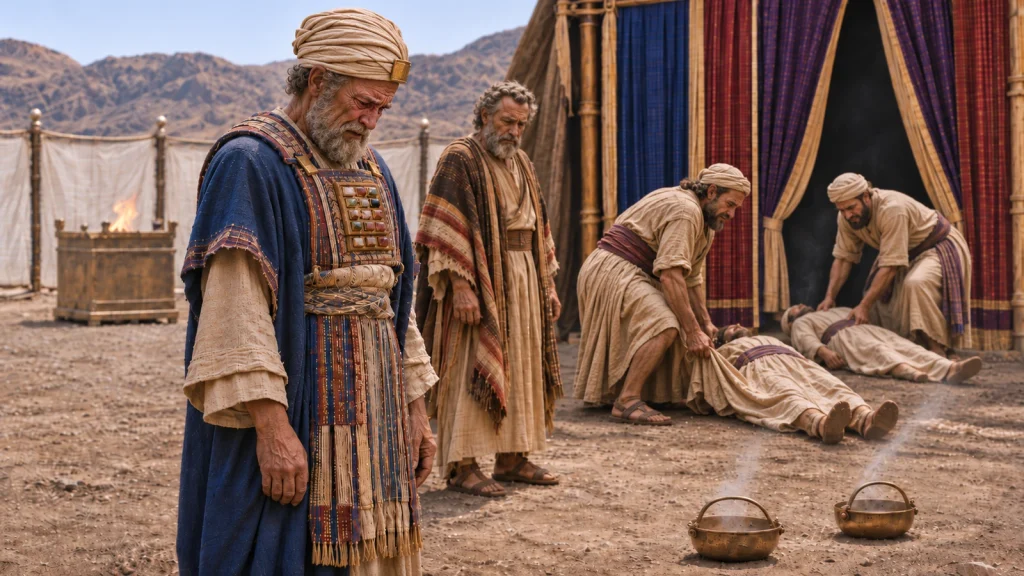
Source: AI-generated image created for Beyond The Known.
Nadab and Abihu died because they brought fire and incense before the LORD in a manner that had not been commanded. Leviticus 10:1 calls their presentation ʾēš zārāh (אֵשׁ זָרָה), traditionally translated “strange fire” and often rendered “unauthorized fire.” Fire then came from the LORD’s presence and consumed them.
What made their offering unacceptable is less certain. The passage does not identify the source of their coals, describe an improper incense mixture, or establish that they entered a forbidden area. Each possibility has been considered by interpreters, but the opening verses leave the precise offense unresolved.
The timing makes their deaths especially disturbing. In the previous chapter, Aaron had completed the inaugural sacrifices, the glory of the LORD appeared, and fire consumed the offering on the altar. Israel responded with a cry and fell facedown. Now fire emerges from the divine presence again, with devastating consequences for the newly installed priesthood.
The tragedy also leaves Aaron facing an extraordinary conflict. He must continue serving at the sanctuary while mourning two sons. Later, when Moses discovers that a purification offering has been burned rather than eaten, Aaron questions whether consuming it under such circumstances would have pleased the LORD.
That final conversation is essential to understanding Leviticus 10. The chapter moves from an unauthorized act and divine judgment to a disagreement over priestly duty in which Aaron’s explanation is accepted.
The Fire That Followed Israel’s Inauguration (10:1–2)
Nadab and Abihu were among Aaron’s sons consecrated for priestly service in Leviticus 8. Their installation had required washing, sacred garments, anointing, sacrifices, and seven days of observance at the Tent of Meeting. On the eighth day, Aaron began performing the appointed offerings for himself and the congregation. Our previous study, Why Did Fire Come Out from Before the LORD in Leviticus 9?, examined the extraordinary manifestation that concluded that service.
Leviticus 10 opens without a new date. The close relationship between the chapters is reinforced by the purification-offering goat mentioned later in 10:16, which corresponds to the animal presented for the people in 9:15. The events therefore belong to the immediate circumstances of the priesthood’s inauguration. Each brother takes a censer, places fire in it, adds incense, and approaches the LORD with his offering. The familiar materials make the outcome unexpected. Incense was already part of Israel’s sanctuary worship, with regulations provided in Exodus 30. Censers and burning coals were not inherently inappropriate objects.
Something about this particular presentation, however, stood outside the instructions governing sacred service. The response is immediate. The men die before the LORD. The account offers no intervening warning, argument, or opportunity for them to explain their actions. The suddenness sets the tone for everything that follows.
What Made Their Fire Unauthorized? (10:1)
The Hebrew expression ʾēš zārāh combines ʾēš, meaning “fire,” with zārāh, a form of an adjective associated with what is foreign, alien, or outside an authorized category. Its meaning in this context depends on more than the physical nature of the flames. The narrator adds a defining qualification: the LORD had not commanded the brothers to present this fire. That statement establishes the central problem but leaves several questions unanswered.
Was the Source of the Coals Incorrect?
One influential explanation concerns where the brothers obtained the fire placed in their censers. Jacob Milgrom proposed that the coals came from an unauthorized source rather than from the altar designated for sanctuary service. The NET Bible’s translators include this proposal among the principal explanations for the incident. Leviticus 16:12 provides a relevant comparison. During the Day of Atonement, the high priest must take burning coals from the altar before the LORD as part of the prescribed incense procedure.
That requirement shows the importance of the source of fire in at least one sanctuary ritual. It does not prove that Nadab and Abihu violated the same instruction. Their source of coals is never identified.
Was the Incense or Its Presentation Improper?
Another explanation focuses on the incense. Exodus 30:9 prohibits unauthorized incense on the incense altar, while verses 34–38 regulate the preparation and restricted use of the sacred mixture. Nadab and Abihu may have presented an unsuitable composition. Alternatively, the error might have involved the occasion or location of their offering. The relationship with Leviticus 16 is also significant. Its opening verses recall their deaths before warning Aaron against entering the innermost sanctuary whenever he wishes.
This connection gives questions of access and priestly boundaries particular weight. Yet Leviticus 10 does not say that the brothers entered the Most Holy Place. These proposals illuminate possible violations without establishing which one occurred.
Does the Account Reveal Their Motives?
The brothers speak no recorded words, and no intention is attributed to them. Their actions have been interpreted as pride, ambition, disregard for instruction, or excessive religious enthusiasm. Edward L. Greenstein surveys the remarkable variety of explanations developed around the incident, including interpretations that challenge the assumption that their motives can be confidently reconstructed. The absence of a stated motive is not a detail that historical imagination can resolve. Bryan D. Bibb approaches the uncertainty as part of the narrative’s significance. His study argues that the gaps surrounding the episode expose the difficulty of acting within sacred law when every possible situation has not been explicitly addressed.
This perspective does not make the brothers innocent or erase the narrator’s judgment that their offering lacked authorization. It does caution against replacing a difficult passage with an invented account of what they privately intended. The clearest evidence concerns the act they performed, not the psychological circumstances that led them to perform it.
Why Did Moses Speak About God’s Holiness? (10:2–3)
Moses responds to the deaths with a declaration concerning the LORD’s holiness and glory. Those who approach God must recognize his holiness, and his glory is to be acknowledged before the people. The Hebrew wording draws on two important roots: q-d-š, associated with holiness and consecration, and k-b-d, associated with honor and glory. The statement places the tragedy within the responsibilities of priestly proximity. Aaron’s sons had been consecrated for duties that ordinary Israelites were not authorized to perform. Their office brought them into direct involvement with the sanctuary’s most restricted activities.
That privilege did not remove the boundaries governing their conduct. Moses’ words also recall the emphasis on divine glory at the conclusion of Leviticus 9. There, the manifestation accompanied the inaugural sacrifices. Here the concern is how God’s holiness is acknowledged by those who serve in his presence. Neither passage portrays the priests as possessing authority over the divine response.
Why Did Aaron Remain Silent?
After Moses speaks, Aaron says nothing. The narrator gives no explanation for his silence. It could reflect grief, shock, restraint, or an inability to respond. Interpreters have also understood it as acceptance of Moses’ declaration. None of these possibilities can be established as Aaron’s complete emotional state from the brief statement alone. Its force comes partly from what has happened immediately before it. Aaron has lost two sons while serving at the sanctuary whose inauguration had just been celebrated. Moses offers a theological explanation, but the account records no reply from their father.
Later in the chapter, Aaron does speak. His answer to Moses concerning the uneaten purification offering becomes the final word in a dispute over sacred duty. The movement from silence to speech gives the chapter a personal dimension that should not be lost amid its legal details.
How Could the Priests Continue Serving After the Deaths? (10:4–7)
Moses summons Mishael and Elzaphan, relatives from Aaron’s extended family, and instructs them to remove the bodies from before the sanctuary. They carry the brothers outside the camp by means of their tunics. The use of other relatives for this task allows Aaron and his surviving sons to remain at their appointed duties without handling the bodies. Moses then gives instructions that seem severe in the circumstances. Aaron, Eleazar, and Ithamar must not dishevel their hair or tear their garments in mourning. They are also forbidden to leave the entrance of the Tent of Meeting. Failure to observe these restrictions would expose them to death and bring consequences upon the congregation.
Were Aaron and His Sons Forbidden to Grieve?
The passage restricts particular actions associated with public mourning. It does not describe the surviving priests as incapable of sorrow. In fact, the rest of Israel is explicitly permitted to mourn the deaths. The distinction separates the priestly obligations of Aaron’s household from the wider community’s response to the tragedy. The anointing oil remains upon the priests, marking their consecrated status and their continuing responsibilities. The NABRE notes another practical consideration: removing the bodies through other relatives avoids the ritual complications that contact with the dead would create for those still serving.
The scene exposes the tension between two obligations. Aaron is a father whose sons have died, but he is also the priest responsible for the sanctuary’s service. Leviticus does not describe how he reconciles these demands emotionally. It reports that he and his surviving sons remain obedient to Moses’ instructions.
Why Does the LORD Prohibit Wine After Their Deaths? (10:8–11)
The next divine speech is addressed directly to Aaron. He and his sons must not drink wine or other intoxicating beverages when entering the Tent of Meeting. The command is presented as an enduring regulation for the priesthood. Because it immediately follows the deaths of Nadab and Abihu, the restriction has often been used to explain their behavior. Perhaps the brothers had been intoxicated and their judgment was impaired. The association is understandable, but the passage never states that they had been drinking.
Its placement after the tragedy does not establish what occurred before it. Sheila Tuller Keiter has explored a more speculative explanation involving the possible effects of incense smoke. Such interpretations illustrate the range of attempts to account for the incident, but the biblical text offers no direct evidence of alcohol consumption or an intoxicating incense preparation. The prohibition can be understood on its own terms without resolving those hypotheses.
Priests Must Be Able to Make Distinctions
Verses 10–11 explain the responsibilities connected with sober judgment. The priests must distinguish between the holy and the common, between the clean and the unclean, and teach the Israelites the LORD’s statutes. These are related but different classifications. Something may be common because it has not been set apart for sacred use without thereby being ritually unclean. Conversely, questions of purity affect eligibility for particular forms of worship and contact with sacred things.
The law requires priests to recognize these distinctions and instruct the people in their application. Their office therefore extends beyond performing sacrifices. They are also responsible for preserving and teaching the boundaries governing Israel’s religious life. This responsibility will become especially prominent in the following chapters, where the laws address clean and unclean animals, bodily conditions, and other matters of ritual purity. The command concerning wine belongs to that larger concern for informed priestly judgment.
Why Does Moses Return to the Rules for Sacred Food? (10:12–15)
Moses next instructs Aaron and his surviving sons about the portions assigned to them from the inaugural sacrifices. The grain offering must be eaten without leaven near the altar because it is classified as most holy. The breast and right thigh from the well-being offerings are treated differently. Aaron’s sons and daughters may share those portions in a ceremonially clean place. These distinctions were established in the legislation examined in Why Does Leviticus 7 Set Rules for Eating Sacrificial Meat?.
The rules identify different recipients and locations according to the offering involved. Their appearance here is not a digression. The deaths have interrupted the inauguration, but the sanctuary’s food portions still require proper treatment. The priests must continue administering what has been presented, even though their family has suffered a devastating loss. The instructions also prepare for a disagreement. Moses expects the priests to consume another portion of sacred meat. When he discovers that it has been burned instead, his response is anger.
Why Was Moses Angry About the Purification-Offering Goat? (10:16–18)
The animal at the center of the dispute is the goat presented for the people in Leviticus 9:15. Moses searches for it and discovers that it has been burned. He confronts Eleazar and Ithamar, asking why they failed to eat the meat in the sacred place. His objection rests on an established requirement. The purification-offering regulations distinguish between animals whose blood is brought inside the Tent of Meeting and those whose blood remains associated with the outer altar.
According to Leviticus 6:26–30, priests may eat the flesh of certain purification offerings. When the blood is brought into the sanctuary for atonement, however, the flesh must be burned instead. The goat offered for the congregation in Leviticus 9 belongs to the category that normally provides a priestly portion. Moses points out that its blood had not been carried inside. The priests therefore should have eaten the meat rather than burning it.
Why Did Eating the Offering Matter?
Verse 17 connects priestly consumption with bearing the community’s iniquity and making atonement before the LORD. The precise relationship between eating the meat and removing guilt has received different interpretations. Some readings understand consumption as an integral ritual action through which the priests participate in dealing with the congregation’s iniquity. Others place greater emphasis on the priestly portion assigned in connection with the atoning service. The NET Bible’s explanatory notes address this difficulty.
For the immediate disagreement, the essential point is that Moses expects the prescribed treatment to have been followed. The meat was available for priestly consumption under the relevant rule, yet it had been burned. After the deaths of Nadab and Abihu, a second action has now occurred that Moses regards as contrary to the sanctuary’s instructions. This time, however, Aaron responds.
Why Did Moses Accept Aaron’s Explanation? (10:19–20)
Aaron reminds Moses of what has happened that day. The required purification and burnt offerings have been presented, but his family has suffered a terrible loss. He then asks whether eating the purification offering under those circumstances would have pleased the LORD. His reply does not reject the authority of the sacrificial laws. Instead, Aaron questions whether performing this particular act of consumption, immediately after the deaths of his sons, would have been appropriate before God.
Moses hears him and is satisfied. The ending is remarkably restrained. There is no extended judgment, no new ceremony, and no further dispute.
Did Aaron Receive an Exception to the Law?
The account does not record a separate divine instruction granting an exception. Nor does it establish a universal rule allowing priests to disregard sacrificial procedures whenever they experience grief. Aaron refers to his circumstances and raises the question of what would have been pleasing to the LORD. Moses accepts his explanation. The NABRE notes that Aaron’s answer remains somewhat indefinite about the precise reason the goat was burned. His bereavement is clearly relevant, but the passage leaves the relationship between that loss and the sacrificial requirement partly open.
That uncertainty is important. It would be too simple to claim that Moses abandoned the law or that Aaron proved priestly regulations could be ignored. The dispute begins with an actual requirement, and neither speaker treats that requirement as insignificant. What changes is Moses’ judgment of the particular case after hearing Aaron. The chapter ends with a decision reached through conversation rather than another manifestation of fire.
The Deeper Discovery
Why Two Irregularities Produced Different Outcomes
Leviticus 10 is often remembered almost entirely for the deaths of Nadab and Abihu. Yet its final episode raises an equally important interpretive question. Both the opening tragedy and the closing dispute concern conduct that does not follow the expected ritual pattern. The brothers present fire and incense that had not been commanded. Later, a purification offering that normally should have been eaten is burned instead. Only the first incident results in divine judgment. Understanding the difference requires close attention to how the situations are described.
An Uncommanded Offering Versus a Disputed Obligation
Nadab and Abihu introduce a presentation the narrator explicitly identifies as unauthorized. The brothers act, and the fire from the divine presence consumes them. No explanation from either man is recorded. The later incident concerns a sacrifice already offered on behalf of the people. Moses knows its prescribed treatment. Because the blood was not carried into the sanctuary, he expects the priests to eat the meat. Aaron does not dispute the normal rule. He asks whether eating the offering after the deaths of his sons would have pleased the LORD.
These differences prevent the two episodes from being treated as equivalent examples of deliberate rebellion. The first concerns the presentation of an uncommanded act before God. The second concerns the appropriate handling of sacred food after the prescribed sacrificial procedures have been performed under extraordinary personal circumstances. The narrative does not disclose every detail behind either decision. But it does give Aaron an opportunity to explain the second, and Moses accepts what he hears.
What Aaron’s Answer Reveals
A subtle change occurs between Aaron’s first and last responses in the chapter. After the deaths, he remains silent. When confronted about the burned goat, he speaks. His words do not challenge God’s holiness or deny the demands of priestly service. They raise a question about the acceptability of his own participation in a sacred meal while grieving the loss of his sons. The issue is not merely whether the correct action can be identified. Moses already knows the regulation.
Aaron asks whether carrying it out in these circumstances would have been fitting before the LORD. The distinction should not be exaggerated into a general principle that sincere feelings override ritual instructions. Leviticus offers no such declaration. Instead, it presents a particular case in which the expected requirement and the personal circumstances of the priest come into tension. Moses’ acceptance acknowledges the force of Aaron’s explanation without providing a complete legal theory for future situations.
The Significance of the Priests’ Teaching Responsibility
The instructions in verses 10–11 connect the two parts of the chapter. Priests must distinguish the holy from the common and the clean from the unclean. They must also teach Israel the statutes given through Moses. Such duties require knowledge of the regulations, but they also involve applying them in particular circumstances. Bryan D. Bibb’s study of Leviticus 10 examines how the encounter between law and narrative exposes gaps in human understanding. His argument suggests that priestly service involves decisions made in situations where the application of existing commands is not always self-evident.
The closing dispute offers a concrete example of that difficulty. Moses approaches the burned goat through the established rule. Aaron responds through the circumstances of the day and the question of what would be acceptable to God. The two men do not reject the sanctuary’s authority. They reason from within their responsibilities, and the disagreement ends with Moses’ approval. This episode adds an important dimension to the opening tragedy. The priesthood is not authorized to invent offerings simply because an action appears religiously meaningful. At the same time, those entrusted with sacred service must exercise discernment when carrying out their duties in circumstances the regulations do not describe in detail.
The chapter does not resolve every tension between law, judgment, and personal suffering. Its final scene is powerful partly because that tension remains. Aaron has lost two sons. His silence has given way to a difficult question, and Moses has listened. The concluding words concern neither fire nor punishment, but the acceptance of an explanation.
What Does Leviticus 10 Reveal About Priestly Responsibility?
The deaths of Nadab and Abihu establish the seriousness of approaching the LORD through an unauthorized act. Whatever the precise defect in their offering, the narrator identifies the absence of divine authorization as central to the incident. The instructions that follow show how demanding priestly service remains even under extraordinary circumstances. Aaron and his surviving sons must observe restrictions on mourning, remain attentive to the requirements of the sanctuary, distinguish among ritual categories, and teach Israel the laws they have received.
The final dispute adds a human dimension to those responsibilities. Moses insists on the prescribed treatment of the purification offering. Aaron responds from within the grief of the day, questioning whether eating the meat would have been acceptable before the LORD. Moses accepts his answer. Together, these episodes portray a priesthood whose service requires fidelity to divine instruction and careful judgment in difficult circumstances. Leviticus 10 does not explain every unanswered question surrounding the brothers’ deaths. It does, however, connect the tragedy with the wider responsibilities of those who serve near the sanctuary.
FAQ
Why did Nadab and Abihu die?
Leviticus 10:1–2 attributes their deaths to presenting unauthorized fire and incense before the LORD. The precise procedural offense is not fully identified.
What does “strange fire” mean?
The Hebrew expression ʾēš zārāh describes fire characterized as strange, foreign, or unauthorized. Interpreters have proposed several explanations involving the coals, incense, timing, or sanctuary access.
Were Nadab and Abihu intoxicated?
The passage never says they were. The prohibition on wine appears after their deaths, but it does not establish intoxication as the cause.
Why did Aaron remain silent?
Verse 3 records his silence after Moses’ declaration concerning God’s holiness. His emotional state is not explained, although the loss of his sons provides the immediate context.
Why could the surviving priests not perform ordinary mourning gestures?
Aaron, Eleazar, and Ithamar were required to maintain particular restrictions during their consecrated service. The wider congregation was permitted to mourn the deaths.
Why should the purification-offering goat have been eaten?
Its blood had not been brought inside the sanctuary. Under the relevant sacrificial regulations, the priests ordinarily should have consumed the allotted meat in a sacred place.
Why did Moses accept Aaron’s explanation?
Aaron questioned whether eating the purification offering after his sons’ deaths would have pleased the LORD. Moses accepted his response, although the narrative does not establish a general exception for all similar circumstances.
What Comes Next?
Leviticus 10 instructs the priests to distinguish between what is holy and common and between what is clean and unclean. They must also teach Israel how those distinctions apply. The following chapter turns to one of the most recognizable areas of biblical law: the classification of animals. Land animals are evaluated according to their hooves and whether they chew the cud. Aquatic creatures are distinguished by fins and scales, while birds and other creatures are addressed through additional regulations.
These laws raise questions that extend beyond identifying permitted foods. Why were particular animals classified as clean or unclean, and how should the reasons behind those distinctions be evaluated when the text itself gives only limited explanations? Next Study: Why Does Leviticus 11 Distinguish Clean and Unclean Animals? Series navigation Previous study: Why Did Fire Come Out from Before the LORD in Leviticus 9? Explore the series: Leviticus Studies
Selected Sources
- NET Bible. Leviticus 10, with Translators’ Notes. New English Translation. Bible.org. Especially the notes on unauthorized fire, the relationship with Leviticus 9, and the purification-offering dispute.
- United States Conference of Catholic Bishops. Leviticus 10, with Explanatory Notes. New American Bible, Revised Edition. Particularly the notes on verses 1–5, 10–11, and 16–20.
- Bryan D. Bibb. “Nadab and Abihu Attempt to Fill a Gap: Law and Narrative in Leviticus 10.1–7.” Journal for the Study of the Old Testament 26, no. 2 (2001). The interpretation discussed is grounded in the publicly available abstract.
- Edward L. Greenstein. “The Incident of Nadav and Avihu.” TheTorah.com, March 15, 2014. An examination of the episode’s interpretive difficulties and the history of explanations for the brothers’ deaths.
- Sheila Tuller Keiter. “The Cause of Nadav and Avihu’s Death: Incense Smoke?.” TheTorah.com. Presents a speculative explanation involving incense and intoxication, distinguished in this study from the explicit biblical account.
- Roy E. Gane. “Sacrifice and the Old Testament.” St Andrews Encyclopaedia of Theology. University of St Andrews, August 17, 2022. For the broader framework of sacrificial regulations and priestly responsibilities.
- United States Conference of Catholic Bishops. Leviticus 16, with Explanatory Notes. New American Bible, Revised Edition. Particularly verses 1–13 concerning restricted sanctuary access and incense coals.
- United States Conference of Catholic Bishops. Leviticus 6, with Explanatory Notes. New American Bible, Revised Edition. Particularly the instructions concerning priestly consumption of purification offerings.