Why Does 1 Enoch 10 Join the Judgment of the Watchers to the Healing of the Earth?
The answer to humanity’s cry includes restraint, survival, and a future in which the earth can sustain life without violence.
First Enoch 10 joins the judgment of the Watchers to the healing of the earth because the rebellion has damaged more than the offenders themselves. Their disclosures and their violent offspring have made human life precarious. The response therefore addresses the agents of corruption, preserves Noah’s line, and promises an inhabited, fruitful world. Healing does not mean that the rebellious angels are pardoned: their confinement and the removal of destructive powers belong to the restoration being commanded.
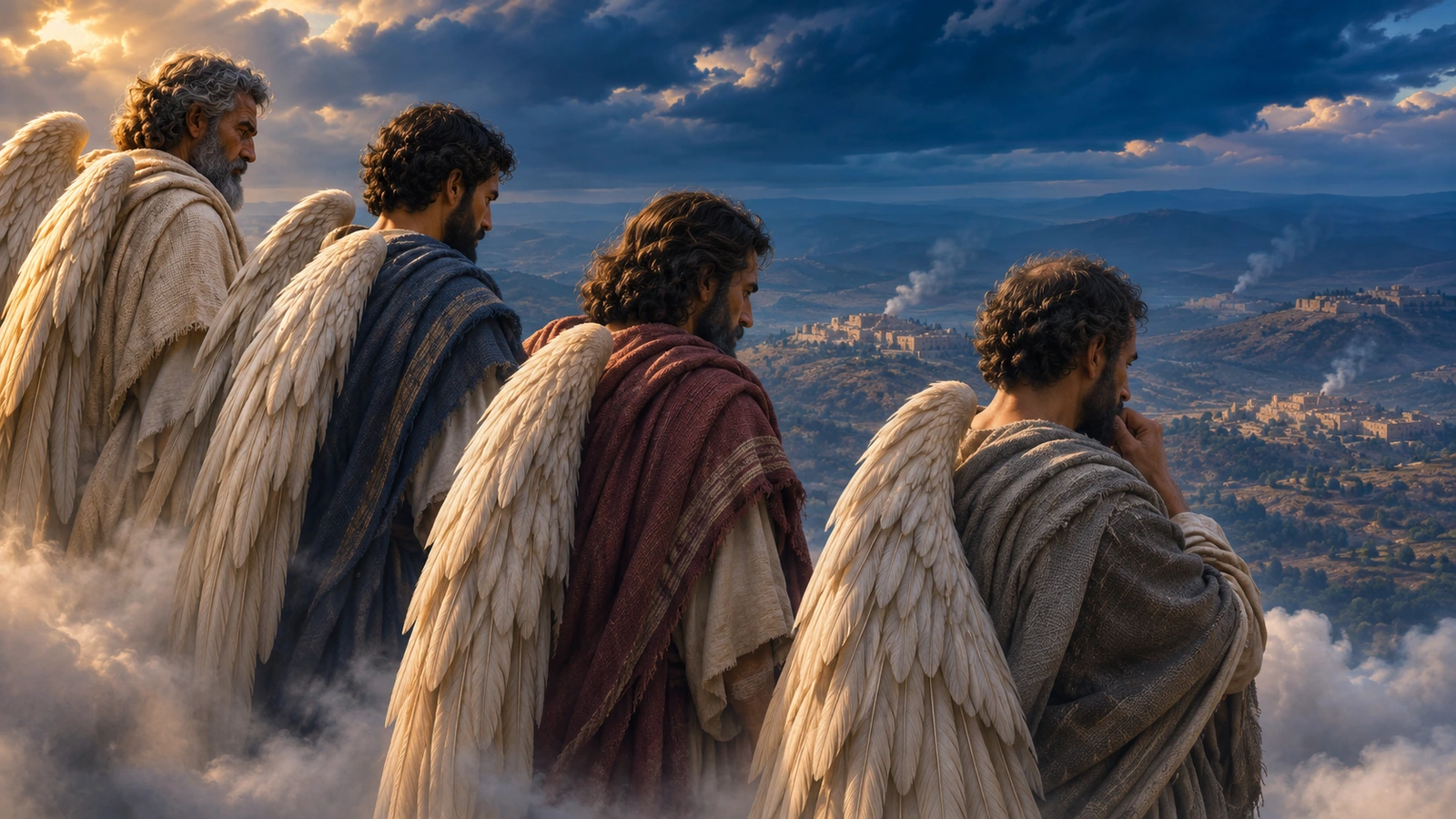
The previous study, Why Do the Holy Angels Bring Humanity’s Cry Before God in 1 Enoch 9?, ended with heavenly witnesses asking what they should do. Chapter 10 supplies commissions. The holy angels who receive these assignments must be distinguished from the fallen Watchers against whom they act. Both groups are angelic beings in the narrative; the distinction concerns allegiance and conduct, not angels versus ordinary human rulers.
This study follows R. H. Charles’s translation of 1 Enoch 10, as presented by the Internet Sacred Text Archive. A comparison with the Nickelsburg–VanderKam translation is identified where it affects names or visual details. This is a reading of an ancient Enochic narrative, not a claim that its entire account appears in Genesis or that every biblical tradition gives it the same canonical status.
The response begins by preserving a future
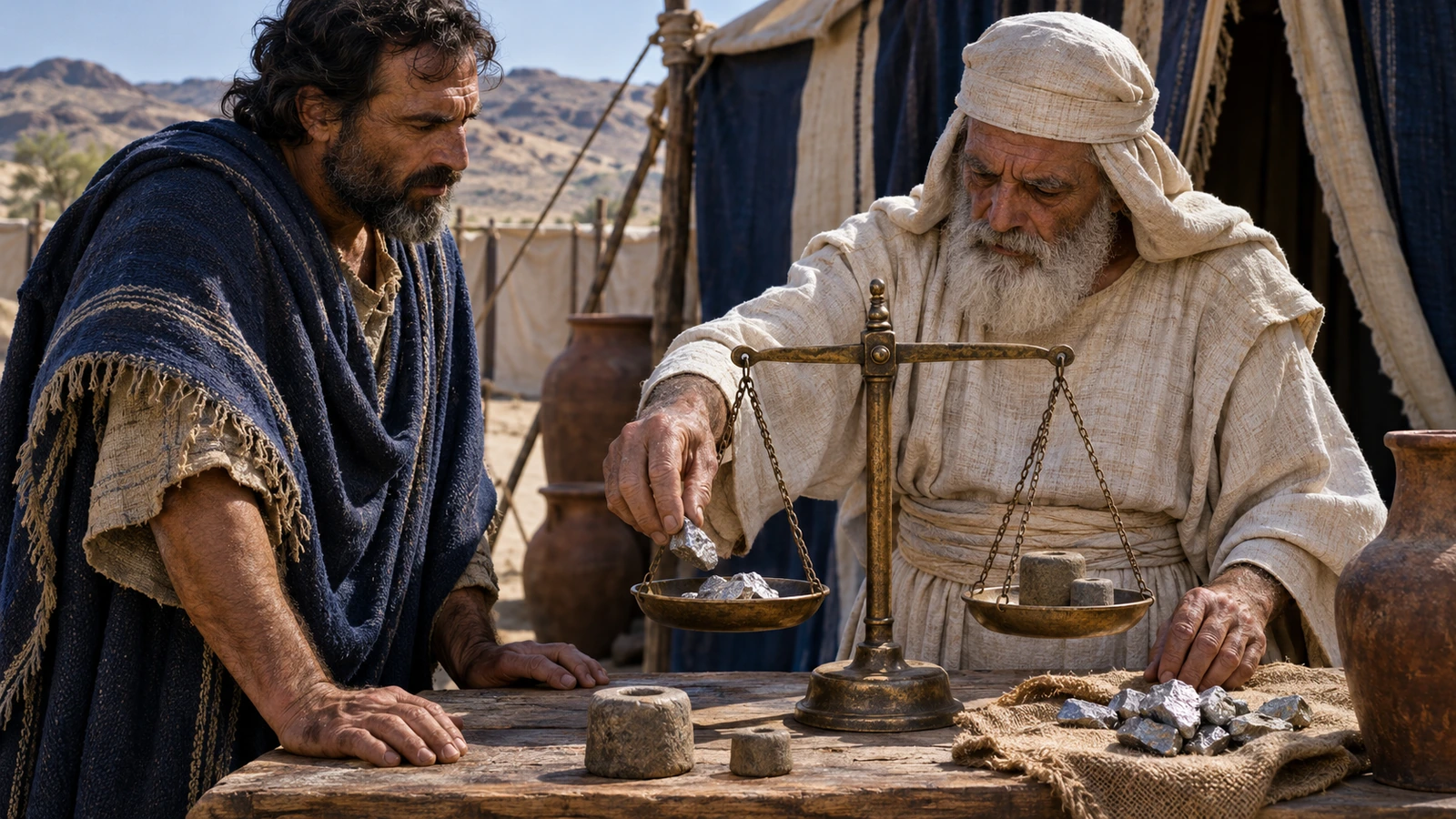
Before the chapter describes the confinement of a rebel, it directs a message to Noah, identified through his father Lamech. Charles names the messenger Uriel. The warning concerns a coming deluge and the preservation of Noah and his descendants. The first commission thus establishes that the destruction will not extinguish the human future altogether.
That opening controls how the rest should be read. If the goal were simply to remove every living creature from the story, there would be no need to instruct Noah about escape or mention the generations that will follow him. The preservation command is part of the divine response to the crisis, not an exception introduced after the judgment has failed.
The account is compressed. It does not describe the construction of an ark in this chapter, give its measurements, or narrate the flood’s stages. Readers familiar with Genesis can recognize the setting without silently importing its entire narrative into these few verses. Here the emphasis falls on a warning delivered through a heavenly agent and on the survival of a lineage.
There is already a meaningful contrast with the previous disclosures. Knowledge transmitted from heaven can preserve life, as this warning does. The problem with the Watchers is therefore not simply that humans receive information from a nonhuman source. The narrative distinguishes destructive instruction from a commissioned warning directed toward survival.
Raphael’s assignment has two connected parts
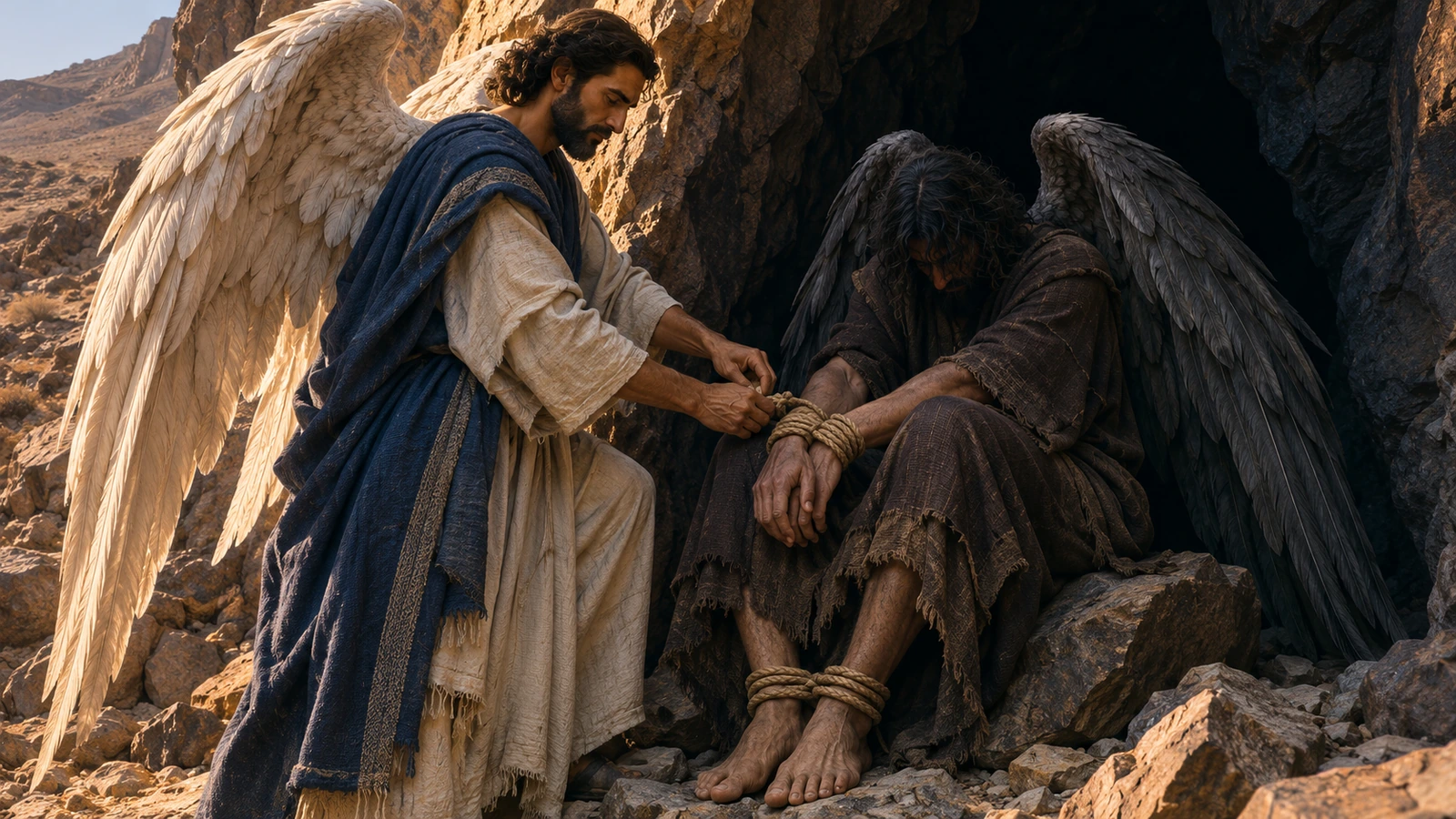
In verses 4–8, Raphael receives instructions concerning Azazel, the name used by Charles. He is to bind the offender hand and foot and place him in darkness in the wilderness of Dudael. Jagged stones and the covering of the face emphasize removal from the world in which his teaching has been active. The command then turns directly to healing the earth.
This transition is the clearest answer to the article’s central question. The imprisonment and the healing belong to the same commission. The passage names the corruption caused by the angels and links human peril to the secrets they taught. The earth is not an incidental backdrop that becomes green again after the interesting supernatural action is over; its condition is an explicit object of intervention.
Raphael’s task also contains a temporal distinction. Confinement in darkness precedes the great judgment and the further punishment associated with fire. An illustration that already places Azazel in a lake of flames while Raphael binds him would collapse those stages. The present artwork represents the initial restraint at a rocky opening, with wings and the specific restraints treated as artistic reconstruction.
The place-name Dudael does not make the image a verified location photograph. The chapter supplies a wilderness setting and an opening, but no coordinates by which the scene could be securely identified on a modern map. A dramatic cave can illustrate the language without becoming archaeological evidence for the event.
The term “healing” should also retain the scope given by its surroundings. The harm includes disclosed practices, death, and the disruption of human life. Nothing here offers a modern medical diagnosis for the earth or reduces the problem to one environmental process. The chapter’s language gathers moral, social, and terrestrial injury into one restoration.
Does assigning all sin to Azazel erase everyone else’s guilt?
Verse 8 places sweeping responsibility on Azazel for the corruption associated with his teaching. Taken in isolation, it might sound as though every other participant has become innocent. The commissions that follow make that reading untenable. The offspring are destroyed, Semjaza and his associates are bound, and wrongdoing is to be removed from the earth.
The force of the accusation is therefore best understood within the narrative’s allocation of responsibility. Azazel embodies a decisive source of corrupting instruction; the wording concentrates blame on him without ending the proceedings against other actors. The chapter can emphasize one offender’s role while still dealing separately with the actions and consequences of others.
The preceding study of the Watchers’ forbidden arts in 1 Enoch 8 helps explain why teaching receives such prominence. The accusation concerns practices transmitted into human society and their place in the resulting disorder. Chapter 10 responds to that earlier account, rather than introducing a wholly unrelated punishment for an unnamed offense.
It would be too broad to infer that the book condemns all technology, craftsmanship, or learning. The later promise includes cultivation, planting, and productive human work. The narrative judges the disclosures within the destructive sequence it has described. A universal prohibition on every human skill would exceed that argument.
Gabriel confronts the violent offspring
Verses 9–10 commission Gabriel against the offspring of the Watchers. Charles’s translation uses severe language to describe their illicit origin and directs them against one another in destructive conflict. These offspring are the giants born from the union of the fallen Watchers and human women in 1 Enoch 7:1–2. The narrative distinguishes them from both their angelic fathers and the human population they devastate.
The manner of their destruction reverses the earlier violence. Beings who have consumed and attacked others now become the agents of one another’s ruin. This is a literary reversal within the story, not a recommendation that human communities resolve wrongdoing by engineering reciprocal violence.
The denial of long life is important. Their enormous power does not secure an enduring place in the world. Verse 10 addresses the expectation of prolonged existence and the refusal of a successful petition on their behalf. The passage places a limit on a life that has become destructive to others.
There is an emotional cost in the sequence that a purely mechanical account of cleansing would miss. The following commission makes the Watchers witness the destruction of their offspring. The narrative calls those offspring their beloved ones. Acknowledging that wording does not cancel the accusation; it shows that the punishment is represented through the collapse of the very relationships the rebels established.
Michael’s commission distinguishes restraint from final judgment
Michael is sent against Semjaza and his associates in verses 11–15. Their conduct is identified through their unions with women and the resulting defilement. After the death of their sons, they are bound for seventy generations until the specified judgment. The number belongs to the narrative’s extended interval of restraint.
A claim that this yields a precise date on a modern calendar would require several assumptions the passage does not supply: a fixed length for each generation, an independently established starting date, and a justification for converting the literary period into that calendar. The text gives an interval and an endpoint, not the additional chronological apparatus.
The distinction between imprisonment and the later fiery judgment also appears in Raphael’s commission. In both sequences, the offender is prevented from continuing freely before the final outcome is described. The parallel supports a reading in which containment itself is part of the answer to the victims’ cry.
Readers sometimes import a complete account of the origin of demons into these verses. Chapter 10 refers to destructive spirits, but it does not here develop every distinction found later in the Enochic work. Its immediate concern is the removal of forces that have wronged humanity. More detailed claims about their subsequent existence require analysis of those later passages rather than an expansion of this paragraph from memory.
A documentary example: are the stones beneath him or over him?
A concrete edition comparison shows why visual certainty must remain limited. Charles’s presentation of 10:5 puts the rough stones upon Azazel. In George W. E. Nickelsburg and James C. VanderKam’s 1 Enoch: A New Translation, printed page 28, the stones are beneath him; the accompanying note identifies “over him” as the Ethiopic reading. The difference affects the physical arrangement an artist might portray.
The shared elements remain confinement, jagged stones, and darkness. The disagreement means that a fully specified reconstruction of a stone covering cannot be called the unanimous wording of every witness. Our image stops at the binding and the rocky opening, leaving that disputed arrangement unasserted.
The same edition’s page 27 marks Sariel in 10:1 as an editorial emendation to match 9:1; Charles prints Uriel. These are identified editorial presentations, not evidence that two additional messengers must be inserted into the scene. This comparison uses the published translation and its notes, not a new examination of the underlying manuscripts.
The example has a practical consequence for reading. A small preposition can change a visual reconstruction while leaving the larger narrative function intact. Textual comparison need not overthrow an entire passage to be useful; sometimes it prevents an illustration or a confident paraphrase from claiming more precision than the evidence permits.
The earth is restored as a place people can inhabit
The final movement turns from particular offenders to the conditions of life. Verses 16–22 describe the removal of wrongdoing, the emergence of righteousness, and the survival of the righteous. Youth and old age can be completed in peace. The contrast is with lives cut short by the violence that prompted the earlier appeal.
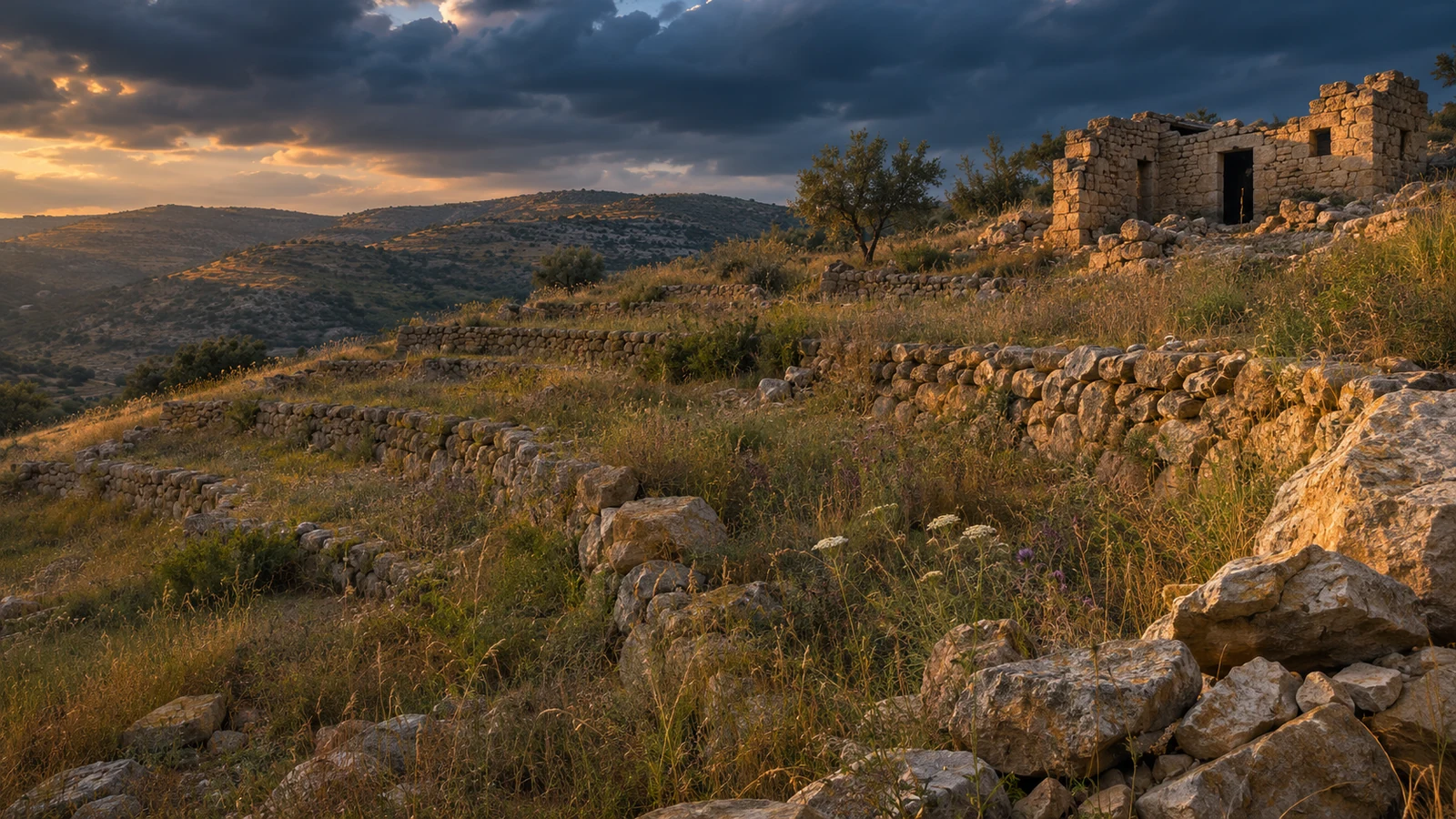
The agricultural language gives this promise concrete form. Trees are planted; vines produce wine; seed and olives yield abundantly. The vision is not of a world emptied of people so that nothing can ever disturb it. It includes cultivation and generations of inhabitants. Human work has a future within the healed earth.
That observation qualifies a simple opposition between nature and civilization. The crisis is not resolved by abolishing agriculture. The land is cultivated in righteousness, linking the character of human activity with the condition of the inhabited world. Productive labor and moral order are presented together.
The extraordinary yields should be read as the imagery of abundant blessing. They are not field measurements from an excavation or an agricultural projection that can be reproduced by following a modern technique. The numbers make the promised reversal expansive; they do not supply experimental evidence for crop performance.
The sequence also includes worship by the nations and cleansing from defilement. Thus “healing” cannot be reduced to increased food production alone. The restored order includes conduct, survival, abundance, and the acknowledgment of God. Removing any one of those dimensions would narrow the ending beyond its actual range.
There is nevertheless a serious question about whose future is being described. The righteous escape, while the preceding commands eliminate destructive beings. Universal language about the nations occurs after that judgment. It should not be used to claim that every condemned rebel is ultimately restored to the same position as the righteous. The chapter has not narrated such a reconciliation.
What Genesis clarifies, and what Enoch adds
Genesis 6:11–13 connects the coming flood with an earth corrupted and filled with violence. That gives a useful point of comparison: the state of the earth and the conduct of its inhabitants belong together in the explanation of judgment. Destruction is not presented as an arbitrary interruption of an otherwise peaceful world.
First Enoch develops the crisis through named heavenly rebels, forbidden disclosures, giant offspring, and commissioned holy angels. Those particulars must remain identified as features of the Enochic account. Genesis 6:11–13 does not name Raphael, identify Dudael, or narrate Azazel’s confinement.
The comparison consequently illuminates both continuity and expansion. The shared connection between violence and a corrupted earth makes the Enochic problem intelligible within a biblical flood setting. The additional assignments explain the crisis and its resolution through a larger cast of heavenly agents. Reading the texts side by side is more informative than silently combining them into one undifferentiated narrative.
Nor does their literary relationship establish every historical claim one might make about the events. A text can interpret another tradition without becoming independent archaeological confirmation of its details. Here the evidence supports comparison of accounts and their moral logic; it does not locate an ancient prison or recover a physical trace of the binding.
The Deeper Discovery
Two petitions receive opposite answers
The victims’ appeal in chapter 9 leads to commissioned action in chapter 10. Yet 10:10 refuses a successful request on behalf of the destructive offspring. Read together, the two petitions reveal that the book is not merely celebrating intercession as a procedure that works for whoever uses it. The identity of the harmed and the conduct of those seeking protection remain decisive.
The contrast adds a sharper meaning to the healing of the earth. If the offenders’ plea simply restored the conditions that produced the victims’ cry, the response would leave the original harm unresolved. The narrative instead places a boundary around the continuation of that destructive life. Mercy toward endangered humanity and refusal toward the agents of devastation are joined within its account of justice.
This is a literary inference from the juxtaposition of the two appeals. It does not settle every later theological question about forgiveness. It does explain why the same section can hear a cry, deny a petition, and speak of healing without treating those actions as contradictions.
FAQ
Are Raphael and Michael fallen Watchers here?
No. They carry out the divine commissions against the rebels. The chapter distinguishes faithful angelic agents from the angelic offenders.
Does the healing mean Azazel is forgiven?
No. The earth’s healing is coupled with his restraint and judgment. The passage does not describe his reconciliation.
Are the wings in the image specified in 1 Enoch 10?
No. They are an artistic convention used to identify the figures as angels. The binding, wilderness setting, stones, and darkness have textual grounds.
Can the seventy generations establish a modern date?
Not from this passage alone. It supplies neither the required calendar starting point nor a fixed number of years per generation.
Is Dudael a verified archaeological site?
No securely identified location is established by the sources used here. The artwork is an interpretation of the setting, not a reconstruction of an excavated site.
What Comes Next?
The judgment removes destructive powers while making room for enduring life. Chapter 11 briefly extends that prospect through heavenly blessing upon human labor and the joining of truth with peace. The next study is Why Does 1 Enoch 11 Link Heavenly Blessing to Human Labor?
Explore the series: Ancient Texts.
Selected Sources
R. H. Charles, translation of 1 Enoch 10, Internet Sacred Text Archive. Primary text for the commissions, restraint of the Watchers, and restoration of the earth.
R. H. Charles, translation of 1 Enoch 9, Internet Sacred Text Archive. The preceding appeal that receives its response in chapter 10.
George W. E. Nickelsburg and James C. VanderKam. 1 Enoch: A New Translation, Fortress Press, publisher’s excerpt, printed pages 27–28. Edition comparison concerning Sariel/Uriel and the placement of stones in 10:5.
Genesis 6:11–13, King James Version. The relationship between violence, corruption, and the flood judgment.
R. H. Charles, translation of 1 Enoch 11, Internet Sacred Text Archive. The continuation concerning blessing, human labor, truth, and peace.