Why Does Leviticus 26 Say the Land Will Enjoy Its Sabbaths?
The land’s enforced rest exposes the limits of possession, while covenant memory survives the loss of home.
Leviticus 26 says the land will enjoy its Sabbaths because Israel’s exile will interrupt the cultivation that denied it rest. Verses 34–35 explicitly connect the country’s desolation with the rest it did not receive while its inhabitants lived there. This is judgment within the covenant, not a description of the soil feeling pleasure. Yet the chapter also says that God will remember the land and will not destroy his people completely. The abandoned fields belong to a warning whose final word is not abandonment.
The previous study, Why Can Land Never Be Sold Permanently in Leviticus 25?, examined restrictions on the sale of ancestral holdings. Chapter 26 asks a more disturbing question: what happens when the community that occupies God’s land refuses the obligations attached to it? The movement from protected inheritance to forced absence gives the land’s Sabbath its severity.
This study follows the King James Version of Leviticus 26, with the New American Bible Revised Edition consulted where its wording clarifies a difficulty. The argument concerns the received chapter and its later biblical interpretation. It does not require a reconstructed date for every stage of the chapter’s composition.
The Sabbath the land was supposed to receive
The instruction behind the warning appears in Leviticus 25:1–7. Six years of sowing and vineyard work are followed by a seventh year of rest. The land’s Sabbath is directed to the Lord. Its produce remains food for the household, workers, resident foreigners, livestock, and wild animals. The law therefore imagines people continuing to live on the land while relinquishing the normal annual cycle of cultivation.
That arrangement distinguishes a Sabbath year from agricultural abandonment. A family observing the command has not been expelled. The interruption of work occurs within a relationship that still provides food and preserves residence. In chapter 26, by contrast, the people are elsewhere. The same cessation that should have expressed obedience now occurs through the destruction of ordinary settled life.
There is an ecological dimension to any interruption of intensive cultivation, but the stated explanation here is covenantal. Neither chapter offers a soil-science account of nutrient recovery. Reducing the command to ancient crop management would miss its explicit orientation toward God and its inclusion of people and animals in access to food. The question is who controls the use of the land and whether its inhabitants acknowledge a limit on their labor.
Nor should every reference to Sabbath in Leviticus 26 be treated as exclusively agricultural. Verse 2 commands the keeping of God’s Sabbaths alongside reverence for the sanctuary. Verses 34–35 then specify the land’s neglected rest. The later language narrows the focus without turning the opening command into a technical reference only to seventh years.
Why the warning begins with abundance
The blessings in verses 3–13 establish what will be lost. Rain arrives in season; fields and trees produce; successive harvests overlap; food is sufficient. The community can lie down without fear, and hostile forces cannot simply overrun it. These promises describe a functioning public world in which cultivation, security, population, and worship belong together.
A close reading needs the agricultural sequence. In verse 5, threshing reaches the vintage and the vintage reaches sowing time. The picture is of abundance extending through the farming calendar. Verse 10 adds the problem of making room for a new harvest while old provisions remain. The later famine reverses these particular assurances, rather than introducing a disconnected catalog of disasters.
The blessing also reaches beyond food. Verses 11–12 describe God’s dwelling and presence among the people. Verse 13 identifies the speaker as the God who brought Israel out of Egypt and broke its yoke. Freedom from slavery supplies the background for obedience: the commands address a people already delivered, not applicants attempting to purchase liberation through agricultural compliance.
This sequence prevents a misleading reading of prosperity. The passage addresses Israel’s collective life in a specified covenant and land. It is not a universal diagnostic chart by which an observer can infer an individual’s moral condition from income, illness, or crop yield. Applying it that way changes its audience, scale, and stated setting before the interpretation has even begun.
Escalation follows repeated refusal
Disobedience enters in verses 14–15 through refusal to listen, rejection of statutes, and violation of the covenant. Neglected land rest is one concrete expression of this breakdown, but the indictment is broader. Idolatry, contempt for divine judgments, and persistent hostility belong to the chapter’s frame. Exile is therefore not presented as the consequence of an isolated farming mistake.
The punishments develop in stages. The NABRE notes on Leviticus 26 identify successive groups in verses 14–17, 18–20, 21–22, 23–26, and 27–39. Each new stage follows continued refusal to respond. This structure helps explain why the passage repeatedly returns to the possibility that the people might listen, even as the threatened consequences intensify.
At first, labor loses its benefit: seed is sown but enemies consume the crop. Next, the sky and ground become unyielding, expressed through the images of iron and bronze. Later, wild animals diminish the population and make roads deserted. The collapse moves from production to movement and settlement. A country can become uninhabitable through more than one kind of failure.
The bread scene in verse 26 makes scarcity domestic and measurable. Ten women use one oven, and bread is distributed by weight without satisfying hunger. The reader need not invent the dimensions of an oven or a daily ration to understand the contrast. Earlier there was insufficient storage for abundance; now there is insufficient bread for those who eat it.
The recurring sevenfold punishment in verses 18, 21, 24, and 28 intensifies the warning. These verses do not supply a conversion rule turning each occurrence of seven into a dated sequence of world history. Their immediate function is to mark the severity of the response to continuing resistance. A proposed chronological scheme would need evidence beyond the repeated number itself.
Desolation gives the land what residence denied it
Verses 31–33 bring together ruined cities, devastated sanctuaries, rejected offerings, and dispersal among the nations. Then verses 34–35 interpret the empty countryside: the land receives its rest while the people are in their enemies’ territory. The location of the inhabitants is essential. The passage does not merely predict that cultivation will decrease; it explains enforced rest through their absence.
The KJV’s verb “enjoy” can sound unexpectedly pleasant in this setting. The NABRE instead speaks of making up lost Sabbaths. That comparison helps modern readers hear the compensatory force of the statement without imagining that the chapter celebrates human suffering. The immediate explanation is supplied by verse 35: the land had not rested during the inhabitants’ earlier tenure.
The contrast also qualifies the meaning of possession. Residence had enabled Israel to sow, prune, gather, and organize household life. It did not give the community unlimited authority to decide that the land would never stop producing for it. Chapter 25 had restricted permanent alienation of holdings; chapter 26 depicts the loss of the ability to use them at all.
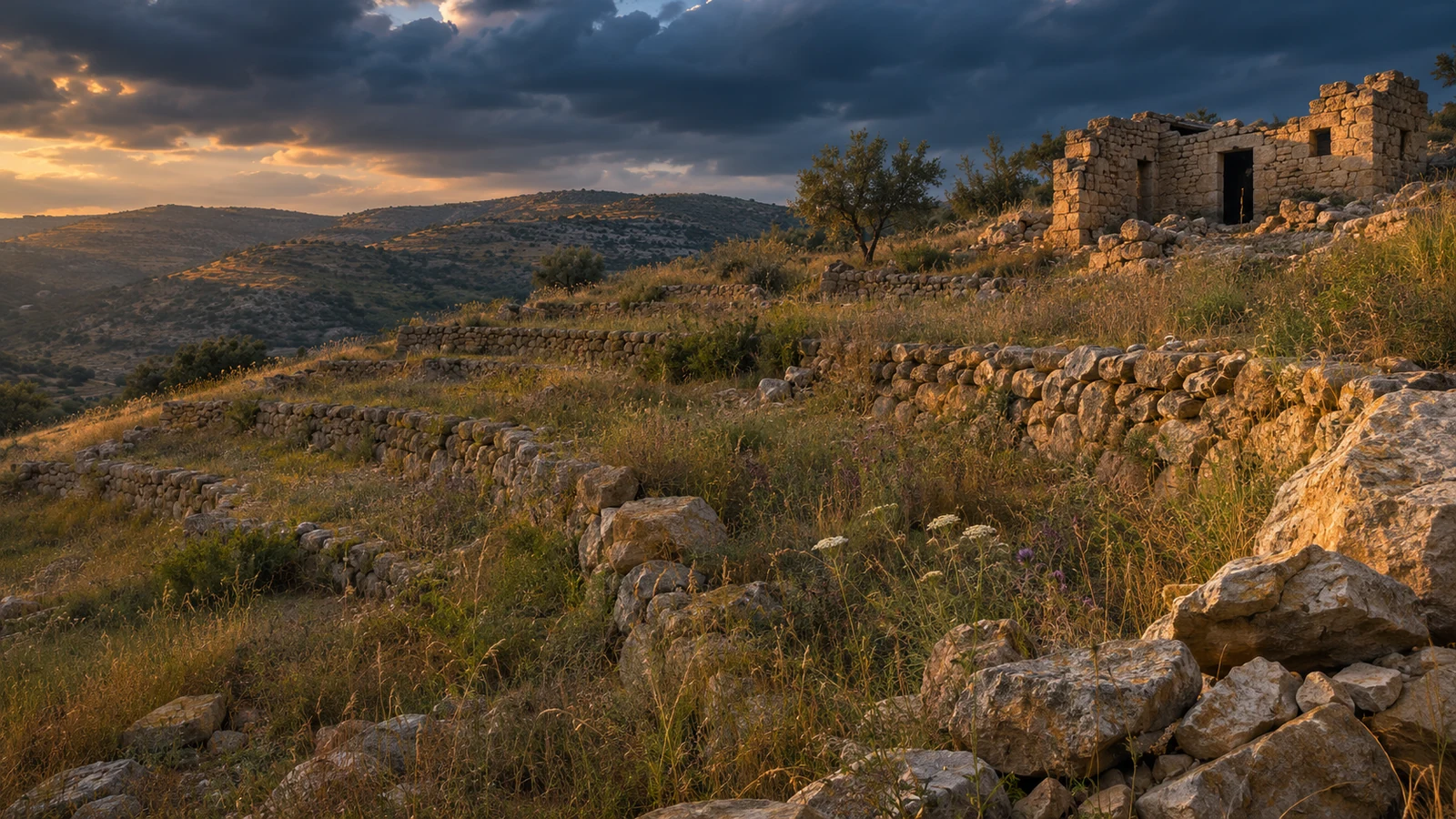
Desolation is not equivalent to a flourishing wilderness. Verse 32 says even enemies dwelling there will be astonished by the devastation. The field can cease to be worked without becoming a pastoral paradise. Abandoned terraces illustrate the interruption of cultivation; they do not establish ecological renewal or a recovery the verses have not yet described.
There is also a difference between the chapter’s language of national devastation and a modern demographic claim that absolutely no person remained anywhere in the territory. Verse 32 itself refers to enemies dwelling in the land. The emphasis falls on Israel’s removal and the breakdown of its settled life. The land’s Sabbath should not be used as a census report.
The survivors do not experience exile as rest
The quiet fields are followed by frightened survivors. In verses 36–37, the sound of a shaken leaf causes flight even without an actual pursuer. This reverses the earlier promise that the people could lie down without fear. External defeat has become insecurity that persists beyond the immediate battle.
The contrast is severe: the land rests while its former inhabitants cannot feel safe. The passage separates the cessation of agricultural work from the human experience of peace. This is one reason to resist treating Sabbath and exile as interchangeable forms of renewal. One was commanded as part of life together; the other dismantles that life.
Verse 38 adds another reversal. The enemies’ land is said to consume the exiles. Earlier, Israel ate the land’s produce; now a foreign land metaphorically eats Israel. The language compresses dispossession and mortality into a territorial image. It does not identify a literal action of soil, just as the land’s enjoyment does not require literal emotion.
These images make the warning difficult to domesticate into a general encouragement to take a break. Its subjects include hunger, defeat, loss of children, and displacement. A responsible theological reading must account for that suffering rather than extracting the attractive word “rest” and leaving the threatened community outside the interpretation.
What the seventy years in Chronicles actually establish
A later biblical text explicitly connects exile with the land’s Sabbaths. Second Chronicles 36:20–21 describes survivors carried to Babylon and interprets the land’s desolation as rest while seventy years are fulfilled. The language is a clear reception of the Sabbath-rest theme, embedded in the Chronicler’s account of Judah’s fall.
The surrounding narrative matters. Verses 14–16 describe widespread unfaithfulness, the defilement of the temple, and rejection of prophetic messengers. Verse 19 describes the burning of the temple and destruction of Jerusalem. The land’s rest is placed within that larger account, rather than offered as a replacement explanation in which neglected agriculture alone caused the catastrophe.
Chronicles also names Jeremiah. In Jeremiah 25:8–14, seventy years concern service to Babylon, followed by judgment on Babylon itself. The Chronicler brings that period into contact with the land’s rest. The connection is interpretively significant, but the two passages should still be allowed to make their own claims.
A common calculation multiplies seventy Sabbath years by seven to obtain 490 years of neglected observance. The arithmetic is straightforward; its historical premise is not supplied by these verses. Leviticus 26 gives no total of seventy years. Chronicles gives the seventy-year period but does not identify the beginning and end of a continuous 490-year record of agricultural violations. One cannot turn the calculation into an independently documented chronology simply by performing it correctly.
This limit does not weaken the explicit connection. Chronicles does interpret desolation through Sabbath language. What remains unestablished is a complete ledger of missed years from which an exact chronology could be recovered. The distinction preserves the strength of the evidence actually present instead of making it carry an additional claim.
Confession and the limit placed on destruction
Leviticus 26 does not end with the empty land. Verses 40–41 describe confession of the people’s own wrongdoing and that of their ancestors, together with humbled hearts. The account acknowledges continuing responsibility across generations without allowing the surviving community to speak only about someone else’s failures. Their own hostility remains part of what must be confessed.
Verse 42 then names the covenants with Jacob, Isaac, and Abraham and adds the land to divine remembrance. Within the argument, remembering is consequential: it belongs to the movement beyond judgment. The text is not describing a lapse in God’s factual memory that confession repairs. It concerns the enduring significance of commitments when present circumstances appear to have contradicted them.
Verse 44 is especially careful. Even in enemy territory, God will not reject the people to the point of destroying them utterly and breaking his covenant. This does not retract the earlier descriptions of defeat and death. It sets a limit on their ultimate effect. Severe judgment and total cancellation of the relationship are not treated as identical.
The return to the exodus in verse 45 reinforces that limit. The God who brought the ancestors out before the nations remains their God. The chapter therefore ends by placing the disaster within a relationship that persists through it. A reading that stops at verse 35 misses this qualification; a reading that rushes to verse 44 without facing the losses makes the qualification too easy.
The two statements about breaking the covenant also deserve comparison. Verse 15 accuses the people of breaking it through refusal to obey. Verse 44 denies that God will break his covenant by completing their destruction. The relationship is therefore not described as a contract that simply disappears once either party violates a condition. The chapter distinguishes Israel’s breach from God’s continuing commitment. That distinction is grounded in the contrasting statements, even though the passage does not resolve every later theological question about covenant and restoration.
The Deeper Discovery
The KJV’s repeated verb “abhor” traces a reversal that is easy to miss. In verse 11, God’s dwelling among the people accompanies his promise not to abhor them. Verse 15 describes their abhorrence of his judgments, and verse 30 answers with divine abhorrence amid the destruction of their cult sites. Verse 44 returns to the refusal to abhor them, now qualified by the limit on utter destruction. The sequence moves from welcome through reciprocal rejection to a boundary that judgment will not cross. This verbal pattern gives concrete form to the distinction between punishment and the cancellation of the covenant.
The land’s place in verses 42–43 belongs within that same movement. Its neglected Sabbaths must be reckoned with, yet it is named as something God will remember. The warning does not leave either the people or their land outside the closing account of covenant commitment.
That placement changes the significance of the deserted field. Its emptiness is not proof that it has become irrelevant to God. The people can be absent from it while it remains present in the chapter’s account of remembrance. This is a literary observation about the sequence, not a promise that every abandoned property will be returned to its former owner.
It also makes the ending more demanding than a simple reversal from bad conditions to good ones. The text does not erase the debt represented by the unobserved Sabbaths. It holds reckoning and remembrance together. The land’s enforced rest can be understood only by following both movements through the final verses.
FAQ
Does “enjoy its Sabbaths” mean the earth has emotions?
The chapter personifies the land. Verse 35 explains the concrete referent: it rests from the cultivation that continued when rest should have been observed.
Does Leviticus 26 predict exactly seventy years?
No duration of seventy years appears in this chapter. That number enters the comparison through Jeremiah and the later interpretation in 2 Chronicles 36.
Is the Sabbath year the same as the Jubilee?
No. Leviticus 25 distinguishes the recurring seventh-year rest from the Jubilee after seven cycles of seven years. They belong to a related legal framework but are not interchangeable terms.
Can illness today be identified as punishment from this chapter?
The passage does not authorize diagnosing a particular person’s illness as proof of guilt. Its stated setting is Israel’s collective covenant life and the threatened loss of its land.
Does the final promise mean no Israelites die?
No. The chapter explicitly describes deaths. The qualification in verse 44 concerns the refusal to destroy the people utterly and annul the covenant.
What Comes Next?
The land receives the rest its inhabitants withheld, but judgment does not remove it from divine remembrance. After this sweeping account of covenant consequences, Leviticus turns to specific vows, valuations, and consecrated property. Continue with Why Does Leviticus 27 Put a Value on What Is Dedicated to God?
Explore the series: Leviticus Studies.
Selected Sources
Leviticus 26, King James Version. Primary text for the blessings, escalating warnings, exile, and covenant remembrance.
Leviticus 25:1–7, King James Version. The land’s seventh-year rest and access to its produce.
United States Conference of Catholic Bishops, Leviticus 26, New American Bible Revised Edition, with notes. Translation comparison and the staged structure of the warnings.
2 Chronicles 36, New American Bible Revised Edition. The later account connecting the land’s rest with exile and seventy years.
Jeremiah 25:8–14, King James Version. Seventy years of Babylonian domination and subsequent judgment.
Leviticus 27, King James Version. The next unit’s treatment of vows and consecrated property.