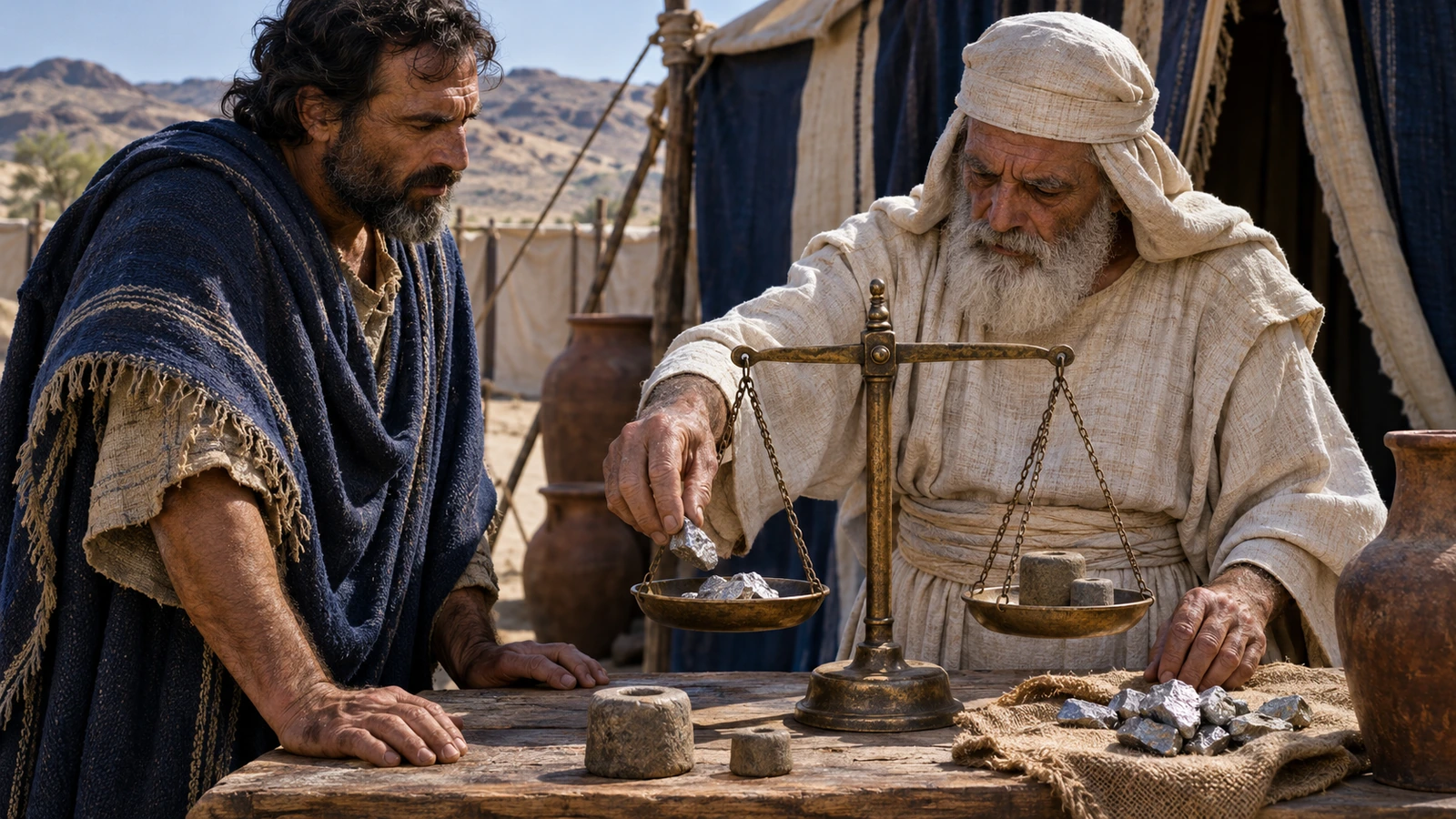
Why Does Leviticus 13 Require Priests to Examine Skin Diseases?
Leviticus 13 places the examination of unusual skin conditions and affected materials under priestly authority. Its detailed procedures reveal how ritual purity, careful observation, and life within Israel’s camp were connected.
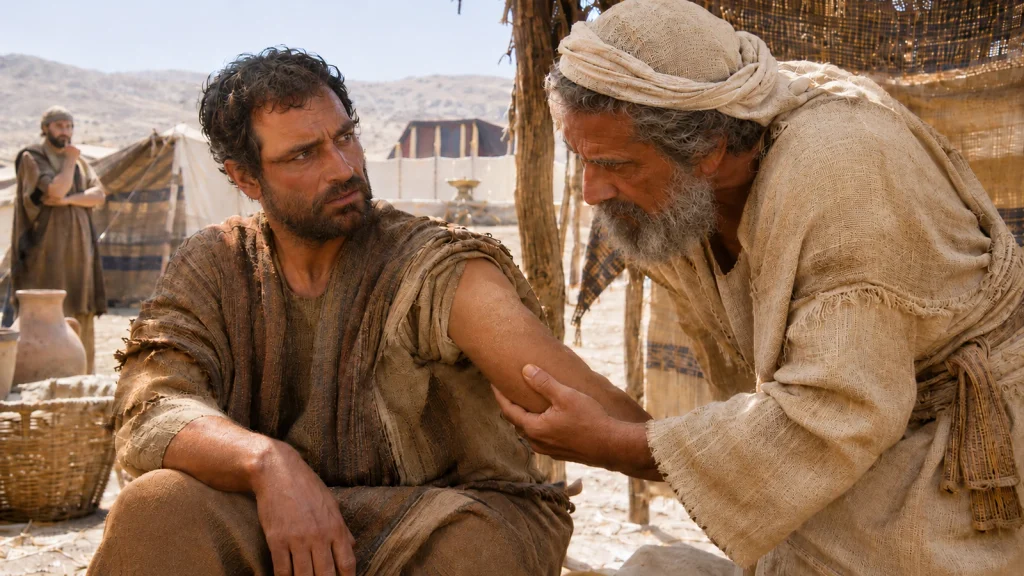
Source: AI-generated historical reconstruction created for Beyond The Known.
In our previous study, Leviticus 12: Why Purification After Childbirth?, we examined how childbirth affected a mother’s ritual status and access to sacred things. A pale swelling appears on an Israelite’s skin. The surrounding hair has changed color, and the affected area seems different from the healthy surface around it. The person is brought before a priest. What follows is not necessarily an immediate judgment. The priest may examine the mark and require seven days of observation. Another inspection might lead to a further waiting period. Depending on what has changed, the individual could be declared clean, remain under examination, or be required to live outside the camp.
The consequences were substantial. Under Leviticus 13:45–46, someone declared unclean because of the specified affliction had to announce that condition publicly and remain separated from the community while it persisted. Why did such decisions belong to Israel’s priests? Were they diagnosing contagious diseases, guarding the sanctuary’s holiness, or carrying out another responsibility altogether? The difficulty becomes especially apparent in verses 12–17. A person whose skin had turned completely white could be declared clean, while the appearance of exposed flesh could reverse that ruling.
Then, unexpectedly, the legislation moves from human bodies to wool, linen, and leather. These instructions cannot be understood adequately by identifying the Hebrew term ṣāraʿat with one modern disease. They belong to a wider system in which visible changes, priestly examination, and ritual status were closely connected.
From Childbirth to the Examination of Skin (13:1–2)
Leviticus 12 dealt with a mother’s purification following childbirth. Although giving birth was not presented as a moral offense, the event involved temporary restrictions concerning access to sacred things. The next chapter addresses bodily conditions of a different kind. The LORD speaks to Moses and Aaron, directing them to bring anyone with a suspicious swelling, eruption, or bright patch before Aaron or another priest. The change in subject is significant, but it is not a departure from the book’s larger concerns.
Following the deaths of Nadab and Abihu, the priesthood was instructed to distinguish between the holy and the common, the clean and the unclean (Leviticus 10:10–11). Our earlier study, Why Did Nadab and Abihu Die After Offering Unauthorized Fire?, examined the seriousness of approaching God’s presence without the required authorization. Here, priestly discernment takes a different form. Instead of assessing an offering at the altar, the priest examines a member of the community. His judgment determines whether the person can remain among the people, must undergo further observation, or is subject to separation.
The authority of the priesthood therefore extends beyond sacrifices. It includes decisions affecting ordinary Israelites whose physical conditions bring them within the Torah’s purity regulations.
What Does the Hebrew Word Ṣāraʿat Mean? (13:2–3)
The Hebrew noun ṣāraʿat (צָרַעַת) is central to understanding these instructions. Traditional English Bibles frequently translate it as “leprosy,” while Portuguese translations commonly use lepra. Both terms can mislead modern readers. Today, leprosy generally refers to Hansen’s disease, a specific infectious condition associated primarily with Mycobacterium leprae. The descriptions in Leviticus 13 cannot confidently be reduced to that diagnosis. The legislation mentions swellings, changes in skin color, altered hair, spreading lesions, exposed flesh, and conditions affecting the scalp or beard. Some suspicious marks are eventually declared clean.
Furthermore, the Hebrew terminology is applied to textiles and leather later in this chapter and to houses in Leviticus 14. That wider usage makes a one-to-one identification with Hansen’s disease untenable.
How Did “Leprosy” Become the Traditional Translation?
The association developed through the history of biblical translation. The ancient Greek translation of the Hebrew Scriptures employed vocabulary related to lepra, which subsequently influenced Latin and other biblical traditions. Ancient descriptions of skin afflictions, however, did not correspond neatly to the categories of modern dermatology. D. L. Kaplan discusses this problem in his medical-historical study of biblical leprosy, cautioning against reading the ancient material as a description of one identifiable contemporary disease.
Joel S. Baden and Candida R. Moss approach the question from biblical scholarship, examining how the Priestly legislation differs from other narratives involving ṣāraʿat. For the purposes of this study, retaining the Hebrew term is often preferable. Expressions such as “skin affliction” or “skin condition” can clarify the discussion, provided they are not treated as exact medical diagnoses. The underlying category remains ancient and ritual, even when the symptoms described are physically observable.
Was Ṣāraʿat Considered Punishment for Sin?
Some biblical narratives connect particular afflictions with divine judgment. Miriam’s experience in Numbers 12 is a prominent example. The account associates her condition with an episode of rebellion against Moses. Leviticus 13 does not follow that pattern. The priest is not instructed to investigate hidden wrongdoing or determine whether the individual deserves punishment. His examination begins with the appearance of the skin. Baden and Moss emphasize this difference between the Priestly regulations and other biblical accounts in which affliction is associated with sinful behavior.
The distinction should not be erased. An individual could be classified as ritually unclean without the law identifying a moral offense responsible for the condition. As our study of clean and unclean animals in Leviticus 11 demonstrated, ritual status and moral guilt are not interchangeable categories.
How Did Priests Examine Suspicious Skin Marks? (13:2–8)
The first set of instructions establishes the signs a priest must observe. He examines the affected area, paying attention to the appearance of the hair and whether the mark seems deeper than the surrounding skin. When the prescribed combination of signs is present, the individual is declared unclean. A white patch without those decisive characteristics requires a different response. Rather than issuing an immediate judgment, the priest separates the person for seven days.
At the next examination, he looks for evidence of change. If the mark has not spread, another week may be required. When the affected area fades and remains limited, the priest can declare the person clean. The individual then washes their garments.
Why Did the Priest Wait Seven Days?
An uncertain appearance did not always justify an immediate decision. Observation over time made it possible to determine whether the affected area was spreading, fading, or remaining stable. The interval also reveals a legal distinction between suspicion and an established condition. A mark requiring examination was not automatically grounds for a final declaration of impurity. This aspect of the procedure deserves attention because the consequences of an unclean ruling could be severe.
The seven-day period should not, however, be presented as an ancient version of a modern laboratory test or a scientifically established incubation interval. The Torah provides a ritual procedure, not a microbiological explanation. Its practical observations serve the purpose of classification.
Could a Clean Person Be Examined Again?
Yes. Verses 7–8 describe a situation in which an eruption spreads after the individual has already appeared before the priest. The person must return for another examination. If the new development meets the required criteria, an unclean declaration follows. A previous judgment does not prevent reassessment when the visible evidence changes. That principle recurs throughout the chapter: priestly examination responds to the condition as it appears at the relevant time.
Why Could Completely White Skin Be Declared Clean? (13:9–17)
The next section introduces the chapter’s most striking difficulty. A chronic swelling involving white hair and exposed flesh can lead to an immediate declaration of impurity. Yet the legislation describes another case in which the affliction spreads across the person’s entire visible body. If the priest sees that the skin has become completely white, the individual may be pronounced clean. The apparent reversal is difficult to explain through ordinary assumptions about the severity of illness. A limited lesion can lead to exclusion, while an extensive change may receive the opposite judgment.
Why Did Raw Flesh Change the Decision?
The clean ruling was conditional. If exposed or raw flesh appeared, the individual was declared unclean. Should that area later return to the prescribed white appearance, another examination could result in a clean declaration. The decisive consideration was therefore not simply how much of the body was affected. The visible character of the surface mattered. A continuous white appearance and a condition containing exposed flesh were treated differently. Leviticus gives the criteria without identifying the biological process behind them.
Did Entirely White Skin Indicate Healing?
The passage does not explicitly say so. It identifies a condition that meets the requirements for ritual cleanness. That ruling should not automatically be equated with a modern physician’s confirmation that a disease has been cured. Albert I. Baumgarten explores this puzzle in The Tzaraʿat Paradox, engaging with Mary Douglas’s work on purity and classification. One interpretive possibility is that the distinction concerns the difference between an irregular, localized condition and one that has become uniform.
That proposal offers a conceptual explanation for the contrast, but the biblical writer does not state it directly. The secure observation is more restrained: Leviticus 13 does not determine impurity solely by the extent of visible bodily change. Particular combinations of signs govern the ruling. This prevents the chapter from being read as a straightforward scale in which a more extensive affliction must always produce greater ritual impurity.
What If the Mark Appeared After a Boil or Burn? (13:18–28)
The legislation next considers skin that has already suffered an injury. Verses 18–23 describe a mark appearing where a boil has healed. The priest examines the discoloration and determines whether its features correspond to ṣāraʿat or to the remaining effects of the earlier wound. A suspicious area may require a seven-day period of observation. If the mark spreads, the person is declared unclean. If it remains limited and is identified as a scar, the judgment is clean. The following verses apply similar procedures to a burn.
Why Was a Scar Different from Ṣāraʿat?
The Torah does not treat every altered area of skin as a qualifying affliction. A healed wound may leave a mark. The priest must determine whether that appearance meets the criteria requiring an unclean declaration. Changes in hair, apparent depth, and spreading help distinguish the cases. This is an important feature of the instructions. The law recognizes that visible abnormalities can have different meanings within its classification system. An injury and the scar it leaves are not automatically placed in the same category as a continuing condition of ṣāraʿat. The priest’s responsibility includes recognizing when the evidence does not justify exclusion.
What About the Scalp, Beard, and Baldness? (13:29–44)
Conditions affecting the head and beard receive their own instructions. In verses 29–37, the priest examines marks associated with changes in hair, including thin yellowish hair within an affected area. When the signs are inconclusive, the individual undergoes further observation. One unusual instruction concerns shaving. The person is required to remove the surrounding hair while leaving the affected area untouched. A later examination then assesses whether the mark has spread or developed the characteristics associated with impurity.
If the condition remains stable and does not meet those criteria, a clean declaration may follow. The appearance of healthy dark hair also becomes relevant when assessing recovery.
Was Baldness Unclean?
Leviticus gives a direct answer. A man who loses his hair is clean (13:40–41). The same applies when hair loss occurs toward the front of the head. Baldness itself is not treated as a sign of ritual impurity. A different judgment becomes possible when a reddish-white lesion appears on the exposed scalp and displays the required characteristics. This clarification is notable because it explicitly protects an ordinary physical condition from being mistaken for ṣāraʿat.
The priest is not authorized to declare someone unclean merely because the person’s appearance differs from that of others. Specific signs are required.
Why Do These Details Matter?
Taken together, the provisions concerning boils, burns, scalp conditions, and baldness show that the chapter is not a blanket condemnation of unusual appearances. Some marks require observation. Others are identified as harmless within the legal framework. Hair loss alone receives an explicitly clean status. The legislation repeatedly differentiates cases that might initially appear similar. Those distinctions become especially consequential when the unclean ruling requires separation from the community.
Why Did Someone Declared Unclean Have to Live Outside the Camp? (13:45–46)
The consequences of an established ṣāraʿat condition become most visible in verses 45–46. The affected person must wear torn clothing, leave the hair disheveled, cover the area around the mouth, and cry out, “Unclean! Unclean!” While the condition persists, the individual must live apart, outside Israel’s camp. These instructions reach beyond the person’s private ritual status. They govern clothing, public identification, movement, and place of residence. For someone ordinarily surrounded by family and community, such separation would have been profoundly disruptive. The law presents a visible boundary between the person declared unclean and the inhabited camp.
Was This an Ancient Quarantine?
The isolation has sometimes been explained as a measure intended to prevent the spread of contagious disease. That possibility should be considered carefully rather than either accepted or rejected without qualification. Separating people may have practical consequences for physical contact. But the legislation does not identify pathogens, describe a medical theory of infection, or establish that every condition classified as ṣāraʿat was contagious. Its rules also include classifications—such as the completely white skin of verses 12–17—that do not fit neatly into a modern account of disease severity.
The immediate framework is ritual purity within Israel’s ordered communal life. Calling the procedure simply “quarantine” risks making a medical explanation appear more certain than the evidence permits.
Did Living Outside the Camp Imply Moral Guilt?
The social consequences were severe, but the chapter does not say that everyone subjected to them had committed a sin. The priest evaluates the visible condition. The law does not instruct him to search for an offense that caused the affliction. That distinction is particularly important when interpreting the requirement to announce one’s impurity. The proclamation communicates ritual status; it is not presented as a confession of wrongdoing. Nor should the hardship of exclusion be minimized. Separation could disrupt relationships, livelihoods, and ordinary communal participation.
Leviticus 13 recognizes the consequence through a clear requirement to live outside the camp. The following chapter will address the procedures by which a person who is no longer subject to the affliction can be formally restored. The wider legislation therefore includes both exclusion and a process of return.
Why Does Leviticus 13 Regulate Clothing and Leather? (13:47–59)
After the instructions concerning human skin, the chapter turns to affected materials. Wool, linen, woven textiles, and leather objects may develop suspicious reddish or greenish marks. These items are brought before a priest, who examines the discoloration and isolates the material for seven days. If the mark spreads, the object is declared unclean and must be burned. When the evidence is less decisive, washing and renewed examination may follow. The outcome depends on what happens to the affected area.
A persistent mark can require destruction even if it has not spread. A faded patch may be removed, while an object whose mark disappears can be washed again and declared clean.
Was the Problem Mold or Mildew?
Modern translations often use terms such as “mold” or “mildew” to describe the marks. These expressions may help readers visualize deterioration in fabric or leather. They do not establish the presence of a particular fungal organism. The Hebrew terminology belongs to the same broad family of expressions used for ṣāraʿat affecting the human body. That connection does not prove that people and garments suffered from an identical biological process. Rather, it shows that the ritual classification could include different visible conditions under related legal vocabulary.
This wider use is one of the strongest reasons to avoid identifying ṣāraʿat exclusively with Hansen’s disease. A medical condition affecting human skin cannot account for every application of the term in Leviticus 13–14.
Why Were Some Objects Destroyed and Others Preserved?
The procedure was not uniform. An affected garment did not automatically have to be burned at the first sign of discoloration. The priest observed whether the mark spread, persisted, faded, or disappeared after washing. These developments produced different legal outcomes.
| Observation | Prescribed action |
|---|---|
| A suspicious reddish or greenish mark appears | Priestly examination and seven-day isolation |
| The mark spreads during observation | The affected article is burned |
| The mark does not spread initially | Washing and a further period of observation |
| The discoloration remains unchanged after washing | Destruction under the specified rule |
| The mark fades after washing | Removal of the affected section |
| The mark reappears | The affected article is burned |
| The mark disappears | Another washing, followed by a clean declaration |
The sequence permits preservation when the relevant conditions are met. A garment could be washed or partially altered rather than destroyed outright. The law nevertheless draws a firm boundary where the prohibited appearance persists or returns. The priest’s responsibility extends to deciding when an object may remain in use.
The Strange Reference to Baldness in Verse 55
Leviticus 13:55 contains a noteworthy textual difficulty. The Hebrew wording includes terms associated elsewhere with the front and back of a bald head. Those expressions are understandable when describing a person. Applied to fabric, they are much less natural. Zev Farber examines this problem in Bald Spots on Clothing: A(n Un)Missable, Ancient Scribal Error. He discusses traditional explanations as well as evidence from the Greek Septuagint, which supports a reading referring to the fabric’s woven structure rather than to the baldness terminology preserved in the Masoretic Text.
Farber argues that the unusual wording may have entered the Hebrew textual tradition through a scribal copying error. That remains a textual-critical argument, not an indisputable fact about the original wording. The difficulty is worth acknowledging because translations can conceal how unusual the Hebrew expression actually is. Whatever explanation is adopted, the immediate legal consequence remains clear: material displaying the prohibited persistent condition is subject to destruction.
Why Were These Examinations Assigned to Priests?
Leviticus repeatedly places the responsibility for inspection and formal declaration in priestly hands. That raises a broader question. Why did the Torah assign these judgments to religious officials rather than simply leaving them to the affected person or the household? The answer lies in the kind of decision being made. The priest was not merely offering an opinion about the appearance of a rash. He was applying the Torah’s criteria and determining ritual status within Israel’s communal order.
His declaration had recognized consequences. Someone judged clean could proceed according to the requirements associated with that ruling. A person declared unclean might face separation. A garment could be retained, washed, altered, or burned. These decisions belonged to the administration of sacred law.
Was the Priest Acting as a Physician?
There are observable features that resemble aspects of medical examination. The priest inspects color, hair, apparent depth, and progression. He may compare the condition with its appearance a week earlier. Nevertheless, Leviticus 13 does not describe him prescribing medication, performing surgery, or treating the underlying ailment. The chapter does not identify a therapy intended to cure ṣāraʿat. Its central action is the declaration of clean or unclean status. The priest is therefore better understood as an authorized ritual examiner than as a physician in the modern clinical sense. This distinction does not mean that the physical observations were meaningless. It identifies their purpose within the biblical legislation.
Could the Priest’s Declaration Change a Person’s Status?
The relationship between observation and formal pronouncement has received scholarly attention. Martha Himmelfarb examines the legal importance of priestly declarations, particularly in the material concerning affected houses in Leviticus 14. The broader issue is how an observable condition becomes subject to an authoritative ritual judgment. In Leviticus 13, priests are repeatedly instructed to examine before declaring someone clean or unclean. Their authority is therefore structured by explicit requirements rather than presented as unrestricted personal discretion.
The later regulations concerning houses provide additional insight into the relationship between inspection, declaration, and legal consequences, although their procedures should not be imposed mechanically upon every skin examination. This responsibility develops the priestly vocation established earlier in the book. In Leviticus 8, Aaron and his sons were consecrated for sacred service. That service included more than sacrifice at the altar. It also required the ability to recognize and pronounce the distinctions through which Israel’s ritual life was regulated.
The Deeper Discovery
The Paradox of Complete Whiteness
A reader might expect that more extensive bodily affliction would always mean greater ritual impurity. Leviticus 13 challenges that expectation. A localized lesion displaying particular signs may be declared unclean. Yet a condition covering the entire visible body in white may receive a clean ruling, provided no exposed flesh is present. The appearance of raw flesh reverses the judgment. This is the chapter’s clearest demonstration that ritual classification cannot be reduced to the apparent severity of symptoms.
The law works through combinations of visible characteristics. A particular feature may matter more than the amount of skin affected. Baumgarten’s discussion of this paradox draws on Mary Douglas’s approach to classification, exploring whether the difference between irregularity and uniformity offers a possible explanation. That reading remains interpretive. Leviticus does not tell us that complete whiteness represents a symbolic restoration of bodily order. What it does tell us is that the priest must evaluate the condition according to its specified features.
The clean ruling is not necessarily a medical declaration of health, and the unclean ruling does not automatically establish moral guilt. Both belong to the ritual vocabulary of the passage.
The Priest Must Know When Not to Exclude Someone
A second pattern emerges when the individual cases are read together. Leviticus 13 repeatedly identifies circumstances in which a suspicious appearance does not justify an unclean declaration. A mark that fades without spreading may be classified as harmless. A scar left by a boil or burn can be declared clean. Hair loss alone does not make a person impure. Certain scalp conditions are reassessed when their appearance changes. And the surprising case of completely white skin demonstrates that extensive discoloration can still meet the requirements for cleanness.
These provisions place limits on the priest’s judgment. His task is not simply to identify everyone whose appearance differs from the ordinary. He must apply the criteria carefully enough to distinguish a qualifying affliction from conditions that do not meet the law’s requirements. This matters because the outcome affects the person’s place within the community. The law includes mechanisms for observation, reconsideration, and clean declarations alongside its rules for separation. Its severity should not obscure those distinctions.
From Priestly Discernment to Community Boundaries
The connection with Leviticus 10:10 now becomes clearer. Following Nadab and Abihu’s deaths, the priests were charged with distinguishing between what was holy and common, clean and unclean. Leviticus 11 developed this responsibility through animal classifications and the handling of carcasses. Leviticus 12 applied purity regulations to childbirth, a natural event that carried temporary restrictions without being described as sinful. The present chapter introduces situations in which appearances may be uncertain and the consequences of a declaration particularly disruptive.
A priest must decide whether further examination is necessary, whether an individual may remain within ordinary communal life, or whether separation is required. His judgment also determines when a previously suspicious condition can be declared clean. The progression across these chapters shows that priestly discernment reaches well beyond the altar. It extends into the daily realities of eating, bodily change, family life, clothing, and the community’s physical boundaries.
Why Are Human Skin and Garments Classified Together?
The transition to textiles strengthens this interpretation. Both people and objects can display visible changes that require priestly examination. Both can be observed over time. Both may receive clean or unclean declarations. Yet the consequences differ. A person may be required to live outside the camp, while a garment may be washed, cut, or destroyed. The shared framework does not imply identical biological causes. Instead, it reveals a broader set of ritual categories applied to different aspects of Israelite life.
When Leviticus 14 extends similar concerns to houses, the range becomes wider still. The central issue cannot be reduced to the clinical identification of one human disease. The deeper discovery of Leviticus 13 is that priestly authority involved making distinctions with real consequences—and recognizing when a person or object should not be declared unclean. That responsibility served the regulation of Israel’s sacred and communal life. It also creates the conditions for the next chapter’s concern: how someone who had lived outside the camp could return.
How Does Leviticus 13 Relate to Jesus Cleansing People with Skin Afflictions?
The Gospels describe encounters between Jesus and people traditionally identified in English translations as lepers. In Mark 1:40–45, a man approaches Jesus and asks to be made clean. Jesus touches him, and the condition disappears. Afterward, Jesus instructs the man to show himself to a priest and present what Moses commanded. The instruction places the encounter within the world of the Torah’s purity legislation.
Why Did Jesus Send the Man to a Priest?
Leviticus 13 establishes the procedures for examining suspicious conditions and declaring their ritual status. Leviticus 14 addresses the requirements for cleansing and restoration after the relevant affliction has ended. Mark’s reference to the priest and the offering points toward that larger framework. The Gospel does not portray the priest as the person who performs the healing. Within the narrative, the man’s condition has already changed through Jesus’ action. The priestly requirement concerns the response prescribed by the Law of Moses and the man’s recognized restoration.
Reading the two passages together makes it possible to distinguish the removal of an affliction from the formal procedures associated with returning to communal and sacred life.
Did Jesus Heal People with Hansen’s Disease?
The Gospel terminology does not provide enough information for a secure modern diagnosis. Greek words traditionally translated as “leprosy” belong to an ancient descriptive vocabulary with a broader history than the medical term Hansen’s disease. Some individuals described in these accounts may have suffered serious visible skin conditions, but the precise nature of those afflictions cannot be established from the narratives alone. It is therefore more accurate to discuss people described by ancient skin-affliction terminology than to assign them a specific bacterial diagnosis.
For Christian readers, Mark’s account also highlights the human consequences of suffering and separation. Jesus’ encounter with the man is not merely an abstract illustration of ritual law. It concerns a person seeking cleansing and the possibility of restored participation in communal life. That New Testament application should be understood alongside, rather than substituted for, the original legislation of Leviticus 13.
Frequently Asked Questions
What does ṣāraʿat mean in Leviticus 13?
The Hebrew term covers conditions affecting human skin and, in the surrounding legislation, materials such as clothing and houses. Its traditional translation as “leprosy” does not establish an exact identification with Hansen’s disease.
Why did priests examine skin conditions?
They were authorized to apply the Torah’s criteria and declare whether a person was ritually clean or unclean. Their decisions determined whether further observation or separation was required.
Why were some people isolated for seven days?
When the initial evidence was inconclusive, the waiting period allowed the priest to observe changes in the affected area. Some cases required a second seven-day interval.
Why was entirely white skin sometimes considered clean?
Leviticus 13:12–17 allows a clean declaration when the visible body is covered in white, subject to the stated conditions. The appearance of exposed flesh changes the ruling. The passage does not explain this distinction through a modern medical diagnosis.
Did every rash make someone unclean?
No. The regulations distinguish qualifying afflictions from scars, ordinary baldness, harmless discoloration, and other appearances that do not meet the prescribed signs.
Was ṣāraʿat always punishment for sin?
Leviticus 13 does not make that claim. Although some other biblical narratives associate particular afflictions with divine judgment, the priestly legislation bases its decisions on observed conditions rather than an investigation of moral wrongdoing.
Why did affected people have to live outside the camp?
Verses 45–46 require individuals with the specified unclean condition to remain separated while it persists. This requirement belongs to Israel’s ritual purity system and carried significant social consequences.
Why were some garments burned?
The Torah required destruction when affected materials displayed certain persistent or spreading marks. Other cases permitted washing, further observation, or removal of a damaged portion.
Is biblical leprosy the same as Hansen’s disease?
There is no secure one-to-one identification. The Hebrew classification includes a variety of signs and extends to materials that cannot suffer from the modern human disease.
What Comes Next?
Leviticus 13 establishes how priests examined suspicious conditions, recognized ritual impurity, and determined whether someone must remain outside Israel’s camp. But the legislation does not end with exclusion. The following chapter describes what happens when a person is ready to return. Leviticus 14 introduces a carefully ordered process involving birds, washing, shaving, sacrifices, blood, and oil. It also addresses visible afflictions affecting houses. Why did restoration require these elaborate procedures? What did the priest do after the visible condition had changed? And how did the ritual mark the person’s return to the community?
The next study will examine the transition from separation to recognized restoration. Next Study: Why Did Leviticus 14 Require Birds, Blood, and Oil for Cleansing? Related Study: Why Does Leviticus 11 Distinguish Clean and Unclean Animals? Explore the complete series in Leviticus Studies.
Selected Sources
- Hebrew Bible. Leviticus 13. Hebrew text and available translations. Primary source for priestly examinations, ritual declarations, and the regulations concerning affected materials.
- New American Bible, Revised Edition. Leviticus 13 and Explanatory Notes. United States Conference of Catholic Bishops. Used for comparison of translation choices and the structure of the purity instructions.
- NET Bible. Leviticus 13, with Translators’ Notes. New English Translation, Bible.org. Relevant to Hebrew terminology and the descriptions of skin conditions and priestly judgments.
- Baden, Joel S., and Candida R. Moss. “The Origin and Interpretation of Ṣāraʿat in Leviticus 13–14.” Journal of Biblical Literature 130, no. 4 (2011): 643–662. Examines the relationship between the Priestly legislation, disease, interpretations of divine punishment, and modern approaches to bodily difference.
- Baumgarten, Albert I. “The Tzaraʿat Paradox.” TheTorah.com, April 14, 2021. Discusses the contrasting rulings concerning localized skin afflictions and entirely white skin, drawing on Mary Douglas’s work on classification.
- Himmelfarb, Martha. “Priests & Rabbis Determine Ritual Reality.” TheTorah.com, 2021. Explores the relationship between priestly examination, formal declaration, and ritual status, particularly in the regulations concerning houses.
- Farber, Zev. “Bald Spots on Clothing: A(n Un)Missable, Ancient Scribal Error.” TheTorah.com, April 22, 2015. Discusses the textual difficulty in Leviticus 13:55 and proposes a scribal explanation based partly on the Septuagint.
- Kaplan, D. L. “Biblical Leprosy: An Anachronism Whose Time Has Come.” Journal of the American Academy of Dermatology 28, no. 3 (1993): 507–510. Medical-historical discussion of the difficulties involved in identifying biblical leprosy with a modern diagnosis.
- Gospel of Mark. Mark 1:40–45. Primary New Testament passage describing Jesus’ cleansing of an afflicted man and his instruction to appear before a priest.