Why Did Leviticus 14 Require Birds, Blood, and Oil for Cleansing?
Leviticus 14 describes how a person who had recovered from ṣāraʿat could return to Israel’s community through a carefully ordered ritual involving birds, washing, sacrifices, blood, and oil. The chapter also extends the laws of ritual purity to houses in the land of Canaan.
Source: AI-generated historical reconstruction created for Beyond The Known.
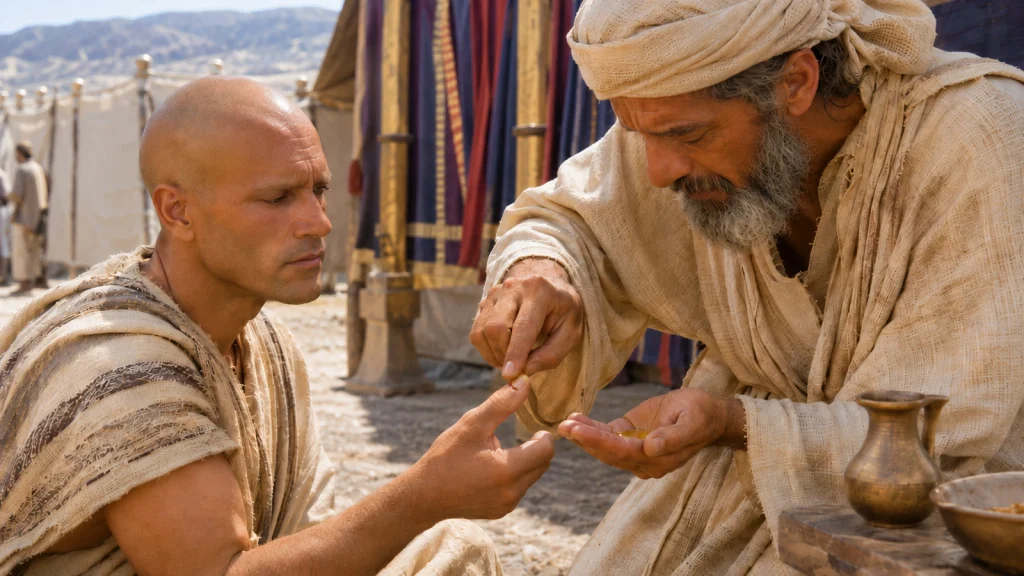
A priest walks beyond the boundaries of Israel’s camp to examine someone who has been living in isolation. The person had previously displayed the condition known in Hebrew as ṣāraʿat. Under Leviticus 13, the priest’s declaration of impurity had required separation from the community. Now the visible affliction has healed, and the possibility of returning has emerged. Yet recovery alone does not complete the process. Two living birds are brought before the priest, together with cedar wood, scarlet material, and hyssop. One bird is killed over fresh water in an earthenware vessel. The other is dipped into the ritual mixture and eventually released into the countryside.
The recovered individual then washes, shaves, and bathes. Reentry into the camp becomes possible, but ordinary residence in the family tent remains restricted for another seven days. On the eighth day, sacrifices follow. Blood is placed on the right earlobe, right thumb, and right big toe. Oil is applied to those same locations and then to the person’s head. Why did returning to the community require such an elaborate sequence?
The answer begins with something easily overlooked: the individual had already recovered before the ceremony started. The priest was not administering a treatment for the affliction. He was overseeing the transition from exclusion to recognized ritual cleanness. Another detail deserves attention. The placement of blood on the ear, thumb, and toe closely resembles the consecration of Aaron and his sons in Leviticus 8. And the connection reaches beyond human bodies. When the regulations turn to houses in Canaan, the ceremony involving two birds appears again.
Together, these instructions reveal a system concerned not merely with identifying impurity, but with establishing how people and places could return to an acceptable ritual condition.
From Separation to Restoration (14:1–3)
Our previous study of Leviticus 13 examined the priestly procedures for assessing suspicious skin conditions, including the circumstances under which an individual was declared clean or unclean. The consequences could be severe. Leviticus 13:45–46 required a person with the specified unclean affliction to live outside the camp for as long as that condition persisted. The following chapter begins with the possibility of return. The LORD instructs Moses concerning the purification of someone previously affected by ṣāraʿat. The individual is brought for priestly examination, but the priest must first go outside the camp.
That location is significant. The person has not yet completed the process required for reentry. Rather than summoning the individual immediately into the sanctuary precincts, the priest goes beyond the community’s boundary to conduct the inspection. Verse 3 establishes the necessary condition: the affliction must have healed.
Did the Priest Heal the Person?
Leviticus does not prescribe a medical treatment at this stage. The Hebrew text uses a form of raphaʾ (רָפָא), a verb associated with healing or recovery, to describe the condition the priest is expected to find. He examines someone whose affliction has already subsided. His task is to verify that change and direct the prescribed ritual. Yitzhaq Feder has explored the biblical treatment of ṣāraʿat alongside ancient Mesopotamian material. His comparison highlights a notable difference: whereas certain neighboring traditions describe treatments for comparable afflictions, Leviticus concentrates on ritual assessment and the requirements following recovery.
The legislation therefore distinguishes two events that should not be confused. Physical recovery makes the process possible. Priestly examination and the ceremonies that follow establish the individual’s return to ritual and communal life.
Why Were Two Birds Required? (14:4–7)
Once the priest has confirmed that the affliction has healed, the person undergoing cleansing must be provided with two living, clean birds. Cedar wood, scarlet material, and hyssop are also required. The priest orders one bird to be killed over fresh water in an earthenware vessel. The surviving bird is then dipped, together with the other materials, into the blood and water. The priest sprinkles the recovered person seven times, pronounces the individual clean, and releases the living bird into the open countryside.
The contrast between the two birds is vivid. One dies during the ceremony. The other returns to life beyond the ritual setting. Yet Leviticus provides no explicit explanation of what every action represents.
Why Was One Bird Killed and the Other Released?
One interpretation understands the surviving bird as representing the removal of impurity. The comparison with the Day of Atonement is understandable. Leviticus 16 also contains a ritual involving two animals, one of which is sent away. But the ceremonies differ in a crucial respect. Leviticus 16 explicitly describes the sins of Israel being placed upon the living goat before it is sent into the wilderness. Leviticus 14 provides no equivalent instruction transferring the recovered person’s guilt to the released bird.
The resemblance should therefore not be expanded into a claim that both rituals have precisely the same meaning. Thomas Staubli offers another interpretation in his study of the bird ceremony. He proposes that the contrast between the two birds may express a movement from a condition resembling social death toward renewed participation in life. That reading corresponds with the broader situation of someone emerging from exclusion. Still, it remains an interpretation of the ritual’s symbolism rather than an explanation explicitly given by the biblical writer. The observable action is clear: one bird is killed, the other released, and the person is ceremonially cleansed.
Why Were Cedar Wood, Scarlet Material, and Hyssop Included?
These materials occur in other biblical purification settings. Hyssop is associated with applying blood during the Passover instructions in Exodus 12:22 and with purification involving water in Numbers 19:18. Cedar wood and scarlet material also appear in the red-heifer ritual of Numbers 19:6. Their recurrence connects Leviticus 14 with a broader vocabulary of sacred cleansing. Hyssop’s use in sprinkling provides a practical connection with the application of liquid, although the precise botanical identification of the biblical plant remains debated.
The individual significance of the cedar and scarlet material is less certain. Interpreters have proposed meanings related to durability, life, blood, and symbolic transformation. The chapter itself does not assign a separate theological definition to each item. Comparison with other rituals can illuminate their place in Israel’s religious practices without establishing a symbolism that the text leaves unstated.
What Was the “Living Water” Used in the Ceremony?
The Hebrew expression mayim ḥayyim (מַיִם חַיִּים), literally “living water,” refers here to fresh water associated with a natural or flowing source. It should be understood within the material requirements of the ceremony rather than automatically read through the theological imagery of later biblical passages. The water is collected in an earthenware vessel, where it is combined with the blood of the slaughtered bird. That mixture is used in the sprinkling ritual.
The use of fresh water is prescribed, but the chapter does not provide a separate explanation for its symbolic significance.
Was the Slaughtered Bird an Altar Sacrifice?
The first ceremony takes place outside the camp, not at the Tabernacle altar. The bird is killed under priestly instruction, but the procedure is not explicitly identified as one of the named altar offerings in Leviticus 1–7. This matters because additional sacrifices will be required later. The bird ceremony permits the first stage of return. The eighth-day offerings complete another part of the process. Treating them as a single undifferentiated sacrifice obscures the structure of the chapter.
Why Did the Person Wash, Shave, and Wait Seven Days? (14:8–9)
Following the initial ceremony, the recovered individual washes the garments, shaves the hair, and bathes in water. Only then does the person enter the camp. Even this return is qualified. For seven more days, the individual must remain outside the family tent. On the seventh day, another shaving takes place. This time the instructions specify the hair of the head, beard, eyebrows, and the rest of the body. The garments are washed once more, followed by another bath. The eighth-day offerings come afterward.
Why Was the Return Gradual?
The sequence establishes several transitions rather than one immediate reinstatement. Before the priest’s examination, the individual remains outside Israel’s camp. After the bird ceremony and the initial washing, reentry becomes possible. Yet living in the family tent is still restricted. The final preparation precedes the offerings presented at the sanctuary.
| Stage | Prescribed action | Effect |
|---|---|---|
| Examination | Priest goes outside the camp | Recovery is verified |
| Two-bird ceremony | Sprinkling and release of the living bird | Initial declaration of cleanness |
| Washing, shaving, bathing | Required before entering | Reentry into the camp becomes possible |
| Seven-day interval | Remain outside the family tent | Further restrictions continue |
| Eighth-day ceremony | Sacrifices, blood, and oil | Final ritual requirements are completed |
The process helps explain why the person can be declared clean before the entire sequence has ended. A first declaration permits a change in location and status. It does not mean that the later offerings have already been performed. Restoration unfolds through successive requirements.
Was Shaving Intended as Medical Treatment?
The chapter gives no medical explanation for the repeated shaving. Removing hair and bathing may have practical effects, but the prescribed actions are part of the ritual sequence following recovery. No medicine is applied to the earlier skin condition, and the priest is not instructed to investigate whether shaving will cure it. The text places these actions between the initial ceremony and the individual’s final presentation before the LORD. They should therefore be interpreted as elements of ritual preparation rather than confidently identified as a treatment for Hansen’s disease or another modern diagnosis.
Why Were Sacrifices Required on the Eighth Day? (14:10–13)
The next stage takes place at the entrance of the Tent of Meeting. Under the standard requirements, the person brings two unblemished male lambs, an unblemished year-old female lamb, fine flour mixed with oil, and a measured quantity of oil. The priest presents the individual and the offerings before the LORD. One male lamb is then designated as a guilt or reparation offering, known in Hebrew as ʾāšām (אָשָׁם). Its appearance raises a difficult question. Why would someone who had recovered from a skin affliction need a sacrifice associated with guilt?
Why Was a Guilt Offering Necessary?
Earlier in Leviticus, the ʾāšām appears in connection with particular offenses, including violations involving sacred property and situations requiring restitution. Our study of Leviticus 5 examined the relationship between guilt, compensation, confession, and the prescribed offerings. Leviticus 14 presents a different situation. The individual has recovered from ṣāraʿat. No specific transgression is identified, and the priest is not instructed to obtain a confession or calculate restitution. Nevertheless, the guilt offering is required.
Esias E. Meyer addresses this difficulty in his study of the ʾāšām in Leviticus 14. Scholars have proposed several explanations. Some interpret the offering in relation to the individual’s transition back into the sacred community. Others examine whether its use reflects broader ancient associations between serious bodily affliction and wrongdoing. Meyer considers the possibility of tension between priestly understandings of impurity and wider religious assumptions about the causes of affliction. These proposals illuminate the problem without resolving it conclusively. The requirement is explicit. Its precise rationale is not.
Does the Offering Mean the Person Had Sinned?
The presence of an ʾāšām does not, by itself, prove that every case of ṣāraʿat resulted from personal misconduct. Elsewhere in the Hebrew Bible, particular afflictions are connected with divine judgment. Miriam’s experience in Numbers 12 is one example. But Leviticus 13–14 does not instruct the priest to determine which sin caused the physical condition. The regulations describe examination, recovery, purification, and the offerings required afterward. A careful reading must preserve the difference between a ritual obligation and an explicit accusation of wrongdoing.
Why Was Blood Applied to the Ear, Thumb, and Toe? (14:14)
The priest now takes blood from the guilt offering and applies it to three specific locations on the recovered person’s body:
- The right earlobe.
- The right thumb.
- The right big toe.
The detail is familiar. In Leviticus 8:23–24, Moses applied blood from the ordination ram to those same locations on Aaron and his sons. The correspondence invites a closer comparison.
The Connection with Aaron’s Ordination
Our study, Why Was Blood Placed on Aaron’s Ear, Thumb, and Toe?, examined the role of this action in the consecration of Israel’s priests. That earlier ceremony marked their entry into sacred service. Leviticus 14 applies a similar pattern to someone returning from exclusion. The recipients do not hold the same position. Aaron and his sons are being installed into priestly office. The recovered individual is not becoming a priest but completing the requirements associated with restored participation in Israel’s community.
The offerings also differ. In Leviticus 8, the blood comes from the ordination ram. In Leviticus 14, it comes from the guilt offering. These distinctions prevent the ceremonies from being treated as identical. Yet the three bodily locations are unmistakably the same. The similarity suggests that a recognizable ritual action could be used in different transitions involving a person’s relationship to the sacred order.
Did the Ear Represent Hearing, the Hand Action, and the Foot Conduct?
This is a familiar theological explanation. The ear is associated with listening, the hand with activity, and the foot with movement or the direction of one’s life. Such an interpretation can communicate how the whole person is involved in covenant obedience. However, neither Leviticus 8 nor Leviticus 14 explicitly assigns those separate meanings to the three locations. The interpretation is possible, but it should not be mistaken for the biblical author’s stated explanation.
What the text establishes is the repeated pattern itself. One ritual consecrates priests; the other helps restore a recovered Israelite. Both use blood at the same points of the body. The significance of that parallel becomes even clearer when the application of oil is considered.
Why Was Oil Applied Over the Blood? (14:15–18)
After placing the blood on the individual’s ear, thumb, and toe, the priest pours oil into the palm of his left hand. He dips his right index finger into the oil and sprinkles it seven times before the LORD. Then he applies oil over the places where the blood was placed. The remainder is put on the recovered person’s head. The sequence is precise: blood first, oil afterward.
What Did the Oil Signify?
Oil was used throughout ancient Israelite life, both in ordinary activities and in sacred ceremonies. It also features prominently in the consecration of Aaron and his sons in Leviticus 8. That wider association gives the ritual of chapter 14 an important context. Still, the recovered person is not receiving priestly office. The oil application does not confer Aaron’s garments, authority, or duties. Its immediate place is within the prescribed completion of purification.
The chapter also does not identify the oil as a remedy for the earlier skin condition. The person has already recovered before these actions begin. The material is applied as part of a ceremony governing ritual status.
Why Was the Oil Sprinkled Seven Times?
The sevenfold sprinkling recalls the earlier bird ceremony and other prescribed actions in Leviticus. Seven also carries wider significance in biblical accounts of sacred time and ritual order. Those associations may help readers appreciate the repeated number, but the passage does not assign it a specific explanation here. The priest’s obligation is defined through the sequence: sprinkle seven times before the LORD, apply the oil to the designated bodily locations, and place the remainder on the individual’s head.
Atonement is then performed on the person’s behalf. The actions belong together, but their individual symbolic meanings cannot all be recovered with certainty.
Why Were Additional Offerings Required? (14:19–20)
The application of blood and oil is followed by further sacrifices. The priest presents a ḥaṭṭāʾt, often called a sin offering but also understood in many contexts as a purification offering. A burnt offering and grain offering follow. The prescribed atonement is completed, and the individual is declared clean. The terminology needs careful handling. As we observed in Leviticus 12: Why Purification After Childbirth?, a ḥaṭṭāʾt could serve a purifying function without implying that the person undergoing the ceremony had committed a specific moral offense. The same caution applies here. The sacrifice is part of the person’s restoration after a condition of impurity.
What Did Atonement Accomplish?
The Hebrew verb kipper (כִּפֶּר), usually translated “make atonement,” appears repeatedly in the eighth-day instructions. Its use must be understood within the procedure being described. The affliction has already healed. The individual has undergone the bird ceremony, washing, shaving, and a further period of restricted residence. The altar offerings complete the prescribed process before the LORD. This sequence distinguishes physical recovery, priestly recognition, and final ritual restoration. All three are relevant, but they are not the same event.
What If the Recovered Person Was Poor? (14:21–32)
The standard offerings would have been costly. Leviticus therefore provides a reduced requirement for someone unable to afford the full set. The person brings one lamb for the guilt offering, a smaller quantity of fine flour mixed with oil, the prescribed oil, and two turtledoves or young pigeons. The birds replace the animals otherwise required for the purification and burnt offerings. The ceremony involving blood and oil remains substantially unchanged.
Why Did the Guilt Offering Lamb Remain Required?
The accommodation does not eliminate the ʾāšām lamb. The priest still applies its blood to the right earlobe, thumb, and big toe. Oil is then placed over those locations. This continuity gives the guilt offering a distinctive role in the ceremony. The law permits less expensive substitutes for other sacrifices but retains the animal from which the blood used in the bodily application is obtained. That observation does not resolve every theological question surrounding the ʾāšām. It does show that the ritual’s central actions were preserved even when the individual’s resources were limited.
How Does This Compare with Purification After Childbirth?
Leviticus 12 also provides a less expensive alternative for someone unable to afford the normal sacrifice. There, a mother may offer two birds instead of a lamb and another bird. Leviticus 14 follows a similar principle while retaining its own requirements, including the guilt offering lamb and oil. The two provisions should not be treated as identical. Both, however, acknowledge that an Israelite’s economic circumstances could affect the sacrifices available to them.
The law provides a way for those with fewer resources to complete the required ceremonies. Restoration was not made dependent upon the ability to afford every element of the standard offering.
Why Does Leviticus 14 Suddenly Discuss Houses? (14:33–35)
After the instructions concerning a recovered person, the LORD speaks to Moses and Aaron about another setting. The subject is no longer the wilderness camp but houses in the land of Canaan. This change introduces an important historical distinction. Israel’s wilderness life was associated with tents and movable structures. The regulations now anticipate the nation’s settlement in the land and the construction of more permanent homes. The LORD describes a condition of ṣāraʿat appearing in a house. The owner must report the suspected mark to a priest.
Could a House Have Ṣāraʿat?
The terminology used for human skin conditions also appears in the laws concerning buildings. The marks may be greenish or reddish and appear deeper than the surrounding wall surface. Modern translations frequently use words such as “mold,” “mildew,” or “fungus.” Those expressions help readers visualize possible deterioration, but the Hebrew does not identify a particular organism. A house cannot suffer from Hansen’s disease. The broader application of ṣāraʿat therefore demonstrates why the term should not be reduced to one modern medical diagnosis.
Leviticus applies related ritual categories to people, textiles, and buildings, even though the underlying physical conditions need not be biologically identical.
Why Does God Say He Will Put the Affliction in a House?
Verse 34 attributes the appearance of ṣāraʿat in a house to the LORD, within the land he is giving Israel. The statement belongs to the passage’s theological understanding of God’s authority over the land. It does not identify a specific offense committed by the homeowner. Later Jewish interpretations sometimes explored moral explanations for afflictions affecting houses. Those traditions form part of the passage’s interpretive history, but they should not be presented as the explicit reason supplied by this legislation.
The immediate concern is procedural: how the owner must report the mark, what the priest must examine, and what response is required.
Why Must the House Be Emptied Before Inspection? (14:35–36)
The homeowner approaches the priest and reports that something resembling the prohibited mark has appeared. The wording is cautious. The owner does not declare the building unclean. That determination belongs to the authorized examiner. Before entering the house, the priest orders its contents to be removed. The reason is stated directly: the possessions must not become impure. This provision raises a revealing question about how ritual status operates.
Why Does the Timing of the Examination Matter?
Martha Himmelfarb has examined the relationship between priestly observation and the formal declaration of impurity. The law permits the household’s belongings to be removed before the priest enters and evaluates the marks. That sequence gives the official procedure practical legal significance. The suspected discoloration already exists, but the possessions can be protected before the assessment is carried out. This does not mean that the physical mark is created by the priest’s words.
The condition is visible enough to require investigation. The distinction concerns the consequences associated with an authorized ritual judgment. Priestly examination is therefore more than a private opinion about the appearance of the walls. It is part of a regulated process through which the house’s status is determined.
How Does This Differ from the Examination of a Person?
A building contains movable possessions that can be removed before inspection. A person with a skin condition does not present the same circumstances. The procedures therefore reflect the nature of what is being examined. A house may be emptied, closed, repaired, or demolished. A human being may be examined, isolated, and later restored. The shared concern is ritual classification, but the required actions differ according to the case.
What Happened When the Marks Spread? (14:37–47)
The priest examines the walls for greenish or reddish marks that appear deeper than the surface. If the specified signs are present, he closes the house for seven days. He returns afterward to inspect the affected areas. When the condition has spread, the damaged stones must be removed and taken to an unclean place outside the city. The interior plaster is scraped away and discarded. New stones are installed, and fresh plaster is applied. The procedure attempts to preserve the building before requiring its destruction.
When Did Demolition Become Necessary?
If the prohibited condition returns and spreads after the repairs, the priest conducts another inspection. A persistent, spreading affliction may require the house to be demolished. Its stones, timber, and plaster are carried outside the city to an unclean place. For an Israelite household, that would represent a substantial loss. A home provided shelter and required resources, materials, and labor to construct. Nevertheless, the legislation does not permit the building to remain indefinitely in use when the conditions for demolition have been met. The requirements are serious, but destruction is not the first response to every suspicious mark.
Could People Become Impure by Entering the House?
Yes. A person entering the closed house becomes impure until evening. Someone who sleeps or eats there must also wash their clothing. The condition of the building therefore affects more than its walls. It shapes how people may use the space and what they must do after entering it. This extends the purity regulations into ordinary domestic life.
Why Was a House Cleansed with Two Birds? (14:48–53)
Not every affected building was demolished. If the priest returned after the repairs and found that the marks had not spread, he could declare the house clean. A purification ceremony then followed. The materials should sound familiar: two birds, cedar wood, scarlet material, hyssop, fresh water, and an earthenware vessel. One bird is killed. The other is used in the ceremony and released outside the city. The house is sprinkled seven times. The priest performs atonement for the building, completing its purification.
Why Does the Earlier Ceremony Reappear?
The repetition connects the two principal sections of Leviticus 14. Both a recovered person and an affected house undergo examination by a priest. Both may be declared clean after the relevant conditions have been resolved. And both purification ceremonies use the same distinctive combination of two birds, cedar wood, scarlet material, and hyssop. The resemblance is deliberate enough to deserve attention. Yet the house does not receive every element prescribed for the human participant.
There is no application of blood and oil to bodily extremities, nor the same eighth-day sacrificial sequence. The ceremonies share a recognizable pattern while addressing different subjects.
Can Atonement Be Made for a Building?
Verse 53 explicitly uses atonement language in relation to the house. That is significant because a building cannot be morally guilty in the way a human being can. The expression demonstrates that kipper must be interpreted according to its ritual setting. Here, the prescribed actions restore the building to an acceptable condition within Israel’s purity system. Atonement language is not limited to situations involving the forgiveness of personal misconduct. The same general vocabulary can be used for the purification of people, objects, and spaces.
The Deeper Discovery
The Blood of Leviticus 8 Returns in Leviticus 14
One of the chapter’s most revealing connections lies in three small details: the right earlobe, right thumb, and right big toe. Those locations first appeared in the consecration ceremony of Aaron and his sons. In Leviticus 8:23–24, Moses placed blood from the ordination ram on these parts of the priests’ bodies. In Leviticus 14:14, the same pattern appears during the restoration of someone previously excluded from the community. The similarity is explicit.
But the recipients are not equivalent. Aaron and his sons were entering priestly service. The recovered Israelite was returning from a period of separation. One ceremony established sacred office. The other belonged to the requirements for renewed participation in communal and ritual life. The shared actions suggest a broader significance: the body could become the location where a change in ritual standing was formally marked. The comparison should not be pushed further than the evidence permits.
Leviticus does not explicitly assign a symbolic meaning to each body part, nor does the restoration ceremony make the recovered person a priest. The stronger observation is that a distinctive ritual pattern appears in two different transitions involving a person’s relationship to the sacred order. That connection is more securely grounded than attempts to decode every gesture as an independent symbol.
The Person Was Healed Before Being Restored
The structure of Leviticus 14 also reveals an important distinction between recovery and reintegration. The priest does not initiate the process until the affliction has healed. Only afterward does the two-bird ceremony take place. The person then washes, shaves, and returns to the camp while remaining outside the family tent. Seven days later, another preparation is required before the final sacrifices. These stages form a deliberate progression: Recovery → examination → initial cleansing → restricted reentry → final offerings.
The sequence shows that the end of a visible affliction and the completion of ritual requirements are related but separate events. A person could be physically recovered while still awaiting the ceremonies necessary for full restoration. This also clarifies the repeated declarations of cleanness. They occur at different stages of a process rather than referring to one identical action.
Why Does the Same Bird Ritual Apply to a Person and a House?
The chapter’s two major sections share an unusual ceremony. A person recovering from ṣāraʿat and a house whose prohibited marks have disappeared both undergo purification involving two birds. That similarity cannot be explained adequately through the treatment of a single human disease. Buildings have no skin to heal. They can nevertheless be examined, repaired, declared clean, and returned to use. The repeated ceremony shows that the legislation addresses a wider ritual category embracing different aspects of Israelite life.
It is not necessary to assume that human afflictions and marks on plaster had identical physical causes. Their common feature is that they fell within a system requiring priestly assessment and an authorized process of cleansing.
The Movement from Outside to Inside
A final pattern brings the chapter together. At the beginning, the priest leaves the camp to examine someone who has been excluded. The ceremony makes it possible for that individual to return. Even then, reentry is gradual. The family tent remains inaccessible for a time, and the final offerings must still be completed. In the second half, the setting shifts to homes in Canaan. A building may be closed, repaired, restored, or—when the condition persists—demolished.
Both sections deal with the boundaries of ordinary life. Who may enter the camp? When may someone return to the family tent? Under what conditions may a house remain occupied? These questions connect ritual purity with the practical circumstances of belonging to a community. Leviticus 13 established when exclusion was necessary. Leviticus 14 sets out the procedures through which recovery can be recognized and return becomes possible. The chapter therefore does more than describe cleansing materials.
It shows how priestly authority governed the movement from separation toward restored participation in Israel’s life. Not every case ends in preservation; an affected house may ultimately be destroyed. Nevertheless, the laws provide a defined path for people and places whose conditions have changed.
How Does Leviticus 14 Relate to Jesus Cleansing a Man with a Skin Affliction?
The Gospel of Mark contains a direct reference to these regulations. In Mark 1:40–45, a man described through the ancient terminology traditionally translated as leprosy approaches Jesus and asks to be made clean. Jesus responds, and the affliction disappears. The man is then instructed to show himself to a priest and present the offering commanded by Moses. That instruction points toward the requirements described in Leviticus 13–14.
Why Did Jesus Send the Man to a Priest?
The order of events matters. Within Mark’s narrative, the man is cleansed before being sent to the priest. Leviticus 14 likewise begins with someone whose affliction has already healed. The priest’s responsibility concerns examination and the prescribed process that follows. The Gospel presents Jesus as the one who removes the affliction, while the instruction to appear before a priest acknowledges the Mosaic requirements associated with recognized restoration. The two actions should not be confused.
Healing changes the person’s condition. The legal and ritual process addresses the consequences of that change within the religious framework of the Torah.
Was the Man Suffering from Hansen’s Disease?
Mark does not provide the clinical information necessary for that diagnosis. The Greek terminology traditionally rendered “leprosy” belongs to an ancient vocabulary that cannot be identified precisely with the modern disease known as Hansen’s disease. As discussed in the preceding study, the Hebrew category ṣāraʿat also includes conditions affecting textiles and buildings. A precise modern diagnosis would therefore exceed the evidence available in the Gospel account. The safer conclusion is that Mark describes a man whose affliction was recognized within the ancient purity framework.
What Does This Connection Reveal?
The encounter illustrates why the removal of an affliction and the restoration of ritual standing should be distinguished. Leviticus 14 establishes procedures for return after recovery. Mark’s narrative invokes those requirements when Jesus instructs the cleansed man to present himself to a priest. For Christian readers, the episode also raises broader theological questions concerning Jesus’ actions toward someone affected by suffering and separation. Those questions belong to the interpretation of Mark. They enrich the comparison without replacing the original setting and purpose of the Levitical legislation.
Frequently Asked Questions
What is the purpose of Leviticus 14?
The chapter establishes the procedures for restoring someone who has recovered from ṣāraʿat and describes how affected houses in Canaan were to be examined, repaired, purified, or demolished.
Why were two birds used in the cleansing ceremony?
One bird was killed, while the other was dipped into the prescribed mixture and released. Scholars have proposed interpretations involving removal of impurity and renewed life, but the chapter does not directly explain the symbolism.
Why were cedar wood, scarlet material, and hyssop required?
These materials belonged to the prescribed ceremony and appear in other biblical purification settings. Their individual symbolic meanings remain open to interpretation.
Why did the recovered person wait seven days before the final sacrifices?
The first ceremony permitted reentry into the camp, but further restrictions continued. Washing, shaving, and the subsequent eighth-day offerings completed the prescribed sequence.
Why were blood and oil placed on the right ear, thumb, and toe?
The blood application parallels the ordination of Aaron and his sons in Leviticus 8. In Leviticus 14, oil is then placed over the same locations. The shared pattern is explicit, although the individual symbolism of the three body parts is not explained.
Did the guilt offering mean that the person had sinned?
Not necessarily. Leviticus 14 requires an ʾāšām but does not identify a specific offense committed by the recovered individual. The offering’s precise function in this context remains a subject of scholarly discussion.
Could someone who was poor complete the purification ceremony?
Yes. Leviticus 14:21–32 provides reduced offering requirements, allowing birds to replace some of the animals. The guilt offering lamb and prescribed oil remain necessary.
Why does Leviticus 14 include laws about houses?
The legislation anticipates Israel’s settlement in Canaan and addresses visible conditions affecting permanent buildings. The procedures extend priestly assessment and ritual purity into domestic spaces.
Did every affected house have to be demolished?
No. The law provides for observation, removal of damaged stones, scraping, replastering, and further inspection. Demolition follows when the specified spreading condition persists after these measures.
Why did Jesus tell a cleansed man to show himself to a priest?
Mark 1:44 refers to the requirements commanded by Moses. Leviticus 14 provides the relevant framework for priestly assessment and the offerings associated with restoration following recovery.
What Comes Next?
Leviticus 14 completes the regulations concerning ṣāraʿat by explaining how a recovered individual could return to the community and how an affected house might be restored to ordinary use. The next chapter turns to bodily discharges. Leviticus 15 distinguishes between different male and female conditions, including ordinary physiological processes and prolonged discharges. It describes how impurity could be transmitted through contact, when washing was required, and which circumstances called for sacrifices.
These instructions introduce another question about the relationship between the human body and sacred life. Why did natural bodily functions sometimes produce ritual impurity? What distinguished an ordinary discharge from a prolonged condition? And how did the law regulate a person’s return to ritual cleanness? The next study will examine these requirements while maintaining the distinction between bodily impurity and moral wrongdoing. Next Study: Why Does Leviticus 15 Treat Bodily Discharges as Unclean? Related Study: Why Does Leviticus 11 Distinguish Clean and Unclean Animals? Explore the complete collection in Leviticus Studies.
Selected Sources
- Hebrew Bible. Leviticus 14. Hebrew text and available translations. Primary source for the rites involving birds, blood, oil, sacrifices, and affected houses.
- New American Bible, Revised Edition. Leviticus 14 and Explanatory Notes. United States Conference of Catholic Bishops. Relevant to the distinction between recovery and ritual cleansing, the two-bird ceremony, and the use of fresh water.
- NET Bible. Leviticus 14:12–18, with Translators’ Notes. Bible.org. Useful for the terminology of the guilt offering and the application of blood and oil to the ear, thumb, and big toe.
- Meyer, Esias E. “Why Is There an אָשָׁם Sacrifice in Leviticus 14?” Verbum et Ecclesia 44, no. 1 (2023). Investigates the role of the guilt offering in the cleansing ritual and competing interpretations of the relationship between ṣāraʿat and sin.
- Staubli, Thomas. “Die Symbolik des Vogelrituals bei der Reinigung von Aussätzigen (Lev 14,4–7).” Biblica 83, no. 2 (2002): 230–237. Examines the symbolism of the two birds and proposes an interpretation emphasizing restoration from social exclusion to life. The published abstract and bibliographic record were consulted.
- Feder, Yitzhaq. “Tzaraat in Light of Its Mesopotamian Parallels.” TheTorah.com, April 24, 2017. Compares the biblical regulations with Mesopotamian material and discusses the absence of prescribed medical treatment in Leviticus.
- Himmelfarb, Martha. “Priests & Rabbis Determine Ritual Reality.” TheTorah.com, 2021. Examines the legal significance of priestly declarations, especially the instruction to empty a house before examination.
- Maccoby, Hyam. “The Purification of the Leper.” In Ritual and Morality: The Ritual Purity System and Its Place in Judaism. Cambridge University Press, 1999. Discusses the complexity and comparative ritual features of Leviticus 14. The publicly available chapter summary was consulted.
- Gospel of Mark. Mark 1:40–45. Primary New Testament passage describing Jesus’ cleansing of an afflicted man and the instruction to appear before a priest.