Why Does Leviticus 17 Restrict Sacrifice and Forbid Eating Blood?
Leviticus 17 regulates the slaughter of animals, prohibits unauthorized sacrifices, and explains why blood must not be eaten. Its central principle is that blood represents the life of a creature and has been assigned a sacred purpose in Israel’s worship.
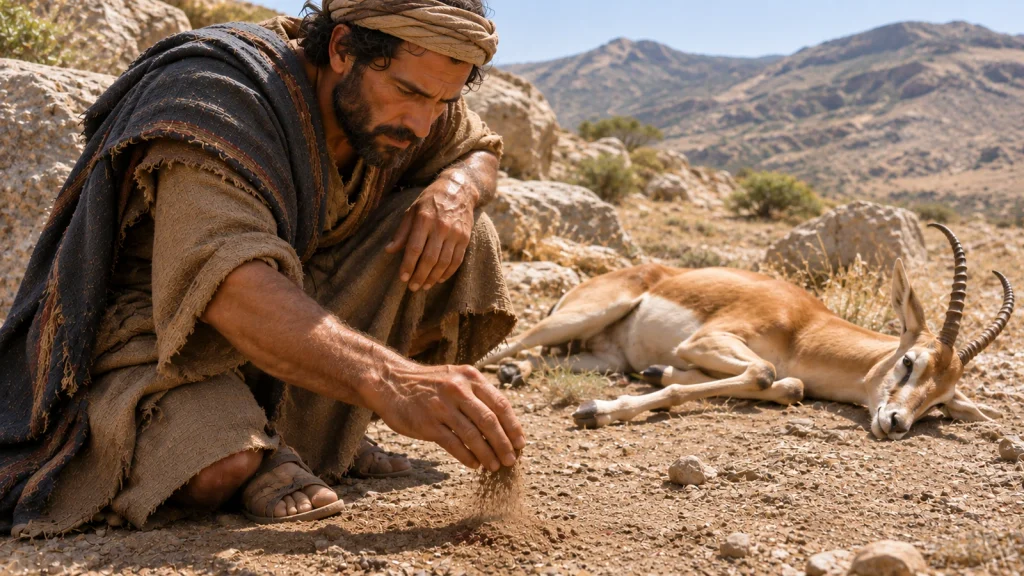
Source: AI-generated image created for Beyond The Known.
An Israelite slaughters a goat away from the Tabernacle. Under the opening law of Leviticus 17, failing to bring that animal to the designated sanctuary can result in an accusation of bloodguilt and the severe penalty of being cut off from the community. Yet a hunter who kills an edible wild animal receives a different instruction: pour out its blood and cover it with earth. Why does the same substance receive such different treatment?
Leviticus 17 restricts the slaughter of animals associated with sacrifice, requires offerings to be brought to the LORD, and forbids consuming blood because of its relationship to life. In sacrificial worship, blood has an appointed function at the altar. When an edible animal is obtained through hunting, its blood must be disposed of according to a separate rule. Neither situation permits treating blood as ordinary food. The chapter provides its central explanation in verse 11: the life of the flesh is in the blood, and the LORD has given blood for making atonement upon the altar.
Our previous study, Why Did Leviticus 16 Require Two Goats on the Day of Atonement?, examined a ceremony in which sacrificial blood was carried into the sanctuary to purify sacred space, while a living goat bore Israel’s confessed iniquities into the wilderness.
Leviticus 17 now moves from that exceptional annual observance to the broader responsibilities of the community. Its laws concern livestock, sacrifices outside the camp, the blood of hunted animals, and the consequences of eating meat from an animal that has died.
Several difficulties emerge. The first verses appear to demand that domestic animals be brought to the sanctuary, while Deuteronomy 12 permits slaughter for ordinary meals away from the central place of worship. The chapter also refers to mysterious goat-like beings receiving illicit sacrifices. And its explanation of blood and atonement has influenced theological interpretations far beyond its original setting. The key to these questions lies in reading the regulations together while preserving the differences between their individual cases.
Why Did Slaughtering an Animal Outside the Tabernacle Bring Bloodguilt? (17:1–4)
The LORD instructs Moses to address Aaron, his sons, and all the Israelites. The law concerns anyone who slaughters an ox, sheep, or goat, whether inside or outside the camp, without bringing the animal to the entrance of the Tent of Meeting to present it before the LORD. The offender is declared guilty of shedding blood and is to be cut off from the people. The animals named belong to the principal domestic species accepted for sacrifice. That connection is important, but it does not settle every question about the law’s extent.
Did Every Animal Have to Be Brought to the Sanctuary?
The traditional Hebrew text uses broad language concerning the slaughter of cattle, sheep, and goats. One interpretation understands the requirement as applying to the ordinary killing of these domestic animals for food. Their slaughter would thus be connected to the sanctuary, even when the resulting meat could be consumed. Another reading emphasizes the sacrificial context that follows, especially verses 5–9, and understands the prohibition as directed more specifically against unauthorized ritual slaughter.
There is also a significant textual issue. The Greek Septuagint and Samaritan Pentateuch preserve a longer reading in verses 3–4 that explicitly refers to presenting the animal as a burnt or well-being offering. René Péter-Contesse and John Ellington discuss this difference in A Handbook on Leviticus. That variation affects how clearly the passage refers to sacrificial slaughter rather than slaughter more generally. The longer reading cannot simply be substituted for the received Hebrew wording without explanation. Nor should the textual difference be ignored when discussing the scope of the law.
The historical problem becomes sharper when Leviticus 17 is compared with Deuteronomy 12, which explicitly permits ordinary slaughter away from the central sanctuary under certain conditions. For now, the first instruction establishes a serious boundary: the designated domestic animals cannot be slaughtered in disregard of the requirements attached to the LORD’s dwelling.
Why Was the Offender Accused of Shedding Blood?
The legal language is unusually strong. The Hebrew expression translated “bloodguilt” normally conveys responsibility for blood that has been improperly shed. Here, however, the immediate object is an animal rather than a human being. This is not an assertion that slaughtering livestock is always equivalent to homicide. Leviticus itself permits animal sacrifice and the consumption of specified meat. The accusation concerns slaughter performed outside the prescribed conditions. The seriousness of the penalty suggests that animal blood was not viewed as something humans could handle without restriction.
Its treatment belonged to a sacred order. The phrase “cut off from the people” indicates severe consequences, although scholars debate its precise implementation. Interpretations include divine judgment and exclusion from communal standing. The passage does not specify an execution procedure, so one should not be invented. An important connection emerges with verse 11, where the LORD explains that blood has been given for atonement upon the altar. Some interpreters, including the editors of the New American Bible’s explanatory notes, understand the altar’s use of blood partly in relation to liability for taking animal life.
That proposal helps illuminate the relationship between verses 4 and 11. Still, the chapter’s broader language of atonement should not be reduced automatically to a single explanation of bloodguilt.
Why Were Sacrifices in the Open Fields Forbidden? (17:5–7)
Verse 5 explains that offerings previously made in the open fields must instead be brought to the LORD at the entrance of the Tent of Meeting. The priest is to handle the blood at the altar and burn the prescribed fat. These sacrifices are identified as zevaḥ shelamim (זֶבַח שְׁלָמִים), commonly translated “well-being,” “peace,” or “fellowship” offerings. Unlike a sacrifice whose entire flesh was consumed by fire, a well-being offering could provide meat for an authorized meal.
The distinction between what belonged to the altar and what could be eaten was already established in our study of Leviticus 3. That earlier chapter required the priests to dash blood against the altar and burn particular fatty portions. The remaining meat was subject to further regulations developed later in Leviticus. Chapter 17 places those procedures within a wider demand for authorized worship.
Why Did the Location Matter?
The law does more than designate a convenient place for slaughter. It requires that sacrifices be offered to the LORD within the recognized sanctuary framework. The priest’s involvement matters because certain ritual actions belong to his office. The worshiper does not independently decide how sacrificial blood or the altar’s portions will be handled. Leviticus 17:6 identifies two such actions: the blood is splashed against the altar, and the fat is burned.
These requirements also distinguish sacrificial eating from a private meal. Even where the worshiper receives meat, the ceremony acknowledges portions and procedures reserved for the LORD. The restriction on location thus protects the sacrificial system from becoming a collection of unrelated local practices. The following verse reveals a more specific religious concern.
Who Were the Goat-Demons in Verse 7?
Israel must no longer offer sacrifices to the beings called seʿirim (שְׂעִירִים). The word is related to the Hebrew designation for goats or hairy creatures. In this context, many translators use “goat-demons.” The passage condemns their worship as an act of religious infidelity. It does not describe these beings in detail or explain precisely how the prohibited practices originated. The connection with goat imagery is nevertheless striking because the preceding chapter describes the living goat sent into the wilderness for Azazel.
Some interpreters associate the two passages through ancient ideas about wilderness beings. That comparison is possible, but the names are not interchangeable. Leviticus 17 does not explicitly identify the seʿirim with Azazel, nor does it explain the Day of Atonement ritual through these forbidden sacrifices. The reliable distinction is that Leviticus 16 describes a ceremony commanded by the LORD, while Leviticus 17 prohibits sacrifices directed toward other recipients. The prohibition safeguards Israel’s exclusive worship of its God.
Why Did These Laws Also Apply to Foreign Residents? (17:8–9)
The next command includes both Israelites and foreigners residing among them. Anyone from either group who presents a burnt offering or another sacrifice without bringing it to the Tent of Meeting is subject to the penalty of being cut off. The Hebrew term gēr (גֵּר) refers to a resident foreigner living within Israel’s community. It should not be equated directly with every modern category of immigrant or visitor. Ancient legal status depended upon social circumstances and the particular collection of laws being considered.
Here, however, the obligation is explicit. Resident foreigners are subject to the sanctuary requirement when offering sacrifices. The prohibition against consuming blood will likewise extend to them. The repeated inclusion of this group shows that the regulations are organized around membership in the community and participation in its practices, rather than ancestry alone. This aspect of Leviticus 17 later became important in Jewish and Christian discussions of which biblical obligations applied to non-Israelites.
Does Leviticus 17 Conflict with Deuteronomy 12?
Deuteronomy 12 presents one of the strongest challenges to a straightforward reading of Leviticus 17. The two passages regulate animal slaughter, but their wording and permitted circumstances differ. Leviticus 17:3–4 demands that specified domestic animals be presented at the sanctuary. Deuteronomy 12:15–16 and 12:20–27 permit ordinary slaughter for food away from the central place of worship, while continuing to prohibit the consumption of blood. How should these instructions be understood together?
The Explanation Based on Israel’s Changing Location
A reading of the Pentateuch in its final narrative form can distinguish the settings. Leviticus addresses Israel gathered around the wilderness Tabernacle. Deuteronomy anticipates settlement throughout the land, where households may live far from the chosen sanctuary. Under those circumstances, bringing every animal killed for food to the central sanctuary would have different practical implications. Deuteronomy therefore permits local slaughter for ordinary consumption while retaining the requirement that sacrificial offerings belong at the authorized place of worship.
This explanation makes sense of the contrast within the Bible’s narrative sequence. It should not, however, be mistaken for a complete historical reconstruction of how the laws developed.
What Does Historical-Critical Scholarship Propose?
Scholars have debated the literary relationship between the laws of Leviticus and Deuteronomy. Some understand the differences through the development of sacrificial centralization or revisions of earlier legislation. Others question whether direct literary dependence can be demonstrated. Chelcent Fuad addresses this issue in “What Has Leviticus 17 to Do with Deuteronomy 12.20–27?” His study concludes that the two passages may have been literarily independent, even though they address related social and religious concerns.
That proposal challenges models in which one law must necessarily be a direct revision of the other. It remains a scholarly argument rather than a fact stated by either biblical passage. The difference between the texts should therefore be acknowledged instead of dissolved through an explanation presented as certain. At the same time, they share two important commitments: sacrificial worship belongs under the LORD’s authority, and blood is not to be consumed. Those common concerns remain visible despite the differing provisions for slaughter.
Why Was Eating Blood Forbidden? (17:10–12)
Verse 10 introduces a prohibition that applies to both native Israelites and resident foreigners. Anyone who consumes blood is subject to divine opposition and the severe penalty of being cut off from the community. The reason is given in the following verse.
“For the life of the flesh is in the blood.” — Leviticus 17:11
This statement connects blood with life and then assigns it a function within the sacrificial system. The LORD declares that he has given blood for making atonement on the altar. The prohibition is therefore more than a dietary preference.
What Does the Hebrew Word Nephesh Mean?
The Hebrew noun nephesh (נֶפֶשׁ) has a broad range of meanings, including life, living being, and person. It is sometimes translated “soul,” although that English word can suggest philosophical ideas that are not always appropriate to the Hebrew context. In Leviticus 17:11, nephesh concerns the life of a creature in relation to its blood. The word for blood is dām (דָּם). The passage draws a close association between the two terms without offering a modern account of circulation or blood physiology.
Its explanation belongs to the theological understanding of life and sacrifice expressed by the law. The point is not that an ancient writer had discovered the scientific properties of blood. It is that blood, because of its association with life, receives a status distinct from edible flesh.
Why Was Blood Assigned to the Altar?
The phrase “I have given it to you” is especially significant. The LORD identifies the altar’s use of blood as something established by divine provision. Worshipers may present animals, and priests perform the prescribed blood rites, but the authority for those actions does not arise from personal preference. Blood has been assigned a place within worship. This helps explain the preceding restrictions on slaughter and sacrifice. The worshiper cannot treat sacred offerings as private acts unrelated to the sanctuary.
The same principle also governs consumption: blood is not another portion of the animal available for food. Its association with life and atonement places it under a different requirement.
Does Blood Automatically Remove Sin?
William K. Gilders examines the diversity of biblical blood rituals in Blood Ritual in the Hebrew Bible: Meaning and Power. His study demonstrates that blood is handled in different ways depending upon the ceremony. It may be splashed against an altar, placed on its horns, applied to the human body, or sprinkled in relation to sacred objects. These actions do not have identical settings or functions. Gilders also treats Leviticus 17:11 as a significant statement whose relationship to the broader development of blood ritual requires historical interpretation.
His approach cautions against using one verse as a universal explanation for every appearance of blood in the Torah. The Hebrew verb kipper (כִּפֶּר), commonly translated “make atonement,” likewise operates within different ritual circumstances. Leviticus 16 addresses the purification of sacred space. Other offerings concern particular offenses or conditions. Leviticus 17:11 explains why blood occupies a privileged place in the sacrificial system. It does not specify that every ritual involving blood accomplishes precisely the same result.
Did Atonement Depend on One Life Replacing Another?
The relationship between blood, life, and atonement has generated competing theological interpretations. Some understand the use of sacrificial blood through the idea of substitution, with the animal’s life offered on behalf of the worshiper. Others emphasize purification, ransom, or the role of blood within an authorized ritual exchange. The exact interpretation of the Hebrew wording in the final clause of verse 11 remains debated. Baruch J. Schwartz’s study of the blood prohibitions examines the passage’s rhetorical and literary dimensions, while Gilders investigates how ritual practice shapes the meaning of blood.
Their work helps prevent a complex sacrificial system from being reduced to a single theological formula. The explicit claim of Leviticus 17 is narrower and firmer: the LORD has given blood for use on the altar in atonement, and its consumption is prohibited. Broader accounts of how atonement works must be argued from the relevant passages rather than assumed.
Why Could Israelites Eat Meat but Not Blood?
The Torah permits the consumption of specified animals under prescribed circumstances. Some sacrifices provided portions for priests or eligible worshipers. Other animals could be obtained as food. Yet blood remained subject to a separate restriction. That distinction becomes clearer through the regulations for sacrificial meals. Leviticus 7 determines which portions belong to the altar, which are assigned to priests, and what eligible worshipers may consume. The animal is not treated as an undifferentiated collection of edible parts.
Its blood and designated fat are subject to obligations that the remaining meat does not share. The prohibition in Leviticus 17 gives the treatment of blood an explicit theological explanation. Blood is associated with the creature’s life. The law permits meat in particular circumstances but does not permit the life-bearing blood to become ordinary food. This is not a command against eating all animal products. It is a distinction within permitted animal consumption.
For a fuller examination of how these portions were allocated, see the related study linked in the series navigation below.
Why Did Hunters Have to Cover Blood with Earth? (17:13–14)
The next case moves beyond domestic sacrificial livestock. An Israelite or resident foreigner who hunts an edible animal or bird must pour out its blood and cover it with earth. The law does not direct the hunter to bring that blood to the altar. Instead, it requires a different treatment appropriate to the situation.
Why Was Hunting Different from Sacrifice?
The regulations distinguish animals used in the sacrificial system from edible wild game. Game animals do not belong to the ordinary categories of livestock presented as altar sacrifices. A hunter may obtain food from an eligible wild animal without turning the hunt into a sanctuary offering. The blood, however, cannot be consumed. It must be poured out and covered. This provision prevents the first section of Leviticus 17 from being interpreted as a rule requiring every edible animal’s blood to be handled by a priest. The laws recognize different circumstances of slaughter and assign different procedures.
What Did Covering Blood with Earth Represent?
Verse 14 repeats the association between blood and the life of the creature. That repetition connects the hunting rule with the prohibition introduced in verse 10. The chapter does not explicitly identify covering the blood as a burial, an act of mourning, or a sacrifice returned to the earth. Such meanings may be explored as theological interpretations, but the stated requirement is simpler. The hunter must dispose of the blood rather than eat it.
One may reasonably infer that this handling expresses respect for the restriction placed upon animal life. The law itself, however, leaves the individual symbolism of the earth-covering action unexplained. The distinction between altar blood and blood poured onto the ground will become central to understanding the chapter as a whole.
What Happened When Someone Ate an Animal Found Dead? (17:15–16)
The final case concerns meat from an animal that died naturally or was killed by another creature. Anyone who eats such meat, whether an Israelite or a resident foreigner, must wash clothing, bathe, and remain unclean until evening. After completing the required procedure and reaching the appointed time, the individual becomes clean. If the washing is neglected, the person bears the consequences of that failure.
Does the Law Permit Eating Such Meat?
Leviticus 17:15 describes what must happen when someone eats an animal found dead or torn. The wording does not expressly recommend doing so. It establishes a ritual consequence. That distinction becomes important when the passage is compared with Deuteronomy 14:21. Deuteronomy prohibits Israelites from eating an animal that has died naturally while allowing it to be given to a resident foreigner or sold to someone outside the community. Leviticus, by contrast, addresses the purification requirement for both native Israelites and resident foreigners who consume such meat.
The regulations are not worded identically. One approach understands Leviticus as prescribing the consequence of an act without necessarily granting permission for it. Historical-critical interpretation also considers how the differing legal traditions may have developed. Neither explanation should conceal the actual wording of the passages. Leviticus 17:15–16 describes impurity and the required washing. Deuteronomy 14:21 addresses the permissibility of consumption more directly.
Why Does Failure to Wash Bring Guilt?
The closing verse shifts attention to the person’s response. The preceding instruction has already established how impurity is to be addressed. Failure to wash clothing and bathe leaves that requirement unfulfilled. The text therefore distinguishes becoming ritually unclean from neglecting the prescribed cleansing. That distinction also appears elsewhere in Leviticus. Our study of Leviticus 11 examined how contact with carcasses could bring temporary impurity without necessarily implying a moral offense.
Chapter 17 places a similar concern at the end of its discussion of slaughter and blood. The issue is no longer how an offering is presented, but how a person responds after consuming meat from an animal that has died under particular circumstances. The regulation brings the chapter back to ordinary household life.
How Does Leviticus 17 Relate to Genesis 9 and Acts 15?
The prohibition against consuming blood appears elsewhere in Scripture. Its earlier biblical background is especially important. Genesis 9:4, within the instructions given to Noah after the flood, prohibits eating flesh with its life, identified with its blood. The surrounding passage also addresses human bloodshed. Both ideas establish a connection between life, blood, and the limits placed upon human conduct.
Why Is Genesis 9 Relevant?
Genesis 9 permits animal flesh as food while restricting the consumption of blood. Leviticus 17 develops the issue within Israel’s sacrificial and communal legislation. The two passages differ in setting and scope, but their association between blood and life is unmistakable. That comparison helps explain why the prohibition cannot be treated solely as a technical detail concerning the Tabernacle. The wider biblical tradition attaches particular significance to animal blood even where eating meat is permitted.
Deuteronomy 12 preserves the same prohibition while allowing ordinary slaughter away from the central sanctuary. The rules governing location therefore vary across legal contexts, while the exclusion of blood from food remains prominent.
Why Does Acts 15 Mention Blood?
In Acts 15, the Jerusalem council addresses obligations concerning Gentile believers. The resulting instructions include abstention from blood and from animals that have been strangled. The passage belongs to a different historical situation from Leviticus 17, but the comparison is relevant to the later interpretation of biblical dietary restrictions. Holger M. Zellentin explores such connections in Law Beyond Israel: From the Bible to the Qur’an. He examines how the laws associated with Noah and resident foreigners in Leviticus informed later Jewish and Christian approaches to the obligations of non-Israelites.
The history is more complicated than a direct repetition of the Mosaic commandments. Acts 15 reflects an early Christian discussion about communal life involving Gentiles, while Leviticus 17 concerns Israel’s religious and legal order. Recognizing the relationship does not make their situations identical. Likewise, Christian interpretations of sacrificial blood in Hebrews should be distinguished from the immediate meaning of Leviticus 17:11. The chapter’s own concern is how animal life, blood, sacrifice, and authorized worship belong together.
The Deeper Discovery
Three Treatments of Blood—and One Governing Prohibition
The laws of Leviticus 17 become more coherent when read through the treatment of blood rather than through the repeated mention of slaughter. Three circumstances organize the discussion. First, the blood of designated domestic animals must be handled according to the sacrificial requirements. Second, the consumption of animal blood is prohibited. Third, the blood of edible hunted game must be poured out and covered with earth.
| Circumstance | Treatment required | Passage |
|---|---|---|
| Authorized sacrifice involving designated livestock | Blood handled at the altar | 17:3–9 |
| Consumption of animal blood | Forbidden | 17:10–12 |
| Hunting an edible animal or bird | Blood poured out and covered with earth | 17:13–14 |
These instructions distinguish two permitted destinations for blood within the cases described: the altar and the ground. The human table is excluded. That distinction explains why Leviticus 17 cannot simply be summarized as a command to sacrifice every animal before eating it. The law provides separate treatment for edible game. The common requirement is that blood cannot be consumed as ordinary food.
The Contrast Between Bloodguilt and Atonement
Another connection appears between verses 4 and 11. At the beginning of the chapter, unauthorized slaughter can make an individual guilty of shedding blood. Later, the LORD explains that blood has been assigned to the altar for atonement. The two statements create an important contrast. Blood handled outside the prescribed conditions may involve serious liability. Blood used in the authorized ritual has a sacred function. Some interpreters understand the altar’s use of blood as addressing the responsibility incurred when animal life is taken.
That reading gains support from the proximity of the bloodguilt language and the explanation in verse 11. It remains an interpretation of their relationship, not a complete definition of every biblical sacrifice. The more firmly grounded observation concerns authorization. The law does not allow the slaughterer to determine independently how sacrificial blood will be treated. The LORD has established the purpose and location of its ritual use.
The Verse That Connects Sacrifice with Food
Verse 11 is the chapter’s theological center. Before it, the legislation regulates unauthorized slaughter and sacrifices offered outside the sanctuary. After it, the rules concern hunters, animal blood poured onto the ground, and the consequences of consuming meat from animals that have died. The statement about life and blood connects these subjects without erasing their differences. It explains why blood occupies a protected position in Israel’s sacrificial system. It also provides the rationale for excluding blood from ordinary consumption.
The progression is deliberate enough to support a literary observation: a chapter that begins with the location of animal slaughter moves toward the wider treatment of animal life in everyday food practices. The same concern extends from the altar into the household.
Why Leviticus 17 Follows the Day of Atonement
The placement of the chapter adds another layer. Leviticus 16 describes the application of sacrificial blood during the annual purification of the sanctuary. Leviticus 17 then provides the explicit declaration that blood has been given for atonement. Read together, the chapters move from a distinctive ritual to a broader explanation of blood’s protected status. The connection should not be mistaken for proof that the two chapters were necessarily composed at the same time or that one was originally written to explain the other.
Those are questions for historical-critical investigation. In the final form of Leviticus, however, the sequence is meaningful. The reader first encounters the elaborate blood rites of the Day of Atonement and then receives a law governing sacrificial blood, animal slaughter, and consumption. Bryan D. Bibb, in “Blood, Death, and the Holy in the Leviticus Narrative,” draws attention to the book’s broader movement from priestly ritual toward the responsibilities of the community.
Leviticus 17 fits that literary development. The sanctuary remains central, but the laws now reach into obtaining food, hunting, and the handling of animal remains.
Who Has Authority Over the Life Represented by Blood?
The chapter’s separate cases converge on one larger issue. The slaughterer may not disregard the requirements of the sanctuary. The person preparing food may not consume blood. The hunter must pour it out and cover it. These are different actions, yet each places a limit upon the human use of animal life. The law does not prohibit all slaughter or all consumption of meat. It establishes boundaries within activities that are otherwise permitted.
Those boundaries rest upon the understanding that life is not subject to unrestricted human disposal. Within the text’s theological framework, the LORD determines how blood may be used. That is the deeper connection between the opening accusation of bloodguilt and the later explanation of atonement. Leviticus 17 regulates blood because the life it represents belongs within an order established by God, whether an animal is presented at the altar or obtained for food.
This is not an abstract principle detached from the chapter. It emerges from the differences among the laws themselves. The altar, the hunting ground, and the household table are not interchangeable places. The rules governing them express the sacred significance assigned to blood within Israel’s life.
Frequently Asked Questions
Why did Leviticus 17 forbid eating blood?
Verse 11 associates blood with the life of the creature and states that the LORD has given it for making atonement on the altar.
Did Israelites have to sacrifice every animal they ate?
The chapter imposes strict requirements on the slaughter of specified domestic livestock, but treats hunted game separately. The scope of the first restriction remains debated, particularly in comparison with Deuteronomy 12.
What does “the life is in the blood” mean?
The Hebrew nephesh refers here to the life of a creature in relation to its blood. The statement explains blood’s ritual significance rather than describing modern physiology.
Who were the goat-demons in Leviticus 17:7?
The Hebrew seʿirim refers to beings associated with illicit worship. Their exact identity is uncertain, and the passage does not explicitly equate them with Azazel.
Why did hunters cover animal blood with earth?
Leviticus 17:13–14 requires hunters to pour out and cover the blood of edible game. The action enforces the prohibition against consumption, though its individual symbolism is not explained.
Does Leviticus 17 contradict Deuteronomy 12?
The texts differ concerning ordinary slaughter away from the sanctuary. Scholars explain the relationship through narrative setting, legal development, or the possibility of distinct literary traditions.
What did it mean to be “cut off” from Israel?
The expression denotes a severe sanction. Its precise implementation is debated and should not automatically be identified with one specific form of execution.
What Comes Next?
Leviticus 17 extends the responsibilities of Israel beyond ceremonies performed at the altar. Slaughter, sacrifice, hunting, and the preparation of meat must respect the restrictions associated with blood and life. The next chapter turns to human relationships and the land itself. Leviticus 18 establishes prohibitions concerning sexual conduct and the practices of surrounding nations. It also warns against offering children to Molech. Then the legislation makes a striking claim: the land can become defiled by the conduct of its inhabitants and eventually expel them.
How can human actions affect the land in this way? And why does Leviticus connect the moral behavior of a community with the stability of its place of dwelling? Next Study: Why Does Leviticus 18 Link Sexual Prohibitions to the Land?
Series Navigation
Related Study: Why Does Leviticus 7 Set Rules for Eating Sacrificial Meat? Previous Study: Why Did Leviticus 16 Require Two Goats on the Day of Atonement? Next Study: Why Does Leviticus 18 Link Sexual Prohibitions to the Land? Explore the Series: Leviticus Studies
Selected Sources
- Hebrew Bible. Leviticus 17. Hebrew text and available translations. Primary source for the regulations concerning slaughter, sacrificial worship, blood consumption, hunting, and ritual purification.
- New American Bible, Revised Edition. Leviticus 17 and Explanatory Notes. United States Conference of Catholic Bishops. Discusses bloodguilt, the goat-demons, the treatment of hunted game, and the relationship between Leviticus 17 and Deuteronomy 12.
- Péter-Contesse, René, and John Ellington. A Handbook on Leviticus. United Bible Societies, 1990. The available translation commentary on Leviticus 17:3–4 discusses the longer readings of the Septuagint and Samaritan Pentateuch and the wording of the slaughter prohibition.
- Gilders, William K. Blood Ritual in the Hebrew Bible: Meaning and Power. Johns Hopkins University Press, 2004. Examines the different uses of sacrificial blood, the relationship between ritual action and sacred space, and the interpretation of Leviticus 17:11. Publisher information and the available description were consulted.
- Schwartz, Baruch J. “The Prohibitions Concerning the ‘Eating’ of Blood in Leviticus 17.” In Priesthood and Cult in Ancient Israel, edited by Gary A. Anderson and Saul M. Olyan, 34–66. Sheffield Academic Press, 1991. A study of the literary and rhetorical dimensions of the blood prohibitions. The university bibliographic record was consulted.
- Fuad, Chelcent. “What Has Leviticus 17 to Do with Deuteronomy 12.20–27? The Literary Relationship Between the Deuteronomic and Holiness Codes on Cult Centralization and Animal Slaughter.” Journal for the Study of the Old Testament 45, no. 1 (2020): 20–33. Challenges the assumption of direct literary dependence between the two legal passages. The published abstract was consulted.
- Bibb, Bryan D. “Blood, Death, and the Holy in the Leviticus Narrative.” In The Oxford Handbook of Biblical Narrative, 137–146. Oxford University Press. Discusses the larger literary organization of Leviticus and the movement toward communal holiness. The published abstract was consulted.
- Zellentin, Holger M. “Blood and Demons: Genesis 9 and Leviticus 17 to Q 6 Sūrat al-Anʿām 145–6 and Q 5 Sūrat al-Māʾida 3.” In Law Beyond Israel: From the Bible to the Qur’an, 35–128. Oxford University Press, 2022. Examines the relationship between the laws concerning blood, the obligations of resident foreigners, and later Jewish and Christian legal interpretation. The published abstract was consulted.